Behind Chicago’s Architecture

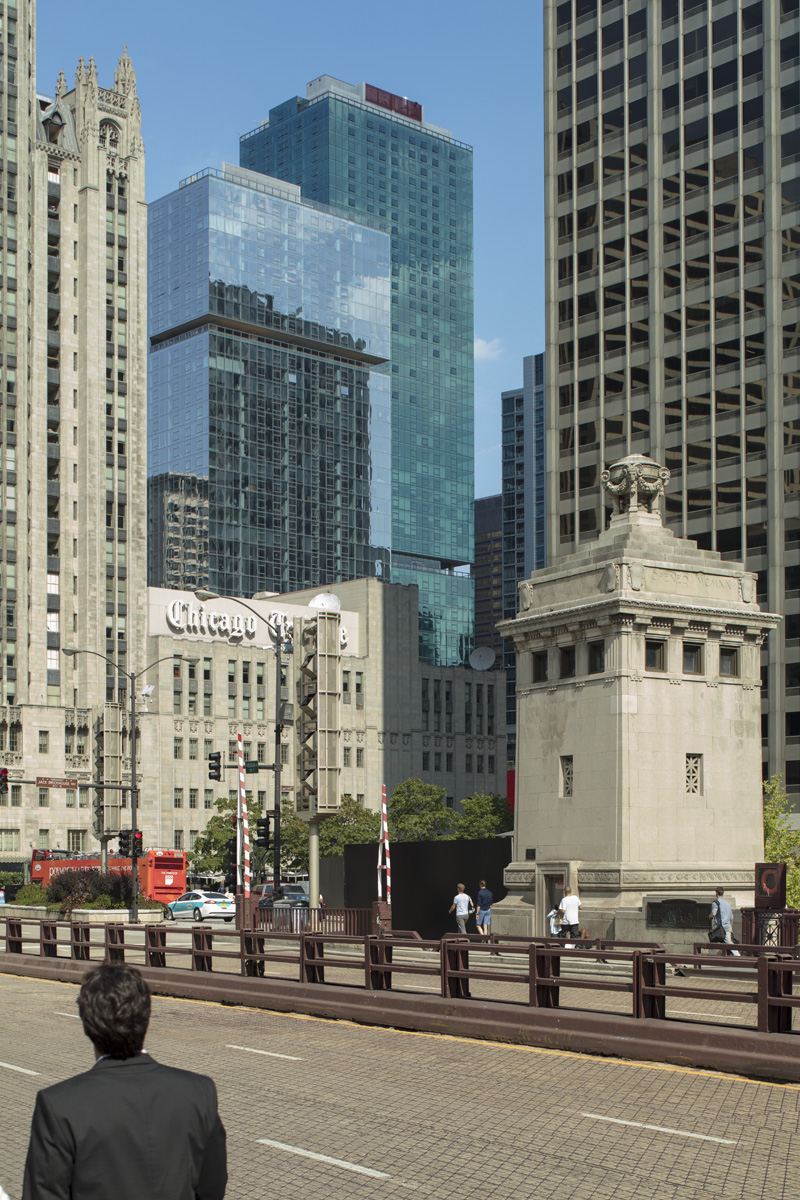
Chicago is home to the world’s first skyscraper, and since that momentous milestone, has remained a pioneer in the architectural world. But what gives Chicago its trendsetting je ne sais quoi? A unique history drives the diverse array of styles and voices that have forever marked architecture in Chicago, and in the world. 

Epicenter of Manufacturing

By the mid-19th century, Chicago was an essential trading hub, with imports and exports flowing in and out via the Illinois and Michigan Canal and railways. Impressive stockyards, manufacturing, banking and other commercial industries, combined with the country’s first comprehensive sewage system, drew in a large, urban population. That population flocked to a concentrated city-center, where buildings shot skywards to keep pace with the growth.

The Great Chicago Fire

Chicago grew quickly, and fell just as fast. In 1871, the Great Chicago Fire destroyed 17,500 buildings, leaving devastation in its wake and demanding the city rebuild. With the chance to start fresh, Chicago rebuilt bigger, better and smarter. A city grid was established, adding order and intentionality. Propelled by two crucial inventions, safety elevators and the Bessemer Convertor, Chicago architects could also build higher than ever before. It was during this time that the world’s first skyscraper, the ten-story Home Insurance Company, was built, marking the dawn of a new era in architecture.

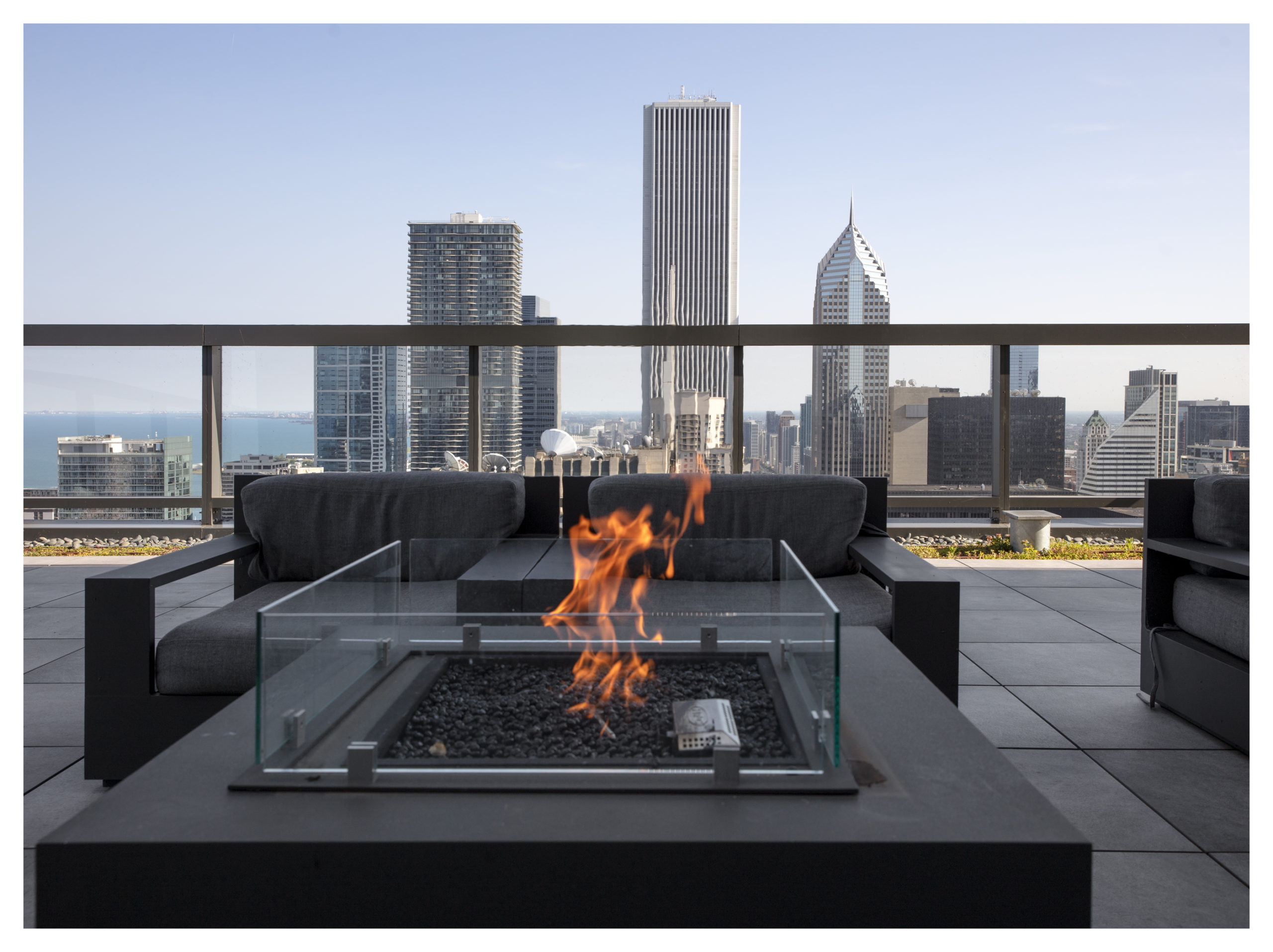
City views from an apartment at Optima Signature

The Burnham Plan

Chicago reached an all-time-high during the Chicago World’s Fair of 1893, with 27.5 global visitors flocking to the city. Planning for the city’s continuous and rapid growth, director of the fair, Daniel Burnham proposed the 1909 Plan of Chicago, or simply the “Burnham Plan.” Their utopian design for the city included lakefront improvement, increased transportation systems and an abundant outer park system. Though not every component outlined came to fruition, the Burnham Plan left a profound mark on contemporary urban planning.

A sweeping view from Club 52 at Optima Signature

Modernism Rises

While the Burnham Plan was classically-influenced, up and coming Chicago architects shared new ideas. Louis Sullivan led the legion of Chicago School architecture under the motto “form forever follows function,” a creed later adopted by the Modernist movement. As Sullivan pioneered a new class of skyscrapers that had international impact, his mentee, Frank Lloyd Wright, explored architecture closer to the ground with his Prairie homes. These innovative thinkers helped drive the diversity of Chicago’s architecture, creating a skyline that is storied, varied, impressive and influential. 

Optima adds our own voice into the mix, designing in the Modernist discipline and applying new approaches, to honor a legacy of harmonious and mixed voices in Chicago. 

A Close Look at the Curtain Wall

As a design-driven real estate development firm, our Modernist roots shine in each one of our projects. A staple of classic Modernist design, we often employ glass curtain walls to create stunningly transparent and sleek exteriors. In respect to the tradition and technique, we’re diving deep into the history of the curtain wall and its impact on our structures today.

The curtain wall at Optima Signature

The Curtain Wall Defined

A curtain wall is a nonstructural exterior component of a building, at first serving the mere purpose of keeping weather out and occupants in. Being nonstructural, curtain walls are often made of lightweight materials such as glass, metal panels or thin stone. Glass curtain walls have the added benefit of introducing deeply penetrating natural light into a building, and can offer broad, sweeping views, creating seamless cohesion between the built environment and its natural surroundings. 

Because curtain walls are nonstructural components, load-bearing responsibilities fall on the shoulders of strong metal frames. The invention of the curtain wall was in fact made possible by the growth of the iron and steel industry, when these strong metal materials were made more readily available and affordable to the mass market in the late 18th century. 

The first Modernist building, The Crystal Palace, was built during this time. Shortly after The Crystal Palace, Modernist master Ludwig Mies van der Rohe pioneered the contemporary steel-and-glass aesthetic that defined an era and way of designing, coining the name for the style: “skin-and-bones architecture.” Today, designing minimalistic, functional building frames in steel and glass, and employing curtain walls to do so, continues to be a signature mark of Modernist structures.

The curtain wall at Optima Old Orchard Woods

Adding Beauty and Sustainability

As a building material, glass has evolved considerably over the years. Our capability to utilize glass in curtain wall systems connects indoors and outdoors, and promises a beautiful environment, with an abundance of natural sunlight and impressive views. Outside of aesthetic, glass curtain walls also serve the functionality of increased performance in temperature moderation, moisture protection and improved acoustics. 

In our own projects, we utilize Low-E UV protected laminated glass with a heat reflective coating, which contributes to a regulated indoor environment, particularly in the harsh Arizona climate, and provides added sustainability, decreasing energy need for additional heating and cooling control.

As we continue to explore the integration of the built and the natural environment, we appreciate the curtain wall for its transparency and sustainability, and the wonder that it adds to exceptional Modernist design.


The Work of Le Corbusier

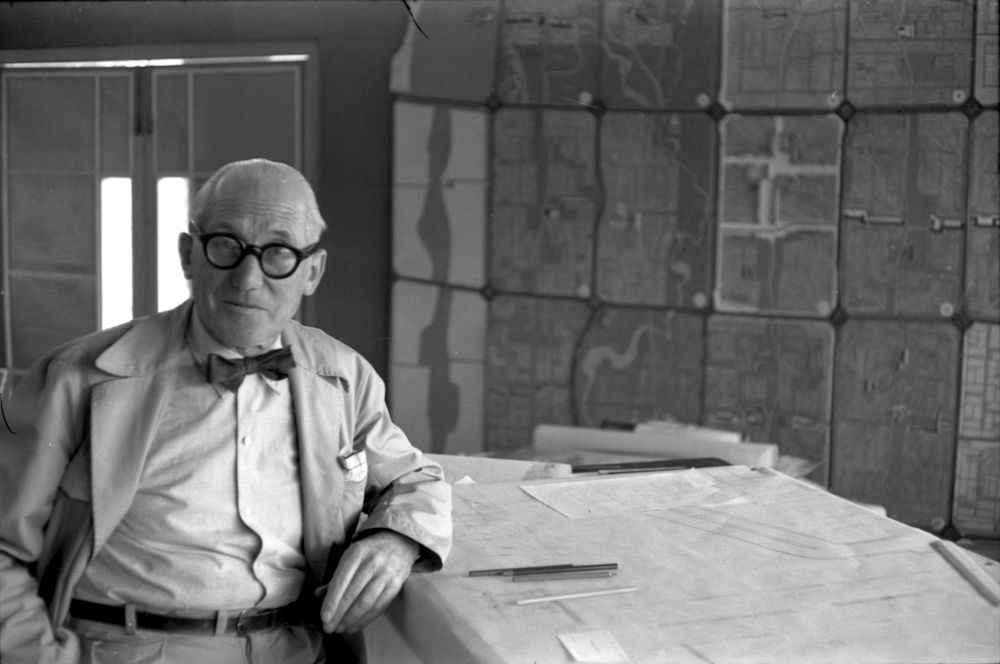
Modernism is an approach that has roots going all the way back to the 1920s. Modernist architecture was pioneered by the inventive and contentious Le Corbusier, a Swiss-French architect, urban planner, painter and furniture designer. To better understand Modernism, we’re diving deep into his life, and highly controversial work.

A Controversial Figure

Born Charles-Eduoard Jeanneret-Gris, architect Le Corbusier built chiefly with steel and reinforced concrete, paring design down to its simplest, elemental geometry and form. He developed his famous theory of modern form and minimalist materials when envisioning affordable, prefabricated housing to help rebuild communities after World War I. His vision for prefabrication was only the tip of a strong, nearly utopian, approach to urban planning and architecture.

Villa Savoye Exterior
Villa Savoye in Poissy, Le Corbusier. Photo Timothy Brown, Flickr Creative Commons

His architectural philosophy was groundbreaking and completely contrary to the dominant narrative of the 1920s. Once he established his ideas, he shared them by publishing the seminal L’Espirit Nouveau (1920), where he revealed his famous “five points of architecture.” Three years later, he published Vers une architecture (Towards a New Architecture) (1923), in which he espoused a new, modern architecture informed by applying principles of cars, planes and ships to buildings. Le Corbusier embraced the conflict that arose to his ideas head-on, making bold declarations such as “a house is a machine for living in” and “a curved street is a donkey track; a straight street, a road for men.”

Chair designed by Le Corbusier at Optima Camelview Village

Form, Function, Furniture

Le Corbusier also designed furniture, his approach following suit to his approach to architecture. His furniture, co-designed with Pierre Jeanneret and Charlotte Perriand, utilized tubular steel that projected a new rationalist aesthetic. Le Corbusier broke down furniture into three types: type-needs, type-furniture and human-limb objects. His rational approach was not without romanticism, as he said, “Certainly, works of art are tools, beautiful tools. And long live the good taste manifested by choice, subtlety, proportion and harmony.” 

At Optima, we employ Le Corbusier furniture in our communities, like those in each of the three building lobbies at Optima Old Orchard Woods in Skokie. The furniture functions just as the artist would’ve wanted — as bold, artistic statement pieces, and as functional, rational furniture.

The History of AIA

At Optima, our love for the practice and art of architecture runs deep. As a way to connect with and participate in the greater architecture community, our architects are active members of the American Institute of Architects, widely known as AIA. An extensive resource and network for the architectural profession, the organization has a lengthy history than spans over 160 years. 

In 1857, thirteen architects met in the New York office of Richard Upjohn, a British-American architect famous for his Gothic Revival churches. The architects convened to discuss how to elevate the standing of the profession. With his influential background, Upjohn was a natural leader and the first president of AIA, serving the organization until 1876. Prior to the establishment of AIA, anyone could claim to be an architect due to lack of schools and licensing laws within the United States. AIA set out to elevate the standing of architecture as a profession and work together towards advancement in the industry. By 1876, AIA launched their first official chapter in New York, closely followed by Philadelphia, Chicago and Boston. 

Although founded in New York, AIA moved their headquarters to Washington, DC by 1898. From Daniel Burnham to Frank Lloyd Wright to Mies van der Rohe, the vast number of members within AIA’s lifespan have changed the built landscape of America. Since its founding, AIA has created standards of excellence, advocacy, education and social change, and continues to do so today.

Now, AIA has over 260+ chapters across the globe, with over 94,000 members worldwide. AIA members adhere to a code of ethics and professional conduct to reassure clients, the public and colleagues of their dedication to the highest standards in professional practice. David Hovey Sr. has earned the title of Fellow, FAIA, AIA’s highest membership honor for those that have exhibited exceptional work and contributions to architecture and society. David Hovey Jr.’s work has also been recognized by AIA numerous times, including a National AIA Award, AIA Distinguished Building Award, AIA Honor Awards, AIA Innovation Award, and AIA Divine Detail Awards from AIA Chicago and AIA Phoenix. His prefabricated system has been described by AIA jurors as the future of American housing.

A prestigious membership organization with deep roots and wide-reaching influence, the American Institute of Architects continues to promote the architectural profession, ensuring its successful, longevity and inspiration — and it is something that we are honored to be a part of.

A Deep-Dive Into the World of Prefabrication

At Optima, we’re in constant pursuit of better and smarter ways of creating, which is why we often employ prefabrication, from our multifamily properties to our desert dwellings. Prefabrication describes the process of building elements off-site in a factory or workshop, and then later fitting those elements together on-site. This carefully calculated process has revolutionized the industry, allowing builders to cut down on time, cost and labor needed to create a structure. To understand just how vastly the industry and the way that we build has transformed, we’re taking a deep-dive into the world and history of prefabrication.

Whale Bay House, Optima DCHGlobal.

Early Origins

Naturally, the idea of building pieces separately before putting them all together in place is centuries old. Prefabrication is inspired by building techniques that date as far back as Mesopotamian civilization and Roman fort-building. In fact, the earliest known example of prefabrication comes from around 3800 BC, when the oldest engineered roadway, the Sweet Track in England, was built using timber sections that were constructed off-site.

Prefabrication techniques were used to erect giant structures in Sri Lanka, to rebuild the Portuegese capital after the great Lisbon earthquake of 1755 and even in 19th century Australia, when a large number of prefabricated houses were imported from the U.K. No matter the circumstances, from building large to building wide, the streamlined technique allowed for increased control, lowered cost and expedited process. 

Relic Rock, Optima DCHGlobal.

Industrialization and Modernism on the Rise

Prefabricated farm buildings and bungalows were the first readily available structures on the market, around since the early 19th century. Most notable during that time was London carpenter Henry Manning’s prefabricated Portable Cottage, which was transported to Australia. Affordable housing was created using the technique, too, supplying homes for 49ers during the 1848 California Gold Rush and to refugees of war during World War II. 

Prefabrication was also an integral tool in rising Modernist architecture. The first ever Modernist structure, The Crystal Palace designed by Joseph Paxton, was built in 1851 using this method. Like The Crystal Palace, Modernist design was rooted in materials such as exposed steel and glass, which were perfectly suited for prefabricated builds as they were most often used in the simple and functional Modernist structural patterns. 

Construction on Whale Bay House, Optima DCHGlobal.

Prefab Concrete and Steel

As the prefabrication practice continued to grow, technical developments such as the development of sheet steel, the improvement in alloys, the use of lightweight aggregates and the promotion of precast reinforced concrete pushed the field even further. Concrete and steel in particular proved to be highly efficient materials in the prefabrication process, with pre-poured concrete allowing for more flexibility, and prefabricated steel sections reducing in-field risk during cutting and welding. These components have proven especially crucial to simplifying the construction process in buildings where a particular part or form is repeated numerous times. 

Created by Optima President David Hovey Jr., Optima DCHGlobal has created The Optima DCHGlobal Building System, a patented prefabricated architectural system that is flexible in both horizontal and vertical directions, sustainable up to the net-zero level, multi-generational, and able to be built quickly and efficiently in any location, climate or terrain. 

His invention of this system has created award-winning residences, such as Relic Rock and Whale Bay House. We continue to utilize the latest in steel technology, and often employ elements of concrete, to create our simple yet stunning Modernist structures. 

As we continue to look forward to a future of innovating and finding new ways of creating, we are humbled to look back at the history of prefabrication and how the technique has grown, allowing us to grow, too. 

The Arts Club of Chicago

An iconic creative space in Chicago, The Arts Club of Chicago has been a hub for contemporary art in the Windy City for more than 100 years. Only a five-minute walk from Optima Signature and Optima Chicago Center, The Arts Club of Chicago exhibits international works from both established and emerging artists, breaking new ground for over 100 years. Today, we explore the fascinating history and unique details that make The Arts Club of Chicago a beloved neighbor within our Streeterville community.

A Scandalous Start

Founded in 1916, The Arts Club of Chicago was founded by artists and advocates after The Armory Show garnered negative attention when it exhibited at the Art Institute. As the first major exhibition of modern art in America, Chicagoans were shocked and scandalized. The Club’s founders took note of the negative reception and aimed to normalize modern art by curating exhibits tailored to Chicago, enabling the Club to present new, cutting-edge culture for residents and visitors alike. 

Finding a Home

Over the years, the Club has moved from an office space, to Michigan Avenue, to the Wrigley Building;  in 1951, it moved to 109 East Ontario Street. The new space was created just for The Arts Club by architectural legend Ludwig Mies van der Rohe. Sadly, in 1990, the owner sold the building, which led to The Club’s current John Vinci-designed two-story building located in Streeterville. Although much of Mies’ architectural work was lost in the move, the building remains an homage to his design and his steel staircase was restored and remains the focal point of the first-floor space, adjacent to Alexander Calder’s Red Petals

The Club Today

Today, The Arts Club offers three or four major public exhibitions a year, along with displaying work from its permanent collection. The Club also offers a broad, rich calendar of programming, bringing lectures, demonstrations, gallery talks, films, music, dance presentations and other educational programming to Chicago, and to our Optima communities. 

For hours and visitor information, visit The Arts Club of Chicago website.

An Inside Look at Architecture Lingo

An intricate and technical field, the world of architecture produces a unique dictionary of jargon all its own. At Optima, our team works in a highly collaborative atmosphere where we all, from architects to property managers to construction superintendents, share ideas and hold conversations across disciplines — so naturally we all encounter the lingo of our architects. Now we’re decoding the secret language that we’ve all come to know and love.

BIM

Better known as Building Information Modeling, BIM is a 3D model-based process that has majorly changed the world of architecture. It’s a highly collaborative process that spans into the planning, design, construction, operations and management of buildings.

But BIM is more than just a technology or a phrase when we expanded our offices to have a second location in Arizona, BIM became the language that connected our team, even across states. Using the technology as a streamlined method of communication, our architects in Glencoe and Scottsdale effectively craft and manage projects as if they were in the same room. 

Optima Kierland Apartments.

Building Envelope 

A building envelope is the exterior shell of a building that acts as a barrier against the elements. This maintains a dry, heated/cooled indoor environment and helps in temperature control. The design is a specialized area of architectural and engineering practice and can vary based on the overall look of the building. 

In many of our projects, such as Optima Kierland Apartments, the building envelope is a Low-E, UV protected laminated glass with a heat reflective coating. Beyond providing functionality and sustainability, this oft-implemented technique in our Optima projects creates a cohesive design language of beautiful, sleek exteriors. 

Cantilevered roofs and balconies at Sterling Ridge.

Cantilever 

A cantilever is any rigid structural element, such as a beam or a plate, that’s anchored at one end to a support, allowing the other end to overhang without support or obstruction. The balancing act performed by cantilevers creates gravity-defying architectural protrusions, often serving as stunning design elements. 

At Optima Signature, we used cantilevered slabs to provide a column-free living room with breathtaking, sweeping views of Chicago. A tool employed to create our mindful, simple and sleek Modernist silhouettes, cantilevers are yet another piece of our common architectural tongue.

Louvers at Optima Sonoran Village.

Louvers

Louvers are angled slats fixed at regular intervals in a door, shutter or screen to allow air or light to pass through. Originating in the Middle Ages to help with kitchen ventilation, louvers have evolved into an element used to redirect light or add privacy. Louvers serve just this purpose, paired with perforated sun screens and our signature vertical landscaping system, at Optima Sonoran Village

Stay tuned for future features on the world of architecture lingo at Optima.


Modernism in Chicago

According to the Tate Modern Museum, Modernism “refers to a global movement in society and culture that from the early decades of the twentieth century sought a new alignment with the experience and values of modern industrial life.” Within a broader cultural narrative, modernism emerged as a criticism of nineteenth-century societal order, and trickled down into everything from political activism, urban planning, psychoanalysis, art, and of course, architecture. As we’ve previously explored, Modernist architecture has an important place in America’s history. But how does it factor into Chicago’s past?

After the great Chicago fire in 1871, the city was a blank slate, re-planned over an entirely new grid. With the world’s first skyscraper completed by 1884 (at only ten stories), Chicago was positioned to be a groundbreaking city for architectural innovation. Our triumphant World’s Fair of 1893 solidified the city’s confidence and paved the way for Daniel Burnham to create his comprehensive city plan. Chicago’s architects banded together to decide how to best develop ever-evolving skyscrapers within the city. One such architect was Louis Sullivan, who helped found the Chicago School of architects around his belief that “form forever follows function.” 

If Sullivan’s creed sounds familiar, it’s because function over form is a cornerstone belief embedded in the Modernist tradition. In the mid-1900s, architects from the growing practices in Europe came to the United States to avoid World War I, and subsequently, World War II. Iconic architects, including Ludwig Mies van der Rohe, came to Chicago to set up shop. Striking buildings of steel and glass defined an entire generation of skyscrapers, and still add to Chicago’s diverse range of architecture. 

Chicago was a city that pioneered the world’s forte into stretching and sweeping skylines. Beginning with sleek and simple Modernist structures, Chicago’s architecture is now made all the more standout by the dynamic mix of styles it holds. From Art Deco to Art Nouveau, Chicago School to International Style, Modern to Postmodern, each style is made more its own when juxtaposed with its counterparts.

Through our own addition to Modernism in Chicago, we are proud to create buildings that contribute to the movement’s and the city’s larger legacy. To learn more about Chicago’s Modernist history, the Chicago Architecture Center offers tours specifically dedicated to the style and craft. 

A Brief History of Steel

One of the most utilized structural materials in the world, you’d be hard pressed to find a construction site not making use of steel. Yet what’s now a ubiquitous material was once so hard to come by that it was regarded as heaven-sent—literally. In paying our respects to steel, we’re diving deep into its rich and storied history. 

Iron, The Metal From Heaven

Before we learned to smelt iron into steel, iron itself was an alloy hard to come by. Ancient Egyptians called iron biz-n-pt, translating to “metal from heaven.” In their time, iron did come from space, crashing onto earth embedded in meteorites. This metal from heaven had a higher nickel content than the iron dug up from the ground, making it supple, malleable and resilient—and more valuable than gems or gold. It wasn’t until 2,500 BC that miners began the arduous task of removing iron from the earth, and even then, it took hundreds more years to discover how to properly separate the precious ore and manipulate it. 

From wrought iron made in primitive smelters, to cast iron made in ancient Chinese furnaces, to iron smelted in blast furnaces, the material remained challenging to produce in mass quantities and to use for a variety of purposes. Certain crafts, such as the delicate process of clock-making, called for a material that was even more malleable, even more resilient than iron. That material was steel, an alloy made by mixing iron and carbon.

One of three Bessemer Converters left in the world, at the Kelham Island Museum.
One of three Bessemer Converters left in the world, at the Kelham Island Museum. Credit: David Dixon on Geograph, licensed under CC BY-SA 2.0 Deed

The Dawn of Steel

The modern steel industry was officially born in 1856 when Henry Bessemer developed a more effective and inexpensive method of producing the precious alloy. Known now as the Bessemer Process, Bessemer designed a pear-shaped receptacle in which iron could be heated while oxygen was blown through the molten metal, reacting with carbon, releasing carbon dioxide and producing a more pure iron. 

Bessemer’s process revolutionized the industry, allowing for the efficient transformation of iron into high-quality steel in mass quantities. In fact, once the steel industry in America adapted the Bessemer process too, they were able to catch up with Britain’s production, sparking an industry that generated more wealth than the 1849 California Gold Rush. 

Steelmaking in America continued to boom as technology improved, allowing for higher efficiency, safety and yield. At the end of World War I, the improved production of steel is what allowed for the invention of skyscrapers. The skyline shot upward in cities like New York and Chicago, a testament to the true strength and power of the material. Steel became a staple in the Modernist structures of masters such as Ludwig Mies van der Rohe, as a material that not only allowed for a fierce, durable structure, but for a simple, bold aesthetic. 

As the steel industry continues to propel forward, metallurgists seek to create more sustainable production methods, exploring electricity-based smelting and utilizing recycled steel for new projects. 

Steel and Optima

Throughout our projects at Optima, steel functions as both a structural component and a Modernist aesthetic choice. In projects such as Relic Rock and Arizona Courtyard House, we utilized Corten steel, which is a 99% recycled material. David Hovey Sr. also utilizes steel in his sculpture work, moulding the material into abstract creative expressions. From humble beginnings to its inventive usage today, steel’s versatility still inspires us to venture into new endeavors.

A Tour of the Mies-designed IIT Campus

The Illinois Institute of Technology (IIT) is the place for Modernist architecture enthusiasts and more specifically, Ludwig Mies van der Rohe enthusiasts to be. Not to mention that the school is where Optima’s own David Hovey Sr. and David Hovey Jr. further honed their architectural education.

The campus, a place with a special place in our own heart and history, is home to the largest group of buildings designed by renowned architect Mies van der Rohe, arguably the most influential figure in American Modernism. As such, there is no better way to get an understanding of where our work began and where Modernism expanded, and to experience Mies’ philosophy than to explore the very campus that he designed and led. 

Perlstein Hall designed by Ludwig Mies van der Rohe.
Perlstein Hall designed by Ludwig Mies van der Rohe. Credit: Joe Ravi on Wikimedia Commons under the license CC-BY-SA 3.0

An Overview of the Campus

Ludwig Mies van der Rohe chaired the IIT School of Architecture from 1938 to 1958. During this time, he created a new master plan for the campus, the most ambitious he ever came up with, including twenty of his own works. This collection is the greatest concentration of Mies buildings in the world. Among the twenty are famous structures such as Wishnick Hall, Perlstein Hall, Carr Memorial Chapel and S.R. Crown Hall. Perhaps Mies’ most iconic piece of work, S.R. Crown Hall is the campus gem, a modern icon and National Historic Landmark, and even heralded by Time magazine as “one of the world’s most influential, inspiring and astonishing structures.” 

Overall, the campus is a bold expression of the Modernist discipline, utilizing steel, concrete and glass minimalist frames as a radical departure from traditional college quadrangles and limestone buildings. 

An Official Architectural Tour

A tour of the campus, offered by the Chicago Architecture Center, places special emphasis on Mies’ time as head of the IIT School of Architecture. The tour covers iconic Mies structures alongside newer additions such as State Street Village, designed by Helmut Jahn. 

During the warmer season, tickets for the tour are available for purchase here. Though not required, advance reservations are recommended, and private bookings are available. Truly enhancing the reach of the experience, the ticket price also gives entrance to the Chicago Architecture Center within seven days of your tour. 

As a piece of our own history at Optima, and as a grander piece of Modernist architecture’s history in America, the IIT campus is something that must be seen to be truly understood. Whether it’s on your own or with a tour, witnessing this iconic collection of designs is a necessity. 

person name goes here

Maintenance Supervisor

Glencoe, IL


    Acceptable file types: *.pdf | *.txt | *.doc, max-size: 2Mb