Women in Architecture: Marion Mahony Griffin

Often unrecognized for her immense contributions to the Prairie School, Marion Mahony Griffin was a leader in the architectural world for many years, paving the way for the countless women who followed her. Today, as part of our ongoing “Women in Architecture” series, we’re exploring the inception of the iconic architect and designer and where her extensive experience led her. 

The Life of Marion Mahony Griffin

A Chicago native, Mahony was born in 1871 to Jeremiah Mahony, a journalist, and Clara Hamilton, a teacher. After the tragic events of the Great Chicago Fire, in which her family’s house was destroyed, her family relocated to the Chicago suburb of Winnetka where she spent the majority of her childhood. Inspired by how rapidly the landscape around her was changing — and encouraged by her cousin Dwight Perkins, an American architect — Mahony was drawn to the idea of furthering her education at the Massachusetts Institute of Technology. 

Mahony graduated from MIT in 1894 and was only the second woman to receive an architecture degree from the school (after the World’s Columbian Exposision’s Women’s building designer, Sophia Hayden). She soon moved back to Chicago where she became the first woman in modern history to sit for, and be granted, an architectural license in the United States, benefiting from the fact that Illinois was the first state in America to allow women to hold licenses.

Ward W. Willits House, designed by Marion Mahony Griffin. Credit: Teemu008 on Flickr Creative Commons, CC BY-SA 2.0 Deed

While in Chicago, Mahony spent two years working with her cousin Dwight Perkins at his studio in Steinway Hall (which Perkins also designed), where a diverse crowd of innovative artists and architects from the Prairie School could always be found. Soon after she left her cousin’s firm, she discovered another young Chicago architect also working in the building, Frank Lloyd Wright. Hired as Wright’s first employee, Mahony worked on and off with him for the next 14 years and became a significant contributor to his practice. 

Ward W. Willits House, Highland Park, Illinois, 1902, One of the numerous intricate watercolor renderings Mahony created for Wright during her employment, Courtesy of Frank Lloyd Wright Foundation

Career and Achievements

While working for Wright, Mohony provided intricate architectural renderings for his designs, becoming an essential participant in his work and leaving her without credit — a recurring theme throughout her career. Today, the renderings are acknowledged as her creations and she is recognized as one of the greatest architectural illustrators. 

Mahony completed numerous independent projects while working for Wright including Evanston’s All Souls Unitarian Church. The intimate church featured an abundance of alluring stained glass in its skylights, windows and numerous other light fixtures. 

Eventually, Mahony left Wright’s studio to work with her husband, Walter Burley Griffin, a fellow architect and leading member of the Prairie School. Together, Griffin and Mahony created their most renowned work, the design of Prairie School residences in Mason City, Iowa, Rock Crest – Rock Glen. The nationally-recognized historic district features eight elaborate Prairie School homes that surround the city’s Willow Creek. 

In 1914 the couple relocated to Australia, where Mahony’s watercolor renderings of Griffin’s design were chosen as the plan for the country’s new capital, Canberra. In Australia, Mahony’s commission’s increased dramatically. One of her final and most well-known works is Melbourne’s Capitol Theatre. The theatre’s opulent decor and avant-garde ceilings and walls were designed to invoke a crystalline cave, and showed a new side of Mahony’s architectural gifts.

Today, Mahony’s extensive experience and portfolio speak for themselves, and she is finally recognized as a trailblazer for architecture and design, and as an original member of the Prairie School.

Romanticism to Ruin: Two Lost Works of Sullivan and Wright

Chicago is fortunate to have a rich architectural tradition. From the city’s first skyscraper built in 1885 to the transcending towers that look over the urban landscape today, architecture is at the forefront of Chicago’s role as a world-class city. At Optima, we are grateful to be part of an ecosystem that appreciates thoughtful and purposeful design. In the spirit of celebrating some of Chicago’s most prominent architects, we are delighted to see an exhibition at Wrightwood 659 that brings two magnificent lost buildings, designed by luminary architects to the public.

Romanticism to Ruin: Two Lost Works of Sullivan and Wright can be seen at Wrightwood 659, located just south of Optima Lakeview. This collection offers a glimpse into the rich history of two buildings designed by renowned architects Frank Lloyd Wright and Louis H. Sullivan. Though few connections are evident between the two structures at first glance, a deeper dive uncovers the rich relationship between the Garrick Theatre in Chicago and the Larkin Administration Building in Buffalo.

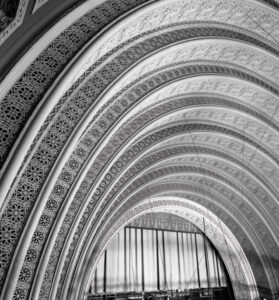
Photo of the Garrick Theatre
The Garrick Theatre, 1891, Photo courtesy of The Richard Nickel Committee and Archive

Reconstructing The Garrick

At the time of its completion in 1892, the Garrick Theatre, with a capacity of 1,300 seats, was among the tallest buildings in Chicago. Sullivan and his firm partner, Dankmar Adler, designed the exquisite structure to reflect the German heritage of its original investors, but made every development choice with careful thought for the theatre’s visitors. As the historic structure faded with time, its decline accelerated, and in 1961, amid much controversy and disagreement, the theatre was razed and replaced with a parking structure.

Reconstructing the Garrick uses stencils, fragments, drawings, photography and narrative to bring the lost architectural treasure back to life. Some of Sullivan’s most opulent designs for the Garrick included numerous terracotta portraits of well-known German men of the arts that protruded from the Theatre’s upper floors. Fragile ornamentation and vibrantly-colored plasters consisting of gold, jade and salmon, salvaged before and after the building’s demolition, are on view as part of the exhibition, offering access to delightful details of this grand structure that have been long-forgotten.

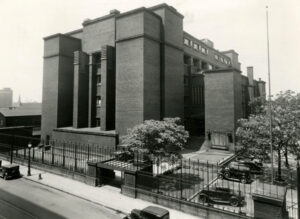
Photo of the Larkin Administration Building
Larkin Administration Building, 1934, Larkin Company photography collection

Reimagining the Larkin

Razed in 1906, the Larkin Administration Building, owned by Darwin D. Martin, was Wright’s first commercially-designed structure and allowed him to apply his innovative and pioneering techniques to a much larger scale. The building, designed and constructed for the Larkin Soap Company, was groundbreaking in its own right as a center where all of the company’s products were both manufactured and mailed. However, at the forefront of Wright’s mind was designing for workability.

Wright and Martin both understood that an ordered, well-lit and harmonious environment would champion the workers. The five-story red brick building included numerous modernized mechanics, including air conditioning, built-in desk furniture and suspended toilets. Wright designed most of the building’s furniture himself, and many pieces are on display within the exhibition. Deemed by critics and architects at the time as the finest commercial building in the world, the Larkin also seamlessly unified technology with the nature that surrounded it with its rooftop garden, recreation areas and water lily ponds.

Unlike the Garrick, after years of deterioration, there was little fight to save the Larkin. However, today both buildings hold greater significance than ever before. The Gerrick and the Larkin prove how transcendent architecture is defined not only by its material and look, but also by the lasting impression it stamps into history.

Romanticism to Ruin is currently open to visitors Fridays and Saturdays through the end of December 2021. You can reserve tickets to the exhibit here.


Ludwig Mies van der Rohe and His Role in the Chicago Skyline

Mid-Century Modernism defines the Chicago skyline. Organic forms rise from Chicago’s foundation and cast shadows across the Lake while innovative use of glass reflects waves of light onto the city streets. The Willis Tower, Marina City, the Aon Center are all notable examples of the mid-century modern masterpieces towering over the city.

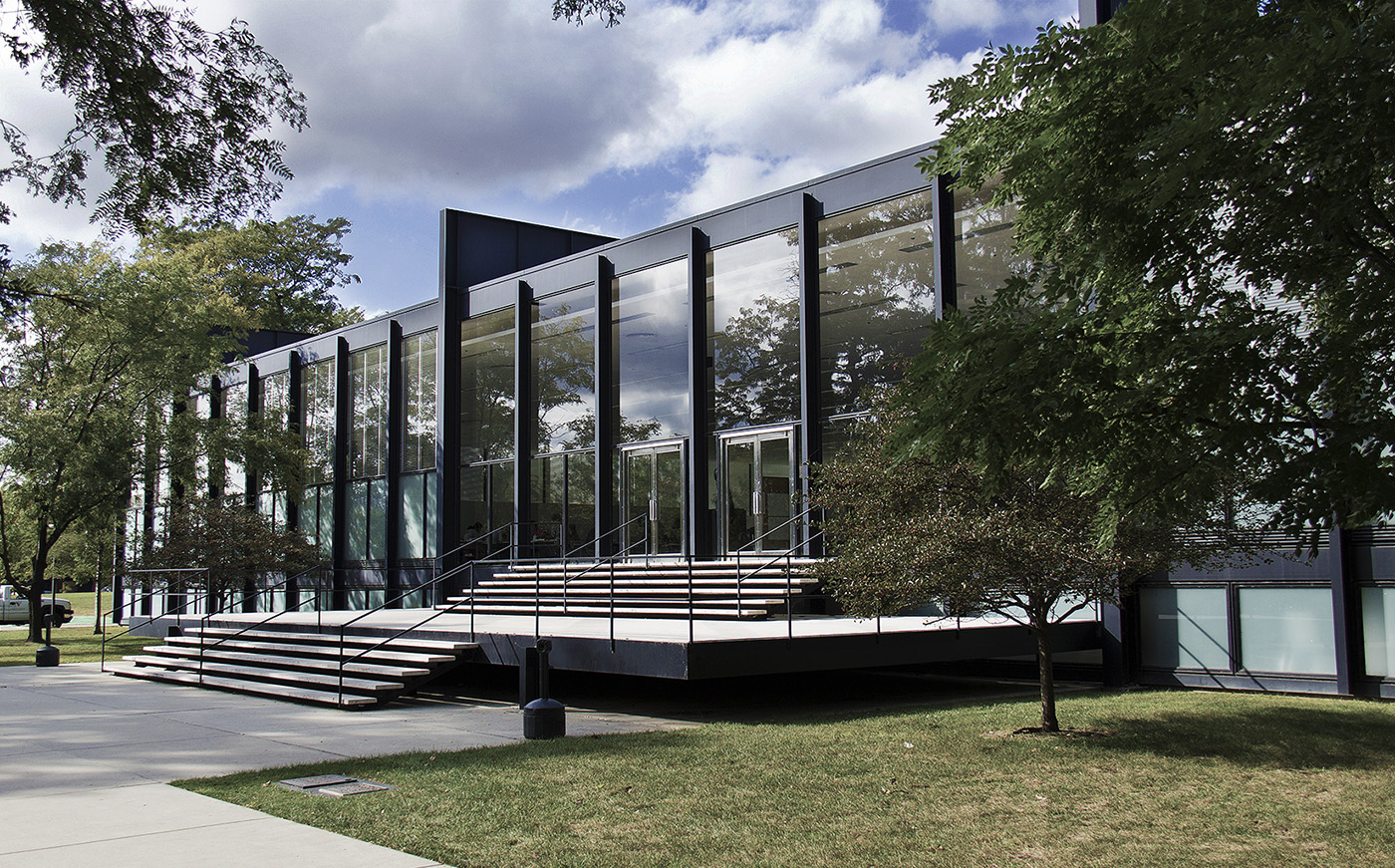
Chicago’s mid-century modern skyline would not be complete without the exceptional contributions of architecture titan Ludwig Mies van der Rohe. Born 1886 in Germany, Mies emigrated to Chicago in the 1930s due to the rise of Nazism in Europe. Already an esteemed architect, in Chicago Mies accepted the position as head of the architecture school at the Armour Institute of Technology (now the Illinois Institute of Technology). At IIT, Mies was commissioned to design buildings for the campus which still stand today. These buildings include Alumni Hall, the Carr Memorial Chapel, and S.R. Crown Hall, some of Mies’ many masterpieces. 

Mies aspired to create architecture that represented modernity with clarity and simplicity. In 1951, Mies completed the two residential buildings of 860-880 Lakeshore Drive which are considered Chicago Landmarks and are listed as National Historic Places. Initially, the towers were viewed critically. However, with time the buildings became the prototype for steel and glass skyscrapers around the world.

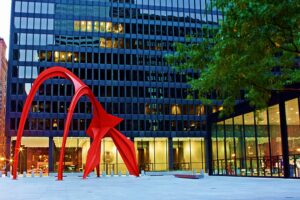
Mies also designed Chicago’s Federal Center Plaza which is composed of three buildings; the Everett McKinley Dirksen courthouse building, the John C. Kulczynski building, and the Post Office building. The three buildings situate themselves around a plaza with Calder’s red Flamingo sculpture at the center. The plaza serves as one of the main gathering points in the Loop, Chicago’s commercial center. 

Kluczynski Federal Building, Chicago, 1973, designed by Mies van der Rohe. Credit: Matt B on Flickr Creative Commons, CC BY-NC-ND 2.0 Deed

Not too far away at 330 North Wabash sits the former IBM Plaza and Building, one of the last American projects designed by Mies. Built in 1973, the building was designed with advanced technology in mind and became well-known for the several atypical features it included as an office space at the time. Today, the Chicago Landmark is known as the AMA Plaza and includes the Langham Hotel, often regarded as one of the best hotels in the nation.

The Promontory, situated at 5530 S Shore Dr, stands 22 stories over Chicago’s Promontory Point and extensive shoreline in the Burnham neighborhood. Mies built the structure with a “Double T” design in which horizontal cross-bars join and the stems of the T’s form wings to the rear. Mies would employ this design in many of his future buildings. 

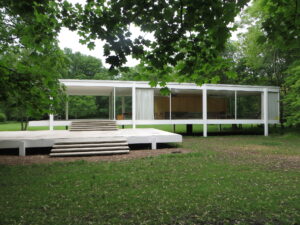
Farnsworth House exterior, Ludwig Mies van der Rohe,1945-1951. Credit: David Wilson on Flickr Creative Commons, CC BY 2.0 Deed

The Farnsworth House, designed as a vacation retreat for Dr. Edith Farnsworth, is located just outside of Chicago in Plano, Illinois. Though the Farnsworth House is not a grand skyscraper, it has left a lasting impact on the Chicago architectural landscape. The house was an exploration for Mies in the convergence of humans, shelter, and nature. Consisting of a glass pavilion raised six feet above a floodplain beside the Fox River, the house has been described as “sublime” an “a poem” and is now a public museum.

Today, Chicago’s skyline has completely transformed from what it was more than 50 years ago when Mies passed. However, even as it continues to evolve with every new development, Mies iconic buildings still stand out as striking, inspiring architectural masterpieces.

Women in Architecture: Amanda Williams

As part of our ongoing “Women in Architecture” series at Optima, we’re taking a look at another spearheading female figure: Amanda Williams. Similar to many of the women in this series, she is a pioneer in her field. Trained as an architect, Williams blurs the line between visual arts and modern architecture. Learn more about her remarkable life and work below. 

The Life of Amanda Williams

Amanda Williams was born in 1974 in Evanston, Illinois. However, she grew up in Chicago’s Southside Gresham neighborhood. She graduated from Cornell University in 1997, where she studied architecture and was a member of one of the nation’s most prominent honor societies. After graduating, Williams moved to San Francisco and worked for a commercial architecture firm for six years before returning to her hometown to focus on her love of painting.

Back in Chicago, Williams discovered The Center Program. The Hyde Park Arts Center’s capstone program is a one-of-a-kind opportunity for groundbreaking artists. While in the program, fellow artist Trisha Van Eck challenged Williams to take her talents a step further and paint on a larger architectural scale. Her response led to some of her most recognized and celebrated work today. 

Throughout her practice, Williams uses vibrant color to draw attention to the complexities and intersections of race, place and value within cities. Her paintings, sculptures and installations are all created to examine how the mundane can be viewed through a new lens and question the state of urban space throughout the country. Notable Work

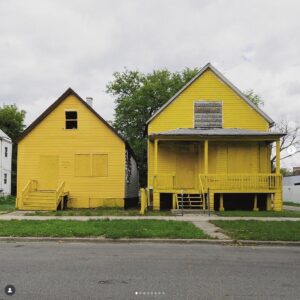
Amanda Williams. Color(ed) Theory: Currency Exchange, Safe Passaage, 2014-16. Photograph by Amanda Williams. https://www.instagram.com/awstudioart/.

In 2015, Williams debuted her most famous project, Color(ed) Theory at Chicago’s Architecture Biennial. The critically acclaimed exhibition, featured in The New York Times, examines race and space on Chicago’s South Side. With the help of family and friends, Williams repainted eight abandoned houses in the Englewood neighborhood between 2014 and 2016 as part of the exhibition. Each house was decorated with specific colors Williams found in products targeted towards Black consumers. Still standing today, the eight eye-opening houses continue to push for further discussions on the complexities of race and space Chicago and around the world.

Chicago is home to another one of William’s most well-known pieces. Located at The Arts Club of Chicago, Uppity Negress was a site-specific exterior installation created in 2017. The work investigates the claim of courtyards as either public or private areas and addresses the vast roles that gender and race play in urban accessibility. 

While much of Williams’ work is located in or near Chicago, her aptitude for creation has led her across the United States. In early 2019, Williams was chosen alongside acclaimed artist Olalekan Jeyifous to design Brooklyn’s newest monument dedicated to Rep. Shirley Chisholm, part of a larger city-wide initiative known as She Built NYC. The monument is soon to be completed and will sit at the Parkside entrance to the neighborhood’s Prospect Park. 

Alongside her transformative work, Williams has been a recipient of many architecture and art awards as well as achievements throughout her career:

  • Chicago’s 3Arts Award, 2014
  • United States Artists Fellow, 2018
  • New Generation Leader, Women in Architecture Awards, 2021
  • Obama Presidential Center Design Team

Williams has lectured at esteemed schools including Washington University, California College of the Arts, Illinois Institute of Technology and her alma mater. Today, she continues to forge a lane of her own and blend traditional visual art techniques with the complexity of architectural design.

Modernist Movements in South America

Countless architects and designers across the world and throughout history share the same passion and appreciation for Modernist design that we hold at Optima. One of our industry’s greatest delights is exploring how design translates through the lenses of other cultures and countries. Today, we’re exploring the ever-important Modernist movements from South America. 

Modernismo in Brazil

Modernisimo, founded in Brazil, began in the wake of World War I and influenced Modernist movements around the world. A rebellion against European artistic and aesthetic influence, Modernismo brought Brazilian life and thought into the modern era through the celebration of the culture’s rich traditions of folklore, architecture, art and style. 

By the 1930s, after decades of success, Modernisimo splintered into factions of artists, thinkers and creatives, but the movement’s influence on later art, sculpture, literature and architecture remains prominent. Brazilian architects and designers such as Lina Bo Bardi adopted concepts of Modernisimo in their own practices, creating world-renowned structures that are still celebrated and used today. 

Casa Luis Barragán. Credit: washingtonydc on Flickr Creative Commons, CC BY-NC-SA 2.0 Deed

Other Movements

Brazil is not the only South American country with a strong Modernist legacy. In Colombia, Venezuela, Mexico and Argentina, Modernism involved active divergence from Spanish influences and was a form of artistic and political protest. 

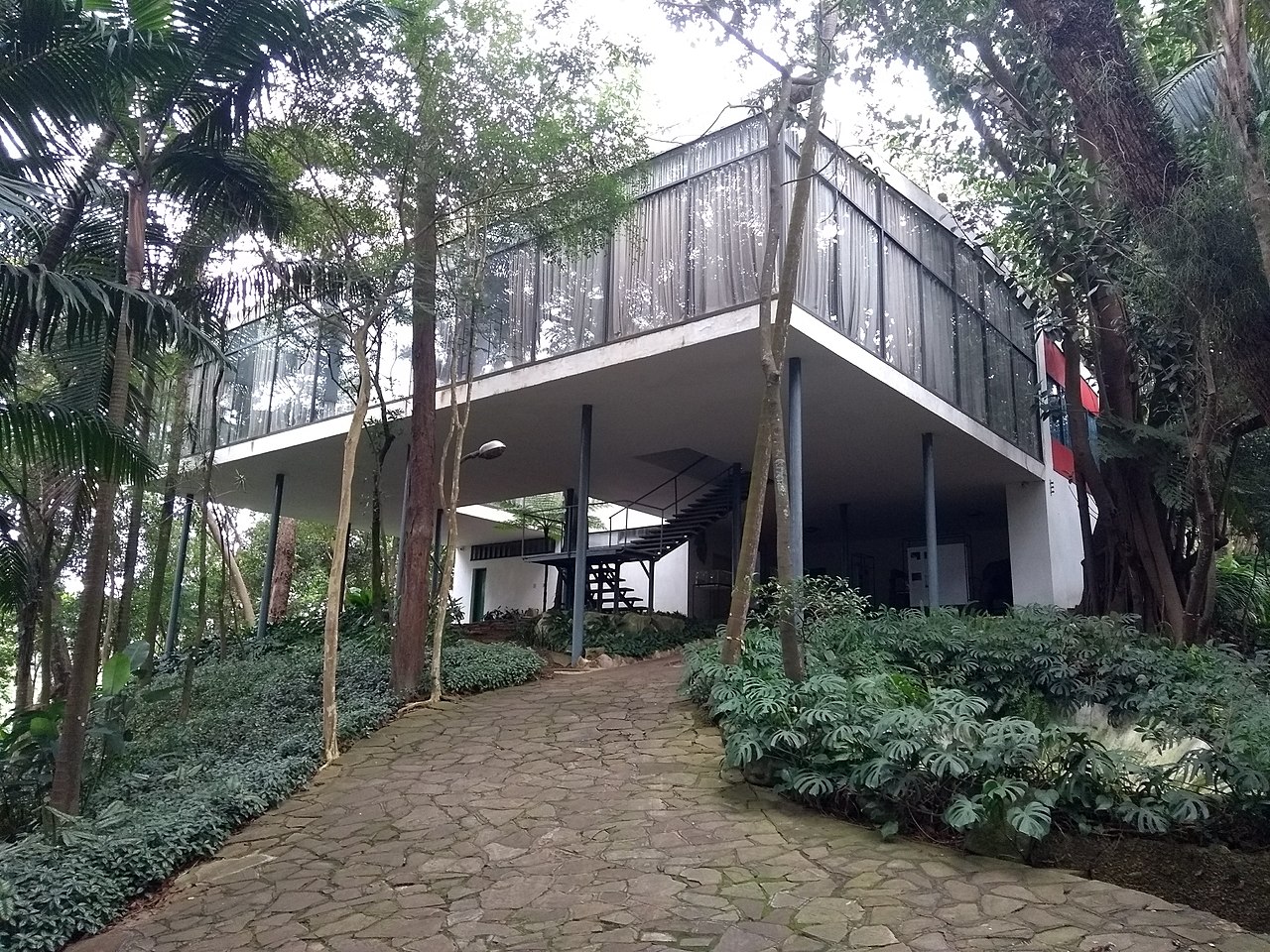
Architects such as Luis Barragán in Mexico and Carlos Raúl Villanueva in Venezuela began designing structures that departed from classic European designs to create a modern visual vocabulary celebrating the traditions and legacies of their home countries. These architects became globally renowned for their work and are considered among the founders of Modernism.

The Casa Luis Barragán in Mexico City, designed by Barragán, is one of the most internationally transcendent pieces of contemporary architecture in the world. Composed of smooth grey, orange, pink and brown cement façades, the structure served as Barragán’s private residence and studio and took influence from Mexican tradition and vernacular. It is the only individual property in Latin America that is listed as a United Nations Education, Scientific and Cultural Organization World Heritage Site. 

Similarly, Raúl Villanueva’s design for the campus and buildings of the Ciudad Universitaria de Caracas utilized Modernist principles and Venezuelan cultural history combined with urban and architectural planning to construct Venezuela’s center of higher education.

Like all artistic movements, South American Modernism served as inspiration for and reflection of Modernist movements internationally, including Europe and America. Today, the impact of the postwar South American Modernist movements can be found abroad and in the work of many famed architects. 

With Optima’s strong connection to Modernism, we continue to study, admire and garner inspiration from the rich traditions that took root in other cultures and remain relevant and vital today.

Women in Architecture: Jeanne Gang

Perhaps one of the most well-known architects of her time, especially in Chicago, Jeanne Gang is the founder and leader of Studio Gang. Born 1964 in Belvidere, Illinois, a small town on the northern border of Illinois, she was raised with the prairies of the midwest and proximity to Chicago’s architectural legacy. 

Gang studied at the University of Illinois before going on to earn a Master of Architecture with Distinction from Harvard Graduate School of Design. After Harvard, she studied abroad in Switzerland and France as a Rotary Fellow before joining Dutch architect and design theorist, Rem Koolhaas and his architectural firm, OMA in Rotterdam. 

In 1997, she established Studio Gang, her own practice headquartered in Chicago. The studio’s mission is to use design to connect people to each other, their communities, and the environment. Soft details that reflect the light of the lake and suggest rippling columns of water can easily be identified as Studio Gang’s work.

Aqua Tower, designed by Jeanne Gang, 2009. Credit: (vincent desjardins) on Wikimedia Commons, licensed under the Creative Commons Attribution 2.0 Generic license

Studio Gang Around Chicago

Much of Gang’s work is a prominent part of Chicago’s landscape. Her designs can be found across the city, from O’Hare International Airport to the Loop to Uchicago dorms. Over the years, the studio’s work has become integral to Chicago’s rich architectural legacy. Gang’s 2010 Aqua Tower, situated at 225 N Columbus Dr in downtown Chicago, takes inspiration from terrestrial topography. The facade emulates the contours of a topographic map and reflects light in a way similar to the wave patterns of Chicago’s Lake Michigan. The tower combines a hotel, offices, apartments, and a green roof into a vertical community that facilitates human interaction.

In addition to the studio’s practice, Studio Gang is a strong supporter of climate action. As a member of the Active Transportation Alliance and Architects Advocate Action on Climate Change, the firm supports sustainable forms of transportation in urban environments and radical change in the building sector in regards to climate.

In effort to take climate action, Studio Gang has submitted a design to the C40 Reinventing Cities competition titled Assemble Chicago, a carbon-neutral residential community next to the main branch of Chicago’s public library. The proposed project would provide housing for the downtown workforce including those who earn as little as minimum wage. The design is also eco-conscious and works to reduce carbon pollution, minimize waste, and promote urban biodiversity. 

Studio Gang in the World

Jeanne Gang’s designs can be found across the globe from a powerhouse in Beloit, Wisconsin to the Kaohsiung Maritime Cultural & Pop Music Center in Kaohsiung, Taiwan. Wherever their location and whatever their purpose, the structures focus on immersing themselves in their environment both aesthetically and through their contributions to their ecosystems. Gang’s designs take inspiration from the topography and ecology of their surroundings and concern themselves with how they can bolster the environment and human communities around them, creating the perfect harmony between architecture and nature. 

The thoughtfulness of Studio Gang’s work has been recognized by receiving numerous awards. 

  • MacArthur Fellowship, 2011
  • Cooper Hewitt, Smithsonian Design Museum’s National Design Award for Architecture, 2013
  • Named Woman Architect of the year by Architectural Review, 2016
  • Royal Institute of British Architects International Fellowship, 2018

Gang currently serves as a Professor in Practice at the Harvard Graduate School of Design and lectures frequently around the world. Her studio continues to present unique and conscious designs to the architectural landscape, working to build a sustainable future and sustainable communities.

Eileen Gray’s E-1027 Reopens to the Public

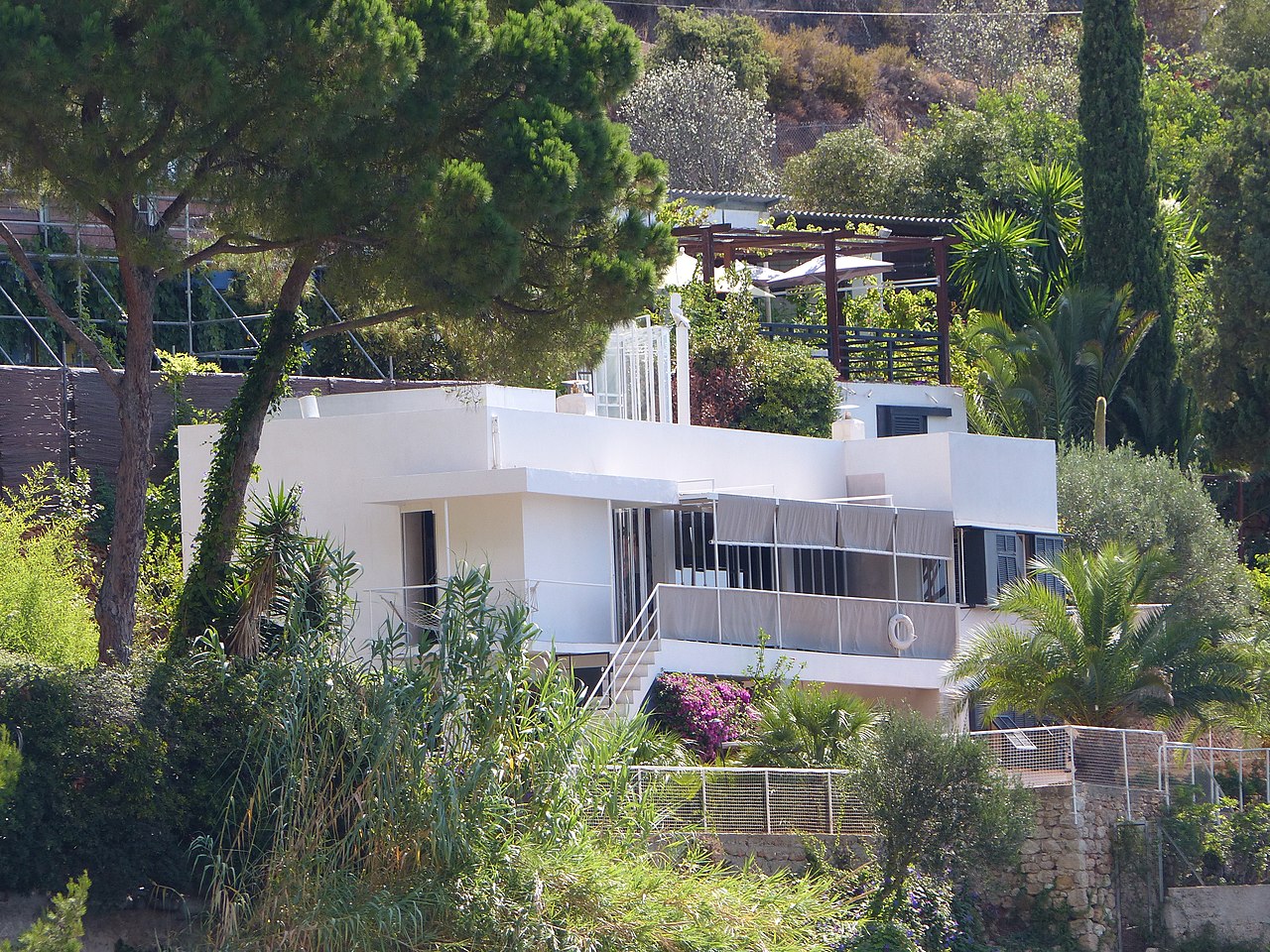
Previously, in our Women in Architecture Series, we highlighted the streamlined, industrial style of the modernist designer and architect Eileen Gray, which you can read here. Of her many projects, Gray’s French Riviera villa, E-1027, remains most notable. Over time, the grandiose structure fell into ruins, but following an extensive restoration project, Gray’s Villa E-1027 has reopened to the public.  

In its prime, one of the property’s most beloved visitors was Le Corbusier. Following his death, the villa experienced neglect from numerous tenants for years. However, the property was purchased in 1999 by the French agency, Conservatoire du littoral, to oversee its protection and preservation. Later, in 2014 they established the Cap Moderne Association to manage the rehabilitation. After six years of comprehensive restoration work, the E-1027 villa mirrors the original design that was completed in 1929 by Gray and her husband, Jean Badovici. 

The project aimed to restore both the exterior environment and the interior fixtures of the villa. Inside, new built-in and free-standing furniture and artwork reflect the villa’s original lived-in state from nearly a century ago. Visitors are invited to consider how Gray pioneered an interpretation of modernist warmth with welcoming internal fixtures that contrast the villa’s sometimes cold, concrete structure. 

On the exterior, vibrant blue awnings covering the outdoor walkways offset the villa’s bright white walls. The “house by the sea” is intended to be a living organism within the structure’s larger atmosphere. Surrounded by lush greenery and landscaping on its north and south-west sides and built on pilotis just above a plunging cliff into the sea, the villa successfully fulfills Gray’s goal of being harmoniously integrated into its environment.

Timed tours of this modernist wonder are currently available for small groups looking for a getaway. You can learn more about E-1027 and how to visit it on Cap Moderne’s website here

The Benefits of Urban Greenspaces

At Optima, we approach every project as an opportunity to explore the best possible ways to create harmony between the built and natural environments to allow our residents to enjoy a wealth of benefits that contribute to a healthier, more sustainable environment.

We understand that greenspaces; parks, gardens, conservatories, roof gardens and residential greenery are crucial to the vitality of urban spaces and the communities where they are found. Population density of urban areas is increasing swiftly. By 2050, it is estimated that 68% of the global population will live in cities. According to the WHO, urban greenspaces promote mental and physical health through the promotion of physical activity, mutual understanding, and mitigating exposure to air and noise pollution as well as excessive heat. 

In the summer, the heat generated by human activity, transport, and industry creates an increased need for energy consumption to cool spaces. Green areas have the ability to absorb that heat and pollution. They also allow urban dwellers to stretch their legs and be outside, improving cardiovascular health and relieving stress. Each space also promotes social cohesion, the coming together of people who would usually not interact with each other due to the individualistic nature of urban living.

Landscaping used to create privacy at Optima Signature

At Optima we recognize the tremendous advantages greenspaces provide. In Chicago, Optima Signature’s inviting plaza filled with lush landscaping and 1.5 acres of amenity space encourages residents to spend time outdoors. Gardens, landscaped fire pits, swimming pools, and outdoor entertainment all radiate the feeling of an oasis within the larger urban environment.

Landscaped Courtyard at Optima Kierland Apartments

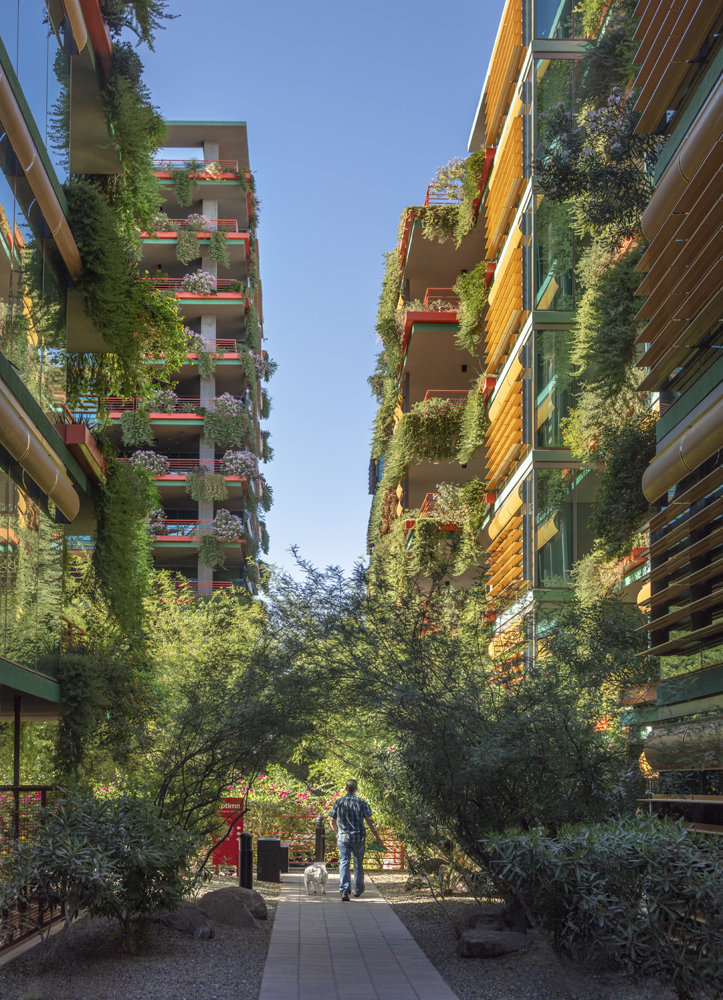
Optima Kierland Center embraces its surrounding beauty and builds off of it. Lush greenery fills the more than 7.5 acres of open space connecting Optima Kierland’s buildings in a park-like setting. Similarly, Optima Sonoran Village utilizes more than half of its 10-acre property to house stunning landscaping, sculpture, and pedestrian paths while mitigating the desert’s harsh climate. We utilize rooftop gardens and our signature vertical landscaping at Optima Sonoran Village, Optima Kierland Apartments, and will be bringing it to Chicago at Optima Verdana, to create an oasis inspired by its surroundings that contribute to the greater environment. This type of green space brings both beauty and positive contributions to their communities. 

Greenspaces make urban living refreshing, enjoyable and social. And as our cities become more and more dense, urban greenspaces become a crucial part of the ecosystem — and of our enhanced quality of life.

Chicago History: The South Shore Cultural Center

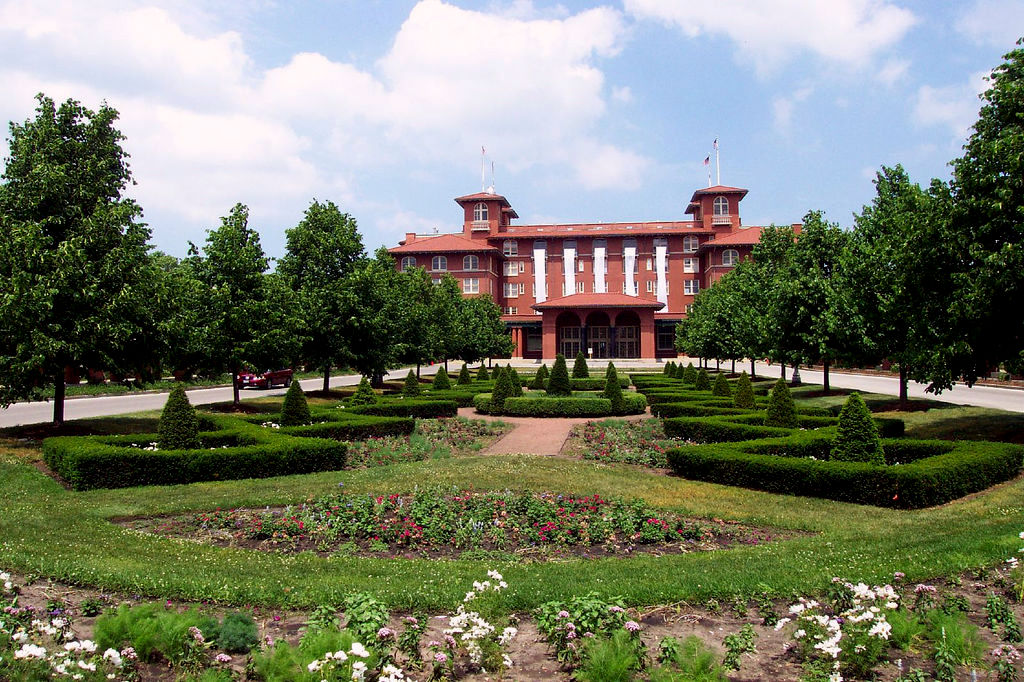
At Optima, our appreciation for timeless architecture and design runs deep, and there’s no better way to feed that passion than by paying a visit to the historic South Shore Cultural Center. On the corner of 71st St and South Shore Drive sits the large, brick building with landscaped gardens, a golf course, beach access, and unbeatable lake views. Many do not know that the structure exists, and many more drive by every day without realizing the rich history of the center and its grounds. The South Shore Cultural Center is one of Chicago’s hidden gems with astounding architecture, interior design, and a wealth of history.

History

The South Shore Cultural Center was originally founded in 1905 to function as a country club similar to the Athletic and Union League clubs downtown.

Designed in the Mediterranean revival style by the architecture firm, Marshall and Fox, the club initially served the wealthy, white population of the South Shore neighborhood and offered stables, a nine-hole golf course, tennis courts, and a bowling green, along with a ballroom, and a private beach.

In the early 1960s, the demographic of the South Shore neighborhood began to change as black families integrated into the neighborhood, and white families left for the suburbs. Originally only open to white Protestants, by 1967, the club became open to anyone who wanted to join.

By 1973, struggling financially, the club liquidated its assets, and in 1975, the property was sold to the Chicago Park District.

Today

Thanks to a coalition of neighborhood activists and historic preservationists, the club’s original facilities remain standing today and are open to the public.

The Cultural Center serves as the home to the South Shore Cultural Center School of the Arts, an organization that provides community art classes, youth and teen programming, art and dance studios, a kiln, and the Paul Robeson Theatre.

The ballroom and banquet facilities can be rented for special events, and the golf course, beaches, and nature center remain open to the public.

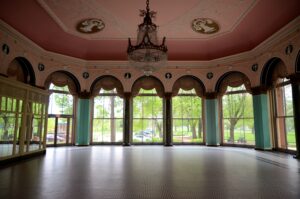
A large chandelier is centered in the middle of a pink ceiling in a grand dining room with windows spanning the length of the wall.
South Shore Cultural Center Dining Room. Credit: on Flickr Creative Commons, CC BY-NC 2.0 Deed

Visit

The South Shore Cultural Center is easy to access from downtown on Lake Shore Drive. The Chicago Lakefront Trail also runs past the center, so it is possible to visit by bicycle. Plan a round of golf or bring the family for a beach day and picnic. 

The Cultural Center also functions as a sort of museum with plaques explaining the building’s history and architecture.

Schedule your visit and learn more about the center here

A Guide to the Chicago Architecture Biennial: The Available City

The first of its kind in North America, Chicago’s Architecture Biennial, an international exhibition of architectural ideas, projects and displays, began in 2014 with the support of the city’s Cultural Affairs department. Similar to Optima, Chicago’s Architecture Biennial celebrates the relationship that design and nature have with one another in urban environments.

Former Chicago mayor, Rahm Emanual described the Biennial as “an ode to the city’s past and an echo to our future.” This year’s theme, “The Available City” stands true to that sentiment. The 2021 edition of the Chicago Biennial “is a framework for a collaborative, community-led design approach that presents transformative possibilities for vacant urban spaces that are created with and for local residents.” Artistic Director, David Brown, a designer, educator, and researcher based at the School of Architecture at the University of Illinois focuses his work on non-hierarchical, flexible and variable approaches to urban design and has selected a group of accomplished collaborators to reflect his vision of an “Available City.” 

In order to achieve a collaborative and community-led design approach that transforms vacant urban spaces, the Biennial invites artists, architects and designers from Chicago and around the world to come together and share their creations, lead workshops and conversations, and create communal spaces where Chicagoans can come together and appreciate their city. Workshops will be held in neighborhoods across the city in which vacant spaces will be transformed into collective spaces. Digital programming will be used to activate these spaces. 

This year’s lineup of collaborators include creators from around the globe and creators who call Chicago home. Chicago-based architect, designer, and educator, Ania Jaworksi, will present a solo exhibition at Volume Gallery in which she pays homage to Chicago and urban life through the humor, pragmatism, and seduction that can be found in design. Other local contributors include Borderless Studio, a research-design practice that leads community-based projects addressing issues of social equity, Central Park Theater Restoration Committee, a group aiming to revive Chicago’s abandoned Central Park Theater, Englewood Nature Trail, a two-mile green infrastructure reuse project located in the Englewood neighborhood, in care of Black women, a creative initiative launched in Chicago’s south side focused on re-activating vacant spaces and creating “cartographies of care,” Open Architecture Chicago + Under the Grid led by Haman Cross III, Lawndale’s resident artist which leads and promotes design-efforts and creative projects in the Lawndale community, PORT, a public-realm design practice founded by Christopher Marcinkowski and Andrew Moddrell, and The Bittertang Farm, an architectural duo composed of Antonio Torres and Michael Loverich who explore architecture’s connection to living organisms. 

International contributors, ranging from Boston to South Africa to China, include Ana Miljački of the Critical Broadcasting Lab at MIT, Atelier Bow-Wow from Tokyo, Japan, Studio Ossidiana from Rotterdam, Netherlands and Venice, Italy, Matri-Archi(tecture) from Basel, Switzerland and Cape Town, South Africa, and Hood Design Studio from Oakland, California among numerous other designers and creatives from around the country and world. 

The 2021 Chicago Architecture Biennial is open to the public starting September 17.

person name goes here

Maintenance Supervisor

Glencoe, IL


    Acceptable file types: *.pdf | *.txt | *.doc, max-size: 2Mb