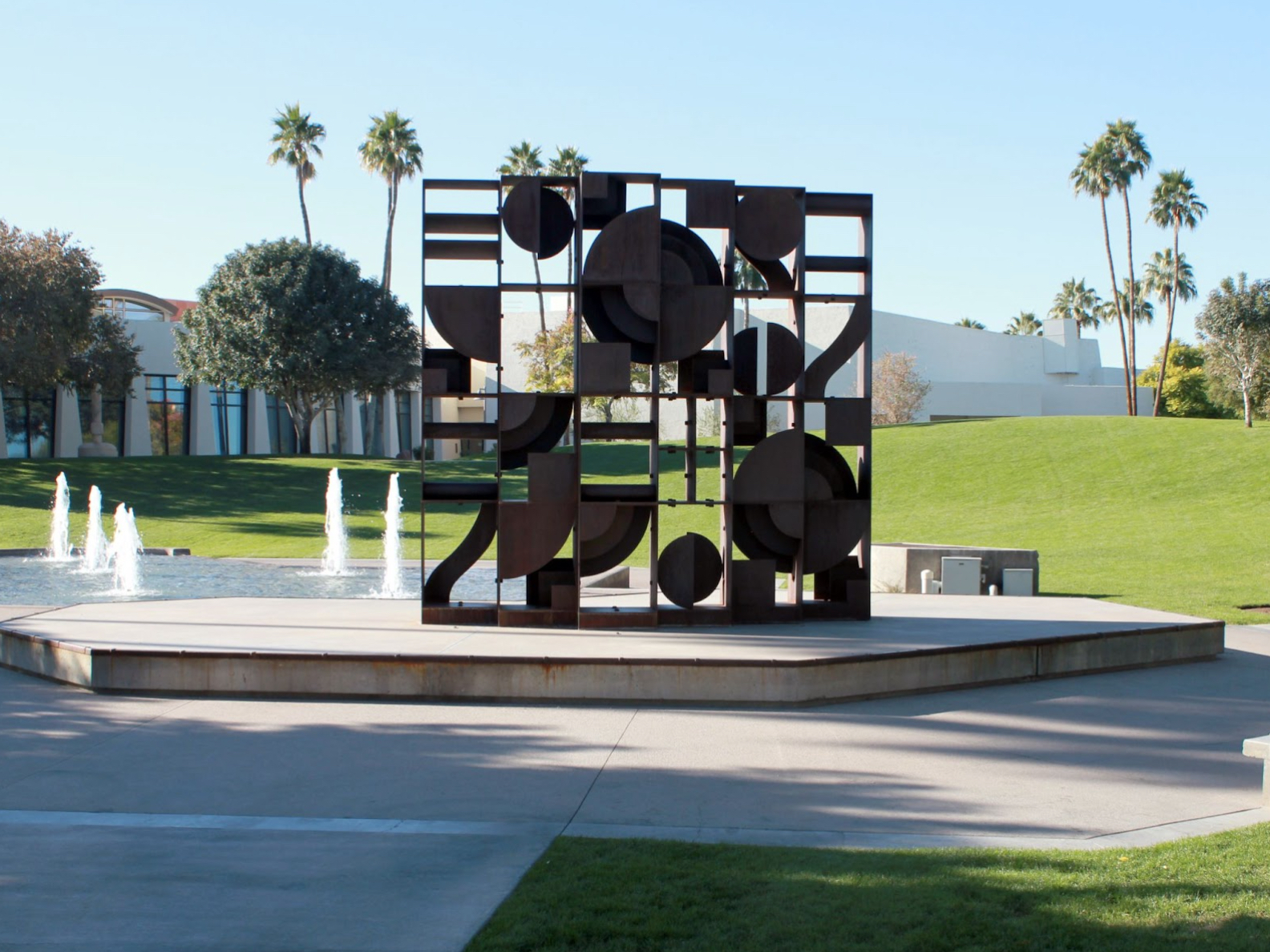
As part of our ongoing public art series, we’ve been exploring exceptional creations to be found across Scottsdale, from the unique Water to Water, to the latest installation, Pinball Wizard. Today however, the spotlight is on Windows to the West, Scottsdale’s first public art installation and one that still inspires the city today after more than 50 years in the city.
In June 1970, the National Endowment for the Arts (NEA) awarded the City of Scottsdale a $20,000 matching grant to commission its own notable work of art by an American sculptor. The NEA program, Works of Arts in Public Places, would go on to fund more than 700 works of public art across the country, and Scottsdale was the first small city they approached at the time.
Two years later, in February 1972, the City of Scottsdale finished raising their $20,000 of the matching grant, and the Scottsdale Fine Arts Commision chose acclaimed sculptor Louise Nevelson to create the first work of public art for the city. Nevelson, who is regarded as one of the best sculptors of the 20th century, completed the expressionist sculpture out of monochromatic corten steel designed to patina with time. Its abstract structure and shapes resemble some of her other iconic creations.
Although the sculpture was originally titled Atmosphere and Environments XVIII, thanks to its westward placement after its completion, it quickly became known as Windows to the West. Since its dedication in 1973, the sculpture has remained a treasured landmark of Scottsdale and continues to showcase how far the city’s appreciation for art has come.
Today, due to renovations on the Scottsdale Civic Center where the Windows to the West lived, the sculpture is in storage until the construction is finished in 2023. When it returns, art enthusiasts can expect the beloved sculpture to find its new home closer to the Scottsdale Center for the Performing Arts, but with the same western spirit as before.
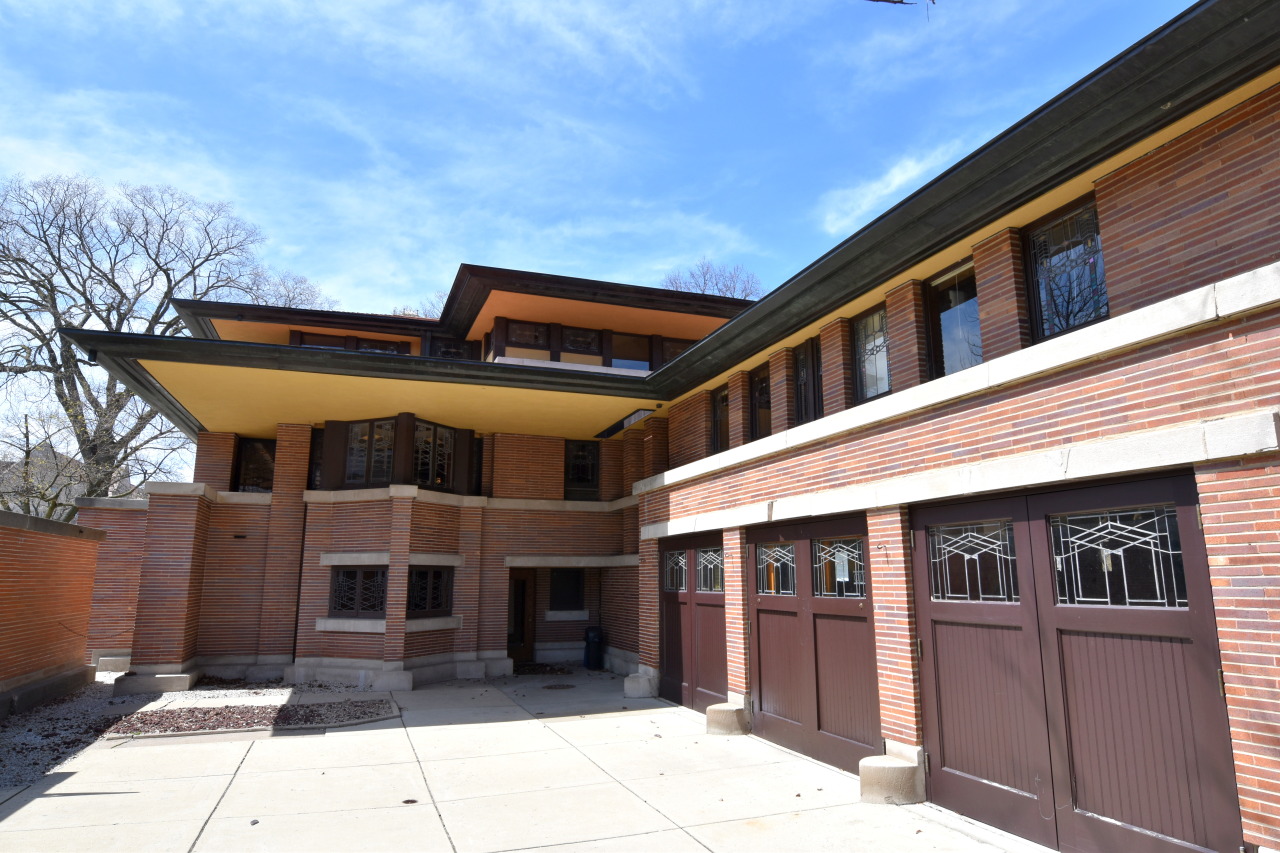
For those tireless fans of Frank Lloyd Wright — unarguably one of the greatest architects of the 20th century — we are delighted to shine a light on one of his innovations that rarely attracts attention. It’s the attached garage.
In a brilliant process of cultural sleuthing, conceptual artist Olivia Erlanger and architect Luis Ortega Govela embarked on a project that culminated in the 2018 publication of Garage by MIT Press. With elegance, wit and panache, the authors tell this tale of Robie House, completed in 1910:
“In the quiet darkness of South Woodlawn Avenue, Frank Lloyd Wright molded and adapted the American home for the automobile. The small rectangular windows of Wright’s Robie House cast rectilinear shadows across the sidewalk. In the moonlight, the red hydrangeas lining the second-floor balcony appeared black, to be identified only by their smell. With no “front” or “back,” the building looms, imperious and totemic. To the pedestrian it looks like a Japanese woodblock puzzle: the riddle of how to enter, or exit, persists until one encounters an oversized gate leading to a three-car garage. The Robie House is known by many as the cornerstone of modernism, but its status as the first home with an attached garage seems to have been forgotten. The garage struck architectural academics as so banal that it became nothing more than a footnote in Wright’s illustrious history.
The garage was invented to domesticate the car. At the end of the nineteenth century, the car made its entrance into the stage of history to replace the horse. Initially it was a temperamental machine, and people were reluctant to incorporate it into their daily lives. The machine had yet to develop the technology necessary to be used regularly, so it was mostly kept in the stable, next to the other animals. Yet at the same time the car needed so much upkeep that mostly they were stored in communal parking lots where the first auto mechanics would constantly be preparing cars for the type of local roads that existed at the time.
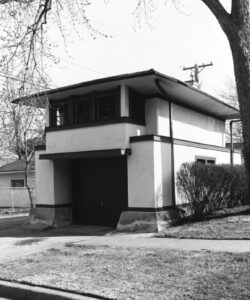
Following the completion of Robie House, Wright was commissioned by Emma Martin to design an attached garage for her Oak Park home in his characteristic Prairie style
If the human entrance to the house was secretive, the one designed for the machine was not. Inside the yard, the garage doors dominate the space. It is here that the garage claims its rightful position on the front of the plot with a direct and easy connection to the street. If we go by Wright’s poetic hand, in 1910 the garage was symbolically integrated into the familial structure. This relationship between home and garage, family and car, would not reappear in architecture until the early 1920s, making the Robie House a premonition of the future.”
For a deeper dive into the history of the garage as a space of creativity (think tech start-ups and musicians), grab a copy of Garageand make time to visit Robie House. Enjoy!
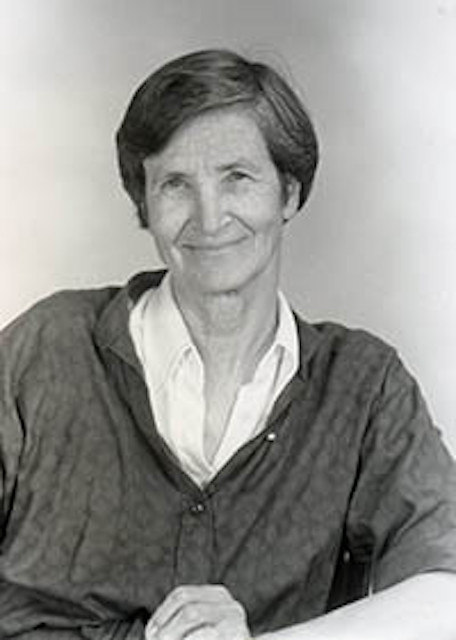
As part of our ongoing “Women in Architecture” series, we’re spotlighting a designer who generously contributed to the refined elegance of American modernism, Natalie de Blois. As an early advocate for women in architecture, de Blois became well-known in feminist architecture circles around the world. Learn more about her incredible life and career below:
The Life of Natalie Griffin de Blois
De Blois was born on April 2, 1921, in Paterson, New Jersey. Following three generations of engineers in her family, she knew by the age of 10 that she wanted to become an architect. Supported by her father, de Blois’ interests in art and architecture flourished; thanks to him, she enrolled in a mechanical drawing course in school, which was typically limited to male students at the time.
The class not only helped de Blois evolve her drawing skills for what would become her passion, but it also introduced her to the bias she would experience throughout her career. In 1939, she visited the New York World’s Fair in Flushing Meadows, further expanding her understanding and vision for modern architecture.
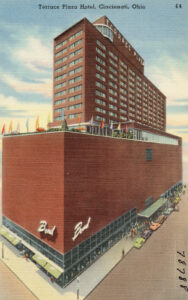
Skidmore, Owings & Merrill, Natalie de Blois, a postcard of the Terrace Plaza Hotel, Cincinnati, Ohio, 1940
De Blois enrolled at Western College for Women in Oxford, Ohio but soon transferred to Columbia University after they changed their architecture school’s admission policy. While at Columbia, de Blois worked for various firms drafting various presentations and projects
Notable Works and Achievements
Following her graduation in 1944, de Blois immediately received her first position at Ketchum, Gina and Sharpe, a firm she admired for their dedication to modern design. However, she left due to gender bias less than a year after starting. But, while one door closed, another opened at Skidmore, Owings & Merrill (SOM), where de Blois’ talents were finally celebrated.
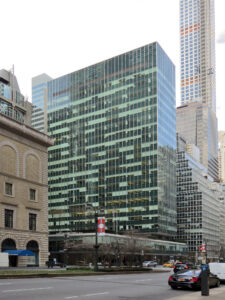
Skidmore, Owings & Merrill, Natalie de Blois, Lever House, Park Avenue NYC, 1952. Credit: Gabriel Fernandes on Flickr Creative Commons CC BY-SA 2.0 Deed
At SOM, de Blois contributed to seminal design proposals including the United Nations Headquarters and Lincoln Center, but it wasn’t until 1948 that she led her first project, Terrace Plaza Hotel in Cincinnati. The hotel immediately received praise for its modern, luxurious look and high-tech amenities for the time. She also contributed designs to many of the firm’s other significant projects, including Manhattan’s Lever House, completed in 1952 and the Pepsi-Cola Headquarters, finished in 1960, perhaps the most complete example of her most modernist design aesthetic.
In 1961, de Blois relocated to work for SOM’s Chicago office, where she was promoted to Associate Partner. In Chicago, she prioritized advocating for women in her field and was a founding member of Chicago Women in Architecture and was appointed to the AIA Chicago Taskforce on Women in Architecture in 1974. However, de Blois left the firm the same year and moved to Texas, where she completed her career in architecture, later becoming a professor at the University of Texas School of Architecture.
Skidmore, Owings & Merrill, Natalie de Blois, Equitable Building, Chicago, Illinois, 1965. Credit: Warren LeMay on Wikimedia licensed under the Creative Commons Attribution-Share Alike 2.0 Generic license
Alongside her revolutionary work, de Blois has received various design awards and achievements, including:
Fellow, American Institute of Architects, 1974
Edward J. Romieniec, FAIA, Award for Outstanding Educational Contributions, Texas Society of Architects, 1998
Tallest woman-designed building in the world, 270 Park Avenue, from 1960 until 2009
Throughout her illustrious career, de Blois’ proved to be a force to be reckoned with. And, in her lifelong pursuit of gender equality, she proved that women could compete at the highest levels of the architecture profession, empowering the careers of countless women who followed her.
Celebrated as the pioneer of modernist architecture, Le Corbusier’s contributions to architecture and design remain as significant as ever. And although much of his work is nearly a century old, designers continue to draw inspiration from his inventive principles. Take a look at how designers are still responding to Le Corbusier’s theories of modernism today.
This year, the international contemporary art gallery, Galerie Philia, displayed Héritages. Found at Cité Radieuse, a Le Corbusier housing complex built in 1952, the exhibit featured works by eight international designs referencing the functionality and minimalist design elements Le Corbusier famously employed through his work.
And although the exhibition featured work from multiple designers, each piece united through a visual response or reinterpretation of Le Corbusier’s theories. While some artists showcased work heavily influenced by Le Corbusier in the exhibition’s “resonance” area, others provided pieces opposing his theories in the “dissonance” area.
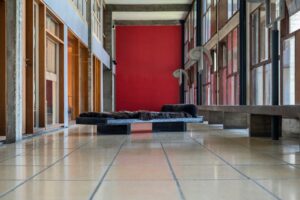
Arno Declerq’s steel daybed in the “resonance” room, Photo by Maison Mounton Noir
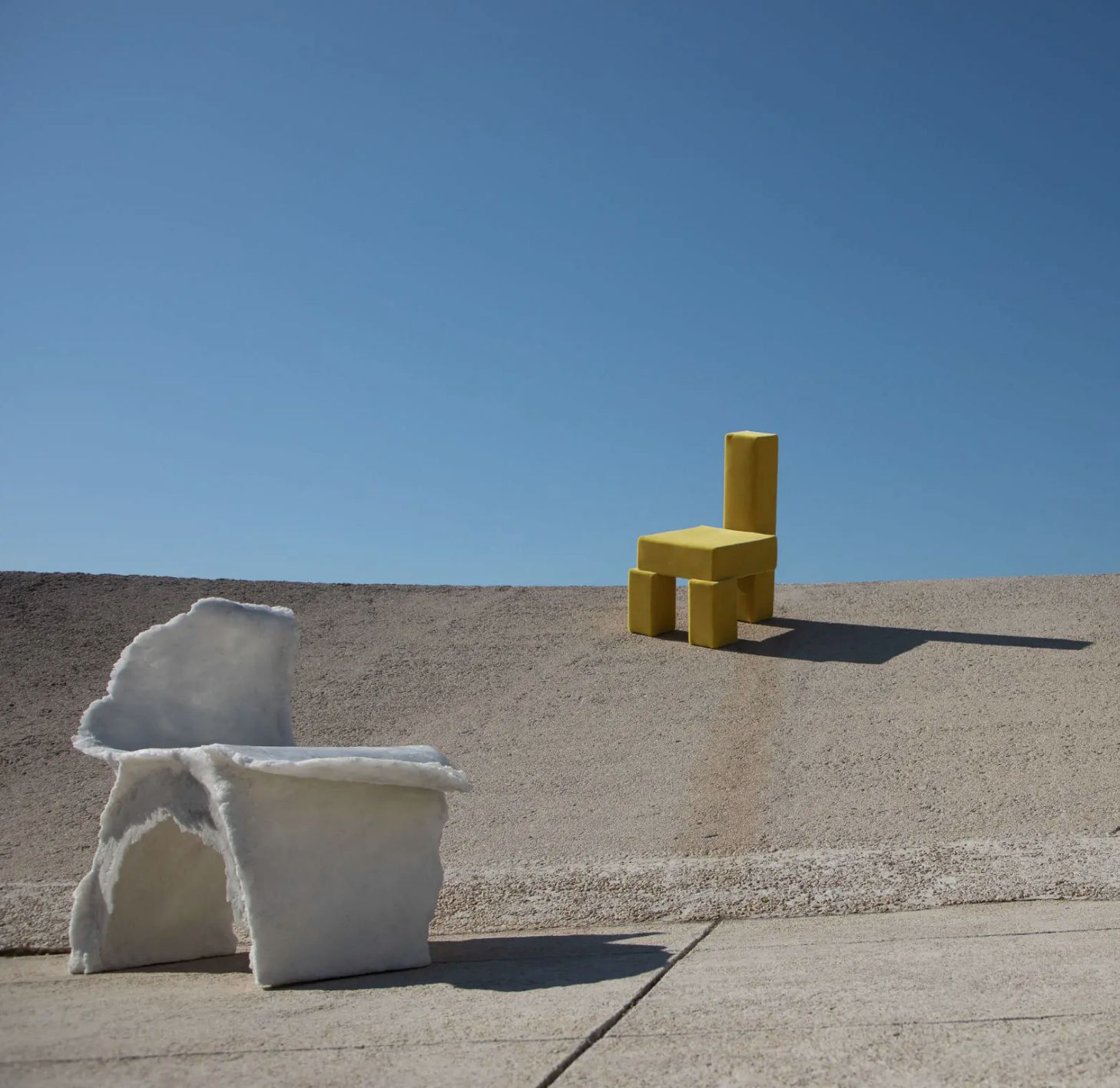
Belgian designer Arno Declercq contributed a sculptural daybed for the “resonance” room, inspired by both Le Corbusier’s famous furniture designs and his architectural contributions. The minimalist design features a structure of steel, a material Le Corbusier often used throughout his architecture. Paired with the daybed, architect and designer Pietro Franceschini contributed a chunky brutalist chair upholstered with vibrant yellow velvet, deeply inspired by Le Corbusier’s bold yet functional armchair designs.
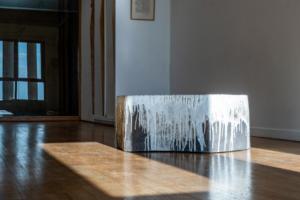
In the exhibit’s “dissancane” room, American visual artist Jojo Corväiá explores imbalance with his standout ceramic table. Using volcanic clay, Corväiá designed the table with the intent of displaying its cracks and irregularities, a practice from which Le Corbusier strayed. Designer Roxane Lahidji also contributed to the room, adding a sculpted chair of marbled salts. The stretched seat and arched base make reference to the fragility of organic designs.
Jojo Corväiá’s volcanic clay table in the “dissonance” room, Photo by Maison Mounton Noir
In addition to the furniture, artist Flora Temnouche created three oil paintings for the space. The paintings touch on the inertia of nature, partially inspired by the sparse relationship to nature Le Corbusier’s approach to design and architecture employed.
Considered one of the most influential figures in contemporary design, Le Corbusier’s work continues to create inspiration across the world today. And, thanks to Galerie Philia’s Héritages exhibition, artists and designers continue to honor and reflect the transformative work, bringing it new meaning and life. Explore the rest of the exhibition’s bold work here!
At Optima, our affinity for modern design and style stretches through all of our Communities. In the past, we’ve explored the history and identity of modern furniture, but we’ve never touched on the defining elements of modern decor. So, if you’re looking to elevate your home with a modern eye, look no further:
Like design, remember that with modernism, form follows function; this means that every decor element you have should always reflect its intended purpose. Avoid inserting decor that doesn’t add supplementary function or purpose to your home. However, this doesn’t mean that your decor has to be limited; many modernist designs also embrace vibrant colors, unique shapes and various materials.
Embrace The Light
One key trait of modernism is utilizing and celebrating a space’s natural light. For windows, modesty is key; even with curtains, use soft and sheer fabrics to keep it minimal. Another great way to stretch the natural light in your home and manipulate space is by adding mirrors to your interior. Hang mirrors where they’re most practical in your home. Rooms that have limited light and feel small may benefit from a large mirror, and it might make sense to place a mirror across from your home’s beautiful view or a statement piece.
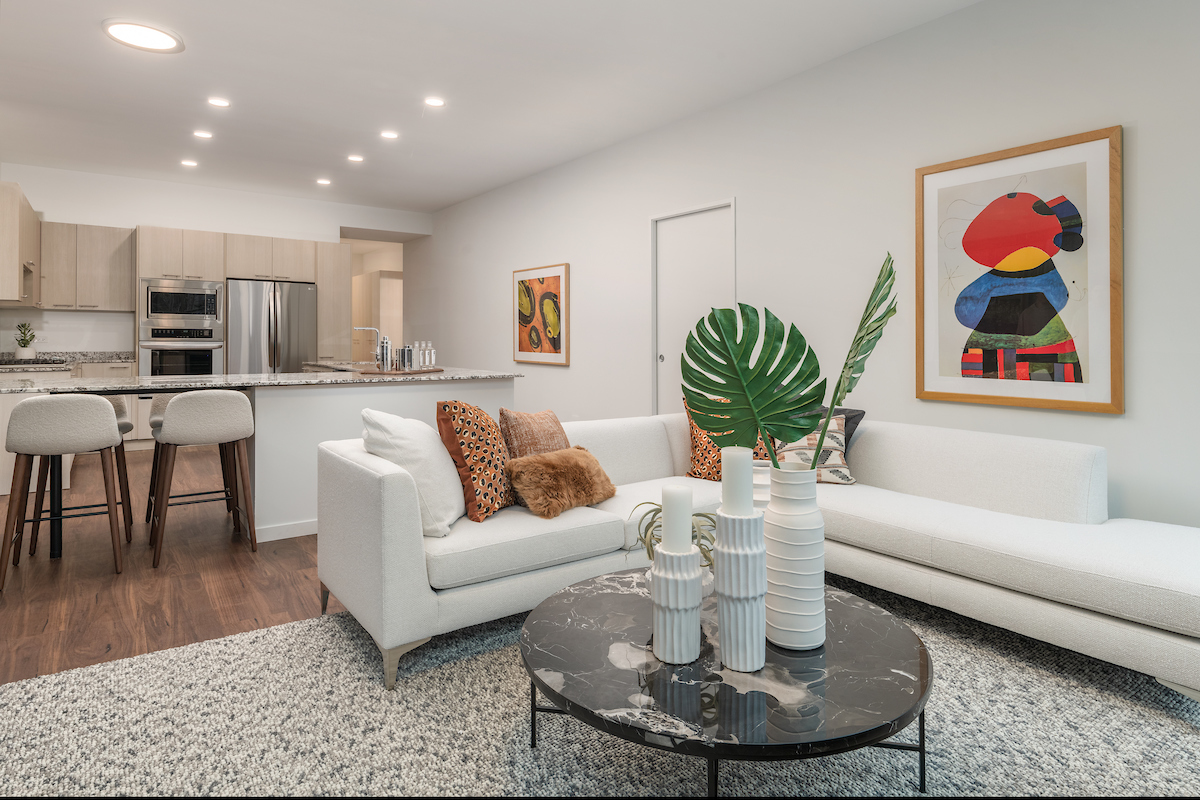
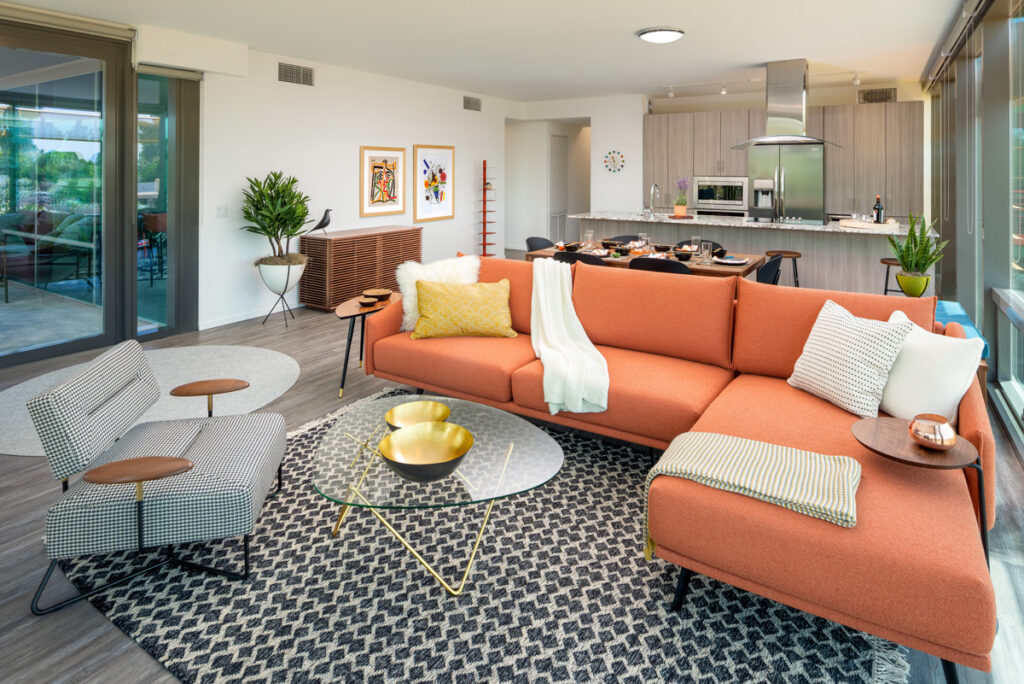
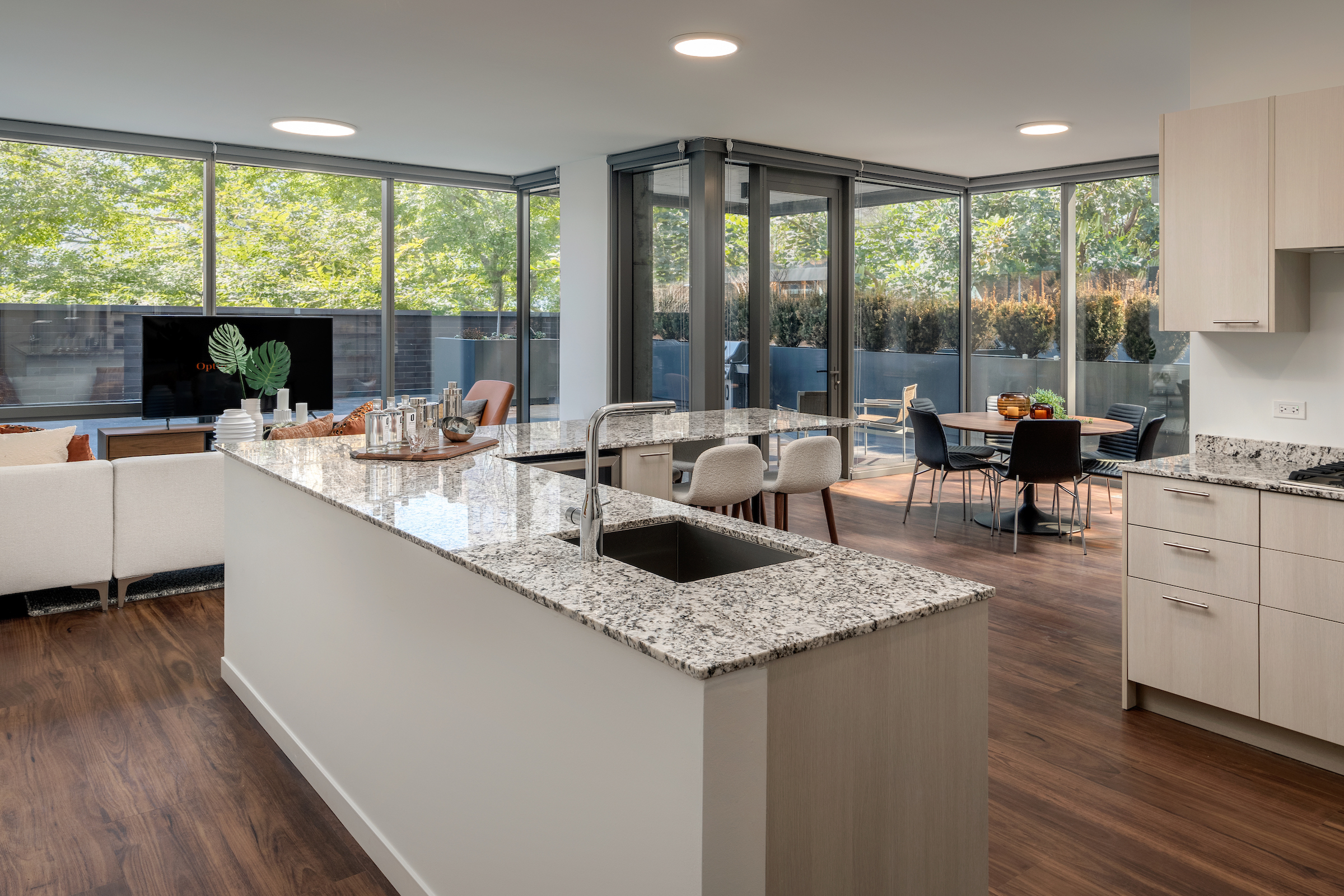
Vibrant colors and organic textures in an Optima Sonoran Village residence
Introduce Texture & Color
Whether you start with the living room or the bathroom, introducing organic textures to your home is a great way to welcome modern design. Bring the outdoors in with furniture and decor elements that feature natural wood and stone. Other warm textures like leather and natural fibers make fantastic options for complimenting other modern features of your home. Modern design and warm elements don’t have to conflict with one another.
To some, modernism is only associated with monochromatic tones like gray, white and black, but extending pops of vibrant color throughout your home is a great way to add life to the environment. Place a bright-colored rug in the center of a large room or go all natural and bring in lush greenery and foliage.
Modern decor and design continue to be timeless templates for accessorizing homes. Whether you start utilizing your home’s natural light or mix in a splash of color, there are countless ways to embrace modern decor throughout your home.
Scottsdale’s appreciation for art enables artists to publicize their talents and add to the environment’s imaginative aesthetic year-round. From initiatives like IN FLUX Cycle 10 to classic installations like Knight Rise, Scottsdale proudly embraces the impact behind sharing art with others. Today, we’re spotlighting Scottsdale’s latest addition of public art, Pinball Wizard.
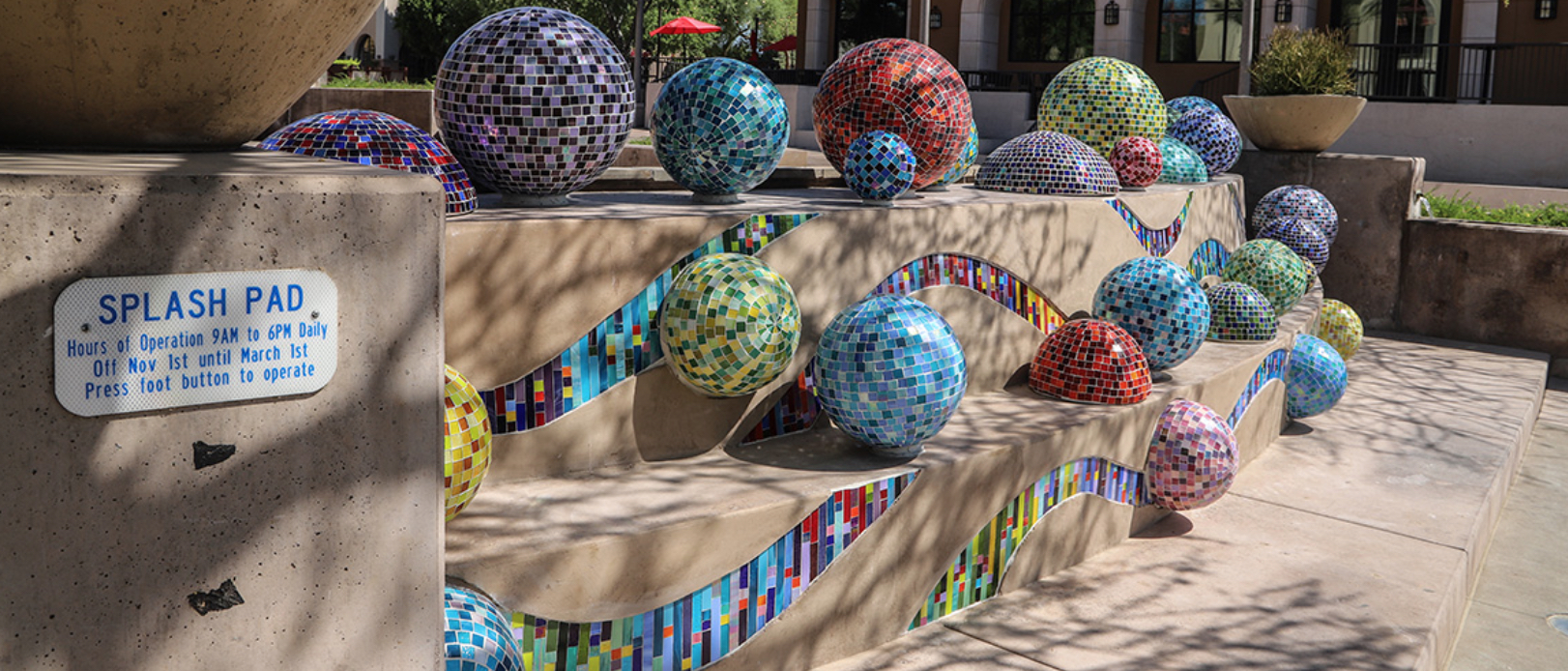
Completed in June 2022, Old Town Scottsdale welcomes Pinball Wizard as the city’s newest public art installation. Public Artist Annette Coleman worked with Scottsdale Public Art to design and construct the vibrant project using colored glass. Coleman is well-known for her illustrative mosaic public art installations, many of which reside in Colorado, and embraces a public art philosophy rooted in stimulating inspiration and creating community.
Pinball Wizard resides at the Stetson Plaza Splash Pad at the Scottsdale Waterfront and features 30 disco-like mosaic orbs and various mosaic waves built into the environment. Designed to catch light from every angle, the myriad of shapes and bright colored glass in Coleman’s design embraces the playful attitude that already fills the area.
Annette Coleman installing Pinball Wizard, Courtesy of Scottsdale Public Art
Drawing inspiration from her appreciation for the outdoors, specifically water, wind, flora and fauna, Coleman included various serpent-shaped waves throughout the concrete wall of the splash pad. Her inspiration behind Pinball Wizard, and many of her other projects, also draws from television shows, games and science productions, and other pop culture references.
Pinball Wizard brings a splash of color to the already lively surrounding at Scottsdale’s Stetson Plaza Splash Pad. Visit the public art yourself and hear more from Coleman about its creation here.
Warm weather, fresh air, and BBQs are all defining aspects of the perfect summer. Across all of Optima’s communities, we provide residents with abundant outdoor space to celebrate living well, and to engage with each other around alfresco cooking and dining.
Our passionate approach to design creates a linkage between architecture and nature throughout each of our communities, but it’s in Optima Kierland, Optima Sonoran Village, Optima Signature, Optima Lakeview and our latest project, Optima Verdana, where residents will find extensive amenity spaces that include outdoor kitchens and communal grills on their sky decks, and additional private grills in select terraces.
For those who are fans of alfresco cooking and dining, here’s your chance to hone your grilling skills with the great American staple — the hotdog. Whether you’re a pro or just getting the hang of it all, here are two great recipes to get you up to the sky deck with your chef’s hat and tongs…
Chicago-style hot dog
Chicago-Style Hot Dog
Since Optima’s roots are in Chicago, we have to highlight the classic Chicago-style hot dog. The best part about the Windy City staple is how easy it is to prepare! All you need is a hot grill and all of the delish garden-fresh ingredients! Find the recipe here.
Sonoran hot dog
Sonoran Hot Dog
While Chicago is famously known for its unique take on the hot dog, Arizona propels the standard bite to a whole different level with the Sonoran hot dog. Like its standard cousin, the Sonoran is topped with tasty condiments, but what makes it unique is its bacon-wrapped exterior. Find the recipe here.
The outdoor kitchens, communal grills and private grills are just some of the many ways we design our residential and communal spaces to invite the outdoors inside. Connecting to nature is an easy way to take some time and connect to yourself and to the environment around you.
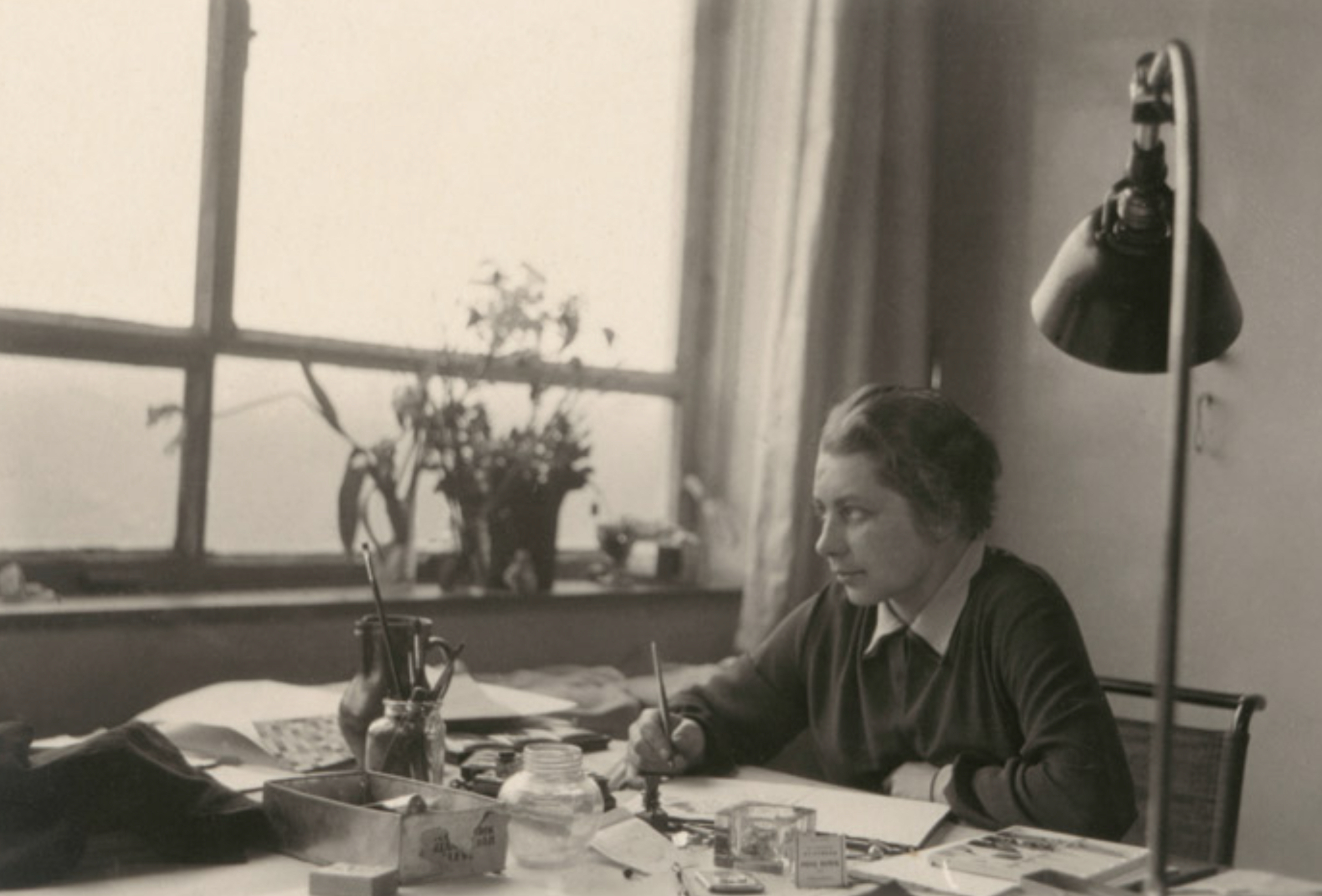
In “The Other Art History: The Forgotten Women of Bauhaus,” an in-depth piece that was published on July 13, 2018 on Artspace by Jillian Billard, we have the opportunity to understand the enormous impact a group of women visionaries had in shaping the Bauhaus.
We learn from Billard that the Bauhaus was dedicated to “interdisciplinary innovation” by combining design and craft through a new model of fostering community as the basis for learning instead of traditional teacher-student interactions. And with this new model as a defining principle, the Bauhaus community was ripe for welcoming and supporting women artists.
As Billard explains, Walter Gropius, who founded the Bauhaus School of Design in Weimar, Germany in 1919, stipulated that the school would be open to “any person of good repute, regardless of age or sex.” So while women were allowed to study at the school, they were directed into practices commonly regarded as “women’s work” –– textiles and weaving — while their male counterparts were encouraged to be architects, sculptors, and painters.
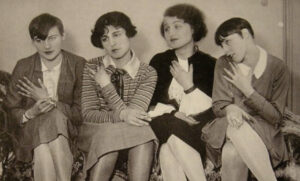
Photo of Alexa von Porewski, Lena Amsel, Rut Landshoff, unknown by Bauhaus photographers Umbo and Paul Citroen), before 1929. Berlinische Galerie, Photographic Collection.
Billard reminds us that the artists most closely associated with the Bauhaus were men, including Josef Albers, Marcel Breuer, Wassily Kandinsky and Paul Klee. At the same time, history has treated the women in the movement as the counterparts of these great artists. In the past ten years, as many have revisited the Bauhaus participants in a more accurate art historical context, we have had the opportunity to celebrate the incredible women artists and the contributions they made.
In “The Women of the Bauhaus,” an extensive thesis presented by Corinne Julius in Blueprint on September 3, 2019, we learn of the rise to prominence of Gunta Stölzl, only one of six students certified as a Master weaver. As head of the department from 1929 to 1931, she ushered in the transition from individual pictorial weaving to modern industrial designs, while also implementing the study of mathematics. Her bold artistic experiments include creating the mercerised cotton and Eisengarn fabric for Breuer’s tubular-steel chairs while leading joint projects with the Polytex Textile Company.
Julius describes Marianne Brandt as a brilliant metalwork artist who joined the Bauhaus as a workshop assistant and eventually took over as acting director in 1928 from László Moholy-Nagy. As both artist and administrator, Brandt helped solidify the role of industrial design
Wera Meyer-Waldeck entered the Bauhaus in 1927, studying with Marcel Breuer in the carpentry workshop making furniture. Over the next several years, she studied in the construction and architecture departments, and went on to establish a distinguished career with a focus on sustainable housing.
And the list goes on. As we shared in Female Weavers and the Bauhaus, virtually every aspect of the Bauhaus and its artistic practices has been informed by a group of women with talent, vision and unapologetic courage. They, along with their male counterparts, continue to inspire the timelessness of Modernist thinking-and-doing. And in every part of our holistic design thinking at Optima, we celebrate their contributions.
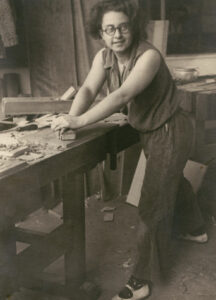
Wera Meyer-Waldeck in the carpentry workshop at Bauhaus Dessau in 1930, photographed by Gertrud Arndt. Credit: VG Bild-Kunst, Bonn 2019 / Bauhaus-Archiv, Berlin
For further reading on 45 luminary women of the Bauhaus, Bauhaus Women: A Global Perspective, written by Elizabeth Otto and Patrick Rössler and published in 2019 by Bloomsbury Publishing, is an excellent resource, along with A Tribute to Pioneering Women Artists (Taschen, 2019), written by Patrick Rössler.
As we continue to tour the public spaces at Optima communities to highlight the impeccably-curated collection of Modernist furnishings, it is always a delight to set our sights on Tulip tables, designed by the luminary architect, Eero Saarinen.
Eero Saarinen (1910-1961), the Finnish architect who conceived the St. Louis Gateway Arch, along with many other well-known structures including the Washington Dulles International Airport, also received enormous recognition for his modernist furniture designs produced by Knoll, including the Womb™ Chair.
Legend has it that Saarinen approached Florence Knoll in 1955 with his desire to explore new approaches to furniture design, evolving from his background in sculpture and a desire to create a table with a single leg.
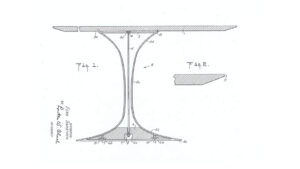
A drawing of the Tulip Table by Eero Saarinen
So in the late 1957, Saarinen proved true to his word and broke tradition by introducing a collection of tables, initially referred to as Saarinen Tables. They feature a single central base, made from single pieces of cast aluminum and finished in black, white or platinum, that appeared to “grow like a flower” with a stem-like base, as opposed to having the more traditional standing legs. With this simple, organic shape that included a slender neck and elegant, organic proportions, the base became the focus of a large series of tables that came to be known as Tulip Tables.
With options for circular and oval tops with tapered edges in a variety of sizes and heights, Tulip Tables were conceived from an integrated design framework that supports a cohesive human experience. They were an immediate hit once they became commercially available, in part because the single base provides visual lightness while inviting people to gather around a table unencumbered by legs. Tulip Tables delighted both residential and commercial furniture buyers with an array of color choices as well, with tops constructed of laminate or wood veneers, or made from natural materials like granite or coated Arabescato marble.
The Tulip Table found in an Optima Lakeview residence
While design trends come and go, a precious few furniture pieces remain timeless and iconic. Saarinen’s Tulip Tables are among those — ever-elegant, minimal and sophisticated.
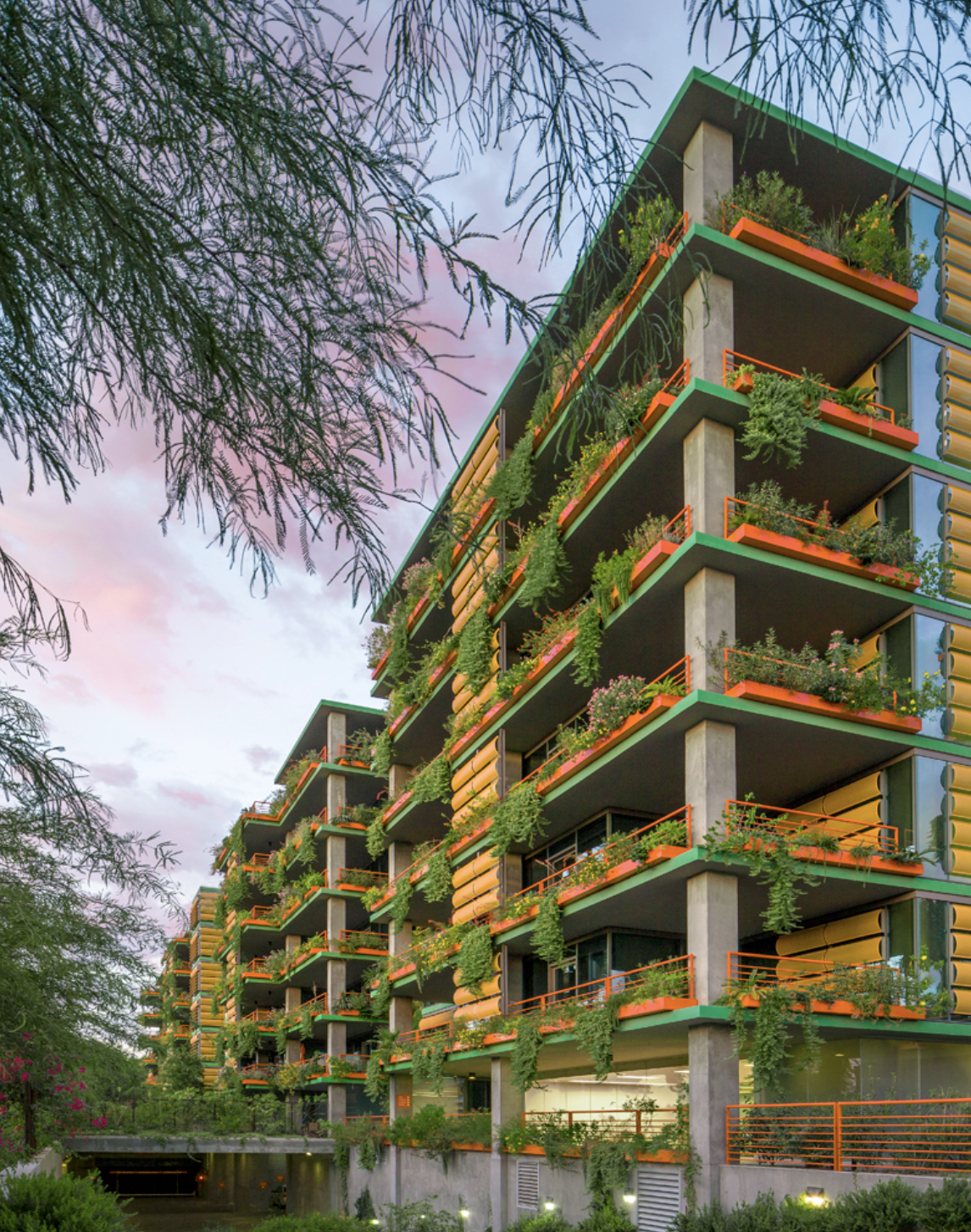
Our passionate connection to nature is an essential piece of our identity at Optima and has been since our founding. This foundation has led to signature design elements in our properties, like our vertical landscaping system. From the vibrant greenery that extends beyond Optima Kierland Center, Optima Camelview Village and Optima Sonoran Village in Arizona to the introduction of vertical landscaping to the Midwest’s four seasons at Optima Verdana in Chicago, the lush green element is a cornerstone of our Optima communities. Given our innovation in this arena, it’s interesting to take a look at how vertical landscaping is used throughout the rest of the world:
In 2016, Mexico City began planning an ambitious project to bring vibrant greenery into the city to reduce pollution and welcome additional natural allure to the area. The city came up with Via Verde, an initiative to cover more than 1,000 highway pillars with lush vertical landscaping. Because traffic in the city is some of the most congested in the world, the pillars not only serve as beneficial to the environment but also as works of natural art for residents.
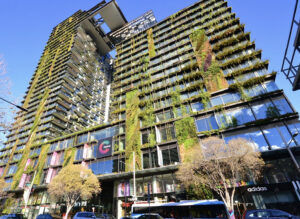
The vertical landscaping at One Central Park, Sydney
Completed in 2012, One Central Park was built as part of Sydney’s Central Park renewal project. The building is a dual high-rise with a height of more than 380 feet, but it is famously known for its vertical landscaping designed by its architects, Foster and Partners, Ateliers Jean Nouvel and PTW Architects. The vertical landscaping system was a collaboration between French botanist Patrick Blanc, the modern innovator of the green wall, and the architects. One Central Park is home to 350 different species, including both exotic and native verdure, and totaling over 85,000 plants that cascade more than meters down its facade.
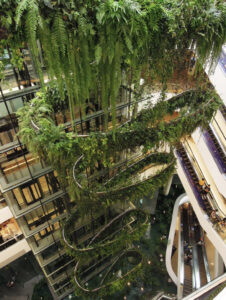
Designed by the American architecture firm Leeser Architecture, EmQuartier is a 2,700,000 square foot mall located in Bangkok, Thailand. The innovative design that makes up the grand retail hub features restaurants, offices, event halls, and at its heart, an open-air atrium. In the atrium’s core, an unprecedented 337-foot chandelier hangs with exotic plants spilling from its sides. Patrick Blac – who also inspired One Central Park’s vertical landscaping – not only designed the ellipse-shaped Rainforest Chandelier for EmQuartier but also included two garden areas and a fully landscaped bridge connecting the mall to other surrounding buildings.
We couldn’t be more proud to have brought vertical landscaping to the Scottsdale and Chicago communities like many other projects have done across the globe, enriching communities and fostering a connection to nature found little elsewhere.