Team Member Spotlight: Amanda Johnson

At Optima, our communities would not thrive without the outstanding work from our spirited team of individuals. We recently sat down with Amanda Johnson, Marketing Associate at Optima, to discuss why she loves being part of such a passionate team and what she has learned throughout her experience here.

Tell us a bit about your background and the role you play at Optima.

Before joining Optima, I held various Marketing and Graphic Design positions for a handful of industries including Interior Design, Travel & Tourism, Hospitality, and Commercial Real Estate. Today, I’m the Marketing Associate at Optima and work alongside the Marketing Director, Ali Burnham, to manage and implement all aspects of the company’s marketing and brand management strategy on both a corporate and property level.

What drew you to Optima?

Tarryn, Optima’s wonderful People Experience Recruiter, reached out to me on LinkedIn and spoke with such positivity and excitement about the role and company, so I naturally had to learn more. Immediately after meeting with Ali, I became even more excited about the opportunity and the wide variety of projects I could potentially work on ranging from resident event flyers to presentations and digital advertisements to demographic research. It seemed like a job I could never get bored with where there was always something different to work on.

But the projects weren’t the only thing that drew me in. Optima’s culture, values, and mission stood out to me. To me, it’s always been important to find a company that aligns with my own values and beliefs (i.e. good work-life balance, volunteer opportunities, relationship-building events, etc) and Optima seemed like a great fit. The rest is history!

How do you view the concept of community at Optima? 

The concept of community is more-so a feeling at Optima. It’s easy for people to work together or live under the same roof, but it’s the strong sense of community that we strive for– we want them to feel at home. We’re constantly looking for ways to improve the everyday lives of our residents and team members.

For example, we have a growing number of families at our properties with young children. Of course, we have many events that cater towards adults, but we wanted more ways to get the kids involved. In efforts to do so, we came up with a Kids’ Club at each of our properties which includes a rotating calendar of events, giveaways, and a move-in folder full of goodies (i.e. property treasure hunt, Optima coloring book, crayons, Kids’ Club passport, etc). Whether it’s through experiences, conveniences, or a change in design or features, we encourage feedback and take the initiative to go above and beyond.

Optima has a unique set of values that differentiates it from other company cultures. How does that affect the quality of your work life? What values matter most to you? 

“Speed and detail set us apart” is the value that resonates the most with me. I work on projects for all properties plus our corporate office that have different priorities and deadlines, so it’s essential that I stay organized and don’t lose sight of the mission and end goal.

I collaborate with each team, whether it’s the Architect, Construction, or Leasing & Management teams, while taking account of team member and resident feedback to develop strategies and marketing materials or collateral from those conversations. It’s important to be detailed throughout the entire process— from the ideation phase to the final design or solution.

What are some of the things you have learned in your time at Optima? 

Where do I even begin? I’ve learned so much at Optima and am constantly learning every day, which is something I don’t think I’ll ever get tired of. New knowledge is so valuable.

I’ve learned that when more people are involved in a project, the longer the process is. But, in return, the result is the best that it could be. Solo creating and editing is fun, but to be able to collaborate and bounce ideas off one another is extraordinarily beneficial.

What makes you most proud to be a part of the Optima team?

What makes me most proud to be a part of Optima is everyone’s genuineness and respectfulness towards one another. I always feel heard and appreciated.

This stretches to the resident-side of things as well. We have a passion for making living at our properties an unmatched experience through the relationships we build, services we provide, amenities we have, and innovative design that we create.

What do you hope to accomplish in the year ahead?

In the year ahead, I plan to support my teams as much as possible, design exceptionally, and learn more—especially from my first lease-up at Optima Lakeview!

Curated Furniture at Optima Lakeview: the Womb™ Chair

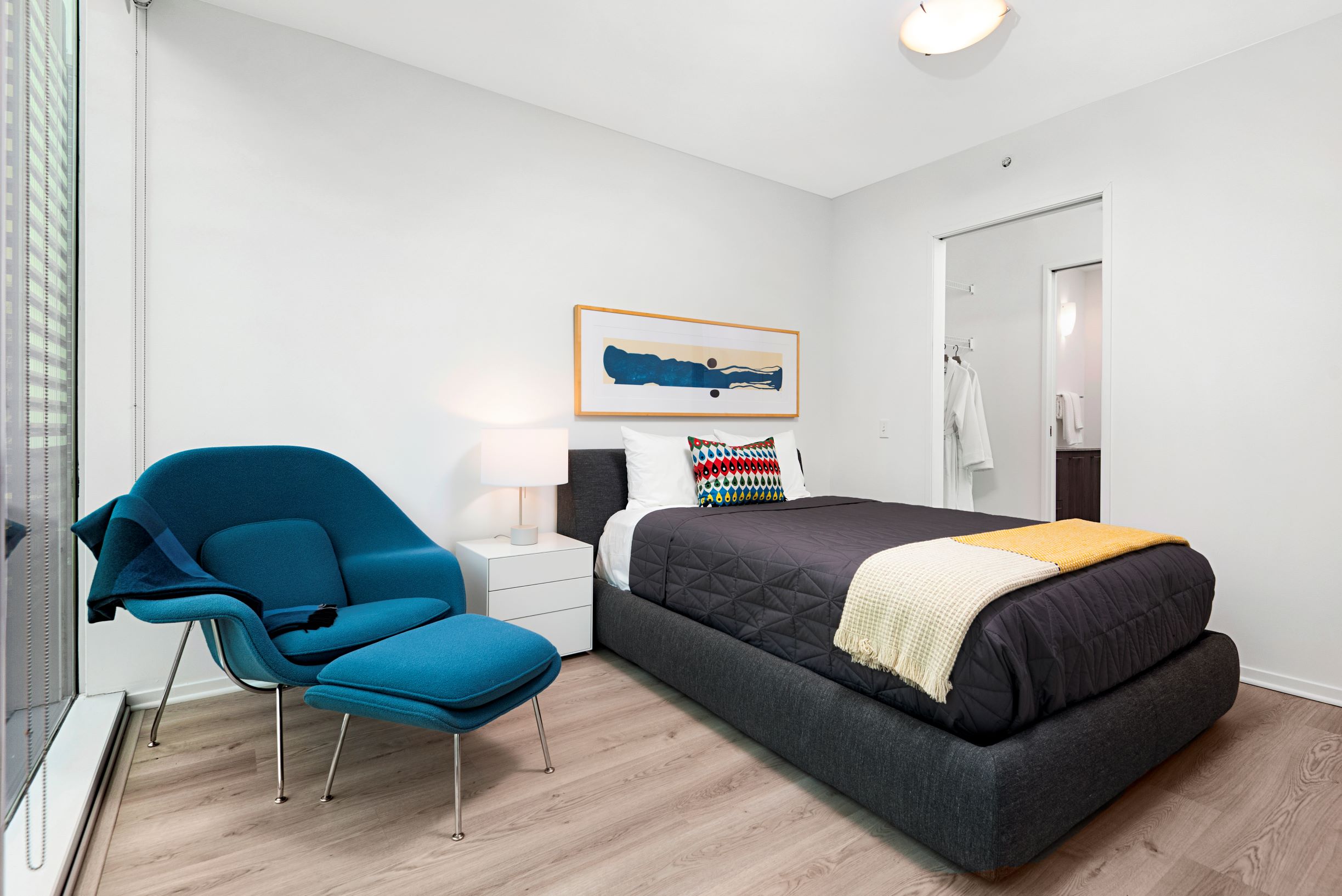
One of the ways we honor the Forever Modern promise and keep it relevant at Optima is by curating both public and residential spaces in our communities with timeless furniture. As we put the finishing touches on the furniture selections for the lobby and model apartments at Optima Lakeview, it’s a perfect time to take a closer look at the Womb™ Chair.

In 1946, Florence Knoll, the pioneering architect who led the furniture empire Knoll Associates with her husband Hans, reached out to friend and fellow architect Eero Saarinen to design a lounge chair for the company. In numerous interviews following the release of the chair, Knoll explained, “I told Eero I was sick and tired of the one-dimensional lounge chair … long and narrow … I want a chair I can sit in sideways or any other way I want to sit in it.” She envisioned “a chair that was like a basket of pillows … something I could really curl up in.”

Originally named No. 70, the chair quickly took on its more intuitive name as people raved about its countless positions and the deep sense of comfort and tranquility it provides. “There seemed to be a need for a large and really comfortable chair to take the place of the old overstuffed chair,” Saarinen explained. “Today, more than ever before, we need to relax.” 

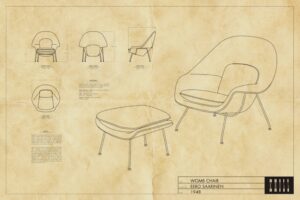
Apart from its novel appearance, the Womb™ chair is also highly innovative from a structural perspective. To achieve a balance between comfort and a modernist silhouette, Saarinen wanted to construct the chair out of a single piece of material. This led him to a groundbreaking new material that had recently been developed to produce minimalistic, yet-durable hulls for Navy vessels during World War II. He then turned to a New Jersey boat builder to use this reinforced-fiberglass-and-resin to produce a prototype of the cropped, folded cone shape he had designed. The final result — a padded and upholstered fiberglass shell that sits on a polished chrome steel frame — combined simplicity of shape with true comfort and flexibility.

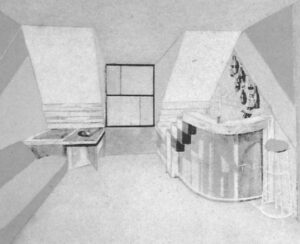
A sketch of the Womb™ chair, designed by Eero Saarinen, courtesy of Bob Ewing

Once released, the Womb™ chair quickly became a cultural icon. A 1958 Coca-Cola advertising campaign showed Santa Claus drinking a Coke in a Womb™ chair. The chair also made an appearance in a New Yorker cartoon as well as a Saturday Evening Post cover by American Painter, Norman Rockwell.

Discover the iconic Womb™ Chairs as part of our invitation to “Expect the Extraordinary” when you visit Optima Lakeview. Experience for yourself what it means to lounge in absolute comfort and modernist simplicity, just as Eero Saarinen and Florence Knoll imagined 75 years ago.

A Guide to Frank Lloyd Wright’s Studios Part 2: Taliesin West

While Frank Lloyd Wright’s Taliesin was the first of his residences and studios, Taliesin West, a monumental exploration of Wright’s unique approach to organic architecture, is arguably Wright’s most intimate creation. 

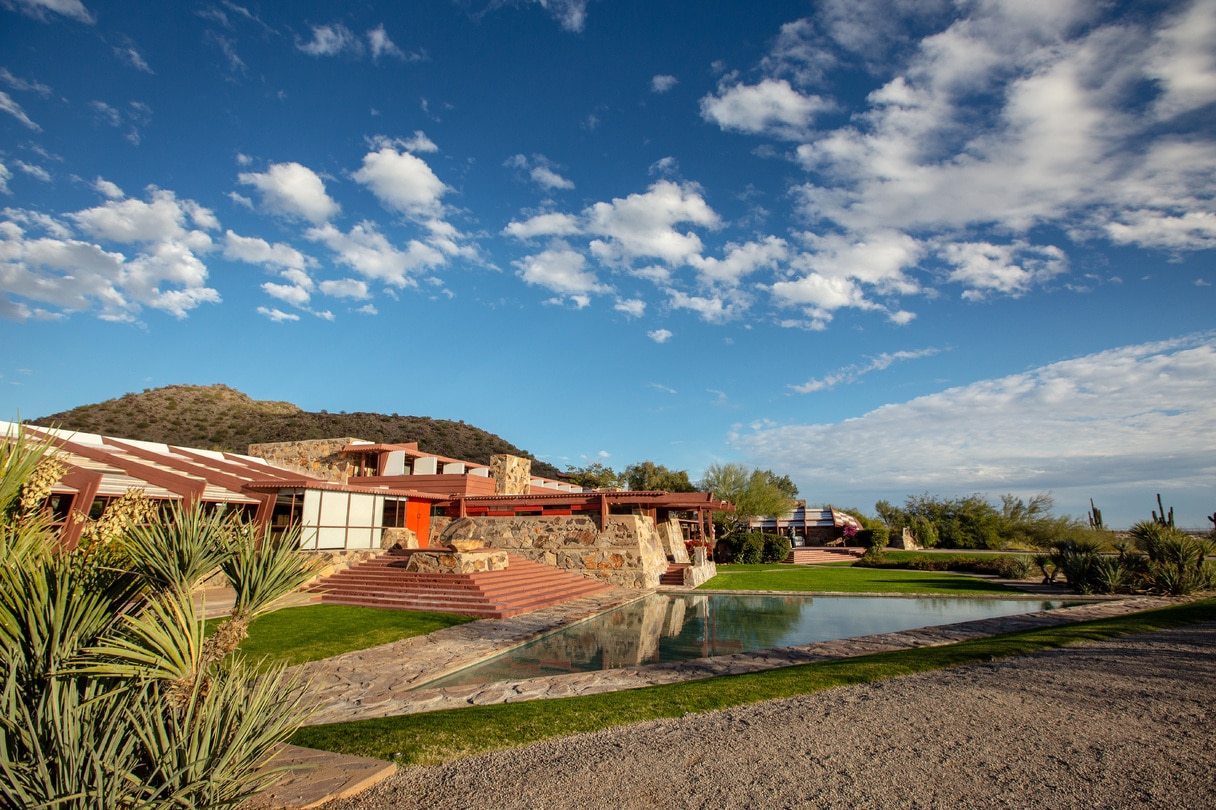
Following the completion of Taliesin, where Wright lived and worked for nearly 30 years, the famed architect became interested in relocating to a warmer climate. In 1935, he purchased 495 acres of stunning Sonoran Desert below McDowell Mountain just outside of Scottsdale. Taliesin West brought extraordinary life to Arizona’s then-desolate desert, and, after nearly nine decades, the complex continues to advance Wright’s legacy and his iconic designs. 

Similar to Taliesin, Taliesin West drew great inspiration from its brilliant surroundings. While working with a group of apprentices throughout the construction process, Wright took advantage of the unique materials found in the surrounding landscapes. Using a mixture of local rocks, cement and desert sand, Wright and his team created, often by hand, what many describe as “desert masonry” to help structure the campus.

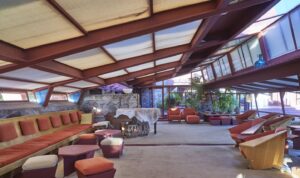
The complex is situated with various unique architectural elements that accentuate its deep-rooted connection to nature. Translucent canvas (now plastic) once covered the roof of many rooms within Taliesin West, creating an illusory linkage to the warm outdoors. Other features include lofty redwood beams accenting the building’s cold structure. 

Throughout Wright’s life, the campus served as both a winter home and a desert studio. While Taliesin West never experienced any misfortunes, unlike its sibling complex Taliesin, the space did experience numerous renovations throughout the period from 1937 to 1959 when Wright lived and worked there. Some of the renovations included the addition of a drafting studio, dining hall,  workshop, three theaters, Wright’s office and living quarters, and the residences for his apprentices and staff. Various decorative walkways, gardens, terraces, and pools acted as both luxuries to the property and connections to each larger structure. 

Taliesin West interior
The Garden Room found inside of Taliesin West, Courtesy of Frank Lloyd Wright Foundation

Today,Taliesin West serves as the headquarters for the Frank Lloyd Wright Foundation and, until 2020, was the winter home for The School of Architecture at Taliesin. The inspiring architecture was added to the U.S. National Register of Historic Places in 1974, was recognized as a U.S. National Historic Landmark in 1982 and was designated a UNESCO World Heritage Site in 2019.

Found just a short drive from the heart of Scottsdale, Taliesin West offers the perfect trip for anyone seeking to explore one of Arizona’s most exciting works of architecture. The complex hosts a variety of events and programs throughout the year and presents visitors with numerous tours that can be discovered on their website here.  

Exploring the Scottsdale Arts District

Since the early 2000s, Optima has called Scottsdale home. The one-of-a-kind desert city offers a little bit of something for everyone. Golf lovers can enjoy the sprawling championship courses, foodies have access to some of the country’s finest dining and chic boutiques provide shoppers endless entertainment. We are proud of our contributions to this vibrant city with the amazing communities of Optima Camelview Village, Optima Sonoran Village, Optima Kierland, and Optima McDowell Mountain and equally proud to see the city continuing to expand its cultural offerings to residents and visitors alike. Today we’re exploring one of the city’s most treasured locations, the Scottsdale Arts District

The arts district consists of an entire neighborhood found in the heart of Downtown Scottsdale, running along Main Street for roughly six blocks. Celebrated art galleries sit next to amazing art installations. Around them, retailers, boutiques and acclaimed restaurants ensure that visitors to the district are fully immersed in the best of everything. 

Some of Scottsdale’s most cherished pieces of public art – like the commanding sculpture Jack Knife – reside in the district, along with a number of the city’s museums and cultural venues including Western Spirit: Scottsdale’s Museum of the West, Scottsdale Center for Performing Arts and Scottsdale Museum of Contemporary Arts, the home of Knight Rise.

Throughout the year, the arts district embraces its warm surroundings and friendly culture with its weekly ArtWalk. Every Thursday from 7 PM – 9 PM, buildings lining Main Street open their doors to the individuals enjoying the Scottsdale ArtWalk. In addition to this weekly tradition, ArtWalk hosts a themed Gold Palette series event every few weeks to offer even more exciting entertainment and showcase only the best of the best works of art. Live music, complimentary food and wine tastings, and extended gallery hours are just some of the few extra features that come along with the special event. Upcoming Gold Palette events include Western Week on February 3 and Native Spirit on March 3.

Scottsdale Museum of Contemporary Art
Scottsdale Museum of Contemporary Art found in the Scottsdale Arts District, Courtesy of SMoCA

As we continue to develop our vibrant culture here in Scottsdale, particularly with the expansion of the Kierland community, we look forward to discovering new opportunities to enjoy the city’s rich cultural and entertainment programming, unique retail experiences and fantastic dining values, where there is truly something for everyone.

2021: A Year in Review

As we kick off 2022, we want to take a moment to reflect on how we’ve continued to grow, learn and serve others over the past 12 months. Here are just a few highlights:

Awards

We were honored to receive a total of 9 awards this year! Our design and architecture were recognized with the AIA Chicago Firm of the Year Award, AIA Chicago Design Excellence Awards – Distinguished Building Award (Arizona Courtyard House), and Chicago Athenaeum’s American Architecture Award twice (Optima Kierland and Optima Sonoran Village). 

Art Baril, our Maintenance Manager at Optima Sonoran Village was awarded the Gold Facilities and Maintenance Manager of the Year by Multi-Housing News at their 2021 MNH Excellence Awards. 

Our culture and values were also acknowledged in 2021 with the AZCentral Top Companies 2021 Award and Best Places to Work in Chicago for the second year in a row. 

To see the full 2021 lineup, visit our awards page here

Projects and Properties

This was a significant year for development, construction, leasing and more at Optima. In Chicago, we continued construction at Optima Lakeview, which is nearly complete. The project is the first multifamily development to achieve the WiredScore Home Gold Certification in North America. We also returned to our roots on the North Shore where we broke ground on our newest development, Optima Verdana, and plan to introduce our signature vertical landscaping system to the Midwest.

In Arizona, our leasing team worked tirelessly to lease up our new 7140 tower at Optima Kierland Apartments, and our second condo building, 7180 Optima Kierland, closed out. We also broke ground on the fifth and final residential tower at Optima Kierland, 7190 Optima Kierland which will open in 2023.

Culture

Throughout 2021 our culture at Optima continued to thrive through richly rewarding avenues of kinship and connection. We celebrated the autumn season with our second annual pumpkin carving and costume contest, observed Diwali, the festival of lights, and shared laughs and stories while celebrating our successful year at company outings at Topgolf and a Chicago Cubs Game. We also enjoyed the return of in-person happy hours during the year.

Our team continued to embrace and internalize our shared values more than ever. We gave back to the communities we live in by volunteering at the Skokie Lagoons on the Chicago North Shore, picking up trash at the boat launch. We also took the opportunity to acknowledge eight Optima employees with our Core Values Award for their exceptional representation of our beliefs throughout their work. 

We can’t thank our leadership, team members and Optima communities enough for making 2021 one to remember. Heading into 2022, we are excited to continue innovating and achieving great things together.

Chicago Skyscraper History: the Merchandise Mart

Chicago has earned its place on the architectural map with endless distinctions, including being home to the tallest building in the world for 25 years and to numerous acclaimed architects like Mies van der Rohe, Frank Lloyd Wright, Marion Mahony Griffin and Jeanne Gang. But did you know that it’s also home to the world’s largest commercial building? Today, we’re taking a look at the history of the city’s beloved Merchandise Mart

How It Came to Be

As dated infrastructure (like the abandoned railroad yards in the downtown area) proliferated in the early decades of the 20th century, more and more land development opportunities opened up. In hopes of beautifying the frontage along the Chicago River, Marshall Field & Co. announced their purchase of one of the largest available sites, at the junction of the River’s branches. The company began construction in 1928 and when the Merchandise Mart opened in 1930, it achieved the company’s dream of becoming a dedicated wholesale center for architectural and interior design vendors and trades serving the entire nation. And, with 4 million square feet on 25 floors under a single roof spanning two city blocks, it became the largest building in the world.

TheMART was imagined as a city-within-a-city. Graham, Anderson, Probst & White, the architects behind the structure’s streamlined look, took inspiration from traditional Art Deco architectural elements, including ribbon piers to define windows, setbacks and pavilions atop each corner to disguise the bulk of the building. Marshall Field himself was involved in the building’s design; his love for art inspired him to employ Jules Guerin to create 17 murals on the interior lobby’s frieze. Each mural details trade throughout the world and depicts the products, transportation and architecture of 14 countries.

TheMART was also a monumental experiment in state-of-the-art engineering and modern materials. At a cost of $26 million, it took advantage of construction techniques normally used in the building of big dams and employed nearly 5,700 workers at the height of the Great Depression.

theMART in the Modern Era

Throughout the latter half of the 20th century, theMART faced a handful of modernization projects. One was designed by Helmut Jahn to connect the building with the Apparel Center located across Orleans Street with a pedestrian bridge. The building was LEED Certified Silver in 2007, followed by LEED Gold Certification in 2013 and in 2018.

In recent years, as the contract furniture industry has evolved from a focus on a wholesale hub and independent manufacturer showrooms, the Mart has repositioned itself as a destination for innovation, creativity, technology and entrepreneurship. Rebranded “theMART,” the building remains the world’s largest commercial building, and has become home to a host of changemakers, including Motorola Mobility, 1871, Yelp, PayPal and MATTER, as well as Fortune 500 companies Conagra, Allstate, Kellogg, Beam Suntory, and Grainger.

Art on theMart, Art Institute of Chicago’s exhibition, Monet and Chicago, April, 2021
Merchandise Mart
Merchandise Mart. Credit: Brandon Olafsson on Flickr Creative Commons CC BY 2.0 Deed

Today, theMART continues to celebrate an appreciation for architecture and art. The building now hosts a digital art display popularly known for “Art on theMART,” to showcase the work of prominent artists on the south façade of the structure. 

With our love for all things “forever modern” at Optima, we are proud to have this magnificent example of design innovation and tireless reinvention in our midst.

A Guide to Frank Lloyd Wright’s Studios Part 1: Taliesin

Frequently referred to as the father of American modernism through his establishment of the Prairie School of architecture, Frank Lloyd Wright gifted the world with many culturally-significant designs, forever leaving his stamp on American architecture. Many of Wright’s designs are widely celebrated and remain standing today, including Taliesin, one of his most iconic works that altered his life and the lives of those around him while serving as his studio.

The archetype of Prairie School architecture was built in 1911 by Wright after he had left Oak Park, Illinois to return to his family’s land in Spring Green, Wisconsin. Derived from Welsh mythology, Taliesin was an ancient poet, whose name means radiant brow. Wright built the exemplary estate in a Wisconsin River valley into the brow of his favorite hill from boyhood, hence its name. 

During the process of designing Taliesin, Wright drew inspiration from the patterns and rhythms of his surroundings. He became inspired by the thought of living among his ancestry and the nature that surrounded him as he embodied the idea of organic architecture within his design. Wright refined visions from his previous Prairie School designs, including a lush courtyard and open floor plan, and used local limestone and sand from the Wisconsin River to invite the outdoors indoors — a radical idea at the time. 

Throughout the estate’s history, it suffered a number of accidents, including two fires that sparked Wright to complete two renovations on Taliesin. The first of which, Taliesin II, was completed in 1915 after arson had destroyed one-third of the house, including Wright’s living quarters. The redesign was nearly identical to the architecture in Taliesin I, excluding its new observation deck and, in an attempt to make the estate completely self-sufficient, Wright’s hydroelectric generator. 

Taliesin, Photographed in 1913 before the first of its two fires, Courtesy of Wisconsin Historical Society

Following another destructive fire in 1925, Wright was forced once again to pour new life into Taliesin and went to develop the third rendition of the estate, Taliesin III. Through the devastation, Wright remained committed to his passion for thoughtful architecture and brought a breath of fresh air to the bare structure that surrounded him. While living at Taliesin III Wright also designed some of his more renowned work, including Fallingwater, the headquarters for S.C. Johnson and Jacobs I (the Herberg Jacobs House).

Beginning in 1932, Wright established the Taliesin Fellowship and hosted 50 apprentices at Taliesin on an annual basis, giving them the opportunity to work for him for a lengthy period of time and experience his intensive working environment. Today, the estate is in the hands of the Frank Lloyd Wright Foundation, and the fellowship uses the neighboring Hillside School as its home base. The esteemed property was listed in the National Register of Historic Places in 1973 and was recognized as a National Historic Landmark in 1976. 

Located just a few hours outside of Chicago, the Taliesen estate is the perfect day trip for anyone who appreciates breathtaking architecture and offers visitors a variety of tours designed for every level of interest, which can be booked on their website here

Women in Architecture: Jane Drew

As part of our ongoing “Women in Architecture” series, we’re spotlighting another luminary in the field: Jane Drew. As the spearhead of the Modernist Movement in London, Jane Drew prevailed as a determined leader in a male-dominated profession, as she changed the lives of many by directing her career to explore the intersections of architecture and wellness.

The Life of Jane Drew

Drew was born on March 24, 1911, in Thornton Heath, Croydon, in South London. Her father was a surgical instrument designer and founder of the Institute of British Surgical Technicians, and her mother was a school teacher who greatly encouraged Drew’s interest and appreciation for art and nature. 

After graduating high school, Drew began her study at one of the most prestigious and competitive architectural schools in the world, the Architectural Association School of Architecture in London. Following five years of study, during which she married fellow architect James Thomas Alliston, Drew propelled herself into the architecture world working for Joseph Hill. During her employment, Drew was introduced to Bohemianism, which fostered her musical, artistic, literary and spiritual pursuits and had a lasting impact on her career. 

Following her divorce in 1939, Drew became heavily involved in the International Congresses of Modern Architecture (CIAM), introducing her to Swiss architect Le Corbusier. Eventually, under the guidance of the CIAM, Drew became a principal founder of the Modern Movement in Britain alongside Henry Moore, Elizabeth Lutyens, and her future husband, Maxwell Fry. 

Inspired by the abundance of talent surrounding her, Drew’s illustrious architectural career blossomed in the 1940s. She opened her firm at the beginning of the decade and only employed female architects, giving them a unique platform for professional and creative pursuit. Due to constraints posed by World War II, much of Drew’s work was limited to London. However, in 1944 she was appointed as the assistant town-planning advisor to the resident minister for the British West African colonies, which would change the trajectory of her career forever. 

Career and Accolades

Alongside the great heartbreak, World War II brought to London came new opportunities, especially for Drew and her husband, who had established a new firm in London: Fry, Drew and Partners. In 1947 she began designing a series of new schools in Ghana and Nigeria. With cultural appreciation in mind, Drew and Fry worked around the unique topography to incorporate native motifs and create a new architecture style for the new nation, now known as Tropical Modernism. 

In 1951, Indian Prime minister Pandit Nehru approached the couple in hopes they would develop the new capital of the Indian state Punjab, Chandigarh. The couple eagerly accepted his offer and began working with Le Corbusier to create their most celebrated architectural work. The couple experimented with new forms of design in the country and discovered methods to integrate schools, health facilities, and swimming baths into housing structures, affecting the future of housing designs throughout India.

Drew’s triumphant accomplishments didn’t stop there; she garnered even greater acclaim during the latter half of her career. Some of her most renowned works included designing the interior of London’s Institute of Contemporary Arts building (an organization that she helped establish), the School for the Deaf in Herne Hill, London, and buildings for the Open University in Milton Keynes, England. 

Drew continued her involvement in architecture after her retirement in 1973 and served on the Council of the Royal Institute of British Architects, of which she was a lifelong fellow. And, shortly before her death in 1996, she was awarded Dame Commander of the Order of the British Empire. 

Throughout her distinguished career, Drew’s passion for conscious design prevailed through her modern work. With every new project, Drew took away an abundance of new knowledge, forever shaping her future work and fashioning the process of thoughtful decision-making that remains in architecture today. 

Exploring Lakeview’s Theatre District

Lakeview’s deep appreciation for the arts and support for its thriving creative community are just some of the many reasons we love the neighborhood. In anticipation of Optima Lakeview’s upcoming opening, we’re taking a walk through one of the community’s most vibrant sectors, the Belmont Theater District

Star-studded Location

A collaboration between the Lakeview and Lakeview East Chambers of Commerce in partnership with local theaters and businesses, the Belmont Theater District functions as a critical supporter of the immense talent that calls the Lakeview community home.

Located in the heart of Lakeview, the theater district pulses with lively energy through more than 20 theaters that line the streets surrounding Belmont Avenue. Its prime location is within walking distance to hundreds of shops and restaurants, making it the perfect spot to spend quality time with friends, family and everyone in between. The historic venues, some of which are nearly a century old, all bring their own unique contributions to the theater district. 

Standout Performances

With more than 100 live shows every week, visitors can find everything from world-class performances to hole-in-the-wall comedy shows. In the midst of this abundance and variety, the Belmont Theater District — the largest theater district in Chicago — is home to a few showstopping venues and performances that stand out from the rest. 

The Blue Man Group performing at the Briar Street Theater.
The Blue Man Group performing at the Briar Street Theater

One of the neighborhood’s most beloved venues, the Briar Street Theater has provided a constant source of entertainment since its opening in 1985. The renowned theater has hosted several famous guests, including Sada Thompson and Dorothy Loudon, and displays artwork created by Van Gogh and Picasso. Since 1997, it has been the home to the iconic Blue Man Group act, which continues to delight audiences of all ages with its stage productions that incorporate many kinds of music and art, both popular and obscure.

The Music Box Theater found on North Southport Avenue has been standing for nearly a century, making it one of the oldest theaters in the neighborhood. The venue originally opened as a single-screen theater playing everything from independent films to Spanish and Arabic language films. Today, the ornately-designed theater operates as an art-house and revival cinema and is recognized as the largest full-time operating film theater in Chicago. 

The interior of the Mercury Theater, Courtesy of the Mercury Theater

Other iconic venues in the community include The Playground Theater, which showcases the Chicago-born art form of improvisation, and Mercury Theater, where melodramatic musicals and plays ranging from Sister Act to Clue are enjoyed by all. 

With a shared appreciation for the arts and community, we couldn’t be more excited to become an official member of the Lakeview community and can’t wait to explore more of the charismatic neighborhood.

Lakeview’s Holiday-Themed Pop-Ups

With the holiday season comes vibrant lighting, extravagant decorations and joyful crowds. And in these gleeful times, Lakeview is one of the best neighborhoods to partake in festive celebrations. The annual Wrigleyville Wonderland, Chicago’s largest pop-up event, draws visitors from near and far, but Optima Lakeview residents and those living in the area have prime access. 

The beloved tradition returns this year to celebrate the holidays with 20 show-stopping Lakeview locations. Each bar brings its own unique twist on a festive theme. Visitors are promised fully decorated spaces filled with costumed performers, cheery music and holiday-inspired food and drinks throughout the season.

The participating bars will be sure to fulfill your craving to celebrate the holidays over the next few weeks and some long after the start of the new year. Check out the list of Wrigleyville Wonderland’s participants below:

  • The Country Club, 3462 N. Clark St., its original holiday pop-up runs through Feb. 1.
  • Deuces, 3505 N. Clark St., Santa Baby Christmas Bar runs through January.
  • Diver at the Park, 3475 N. Clark St., promises a Tulum holiday inspired experience.
  • Gallagher Way, 3635 N. Clark St., featuring Wrigleyville’s Christkindlmarket.
  • The Graystone Tavern, 3441 N. Sheffield Ave., a Hanukkah themed pop-up, running through Jan. 2.
  • Houndstooth Saloon, 3369 N. Clark St., inspired by the famous Griswold family, running through Jan. 10.
  • HVAC Pub, 3530 N. Clark St., the holiday pop-up runs through Jan. 15.
  • The Irish Oak, 3511 N. Clark St., a mash-up of St. Patrick’s Day and Hanukkah, Leprechanunaka,.
  • Wrigleyville Kilwins, 3519 N. Clark St., serving its 25 Days of Chocolate pop-up through Dec. 31.
  • Lucky Dorr, 1101 W. Waveland Ave., the festive Lucky Lodge pop-up is open through Dec. 31.
  • Moe’s Cantina, 3518 N. Clark St., inspired by the beloved holiday classic The Grinch and Whoville. 
  • Casey Moran’s, 3660 N. Clark St., has transformed into Rudolph’s Christmas Bar, open through Dec. 30.
  • Mordecai, 3632 N. Clark St., the annual holiday pop-up bar, Mistletoe, runs until Dec. 30.
  • NOLA Bar & Kitchen, 3481 N. Clark St., its Very Cajun Christmas pop-up runs through Jan. 20.
  • Old Crow Smokehouse, 3506 N. Clark St., featuring a festive Santa’s Workshop pop-up.
  • Rizzo’s Bar and Inn, 3658 N. Clark St., the holiday-themed pop-up features local singer John Vincent at 7 p.m. Thursdays and 5 p.m. Sundays through Dec. 30.
  • Roadhouse 66 Gas N’ Grill, 3478 N. Clark St., the Jingle Junkie pop-up is open through Jan. 8. 
  • Stretch Bar & Grill, 3845 N. Clark St., its Elf’d Up pop-up runs through Jan. 8.
  • Underground Lounge, 952 W. Newport Ave., inspired by the Island of Misfit Toys, the pop-up is open through Jan. 31.
  • Vines on Clark, 3554 N. Clark St., the holiday pop-up transports customers to an Apres Ski vacation.
The Graystone Tavern’s Hanukkah themed pop-up features traditional food and drinks options with a twist

With Wrigleyville Wonderland officially open for the season, don’t miss out on savoring the delicious festive food and drinks served at each immersive location. While some of the pop-ups run through February, others will end with the beginning of the new year. And, due to the popularity of the favorite tradition, many of the participating businesses are reservation only, so make sure to check their availability before making plans for a fun evening out. 

person name goes here

Maintenance Supervisor

Glencoe, IL


    Acceptable file types: *.pdf | *.txt | *.doc, max-size: 2Mb