Visionary Libraries Around The World

At Optima, our appreciation for innovative design and forward-facing architecture runs deep. We continue to be inspired by pioneering design in public structures of all types across the globe, from museums to municipal buildings and everything in between. Today, we’re exploring some of the world’s most celebrated contemporary libraries recognized by Architectural Digest — from their unique futuristic perspectives to their captivating appetite for inventive design.

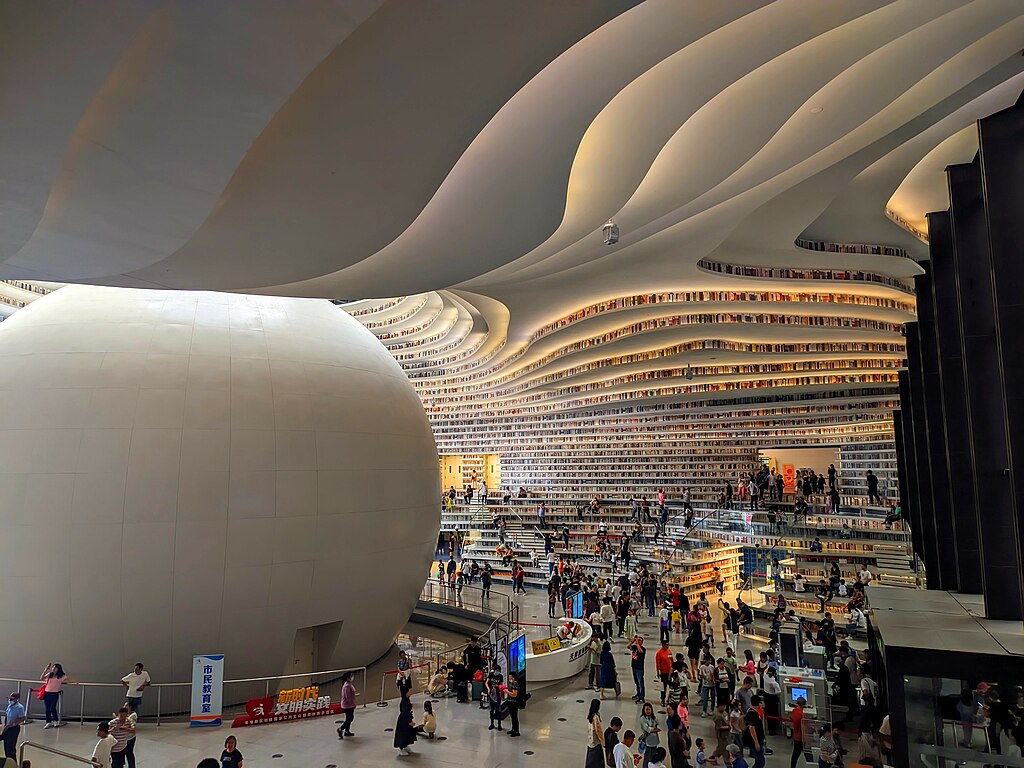
Tianjin Binhai Library, Tianjin, China 

Tianjin Binhai Library is one of Tianjin’s newest developments as part of its emerging cultural district, the Binhai Cultural Center. The future-facing library was designed by the Dutch architectural firm MVRDV in partnership with the Tianjin Urban Planning and Design Institute and opened to the public in 2017. The building features more than 360,000 square feet of space, floor-to-ceiling terraced bookshelves and a massive spherical auditorium that sits in its center — and has earned the library its nickname, The Eye. The unique space frequently serves as a hub for education and performance for Tianjin’s residents and expands the horizons for what the future of shared community attractions and libraries might be. 
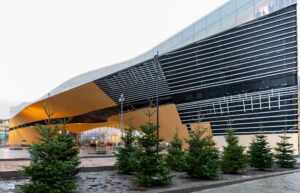
Helsinki Central Library’s façade and undulating roof, Oodi, Finland. Credit: Ninara on Flickr Creative Commons, CC BY 2.0 Deed

Helsinki Central Library Oodi, Finland

Situated in the heart of Finland’s largest city, Helsinki Central Library Oodi offers unrestrained access and experiences for its guests. Designed by Finnish architectural firm ALA Architects, the library was completed in 2018 and boasts an undulating cloud-like roof that contrasts the harshness of its lower wooden body. The library is assembled with a unique mix of glass, steel and spruce wood and combines various aspects of contemporary design. Its visionary architecture separates the library into three distinct layers: an alive ground level, a tranquil upper level and an in-between space complete with studios, game rooms, meeting spaces and workshops equipped with next-generation technology. 
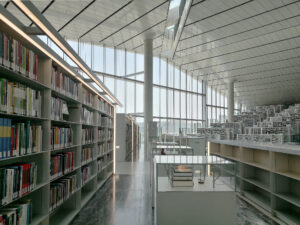
Qatar National Library
Qatar National Library, Doha. Credit: trevor.patt on Flickr Creative Commons, CC BY-NC-SA 2.0 Deed

Qatar National Library, Doah, Qatar

Qatar National Library is a genuine manifestation of contemporary art designed by Dutch firm OMA. The building opened in 2017 and was designed so its focal point — the Heritage Collection — and its entrance reside at its center. Around the center, each of the building’s corners folds up, revealing terraces of marble bookshelves and its People Mover — a one-of-a-kind transportation system that directs its guests throughout its levels. Qatar National Library contains Doha’s National Library, Public Library and University Library, totaling more than a million collective works of literature. 
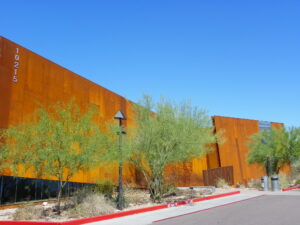
The Arabian Library’s pre-rusted façade, Scottsdale, Arizona. Credit Ellen Forsyth on Flickr Creative Commons, CC BY-SA 2.0 Deed

The Arabian Library, Scottsdale, Arizona

Recalling the silhouette and architecture of Arizona’s Monument Valley and various slot canyons, local firm Richard Kennedy Architects created The Arabian Library on the edge of Scottsdale — only 15 minutes from the Optima Kierland Apartments. The building’s dramatic pre-rusted steel façade complements its stone roof, which is complete with lush, native vegetation. The library’s interior is uniquely designed to mirror the atmosphere of retail and living environments and incorporates an abundance of sustainable materials and technologies.

All works of art in their own novel ways, from their futuristic architecture to their radical functions, these libraries exhibit the best of the best among the world’s most innovative libraries. 

Scottsdale Public Art: Water to Water

Scottsdale is a diverse community with a deep appreciation for its environment, its history and the arts, which are some of the many reasons we love it. Home to the Scottsdale Arts District, the city recognizes the significant benefits that public art provides to neighborhoods, a value we share in our Optima communities. Today, we’re exploring one of Scottsdale’s most unique public works that highlights an essential aspect of life, Water to Water.

Water to Water was completed in 1999 by Christine Tanz in collaboration with Paul Edwards. Edwards is a renowned designer who received the Concrete Reinforcing Steel Institute Design award in 1990. Both artists are recognized in Arizona for their impressive contributions to public art, including their instrumental involvement in developing a public art plan for Metropolitan Tucson.

Located 15 minutes north of Optima Kierland Apartments, Water to Water sits at the entry of the Scottsdale Water Campus, one of the leading water recycling plants in the world and Arizona’s first potable water reuse facility. While Water to Water is acknowledged as a public art display, it operates as a kind of performance, highlighting the water’s importance to Arizona and its encompassing deserts.

Visitors first witness a pierced metal façade, mirroring the walls in our kitchens, bathrooms and gardens, through which many of us have access to water. Once sensors around the display recognize movement, the installation comes alive, and water sprays from the showerheads and faucets that line the metal wall. 

The “interior” of Water to Water revealing its extensive network of pipes

The unique fountain takes advantage of the freshwater stream that stretches across the campus. After the water travels through the extensive network of pipes that lives behind its metal wall and retreats through the various spouts on its other side, it returns directly back into the facility’s stream – a fully-sustainable process. The skeletal framework of the work provides visitors with new understandings of water, a natural element that many take for granted, and tells a powerful, physical story about how life prospers in its barren surroundings. 

Scottsdale Water Campus, where Water to Water resides, is located at 8787 E Hualapai Drive and is open from 6 to 5 most weekdays. The art can be viewed at no cost to visitors.

Women in Architecture: Marion Mahony Griffin

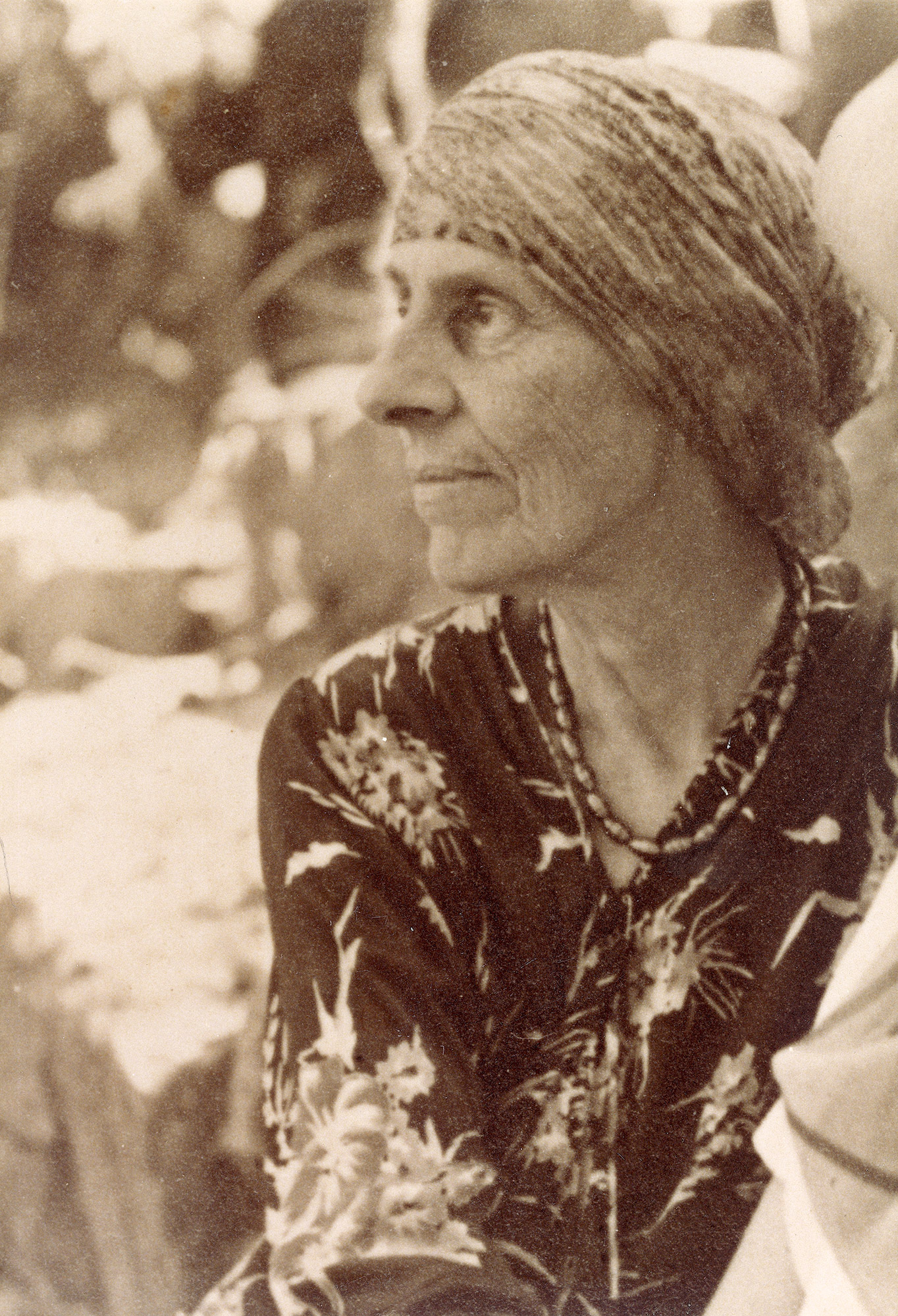
Often unrecognized for her immense contributions to the Prairie School, Marion Mahony Griffin was a leader in the architectural world for many years, paving the way for the countless women who followed her. Today, as part of our ongoing “Women in Architecture” series, we’re exploring the inception of the iconic architect and designer and where her extensive experience led her. 

The Life of Marion Mahony Griffin

A Chicago native, Mahony was born in 1871 to Jeremiah Mahony, a journalist, and Clara Hamilton, a teacher. After the tragic events of the Great Chicago Fire, in which her family’s house was destroyed, her family relocated to the Chicago suburb of Winnetka where she spent the majority of her childhood. Inspired by how rapidly the landscape around her was changing — and encouraged by her cousin Dwight Perkins, an American architect — Mahony was drawn to the idea of furthering her education at the Massachusetts Institute of Technology. 

Mahony graduated from MIT in 1894 and was only the second woman to receive an architecture degree from the school (after the World’s Columbian Exposision’s Women’s building designer, Sophia Hayden). She soon moved back to Chicago where she became the first woman in modern history to sit for, and be granted, an architectural license in the United States, benefiting from the fact that Illinois was the first state in America to allow women to hold licenses.

Ward W. Willits House, designed by Marion Mahony Griffin. Credit: Teemu008 on Flickr Creative Commons, CC BY-SA 2.0 Deed

While in Chicago, Mahony spent two years working with her cousin Dwight Perkins at his studio in Steinway Hall (which Perkins also designed), where a diverse crowd of innovative artists and architects from the Prairie School could always be found. Soon after she left her cousin’s firm, she discovered another young Chicago architect also working in the building, Frank Lloyd Wright. Hired as Wright’s first employee, Mahony worked on and off with him for the next 14 years and became a significant contributor to his practice. 

Ward W. Willits House, Highland Park, Illinois, 1902, One of the numerous intricate watercolor renderings Mahony created for Wright during her employment, Courtesy of Frank Lloyd Wright Foundation

Career and Achievements

While working for Wright, Mohony provided intricate architectural renderings for his designs, becoming an essential participant in his work and leaving her without credit — a recurring theme throughout her career. Today, the renderings are acknowledged as her creations and she is recognized as one of the greatest architectural illustrators. 

Mahony completed numerous independent projects while working for Wright including Evanston’s All Souls Unitarian Church. The intimate church featured an abundance of alluring stained glass in its skylights, windows and numerous other light fixtures. 

Eventually, Mahony left Wright’s studio to work with her husband, Walter Burley Griffin, a fellow architect and leading member of the Prairie School. Together, Griffin and Mahony created their most renowned work, the design of Prairie School residences in Mason City, Iowa, Rock Crest – Rock Glen. The nationally-recognized historic district features eight elaborate Prairie School homes that surround the city’s Willow Creek. 

In 1914 the couple relocated to Australia, where Mahony’s watercolor renderings of Griffin’s design were chosen as the plan for the country’s new capital, Canberra. In Australia, Mahony’s commission’s increased dramatically. One of her final and most well-known works is Melbourne’s Capitol Theatre. The theatre’s opulent decor and avant-garde ceilings and walls were designed to invoke a crystalline cave, and showed a new side of Mahony’s architectural gifts.

Today, Mahony’s extensive experience and portfolio speak for themselves, and she is finally recognized as a trailblazer for architecture and design, and as an original member of the Prairie School.

Romanticism to Ruin: Two Lost Works of Sullivan and Wright

Chicago is fortunate to have a rich architectural tradition. From the city’s first skyscraper built in 1885 to the transcending towers that look over the urban landscape today, architecture is at the forefront of Chicago’s role as a world-class city. At Optima, we are grateful to be part of an ecosystem that appreciates thoughtful and purposeful design. In the spirit of celebrating some of Chicago’s most prominent architects, we are delighted to see an exhibition at Wrightwood 659 that brings two magnificent lost buildings, designed by luminary architects to the public.

Romanticism to Ruin: Two Lost Works of Sullivan and Wright can be seen at Wrightwood 659, located just south of Optima Lakeview. This collection offers a glimpse into the rich history of two buildings designed by renowned architects Frank Lloyd Wright and Louis H. Sullivan. Though few connections are evident between the two structures at first glance, a deeper dive uncovers the rich relationship between the Garrick Theatre in Chicago and the Larkin Administration Building in Buffalo.

Photo of the Garrick Theatre
The Garrick Theatre, 1891, Photo courtesy of The Richard Nickel Committee and Archive

Reconstructing The Garrick

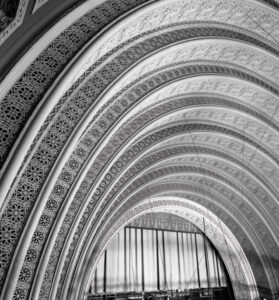
At the time of its completion in 1892, the Garrick Theatre, with a capacity of 1,300 seats, was among the tallest buildings in Chicago. Sullivan and his firm partner, Dankmar Adler, designed the exquisite structure to reflect the German heritage of its original investors, but made every development choice with careful thought for the theatre’s visitors. As the historic structure faded with time, its decline accelerated, and in 1961, amid much controversy and disagreement, the theatre was razed and replaced with a parking structure.

Reconstructing the Garrick uses stencils, fragments, drawings, photography and narrative to bring the lost architectural treasure back to life. Some of Sullivan’s most opulent designs for the Garrick included numerous terracotta portraits of well-known German men of the arts that protruded from the Theatre’s upper floors. Fragile ornamentation and vibrantly-colored plasters consisting of gold, jade and salmon, salvaged before and after the building’s demolition, are on view as part of the exhibition, offering access to delightful details of this grand structure that have been long-forgotten.

Photo of the Larkin Administration Building
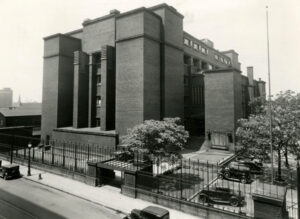
Larkin Administration Building, 1934, Larkin Company photography collection

Reimagining the Larkin

Razed in 1906, the Larkin Administration Building, owned by Darwin D. Martin, was Wright’s first commercially-designed structure and allowed him to apply his innovative and pioneering techniques to a much larger scale. The building, designed and constructed for the Larkin Soap Company, was groundbreaking in its own right as a center where all of the company’s products were both manufactured and mailed. However, at the forefront of Wright’s mind was designing for workability.

Wright and Martin both understood that an ordered, well-lit and harmonious environment would champion the workers. The five-story red brick building included numerous modernized mechanics, including air conditioning, built-in desk furniture and suspended toilets. Wright designed most of the building’s furniture himself, and many pieces are on display within the exhibition. Deemed by critics and architects at the time as the finest commercial building in the world, the Larkin also seamlessly unified technology with the nature that surrounded it with its rooftop garden, recreation areas and water lily ponds.

Unlike the Garrick, after years of deterioration, there was little fight to save the Larkin. However, today both buildings hold greater significance than ever before. The Gerrick and the Larkin prove how transcendent architecture is defined not only by its material and look, but also by the lasting impression it stamps into history.

Romanticism to Ruin is currently open to visitors Fridays and Saturdays through the end of December 2021. You can reserve tickets to the exhibit here.


Ludwig Mies van der Rohe and His Role in the Chicago Skyline

Mid-Century Modernism defines the Chicago skyline. Organic forms rise from Chicago’s foundation and cast shadows across the Lake while innovative use of glass reflects waves of light onto the city streets. The Willis Tower, Marina City, the Aon Center are all notable examples of the mid-century modern masterpieces towering over the city.

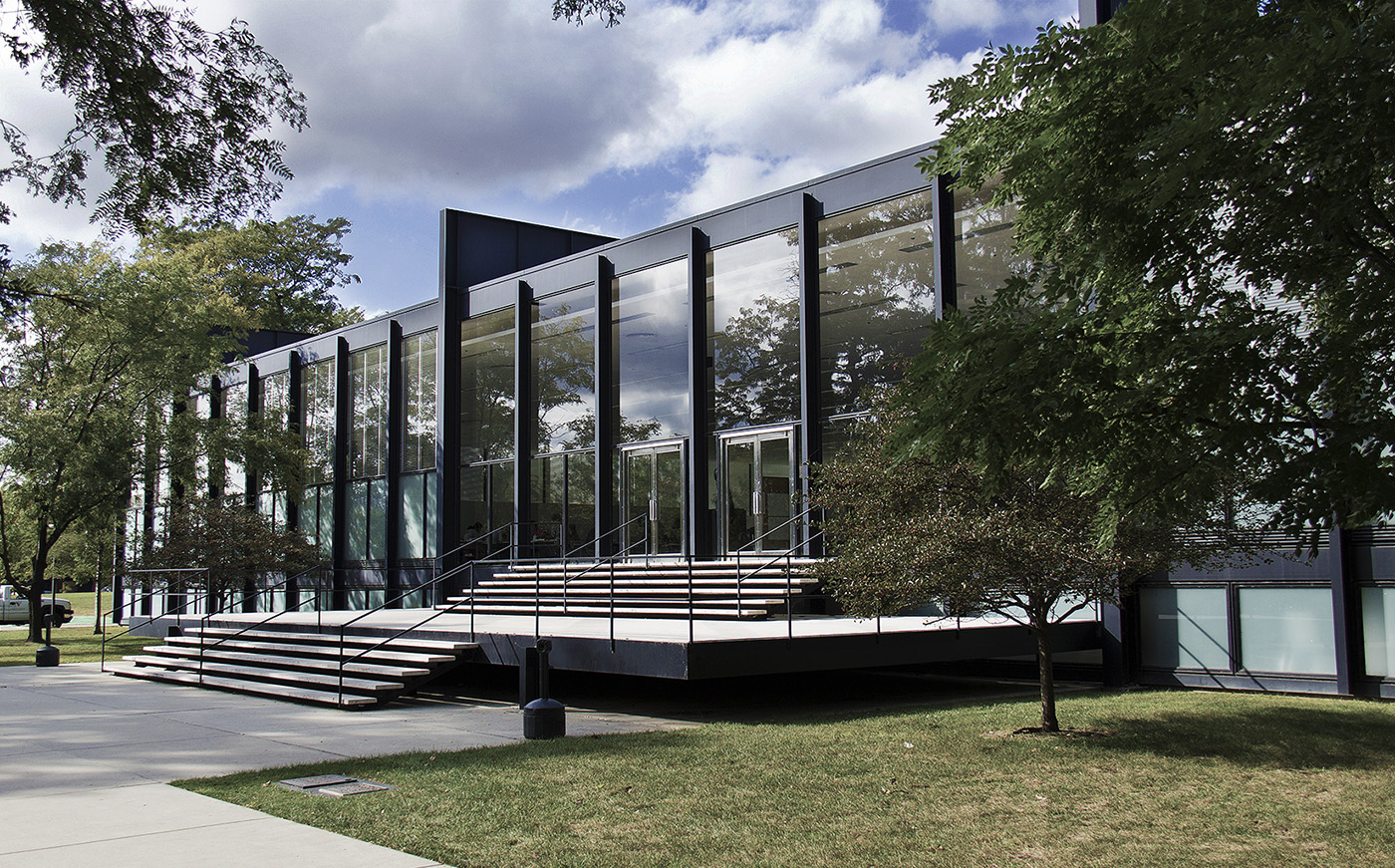
Chicago’s mid-century modern skyline would not be complete without the exceptional contributions of architecture titan Ludwig Mies van der Rohe. Born 1886 in Germany, Mies emigrated to Chicago in the 1930s due to the rise of Nazism in Europe. Already an esteemed architect, in Chicago Mies accepted the position as head of the architecture school at the Armour Institute of Technology (now the Illinois Institute of Technology). At IIT, Mies was commissioned to design buildings for the campus which still stand today. These buildings include Alumni Hall, the Carr Memorial Chapel, and S.R. Crown Hall, some of Mies’ many masterpieces. 

Mies aspired to create architecture that represented modernity with clarity and simplicity. In 1951, Mies completed the two residential buildings of 860-880 Lakeshore Drive which are considered Chicago Landmarks and are listed as National Historic Places. Initially, the towers were viewed critically. However, with time the buildings became the prototype for steel and glass skyscrapers around the world.

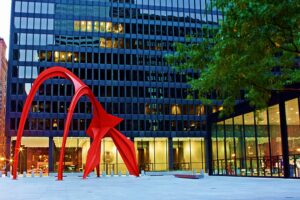
Mies also designed Chicago’s Federal Center Plaza which is composed of three buildings; the Everett McKinley Dirksen courthouse building, the John C. Kulczynski building, and the Post Office building. The three buildings situate themselves around a plaza with Calder’s red Flamingo sculpture at the center. The plaza serves as one of the main gathering points in the Loop, Chicago’s commercial center. 

Kluczynski Federal Building, Chicago, 1973, designed by Mies van der Rohe. Credit: Matt B on Flickr Creative Commons, CC BY-NC-ND 2.0 Deed

Not too far away at 330 North Wabash sits the former IBM Plaza and Building, one of the last American projects designed by Mies. Built in 1973, the building was designed with advanced technology in mind and became well-known for the several atypical features it included as an office space at the time. Today, the Chicago Landmark is known as the AMA Plaza and includes the Langham Hotel, often regarded as one of the best hotels in the nation.

The Promontory, situated at 5530 S Shore Dr, stands 22 stories over Chicago’s Promontory Point and extensive shoreline in the Burnham neighborhood. Mies built the structure with a “Double T” design in which horizontal cross-bars join and the stems of the T’s form wings to the rear. Mies would employ this design in many of his future buildings. 

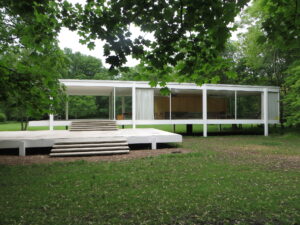
Farnsworth House exterior, Ludwig Mies van der Rohe,1945-1951. Credit: David Wilson on Flickr Creative Commons, CC BY 2.0 Deed

The Farnsworth House, designed as a vacation retreat for Dr. Edith Farnsworth, is located just outside of Chicago in Plano, Illinois. Though the Farnsworth House is not a grand skyscraper, it has left a lasting impact on the Chicago architectural landscape. The house was an exploration for Mies in the convergence of humans, shelter, and nature. Consisting of a glass pavilion raised six feet above a floodplain beside the Fox River, the house has been described as “sublime” an “a poem” and is now a public museum.

Today, Chicago’s skyline has completely transformed from what it was more than 50 years ago when Mies passed. However, even as it continues to evolve with every new development, Mies iconic buildings still stand out as striking, inspiring architectural masterpieces.

Chicago Public Art: AMENDS

When people think of public art in Chicago, their minds often wander to Millennium Park, where iconic pieces like Crown Fountain and Cloud Gate live. However, throughout the city, art is discoverable in every neighborhood. Today, we’re exploring the community-art project: AMENDS. In addition to being an interactive project, the expansive goal of AMENDS is to lay the foundation for the eradication of racism.

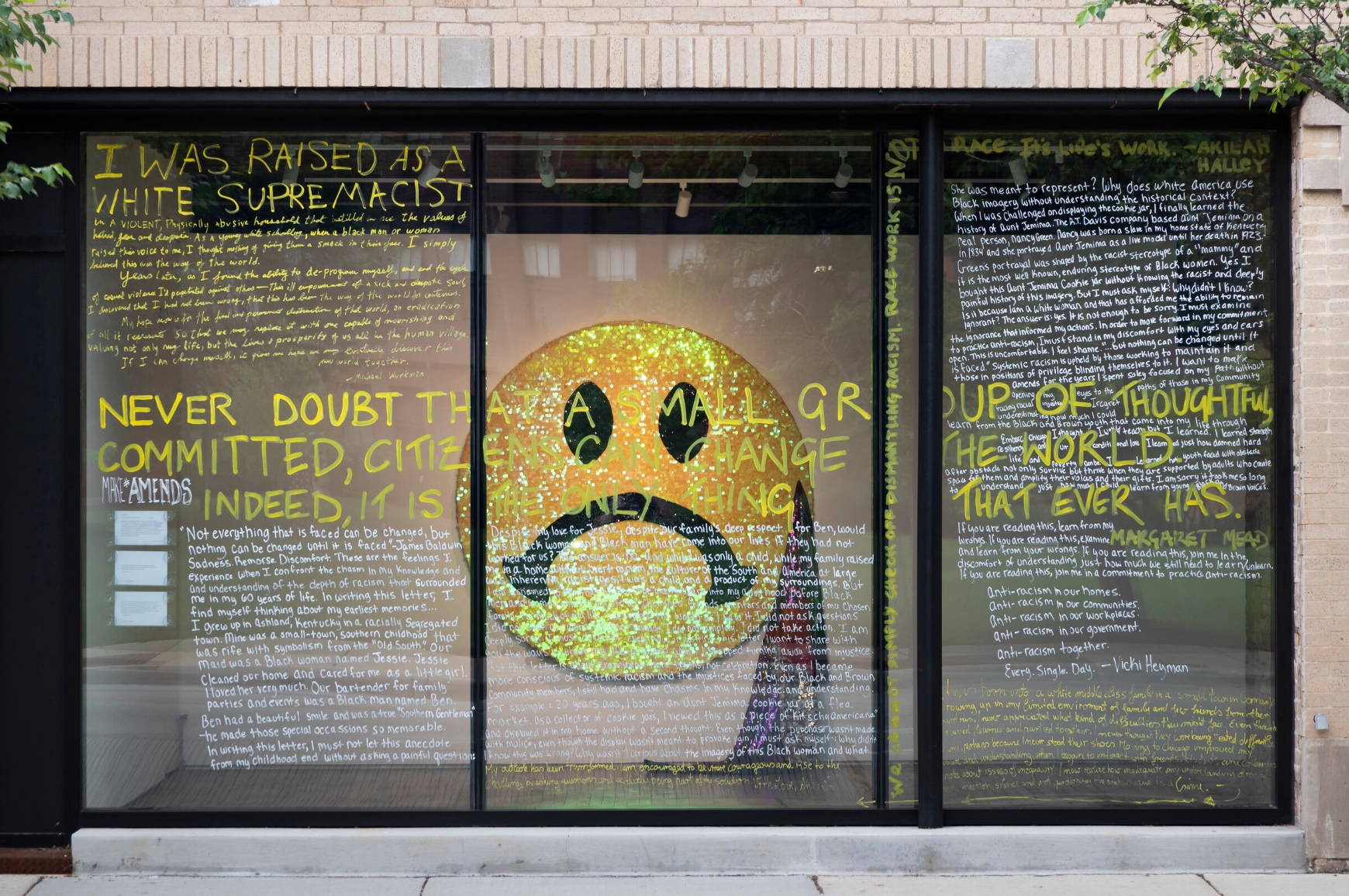
Created by internationally-renowned artists Nick Cave and Bob Faust, AMENDS is a multifaceted project living at the Chicago creative space, Facility. The collaborators first envisioned the project after the death of George Floyd in 2020. The engaging experience encourages individuals to publicly share confessions and apologies that recognize how they may be independently responsible for the continued expansion of racism.

The adversarial action is simple but an extremely intimate and impassioned way to acknowledge where individuals make change and, with hope, where society can too. AMENDS consists of three dynamic phases, each expanding on the project over time.

The first phase,“Letters to the World Toward the Eradication of Racism,” is an assemblage of letters, quotes and notes brought to life by Chicago community leaders on the windows of Facility. The remarks contain various raw and emotional expressions that are on view to everyone in the public.

“Dirty Laundry,” the second phase of AMENDS, Photo from Facility

“Dirty Laundry,” the second phase of AMENDS, progresses at Carl Schurz Public High School across the street from Facility. “Dirty Laundry” challenges the public to address any roles they have played in advancing racism throughout their lives. The declarations of apology metamorphose into yellow ribbons that are tied to clotheslines, creating a public collection of community remorse.

Building upon the previous phases, “Called to Action” asks for participation on a much larger scale. In the form of a hashtag — #AMENDS — the final chapter encourages people across the world to voice their avowals and invite ensuing change for the near future. Bringing together artists, community leaders and everyday people, AMENDS serves as a beacon for Chicago and pushes to keep the city moving forward. 

The power of public art is rooted in its ability to welcome beauty into communities. At the same time, it can be a driving force for inquiry, engagement and participation. The values inherent in public art are also core to the character of Optima, which we express through our commitment to incorporating thoughtful art programs into each community we build.

Optima Communities: Revisiting Lakeview

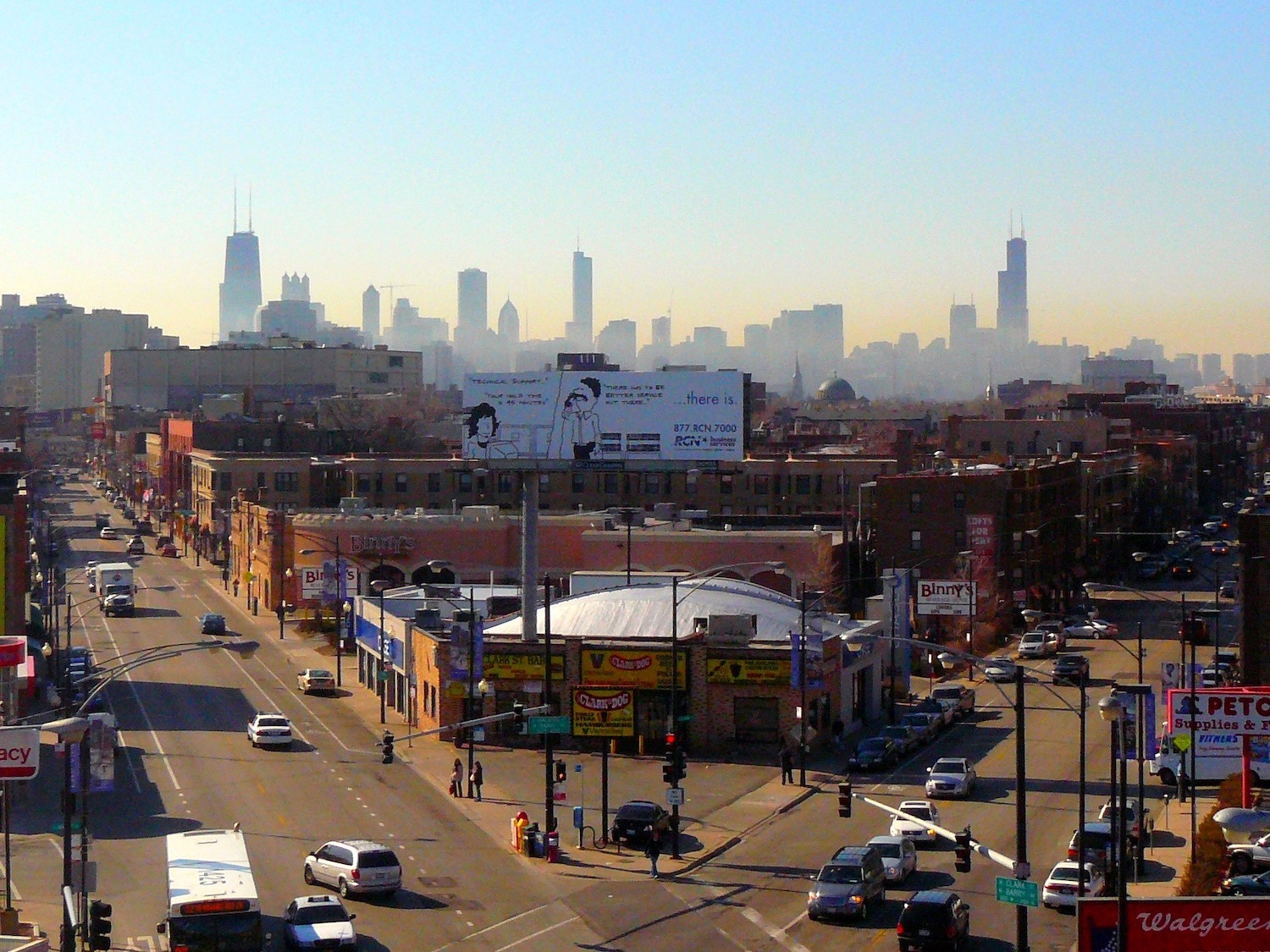
​​As our newest development, Optima Lakeview, nears completion, we are diving back into this beloved neighborhood. Here are just a few things that make Lakeview special to us at Optima and to the residents who call the neighborhood home.

Festivities Year-round 

No matter the season, festivals and markets fill Lakeview’s social calendar, providing locals with numerous opportunities to connect and celebrate. A neighborhood favorite, Restaurant Week kicks things off each spring with a handful of specials on local menus, allowing foodies to explore Lakeview one dish at a time. Fitness fanatics will enjoy the Lincoln Hub Workout Series hosted in South Lakeview Park during the summertime. Halsted Street is filled with pride in June to celebrate Chicago’s LGBTQ+ community. 

Lakeview’s Festival of the Arts spotlights local artists, musicians and restaurants in the autumn months annually. In October, families take part in Trick or Treat Southport, with Halloween-themed activities for all ages. To close the year, festive lights, photos with Santa and more can be found at Lakeview’s Holiday Stroll.

Rendering of Optima Lakeview

Hidden Gems 

Lakeview has plenty of shops, restaurants, museums and theatres to satisfy all interests. However, there are a few neighborhood staples that not many know about. Located just off of Diversey, Clark and Broadway, Landmark Century Centre Cinema is a favorite for film buffs and is complete with a Spanish Baroque façade designed by the prominent architecture firm Levy & Klein. On Lakeview’s South Side, Wrightwood 659, designed by Pritzker Prize-winner Tadao Ando, presents visitors with thought-provoking exhibitions of international art and architecture not found anywhere else. The museum’s current exhibition, Romanticism to Ruin, includes reconstructions of two lost works from Louis H. Sullivan and Frank Lloyd Wright.

Near the exhibition space sits a neighborhood favorite for food, Del Seoul. The local restaurant fuses traditional American, Korean and Mexican food into a tasty menu unique to the city. One of Lakeview’s more well-known hidden gems is Northalsted Market Days. The annual tradition takes place on Halsted Street for six blocks, making it the largest outdoor street festival in the Midwest. During the two-day festival that takes place in August, tourists and locals celebrate the community and enjoy local vendors, food, arts, crafts and music.

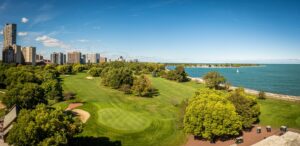
Sydney R. Marovitz Golf Course

An Abundance of Green Space

Neighboring Lincoln Park offers virtually endless pastimes for everyone to enjoy. The Lincoln Park Zoo and landmark Lincoln Park Conservatory offer free admission and are filled with animals and lush greenery to enjoy throughout the year. Located just below the Zoo, dozens of sustainable local vendors sell fresh produce at the Green City Market from May through November, named one of the best markets in the nation.

Residents will find a number of accessible outdoor recreational activities just steps from Optima Lakeview. A short stroll down Lakeshore Drive West leads to a driving range, the Peggy Notebaert Nature Museum, and several beaches and restaurants near the lake. Kayakers and rowers have easy access to Diversey Harbor and South Lagoon, granting the perfect spot to spend a warm day. Tennis and golf lovers can conveniently walk to the renowned Sydney R. Marovitz Golf Course and various tennis courts that neighbor Optima Lakeview and are all open to the public.

The opening of Optima Lakeview is fast approaching and we look forward to sharing more about this state-of-the-art development as it becomes part of the Lakeview community!

Modernist Movements in South America

Countless architects and designers across the world and throughout history share the same passion and appreciation for Modernist design that we hold at Optima. One of our industry’s greatest delights is exploring how design translates through the lenses of other cultures and countries. Today, we’re exploring the ever-important Modernist movements from South America. 

Modernismo in Brazil

Modernisimo, founded in Brazil, began in the wake of World War I and influenced Modernist movements around the world. A rebellion against European artistic and aesthetic influence, Modernismo brought Brazilian life and thought into the modern era through the celebration of the culture’s rich traditions of folklore, architecture, art and style. 

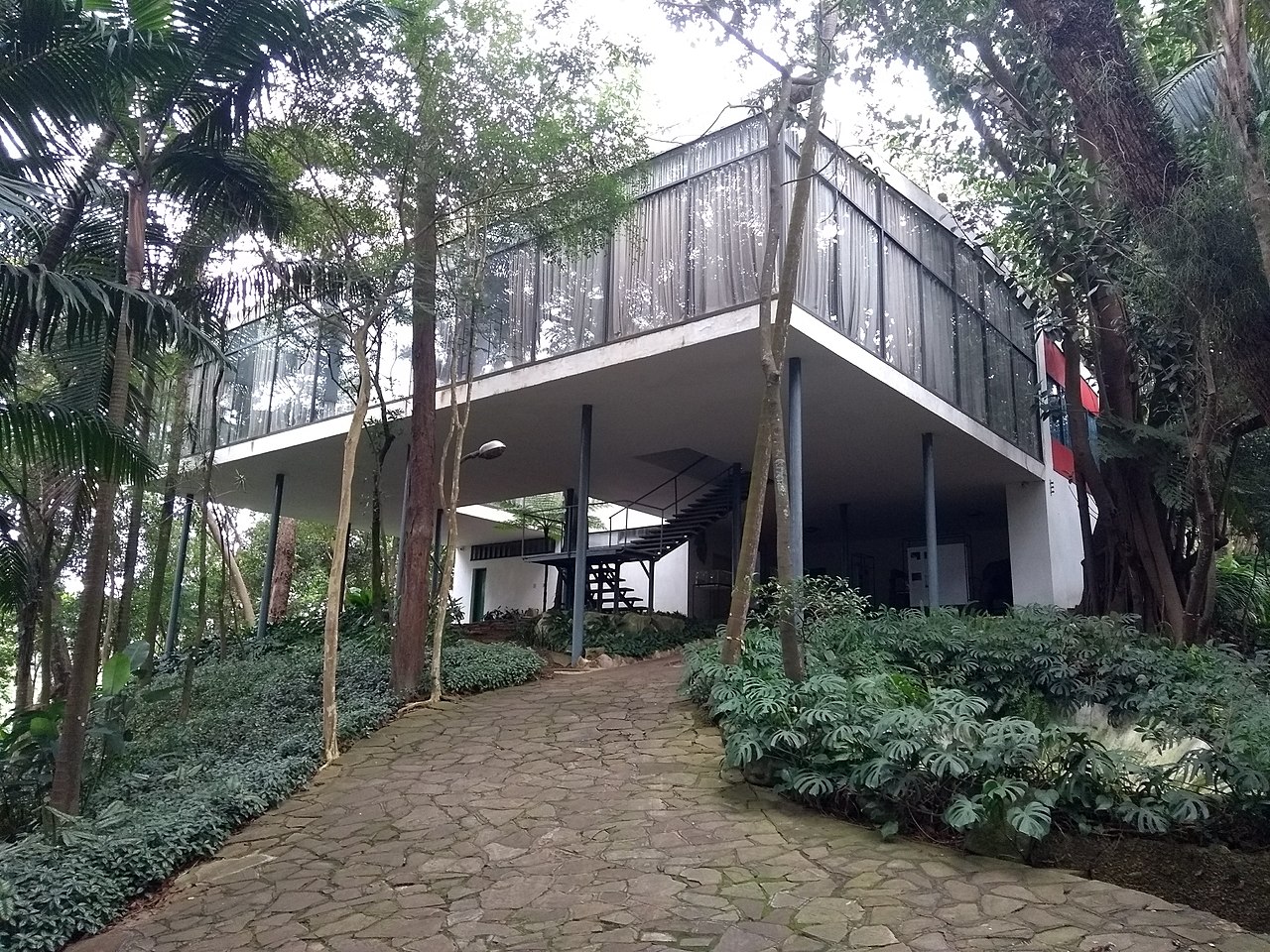
By the 1930s, after decades of success, Modernisimo splintered into factions of artists, thinkers and creatives, but the movement’s influence on later art, sculpture, literature and architecture remains prominent. Brazilian architects and designers such as Lina Bo Bardi adopted concepts of Modernisimo in their own practices, creating world-renowned structures that are still celebrated and used today. 

Casa Luis Barragán. Credit: washingtonydc on Flickr Creative Commons, CC BY-NC-SA 2.0 Deed

Other Movements

Brazil is not the only South American country with a strong Modernist legacy. In Colombia, Venezuela, Mexico and Argentina, Modernism involved active divergence from Spanish influences and was a form of artistic and political protest. 

Architects such as Luis Barragán in Mexico and Carlos Raúl Villanueva in Venezuela began designing structures that departed from classic European designs to create a modern visual vocabulary celebrating the traditions and legacies of their home countries. These architects became globally renowned for their work and are considered among the founders of Modernism.

The Casa Luis Barragán in Mexico City, designed by Barragán, is one of the most internationally transcendent pieces of contemporary architecture in the world. Composed of smooth grey, orange, pink and brown cement façades, the structure served as Barragán’s private residence and studio and took influence from Mexican tradition and vernacular. It is the only individual property in Latin America that is listed as a United Nations Education, Scientific and Cultural Organization World Heritage Site. 

Similarly, Raúl Villanueva’s design for the campus and buildings of the Ciudad Universitaria de Caracas utilized Modernist principles and Venezuelan cultural history combined with urban and architectural planning to construct Venezuela’s center of higher education.

Like all artistic movements, South American Modernism served as inspiration for and reflection of Modernist movements internationally, including Europe and America. Today, the impact of the postwar South American Modernist movements can be found abroad and in the work of many famed architects. 

With Optima’s strong connection to Modernism, we continue to study, admire and garner inspiration from the rich traditions that took root in other cultures and remain relevant and vital today.

Autumn in Chicago

Autumn brings brisk weather, parks filled with vibrantly colored leaves, and an endless array of pop-ups, markets and festive events. The residents of Optima Signature have easy access to all of the city’s most bewitching autumn pastimes. Here are a few of the many activities to do this autumn in Chicago. 

Chicago Classics

Chicago is home to many autumn events that are entirely unique to the city. Jack’s Pumpkin Pop-Up is one of them. The one-of-a-kind outdoor experience is home to an axe-throwing range, classic carnival games, a dense pumpkin patch and Chicago’s largest corn maze. Food trucks serving fall cuisine and bars serving seasonal cocktails can be found across the two-acre experience. General admission for Jack’s Pumpkin Pop-Up is $25 and it is open every day through October 31. You can find more information and get tickets here.

Just a few miles East of Jack’s Pumpkin Pop-Up, Navy Pier’s Pumpkin Lights transform the beloved spot into a must-do fall outing. Throughout the month, guests will find Pier-wide deals, festive activities and more than 1,000 decorated pumpkins. 

After finding carving inspiration at Navy Pier, an architectural boat or walking tour featuring Optima Signature is the perfect way to end a fall day. The crisp, breezy fall weather is perfect for a guided tour on foot through the heart of the city or down the Chicago River in one of its famous river cruises. The educational trips cover more than 50 of Chicago’s iconic buildings and are appreciated by tourists and city natives alike. You can learn more about Chicago’s renowned architecture tours here.  

Fall Day Trip

Just outside the city, you can find a handful of farms home to more traditional autumn favorites. Odyssey Fun Farm, located 40 minutes outside of the city in Tinley Park, is one of the many locations perfect for a fall day trip. The prized destination has zip lines, hayrides, a Pac-Man-themed corn maze and a full pumpkin patch. You can visit the farm every Thursday through Sunday from 10 a.m. to 6 p.m through Halloween.  

Apple picking makes for another fun fall activity. Located just outside of Libertyville, Heinz Orchard is Chicago’s closest. The small family-run orchard offers apple picking over other seasonal endeavors. Red and Golden Delicious, McIntosh, Empire and Jonathan apple trees all fill the spirited environment.  In addition to Heinz Orchard, you can find more apple orchards for the perfect day trip around Chicagoland here

Chicago’s autumn months don’t last long. So before time runs out, take advantage of the unique events located in the heart of Chicago, or plan a day trip to one of the many wonderful locations full of seasonal fun outside of the city.

The Health Benefits of Jogging

Jogging is a wonderfully minimalist form of exercise that requires nothing more than a free slot of time, a good pair of running shoes and open space. At Optima, it is our priority to build communities in and around accessible environments, where our residents can head out their doors to enjoy a run. There are many health benefits to the sport that might inspire you to give it a try. 

Getting Started

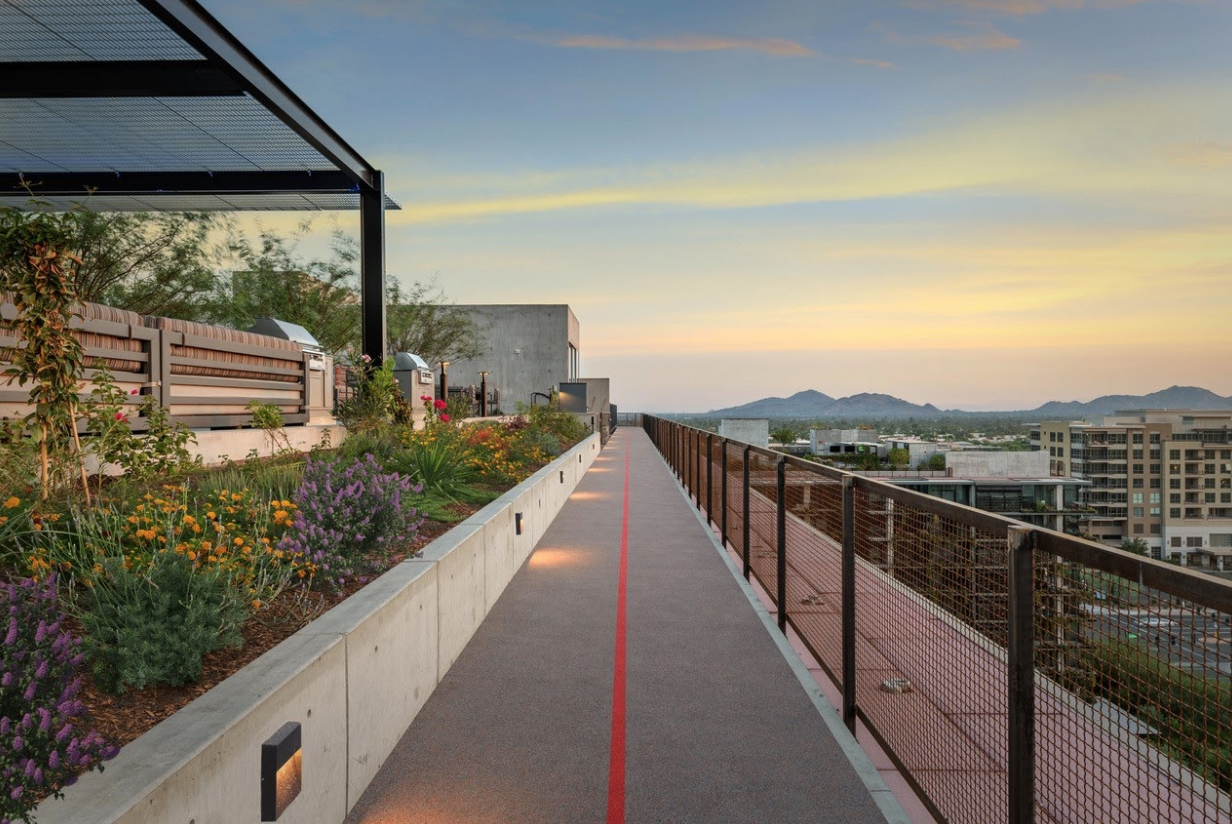
Jogging is not about speed, nor is it about distance — it’s about movement and a slow-and- steady-wins-the-race attitude. One of the activities’ great advantages is that it can be done both individually or within a group. A running club is a fantastic way to meet other runners, form community and stay motivated. Apps like Nike Run Club and Strava track time, distance, and offer guided runs and training programs for beginners and experienced joggers alike. Road Runners Club of America (RRCA) has branches in cities around the country and hosts groups for runners of all levels. In Chicago, RRCA is a perfect option for residents in our Optima Signature and upcoming Optima Lakeview properties, given their incredible proximity to the lakefront trails. And at Optima Kierland, a rooftop running track offers 360° views of the stunning landscape as residents jog outdoors without leaving the building.

Lifetime Health Boost

While jogging relieves pain and increases endorphins, making you happier in the moment, the long-term benefits are also significant. The stress your body endures while jogging actually improves your bone and muscle strength. It’s also excellent for cardiovascular health, improving circulation and maintaining blood pressure while controlling cholesterol and glucose levels. 

A study conducted by Stanford University found that jogging increases longevity and reduces the risk of disability and chronic illness later in life. The habit of regular jogging has been found to add 1 to 3 years to a lifespan.

Positive Mental Impact

Alongside numerous physical benefits, jogging also supports mental wellbeing and overall neurological health. Jogging releases endorphins, which are mood increasing hormones that help to alleviate stress, depression, and leave one feeling calm and rejuvenated. Jogging can also be a meditative activity that helps clear the mind. And when you take your runs outside, you’re also exposed to vitamin D and fresh air which improve overall well being.

Cognitive & Creative Enhancer

As jogging indirectly improves mood and sleep, anxiety and stress levels fall. This leads to sharper thinking and counteracts cognitive disorders like onset dementia. Jogging has also been found to create new brain cells and improve overall cognitive performance. Recent research completed by the British Journal of Sports Medicine discovered that jogging dramatically increases creativity. The more you exercise, the more creative you become. As the activity becomes a regularity, jogging can provide clarity and focus, generating a flow of creativity and new ideas.

Jogging is one of many ways to stay active; it is a wonderful way to maintain your health and get outdoors. For those who jog regularly, the health benefits expand far beyond the immediate moment and leave a lasting impact for years.

person name goes here

Maintenance Supervisor

Glencoe, IL


    Acceptable file types: *.pdf | *.txt | *.doc, max-size: 2Mb