Sculptures are the ultimate exploration of materials and their expression. With Optima Co-Founder David Hovey Sr. having expanded the design reach of Optima to include sculpture, the medium is one that hits close to home for us. To indulge in our love for the craft, we’re exploring Chicago’s public sculpture art, piece-by-piece. First up is an iconic staple in Chicago: The Picasso.
The (Chicago) Picasso
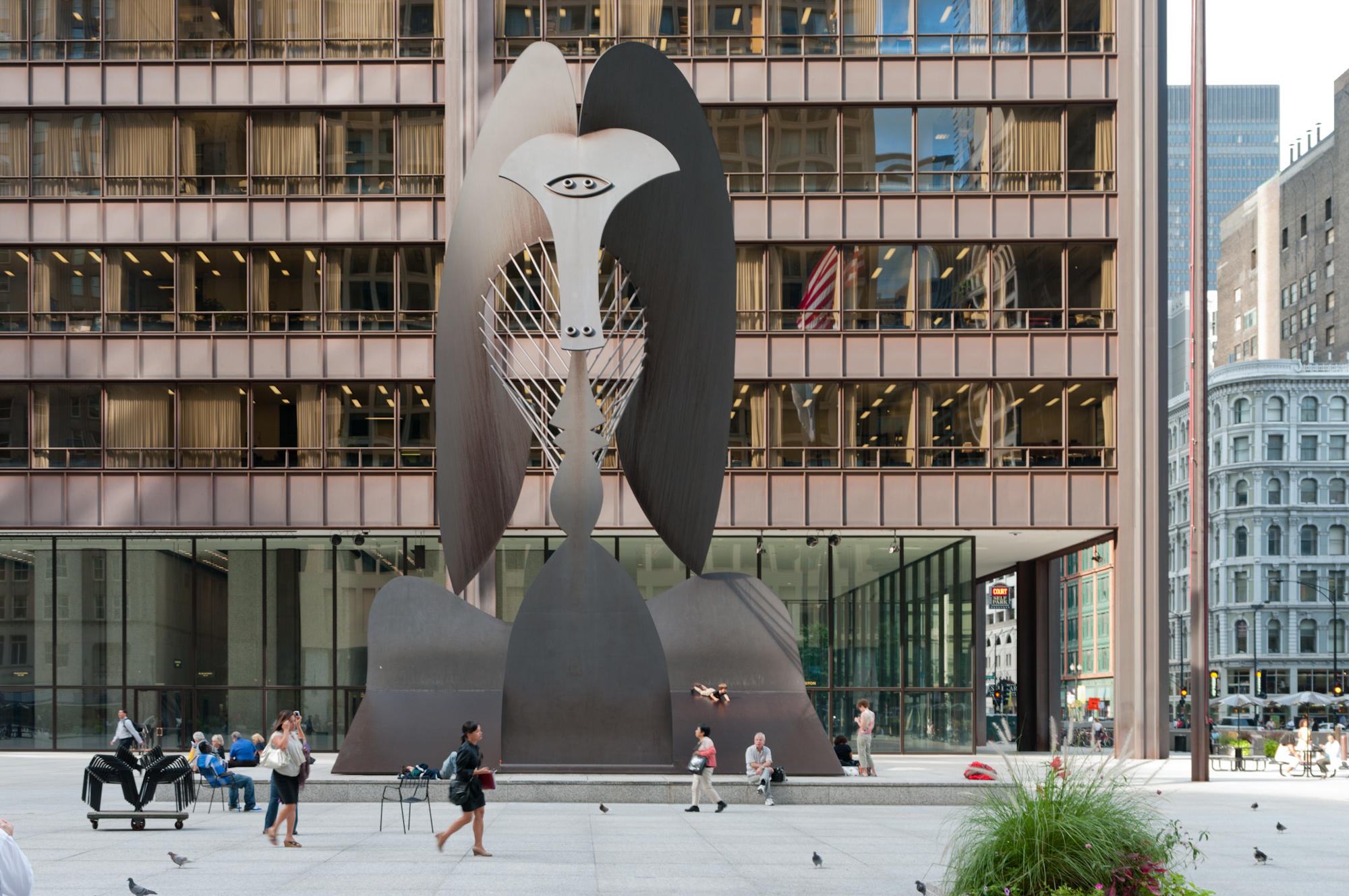
The monumental, larger-than-life sculpture created by Pablo Picasso situated in downtown Chicago goes unnamed by the artist. However, the work is affectionately referred to as The Picasso and even The Chicago Picasso. The sculpture is now a globally-renowned landmark, standing 50 feet tall and weighing in at 162 short tons.
The Chicago Picasso was commissioned by the architects of The Richard J. Daley Center in 1963. Occupying the beloved Daley Plaza alongside the skin-and-bones International Style Modernist skyscraper, the sculpture stands out as a whimsical and abstract piece that invites plaza visitors to jump, climb and slide upon its smooth, COR-TEN steel surface. The interactive sculpture cost the modern day equivalent of $2.8 million, with three charitable foundations shouldering the cost. And although Picasso himself was offered $100,000, he refused the payment, insisting that he wanted to make the work as a gift.
Picasso’s inspiration remains a mystery, though some muse that the armadillo-esque figure is actually an abstracted portrait of the French woman, Sylvette David – now known as Lydia Corbette. The sculpture’s abstract nature was met with tough criticism initially. In a city where most sculptures were famous figures, some didn’t take kindly to the strange public art newcomer. But it was only a matter of time before The Chicago Picasso rightly became a revered piece of Chicago’s vibrant public art collection, brightening the Daley Plaza and the city with its presence.
Achieving work-life balance has taken on new gravity as we shelter-in-place. At Optima, our teams are with you every step of the way to ensure you have a productive workday, and find daily fulfillment and joy in the comfort of your home. Here are just a few of the ways our properties are already optimized for people’s remote working needs:
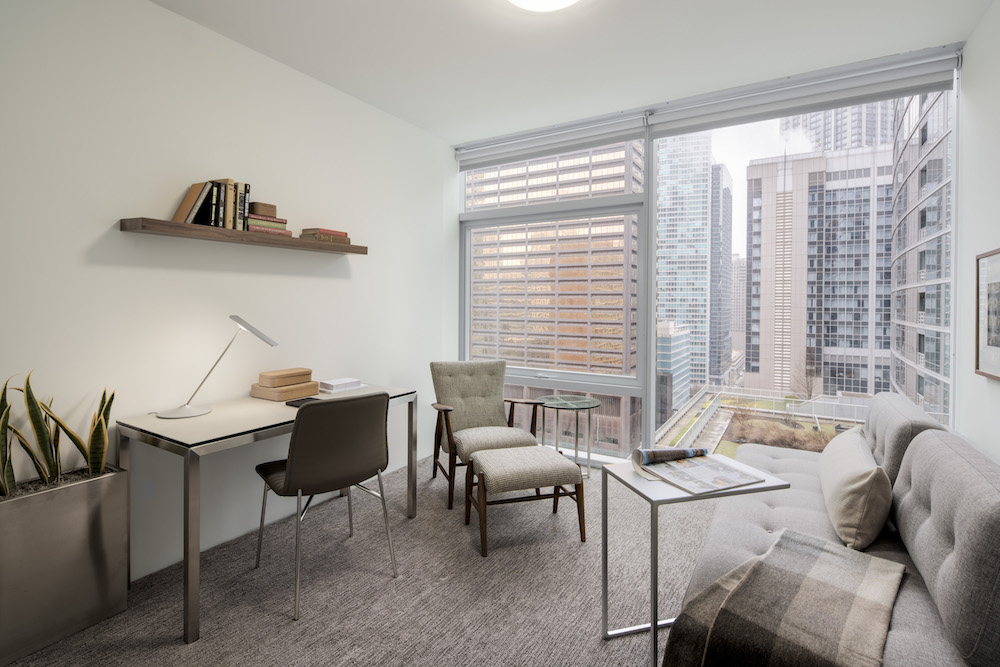
Home office space at Optima Signature
Distinct Work Zones
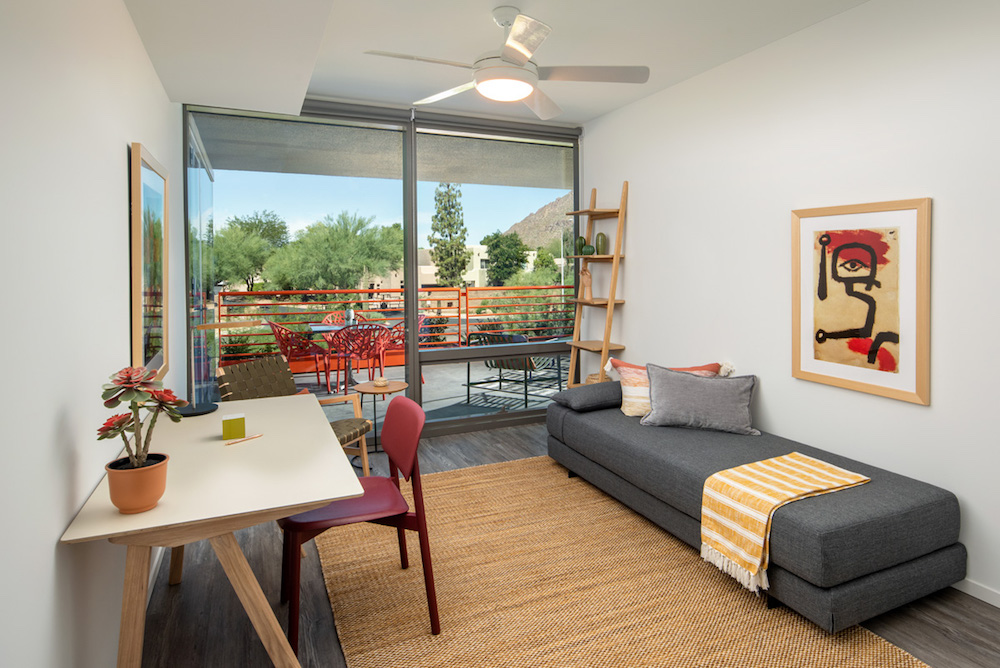
One of the biggest challenges when working from home is achieving a healthy separation between work and life. At our multifamily communities, each home is designed to have space for a desk and at-home workspace. With the opportunity to have a dedicated work zone, you’ll be able to create an environment that is conducive to your daily success and that allows you to tackle any challenge.
Home office space at Optima Sonoran Village
Connection to Nature
A shelter-in-place order doesn’t mean we have to separate ourselves entirely from the outdoors. It’s important to continue finding sensitive ways to get your daily dose of sunshine. With the integration of the built and natural environment integral to our design sensibilities, all of our communities feature vast outdoor spaces, with many homes offering significant outdoor living spaces. These outdoor spaces are the perfect place to take advantage of weather on a nice day — like having an outdoor picnic on your balcony.
Engaging Digital Programming
Our property management teams are committed as ever to ensuring that our communities and residents stay connected — with one another and with their daily patterns. We’ve been hard at work putting together virtual event series and fitness classes that allow Optima residents to enjoy a full array of digital amenities from the comfort of their own home. Some of this programming includes digital patio workouts with a fitness trainer at Optima Sonoran Village, digital fitness classes with an onsite trainer at Optima Signature and even building-wide movie, trivia and comedy nights at Optima Kierland Apartments.
As we continue to shelter-in-place and practice social distancing, our buildings and our teams are ready to collaborate and come together to make being home even more enjoyable for our communities.
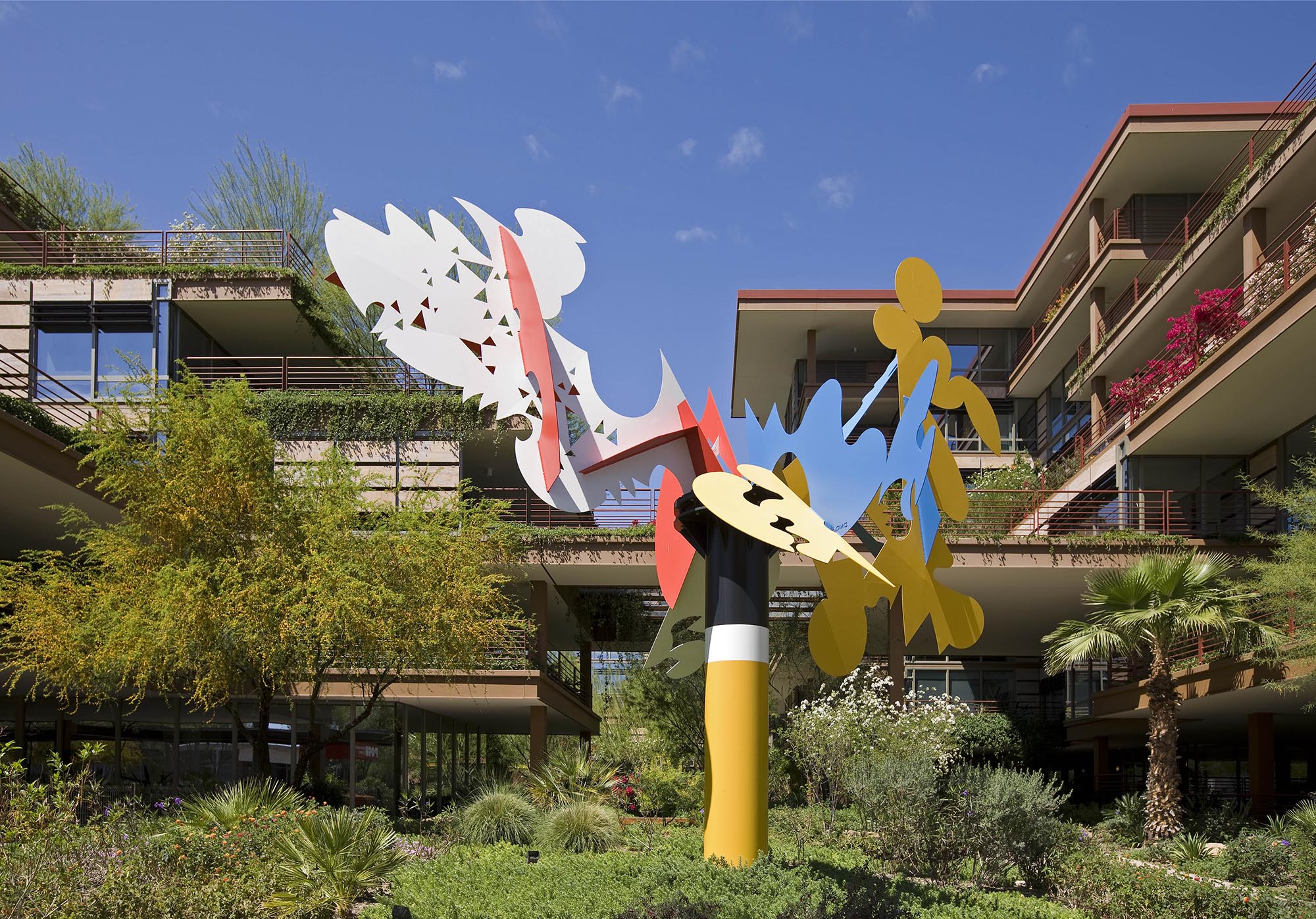
A striking piece that complements the surrounding green space at Optima Camelview Village, Windsong creates a bold statement that both contrasts with and engages its environment. As with Kiwi, Duo and other original Optima sculptures, Windsong was designed by David Hovey Sr., and today we dissect its form and how it integrates into a larger context.
To stand out against its colorful backdrop, Windsong stands more than 15 feet tall, providing a dramatic addition to the Arizona desert foliage. The sculpture is oriented around a rotating turntable, allowing the top pieces to move with the flow of the wind. Through movement and size alone, Windsong celebrates and embraces the elements, subtly alluding to Scottsdale’s connection to and love of nature.
With a mixture of color and shapes, Windsong also evokes a playful and enthusiastic energy. Each piece of the sculpture is composed of both sharp corners and rounded edges, a culmination of form that emits joy.
Optima’s passion for public art, both inside and outside our building, is a reflection of our dedication to engaging, beautiful spaces. Whether it’s through architecture, design or sculpture, we’re in constant pursuit of creating meaningful homes that have a lasting impact.
As a real estate firm centered on design, we recognize how profound impact a truly special piece of furniture can have within our spaces. On that note, perhaps no other piece of furniture is a more iconic staple of Modernist design than the Barcelona chair.
History of the Barcelona chair
The Barcelona chair is the collaborative brainchild of Modernist master Ludwig Mies van der Rohe and Lilly Reich. Initially designed for the German Pavilion at the International Exposition of 1929 in Barcelona, the chair was intended as seating for Spanish royalty overseeing the opening exhibitions of the ceremony. In this way, the piece was contrary to many Modernist designs of the time, which were most often intended for the “common man.” This particular chair, on the other hand, came to signify a structuralist sophistication coveted by novice and seasoned architects alike for their personal homes and professional projects.
A 1947 ad announcing the Barcelona Chair’s addition to the Knoll product catalog. Courtesy of Knoll Archive.
Design of the Barcelona chair
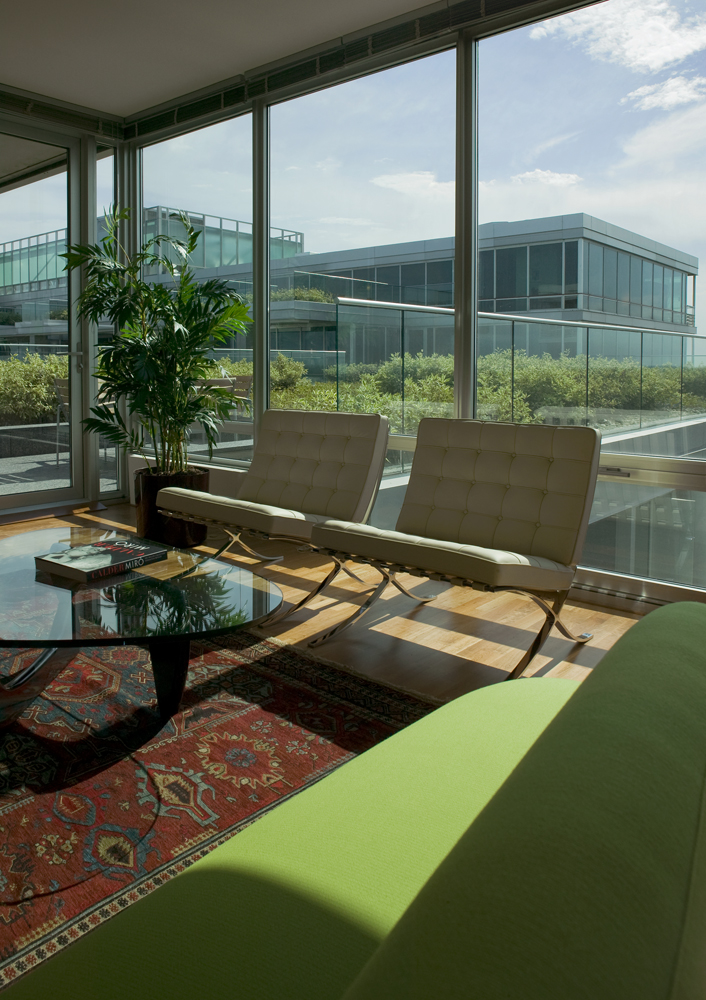
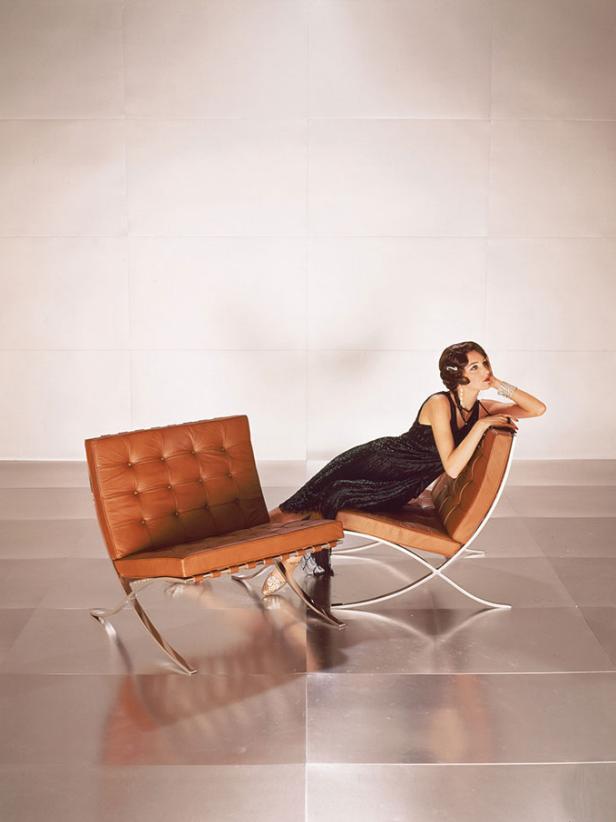
Perhaps what makes the Barcelona chair so striking is its simple elegance, and how directly it expresses the iconic Mies van der Rohe sentiment that “less is more.” A tribute to the marriage of modern design and craftsmanship, what appears a simple fixture is quite complex to construct, with a hand-ground and hand-buffed frame, and upholstery made with 40 individual panels. The chair is now manufactured by Knoll in an almost entirely handcrafted process, with a facsimile of Mies van der Rohe’s signature stamped into the frame. Available in both chrome and stainless steel, the chair’s frame has been redesigned as a single seamless, smooth piece of metal. Upholstered in leather of various shades, the iconic design adapts beautifully to each space.
You can find a Barcelona chair at every one of our communities. Incorporating the iconic piece of furniture into our properties helps us to express our deep appreciation for Modernism and for craftsmanship. For us, it serves as a reminder of the great designers who have created the legacy that enables Modernist design to continue to flourish — and functions as a beautiful piece of furniture to admire and use.
As part of our culture at Optima, our team is aligned around a set of beliefs that provides unity, clarity and meaning to the work we do everyday. One belief — committed to lasting impact — addresses our dedication to design solutions that raise the bar, withstanding the aesthetic test of time to leave a positive, lasting impact on people and the built environment that surrounds them.
From our earliest days, we have approached our work with this mindset. Our first project was in 1978 — a condominium complex at South Kenwood Avenue and East 54th Street in Hyde Park. We acquired the in-fill property at auction, and built six townhouses using Chicago common brick (they are still standing and occupied today). This project established a throughline that stays with us to this day, as we continue to pursue each project with the same intention, inspired by the people who live in and around them.
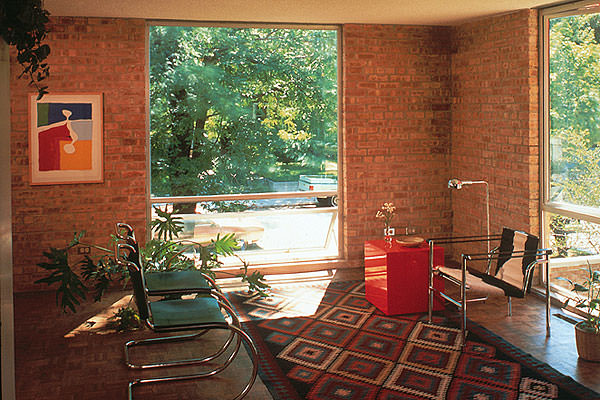
Interior of South Kenwood and East 54th Street
As a natural outgrowth of our focus on people and the places they inhabit, we pay particular attention to how interior space is designed and experienced. Whether it’s our multi-family residences or single family homes, each is outfitted with a multitude of amenities, outdoor spaces and thoughtful design. We also deliberately curate the commercial spaces within our multi-family properties to benefit our residents, tailoring the selection of retailers to include restaurants & juice bars, schools, veterinary services or health & wellness spaces that align with the mix of residents and their needs.
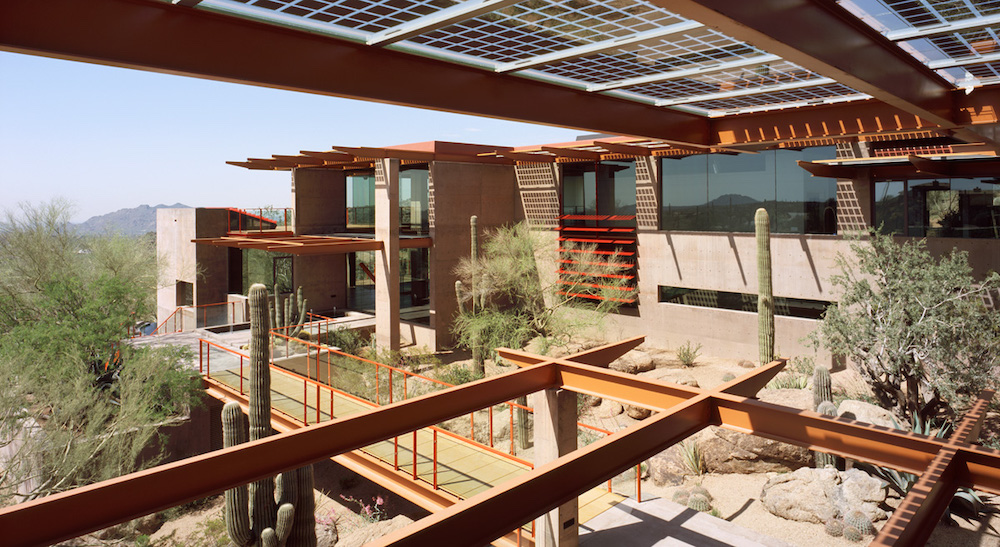
Our passion for buildings that last also translates into how our projects impact our earth. From LEED and IgCC certifications to conscious materials, we design with eco friendly functionality in mind. In building Relic Rock, we utilized design and materials to reduce the need for electricity and heat, lowering the building’s environmental burden. As we continue to grow in our practices, we will continue to implement more conscious design to ensure that our buildings work harmoniously with the surrounding nature.
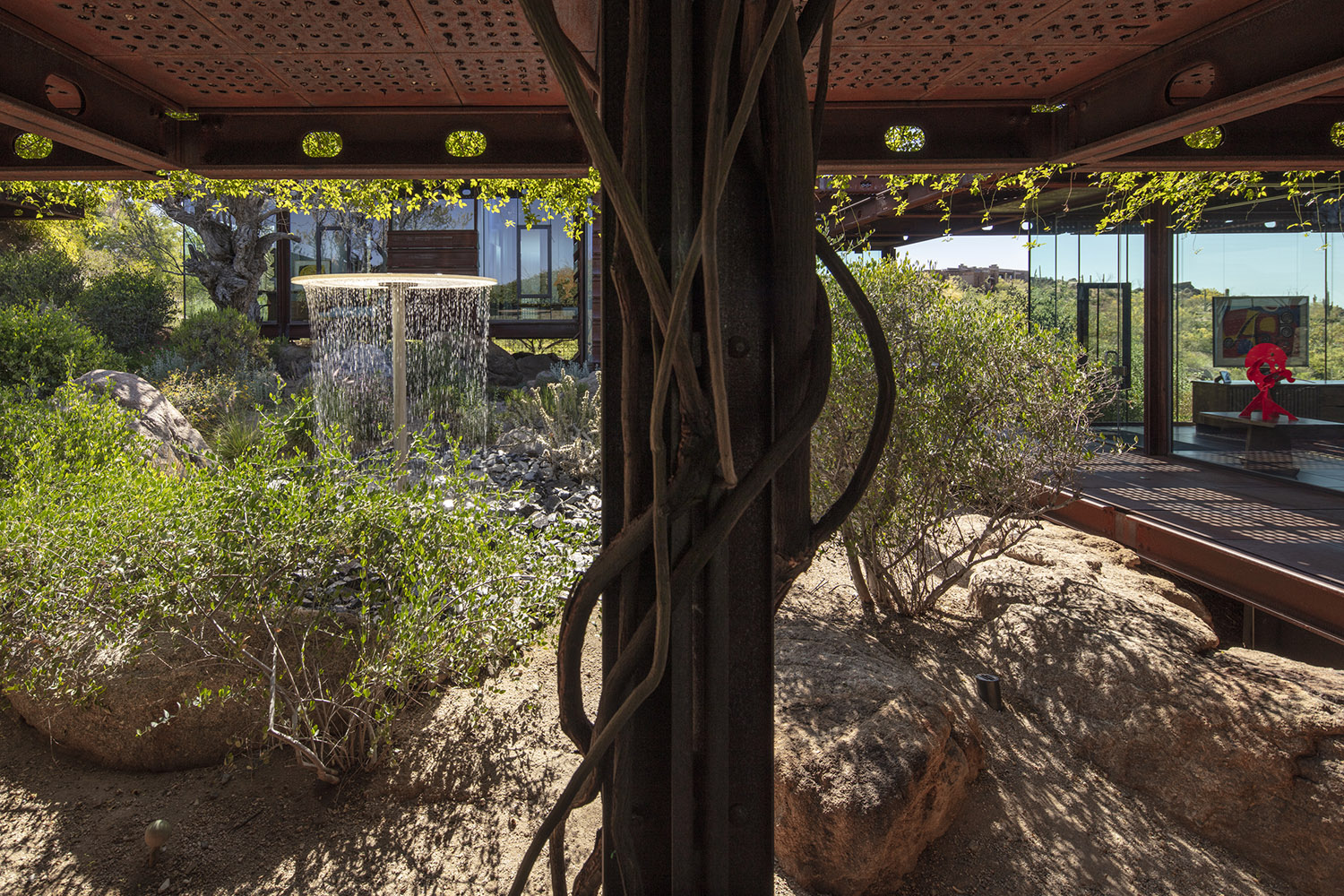
Courtyard Fountain “Cooling Tower” at Relic Rock.
Through each project and with each detail large or small, we strive to improve our communities and the lives of our residents for years to come. Stay tuned for more features on our beliefs as we dive deeper on what makes Optima function and thrive.
When it was developed, Optima Sonoran Village had the privilege of being the pilot project for Scottsdale’s International Green Construction Code, an alternative to LEED fully managed by local municipalities, and was one of the first projects in the world certified under IgCC. To understand the true breadth of its merit, we’re taking a deep dive into the code: its history, its mission and its modern day impact.
History of IgCC
IgCC was first conceptualized by the International Code Council (ICC), a nonprofit association that provides a wide range of building safety solutions including product evaluation, accreditation, certification, codification and training. ICC also develops model codes and standards that are used around the world to construct safe, sustainable, affordable and resilient structures.
ICC realized that there was a significant gap in construction in the way of a mandatory baseline of codes that would address green commercial construction. This kind of regulatory framework was becoming an increasingly appealing concept, with many local and state jurisdictions already exploring their own potential “substitute codes.”
In response to the call, ICC collaborated with cooperating sponsors – the American Institute of Architects (AIA), ASTM International, ASHRAE, the U.S. Green Building Council (USBGC) and the Illuminating Engineering Society (IES) to help get the code passed. And in 2010, ICC established The International Green Construction Code™ (IgCC) to provide model code regulations that promote safe and sustainable construction.
IgCC Today
IgCC “provides the design and construction industry with the single, most effective way to deliver sustainable, resilient, high-performance buildings.” Support of the IgCC promotes a new era of building design and construction that includes environmental health and safety as code minimums.
Benefits of certification under IgCC abound; IgCC certification includes measures that result in better indoor environments, lower impact on natural resources, better neighborhood connections and improved walkability, increased resilience to natural disasters and climate change, resource consumption/management and service interruptions.
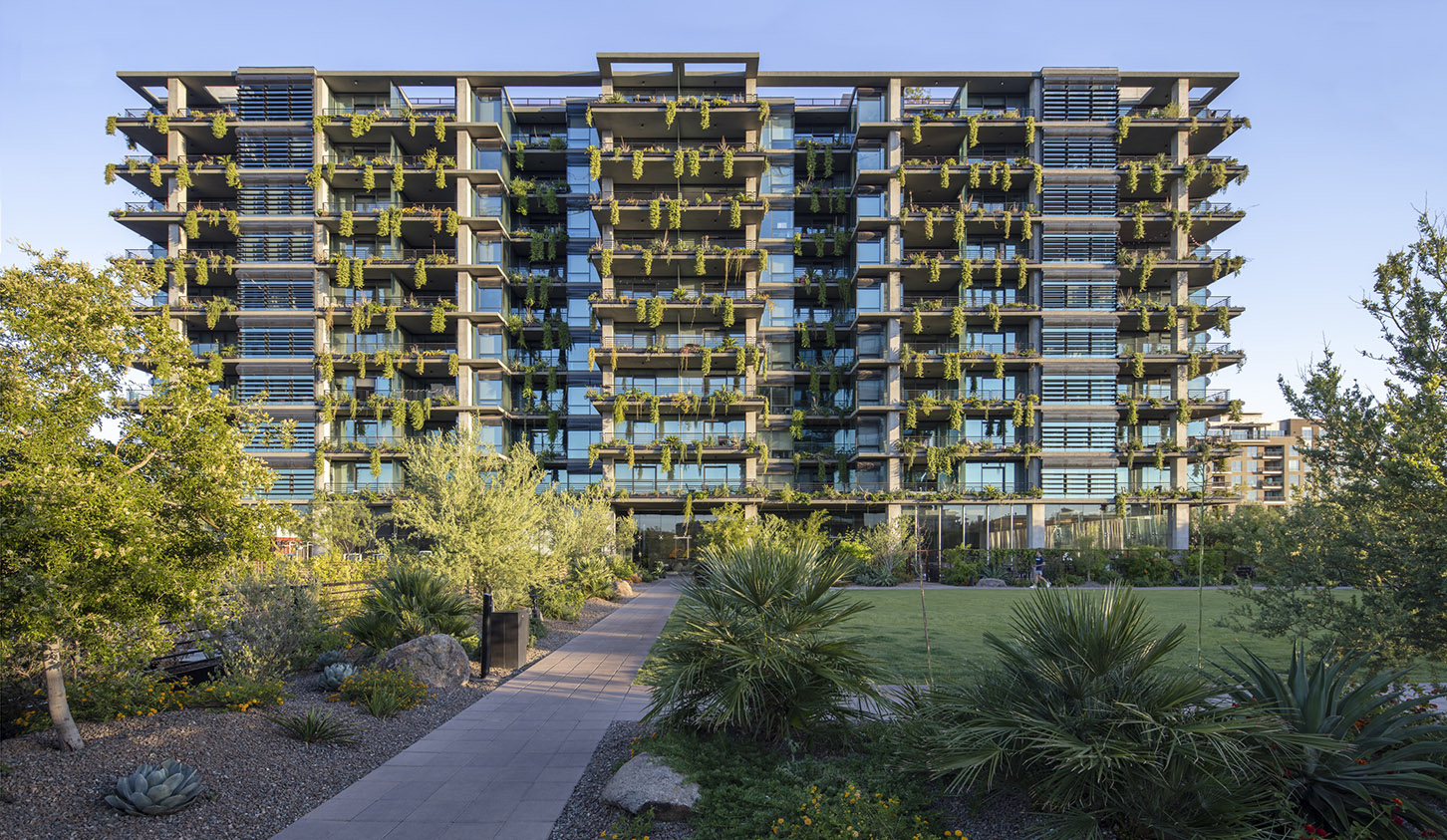
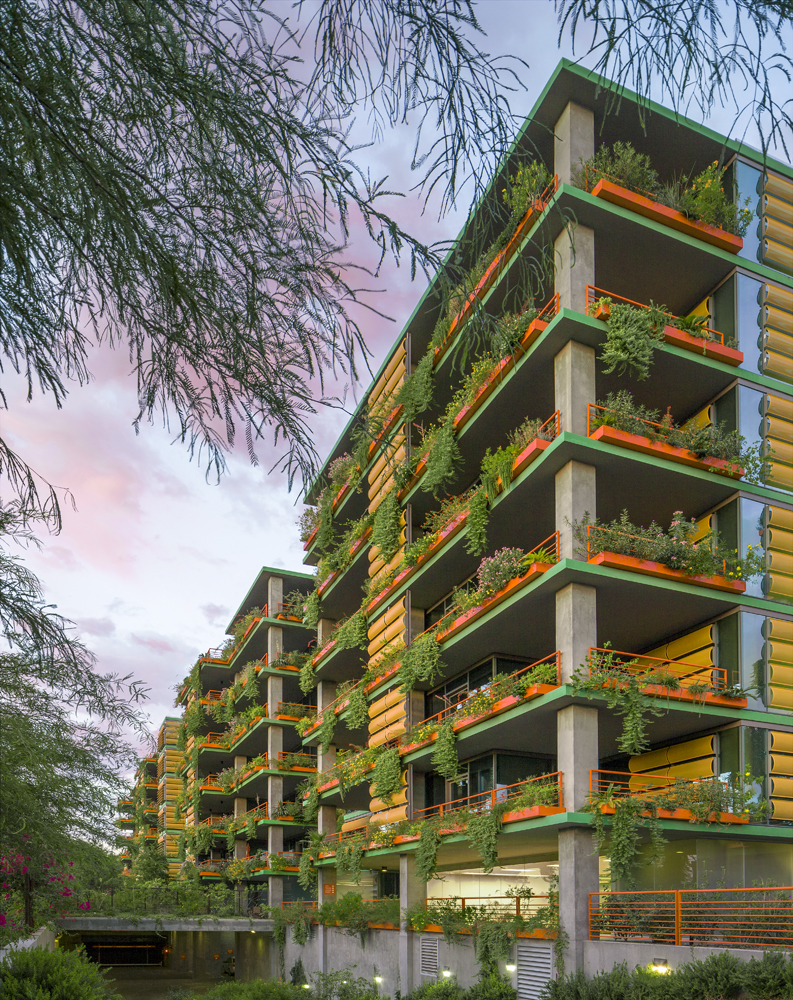
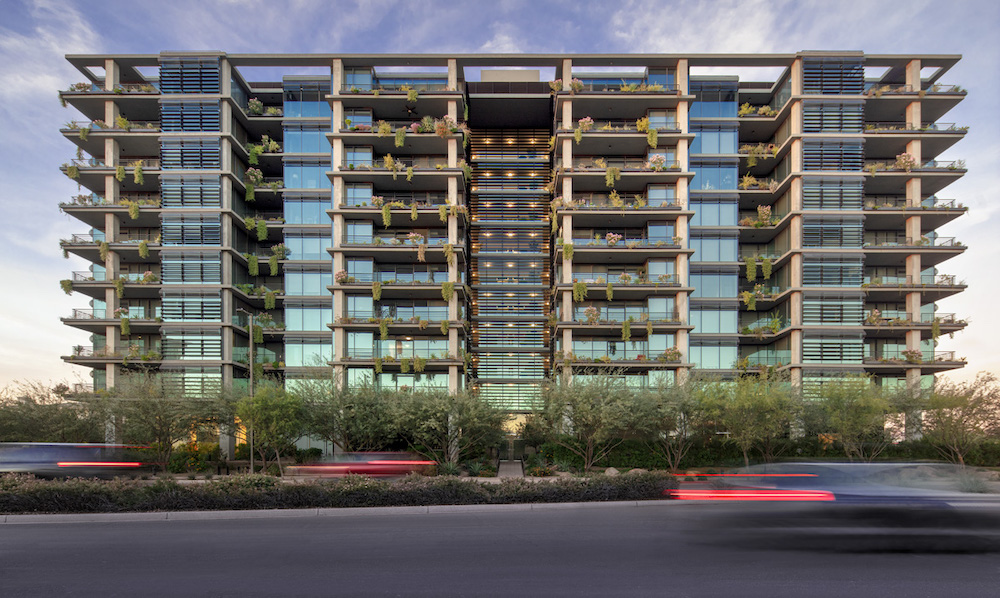
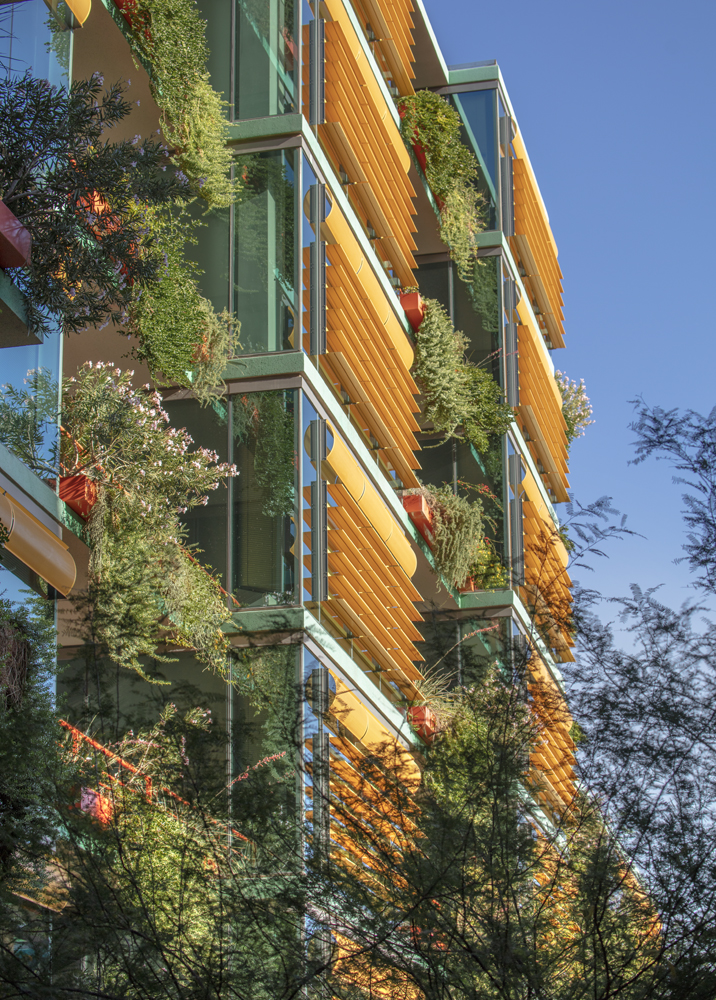
Vertical landscaping at Optima Sonoran Village
IgCC and Optima
IgCC operates as a code that can be easily adapted by public or private entities, allowing government jurisdictions to adopt it and save themselves the labor of creating their own code. Arizona took advantage of this opportunity, adopting the IgCC, which then took effect in January of 2017.
It was at that time that Optima Sonoran Village became a pilot project for IgCC in Arizona.
Optima Sonoran Village IGCC attributes include major building elements consisting of 95 perfect local and recycled content materials; energy efficiency as a result of the high-performing glazing, overhangs, building configurations and exterior shading devices; water resource conservation from plumbing fixtures and excellent indoor environmental quality and reduced material emissions from the materials used in the development. Because of its environmentally-friendly construction, Optima Sonoran Village passed muster and was one of the first buildings in the world to earn certification.
Optima will continue to push the boundaries of building in pursuit of new and sustainable ways to contribute to our built environment. ICC is an association that will continue to do the same—we look forward to a world in which green building is commonplace.
As a design-driven real estate development firm, our Modernist roots shine in each one of our projects. A staple of classic Modernist design, we often employ glass curtain walls to create stunningly transparent and sleek exteriors. In respect to the tradition and technique, we’re diving deep into the history of the curtain wall and its impact on our structures today.
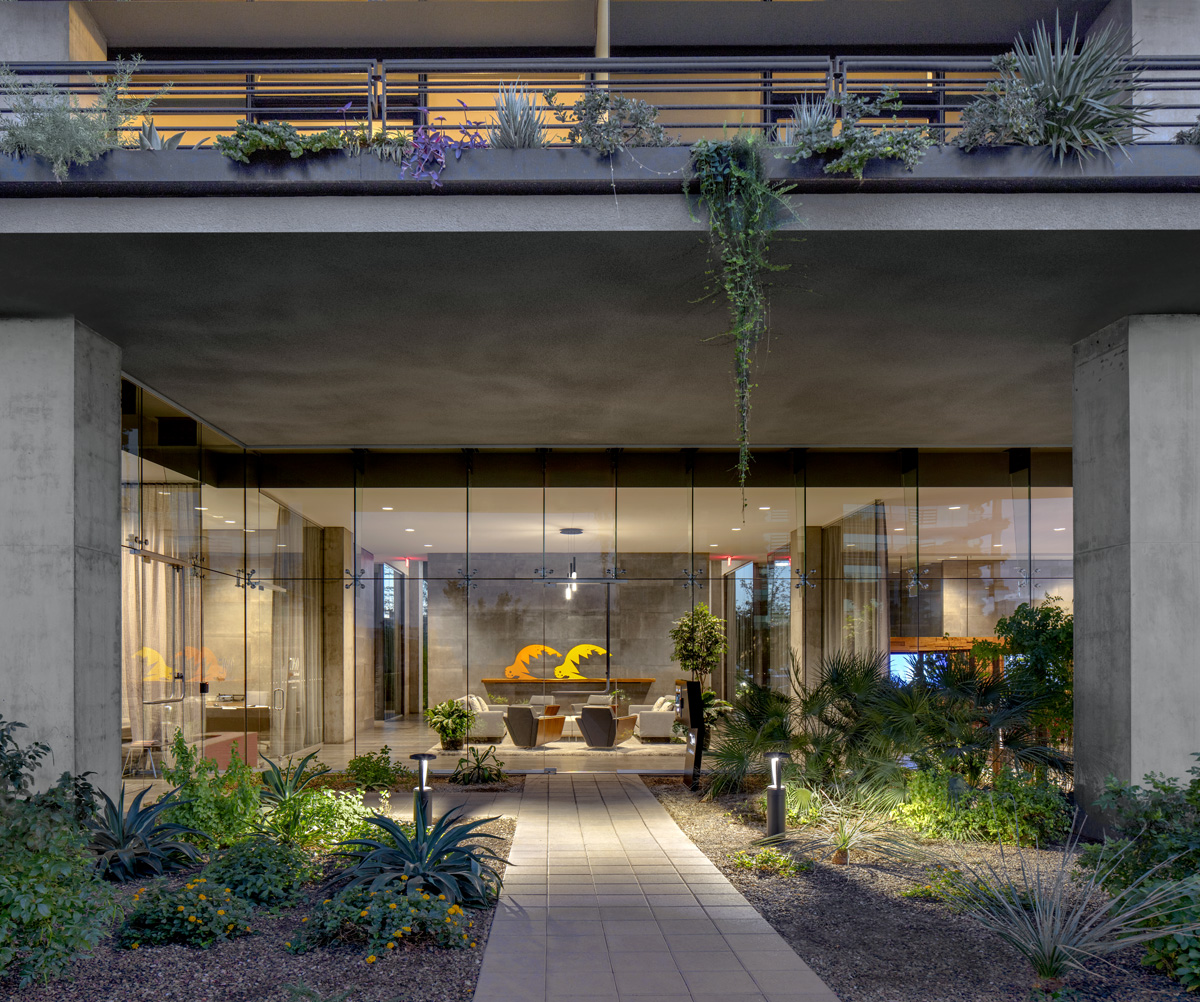
The curtain wall at Optima Signature
The Curtain Wall Defined
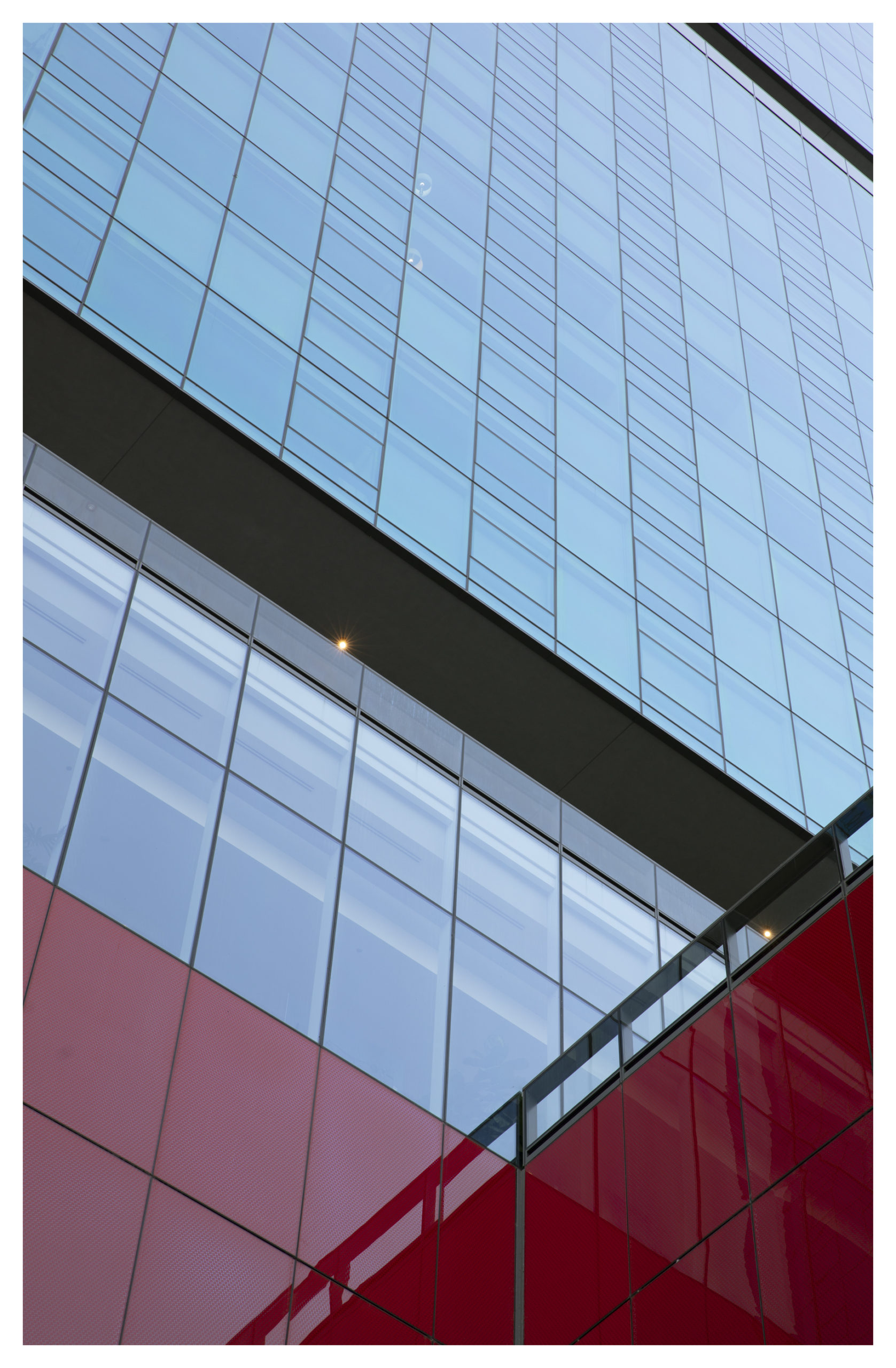
A curtain wall is a nonstructural exterior component of a building, at first serving the mere purpose of keeping weather out and occupants in. Being nonstructural, curtain walls are often made of lightweight materials such as glass, metal panels or thin stone. Glass curtain walls have the added benefit of introducing deeply penetrating natural light into a building, and can offer broad, sweeping views, creating seamless cohesion between the built environment and its natural surroundings.
Because curtain walls are nonstructural components, load-bearing responsibilities fall on the shoulders of strong metal frames. The invention of the curtain wall was in fact made possible by the growth of the iron and steel industry, when these strong metal materials were made more readily available and affordable to the mass market in the late 18th century.
The first Modernist building, The Crystal Palace, was built during this time. Shortly after The Crystal Palace, Modernist master Ludwig Mies van der Rohe pioneered the contemporary steel-and-glass aesthetic that defined an era and way of designing, coining the name for the style: “skin-and-bones architecture.” Today, designing minimalistic, functional building frames in steel and glass, and employing curtain walls to do so, continues to be a signature mark of Modernist structures.
The curtain wall at Optima Old Orchard Woods
Adding Beauty and Sustainability
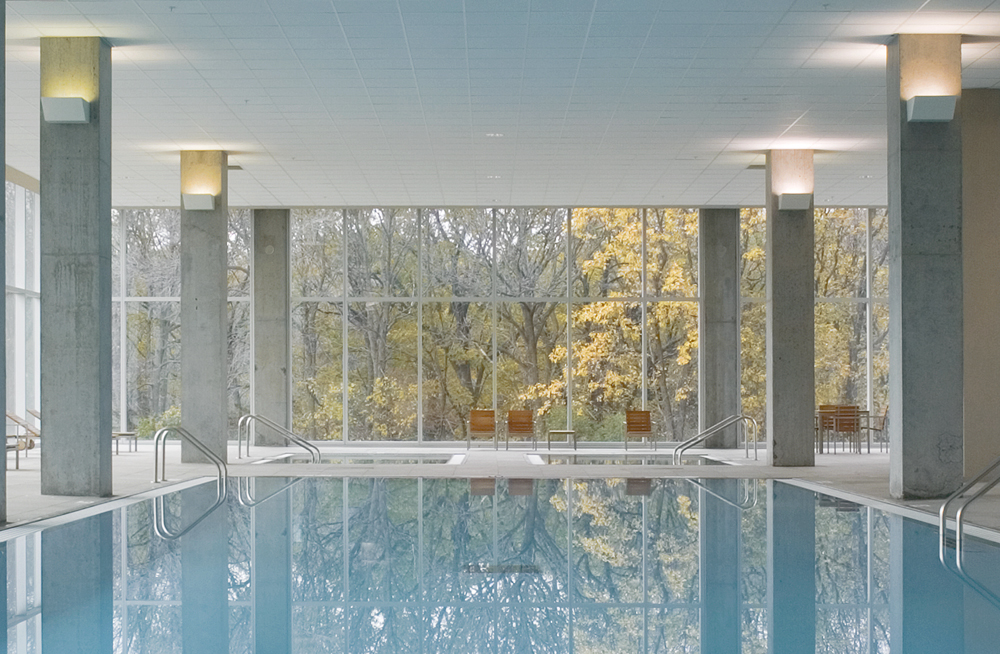
As a building material, glass has evolved considerably over the years. Our capability to utilize glass in curtain wall systems connects indoors and outdoors, and promises a beautiful environment, with an abundance of natural sunlight and impressive views. Outside of aesthetic, glass curtain walls also serve the functionality of increased performance in temperature moderation, moisture protection and improved acoustics.
In our own projects, we utilize Low-E UV protected laminated glass with a heat reflective coating, which contributes to a regulated indoor environment, particularly in the harsh Arizona climate, and provides added sustainability, decreasing energy need for additional heating and cooling control.
As we continue to explore the integration of the built and the natural environment, we appreciate the curtain wall for its transparency and sustainability, and the wonder that it adds to exceptional Modernist design.
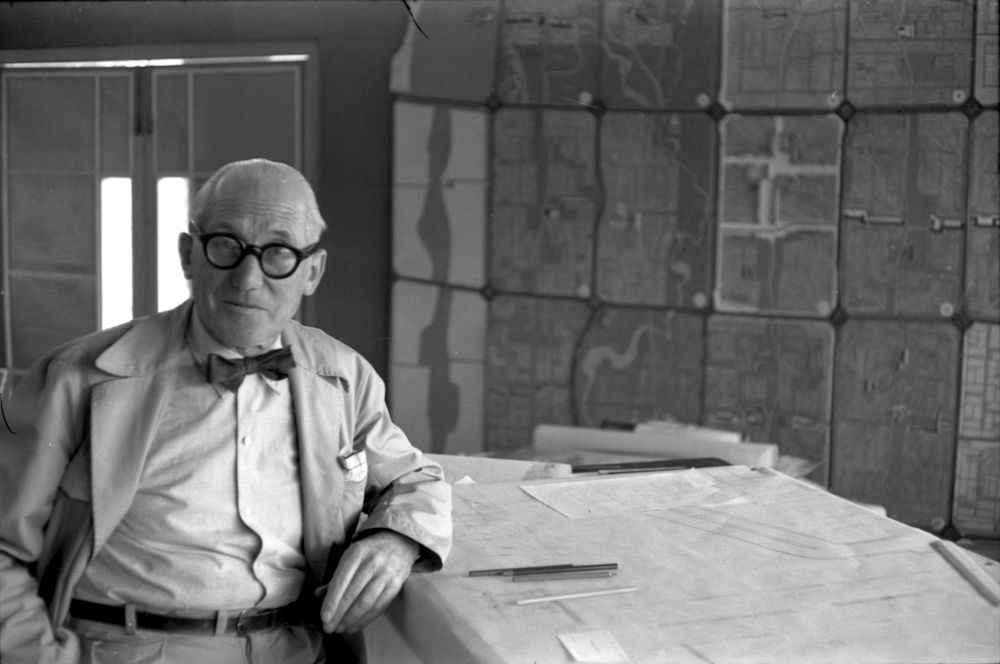
Modernism is an approach that has roots going all the way back to the 1920s. Modernist architecture was pioneered by the inventive and contentious Le Corbusier, a Swiss-French architect, urban planner, painter and furniture designer. To better understand Modernism, we’re diving deep into his life, and highly controversial work.
A Controversial Figure
Born Charles-Eduoard Jeanneret-Gris, architect Le Corbusier built chiefly with steel and reinforced concrete, paring design down to its simplest, elemental geometry and form. He developed his famous theory of modern form and minimalist materials when envisioning affordable, prefabricated housing to help rebuild communities after World War I. His vision for prefabrication was only the tip of a strong, nearly utopian, approach to urban planning and architecture.
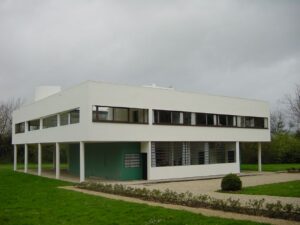
Villa Savoye in Poissy, Le Corbusier. Photo Timothy Brown, Flickr Creative Commons
His architectural philosophy was groundbreaking and completely contrary to the dominant narrative of the 1920s. Once he established his ideas, he shared them by publishing the seminal L’Espirit Nouveau (1920), where he revealed his famous “five points of architecture.” Three years later, he published Vers une architecture (Towards a New Architecture) (1923), in which he espoused a new, modern architecture informed by applying principles of cars, planes and ships to buildings. Le Corbusier embraced the conflict that arose to his ideas head-on, making bold declarations such as “a house is a machine for living in” and “a curved street is a donkey track; a straight street, a road for men.”
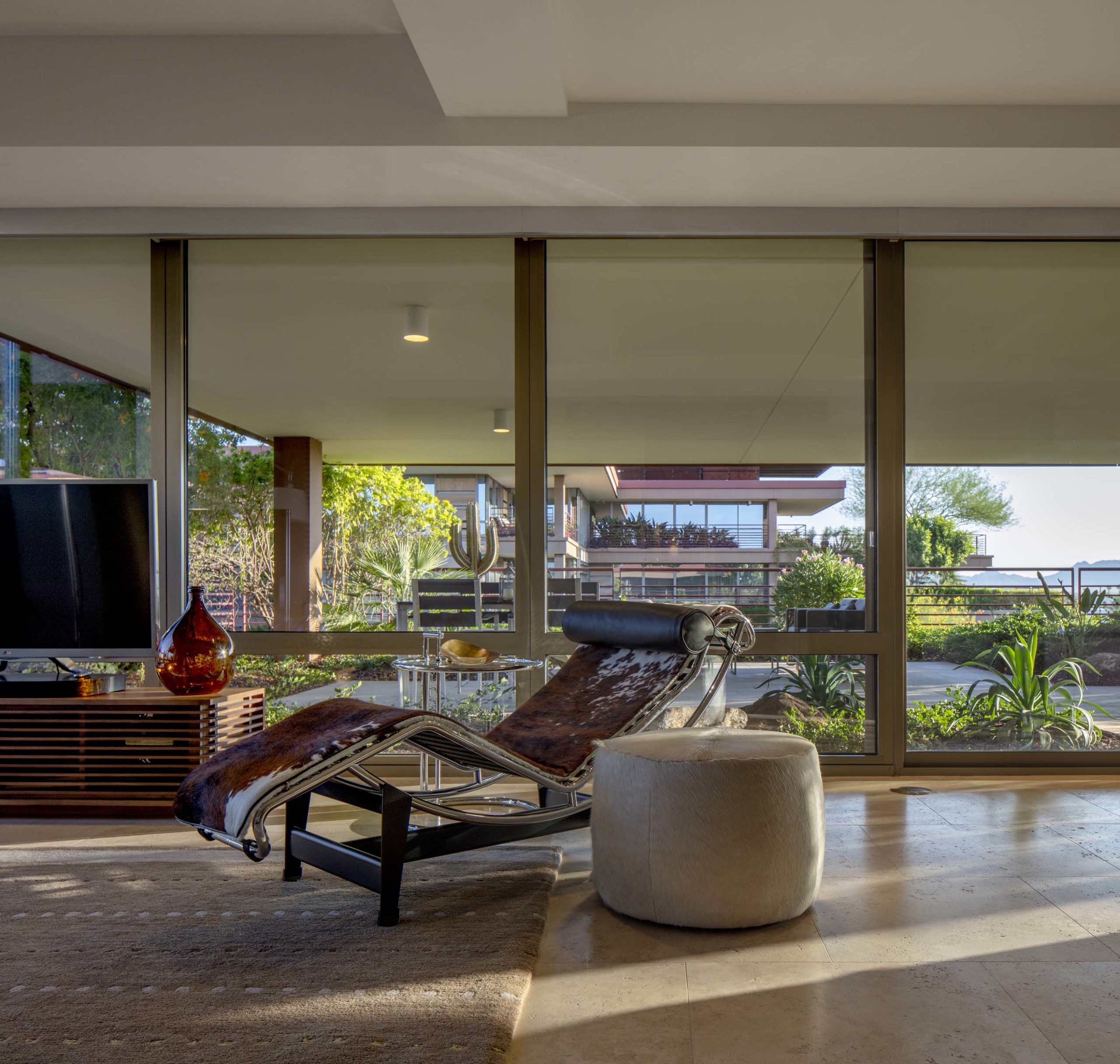
Chair designed by Le Corbusier at Optima Camelview Village
Form, Function, Furniture
Le Corbusier also designed furniture, his approach following suit to his approach to architecture. His furniture, co-designed with Pierre Jeanneret and Charlotte Perriand, utilized tubular steel that projected a new rationalist aesthetic. Le Corbusier broke down furniture into three types: type-needs, type-furniture and human-limb objects. His rational approach was not without romanticism, as he said, “Certainly, works of art are tools, beautiful tools. And long live the good taste manifested by choice, subtlety, proportion and harmony.”
At Optima, we employ Le Corbusier furniture in our communities, like those in each of the three building lobbies at Optima Old Orchard Woods in Skokie. The furniture functions just as the artist would’ve wanted — as bold, artistic statement pieces, and as functional, rational furniture.
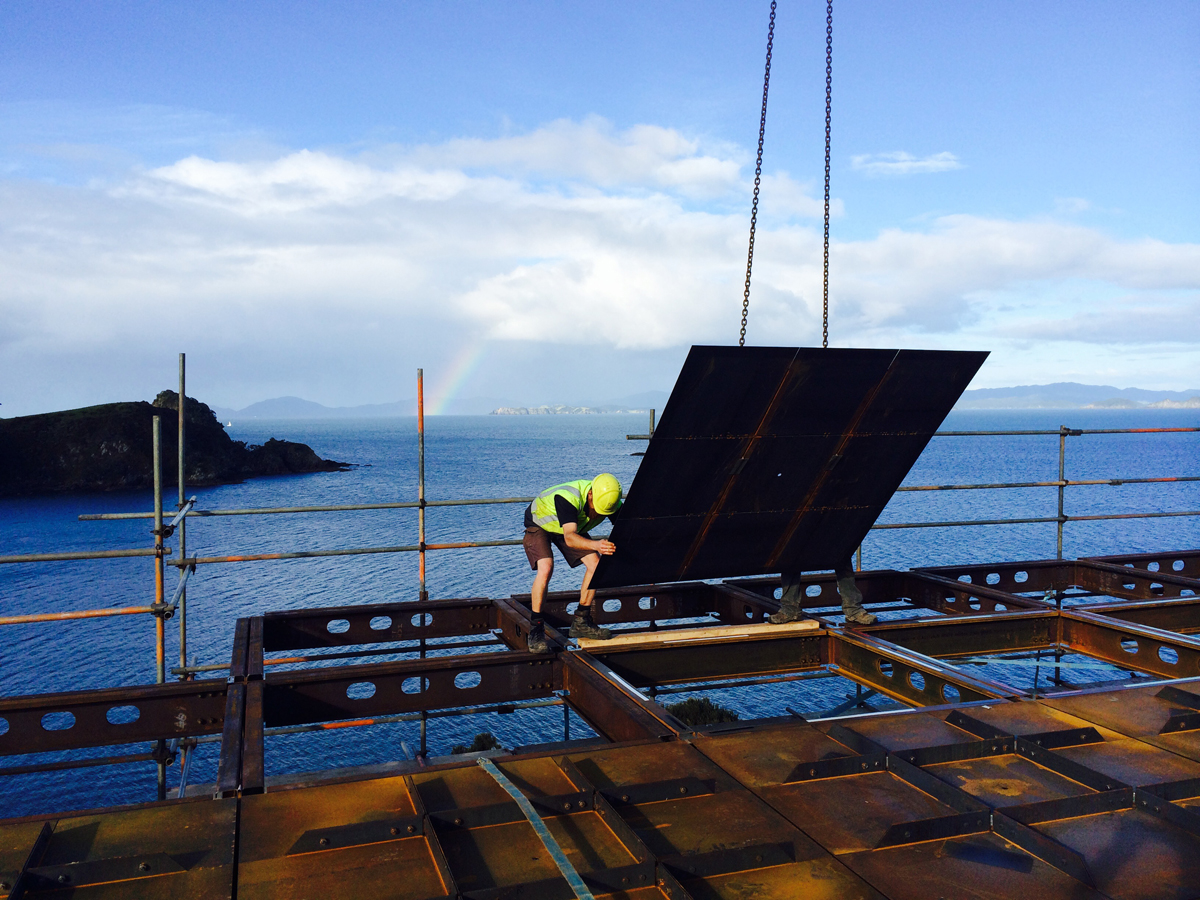
At Optima, we’re in constant pursuit of better and smarter ways of creating, which is why we often employ prefabrication, from our multifamily properties to our desert dwellings. Prefabrication describes the process of building elements off-site in a factory or workshop, and then later fitting those elements together on-site. This carefully calculated process has revolutionized the industry, allowing builders to cut down on time, cost and labor needed to create a structure. To understand just how vastly the industry and the way that we build has transformed, we’re taking a deep-dive into the world and history of prefabrication.
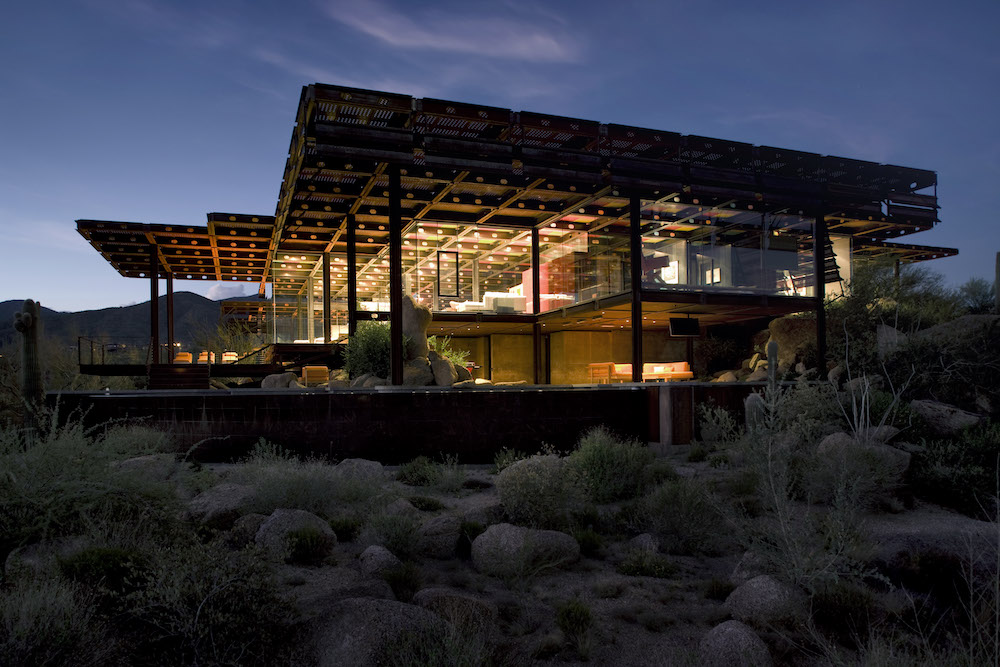
Whale Bay House, Optima DCHGlobal.
Early Origins
Naturally, the idea of building pieces separately before putting them all together in place is centuries old. Prefabrication is inspired by building techniques that date as far back as Mesopotamian civilization and Roman fort-building. In fact, the earliest known example of prefabrication comes from around 3800 BC, when the oldest engineered roadway, the Sweet Track in England, was built using timber sections that were constructed off-site.
Prefabrication techniques were used to erect giant structures in Sri Lanka, to rebuild the Portuegese capital after the great Lisbon earthquake of 1755 and even in 19th century Australia, when a large number of prefabricated houses were imported from the U.K. No matter the circumstances, from building large to building wide, the streamlined technique allowed for increased control, lowered cost and expedited process.
Relic Rock, Optima DCHGlobal.
Industrialization and Modernism on the Rise
Prefabricated farm buildings and bungalows were the first readily available structures on the market, around since the early 19th century. Most notable during that time was London carpenter Henry Manning’s prefabricated Portable Cottage, which was transported to Australia. Affordable housing was created using the technique, too, supplying homes for 49ers during the 1848 California Gold Rush and to refugees of war during World War II.
Prefabrication was also an integral tool in rising Modernist architecture. The first ever Modernist structure, The Crystal Palace designed by Joseph Paxton, was built in 1851 using this method. Like The Crystal Palace, Modernist design was rooted in materials such as exposed steel and glass, which were perfectly suited for prefabricated builds as they were most often used in the simple and functional Modernist structural patterns.
Construction on Whale Bay House, Optima DCHGlobal.
Prefab Concrete and Steel
As the prefabrication practice continued to grow, technical developments such as the development of sheet steel, the improvement in alloys, the use of lightweight aggregates and the promotion of precast reinforced concrete pushed the field even further. Concrete and steel in particular proved to be highly efficient materials in the prefabrication process, with pre-poured concrete allowing for more flexibility, and prefabricated steel sections reducing in-field risk during cutting and welding. These components have proven especially crucial to simplifying the construction process in buildings where a particular part or form is repeated numerous times.
Created by Optima President David Hovey Jr., Optima DCHGlobal has created The Optima DCHGlobal Building System, a patented prefabricated architectural system that is flexible in both horizontal and vertical directions, sustainable up to the net-zero level, multi-generational, and able to be built quickly and efficiently in any location, climate or terrain.
His invention of this system has created award-winning residences, such as Relic Rock and Whale Bay House. We continue to utilize the latest in steel technology, and often employ elements of concrete, to create our simple yet stunning Modernist structures.
As we continue to look forward to a future of innovating and finding new ways of creating, we are humbled to look back at the history of prefabrication and how the technique has grown, allowing us to grow, too.
An intricate and technical field, the world of architecture produces a unique dictionary of jargon all its own. At Optima, our team works in a highly collaborative atmosphere where we all, from architects to property managers to construction superintendents, share ideas and hold conversations across disciplines — so naturally we all encounter the lingo of our architects. Now we’re decoding the secret language that we’ve all come to know and love.
BIM
Better known as Building Information Modeling, BIM is a 3D model-based process that has majorly changed the world of architecture. It’s a highly collaborative process that spans into the planning, design, construction, operations and management of buildings.
But BIM is more than just a technology or a phrase — when we expanded our offices to have a second location in Arizona, BIM became the language that connected our team, even across states. Using the technology as a streamlined method of communication, our architects in Glencoe and Scottsdale effectively craft and manage projects as if they were in the same room.
Optima Kierland Apartments.
Building Envelope
A building envelope is the exterior shell of a building that acts as a barrier against the elements. This maintains a dry, heated/cooled indoor environment and helps in temperature control. The design is a specialized area of architectural and engineering practice and can vary based on the overall look of the building.
In many of our projects, such as Optima Kierland Apartments, the building envelope is a Low-E, UV protected laminated glass with a heat reflective coating. Beyond providing functionality and sustainability, this oft-implemented technique in our Optima projects creates a cohesive design language of beautiful, sleek exteriors.
Cantilevered roofs and balconies at Sterling Ridge.
Cantilever
A cantilever is any rigid structural element, such as a beam or a plate, that’s anchored at one end to a support, allowing the other end to overhang without support or obstruction. The balancing act performed by cantilevers creates gravity-defying architectural protrusions, often serving as stunning design elements.
At Optima Signature, we used cantilevered slabs to provide a column-free living room with breathtaking, sweeping views of Chicago. A tool employed to create our mindful, simple and sleek Modernist silhouettes, cantilevers are yet another piece of our common architectural tongue.
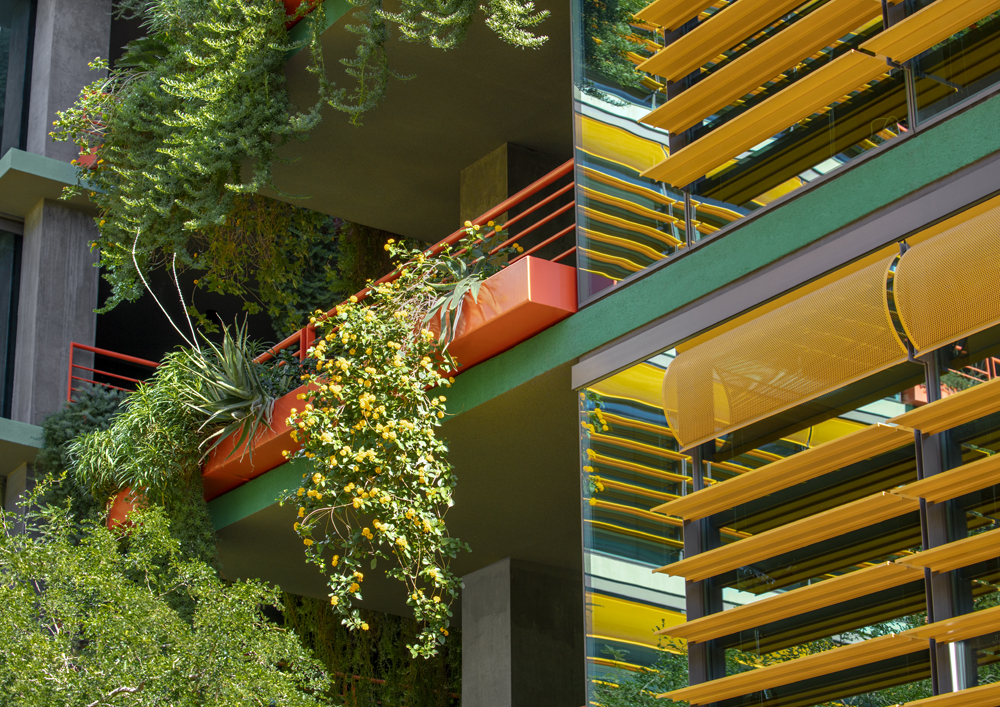
Louvers at Optima Sonoran Village.
Louvers
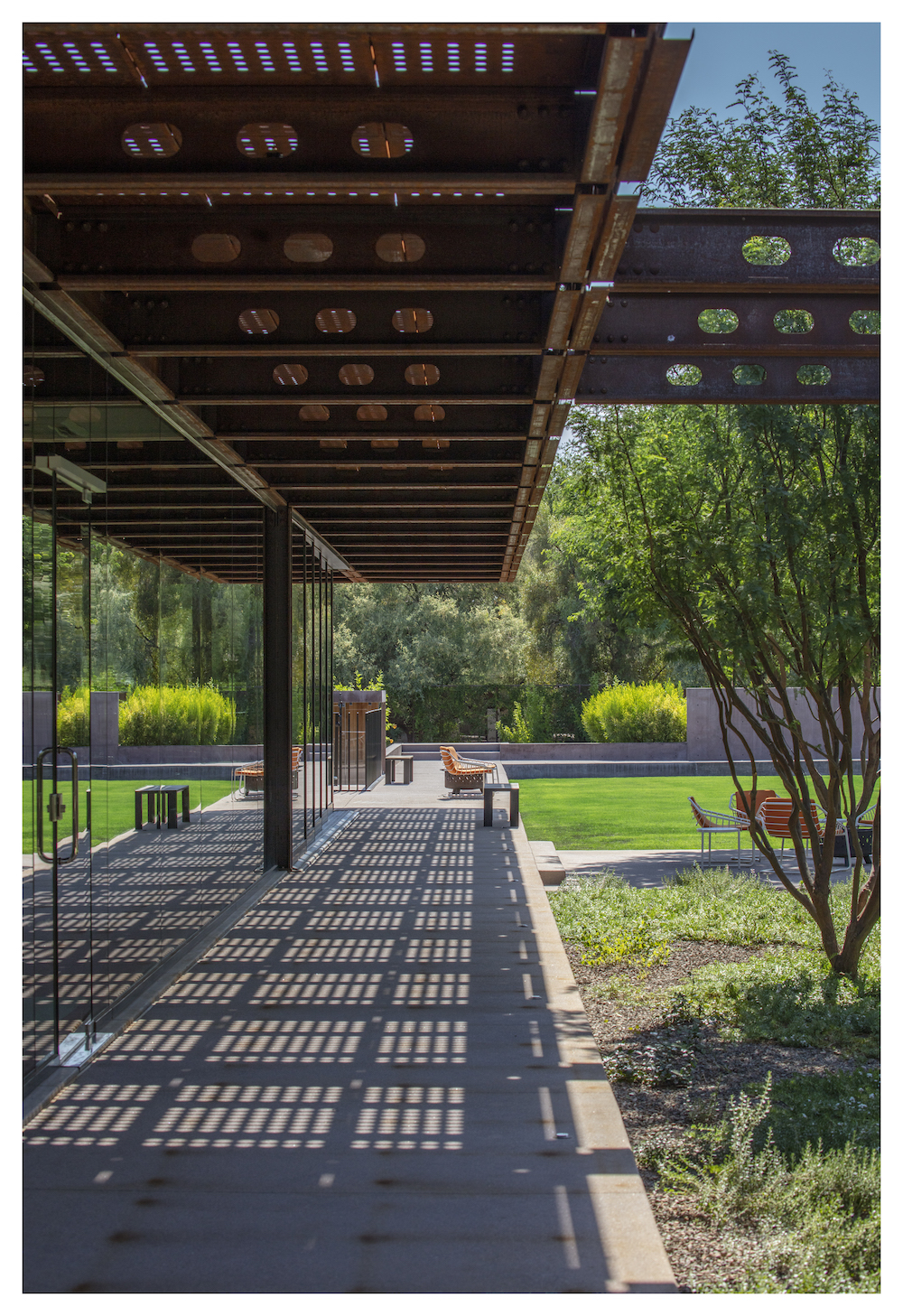
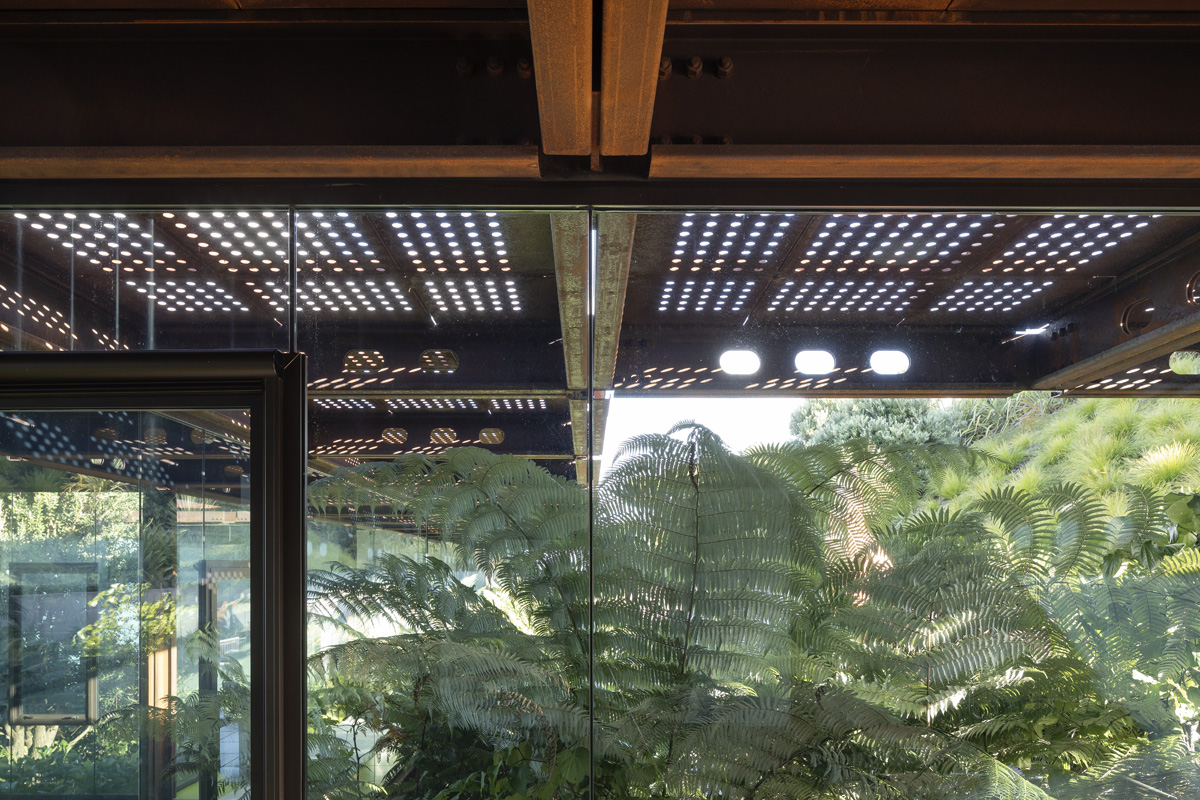
Louvers are angled slats fixed at regular intervals in a door, shutter or screen to allow air or light to pass through. Originating in the Middle Ages to help with kitchen ventilation, louvers have evolved into an element used to redirect light or add privacy. Louvers serve just this purpose, paired with perforated sun screens and our signature vertical landscaping system, at Optima Sonoran Village.
Stay tuned for future features on the world of architecture lingo at Optima.