The Future of Sustainable Design in Architecture

At Optima, sustainable design has always been part of our ethos, as we strive to create vibrant communities built with the surrounding natural environment at the forefront. And as technology continues pushing the boundaries of sustainability in architecture, we wanted to explore what the future might possibly hold. 

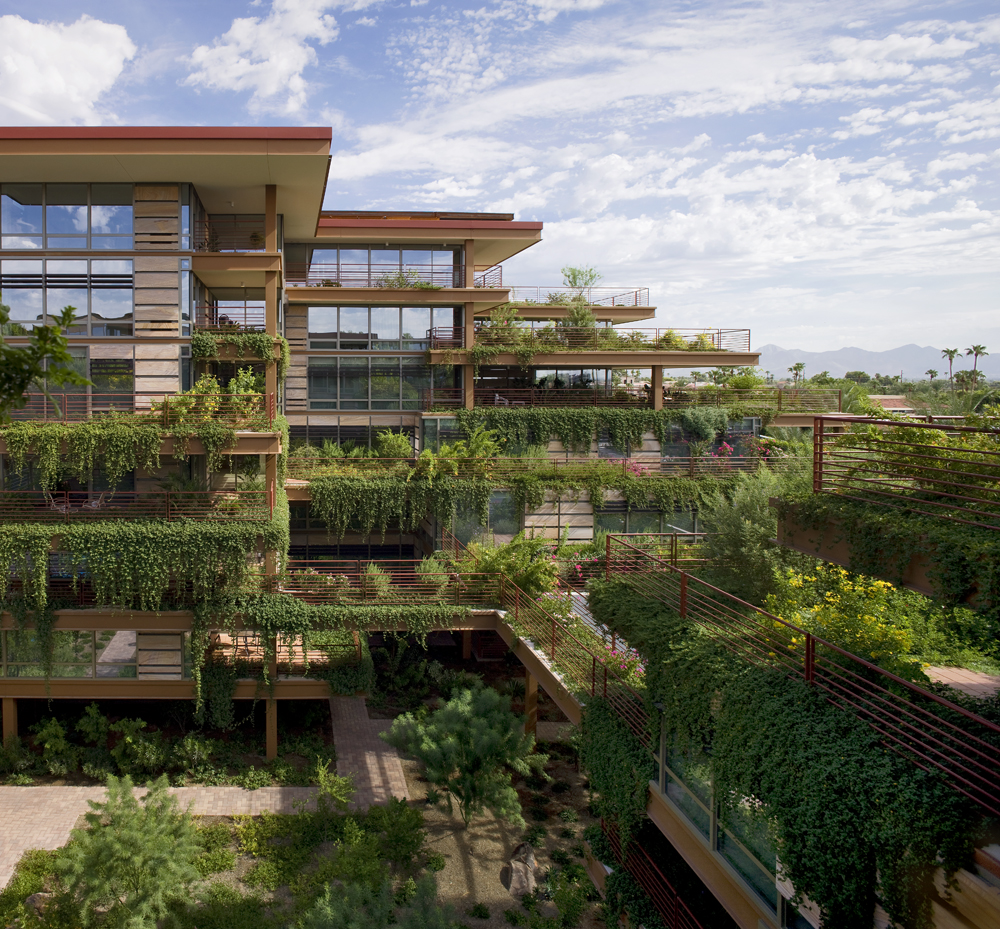
Historically, sustainable architecture has focused on lush outdoor environments, and at Optima, we know the benefits of urban greenspaces, which is why we have incorporated them into our communities for decades. Urban greenspaces and vertical landscaping are just some of the many sustainable features found in many of our Optima communities that help promote mental and physical health, while mitigating pollution and emulating the feeling of oasis. 

Today, as new age modernism continues to evolve and environmentalism exceeds formalism, designers and architects are developing new ways to create built environments that also benefit the Earth. The newest approach to sustainable architecture is found within regenerative building. 

Regenerative building looks beyond lessening harmful impact; it seeks ways to repair and restore the surrounding environment. In the regenerative design process, innovators conceive ways for each building to produce its own energy, treat its own water and emit a net-positive impact on the environment. 

The Centre for the Built Environment’s living wall which features 24 plant species and 7,000 plants, courtesy of Nova Scotia Community College

While global contests like Redesign the World are encouraging designers to envision radical solutions to end environmental issues through built communities, some architects have begun to bring regenerative building to life. 

Kendeda Building For Innovative Sustainable Design
Kendeda Building For Innovative Sustainable Design. Photo: Jonathan Hillyer, 2019. Flickr Creative Commons Attribution-NonCommercial-NoDerivs

Buildings like The Kendeda Building For Innovative Sustainable Design found on Georgia Tech’s campus and Portal High School in Irvine, California use green roofs and water collection systems to reduce reliance on negative forms of energy. Other buildings like Nova Scotia Community College’s Centre for the Built Environment take advantage of multiple sustainable design features like living walls, geothermal systems and solar and wind energy to regenerate and restore their surroundings. 

As sustainable approaches to design continue to expand over time, we can’t wait to continue exploring how – through architecture – we can change contribute to a healthier, more sustainable environment.

Women in Architecture: Charlotte Perriand

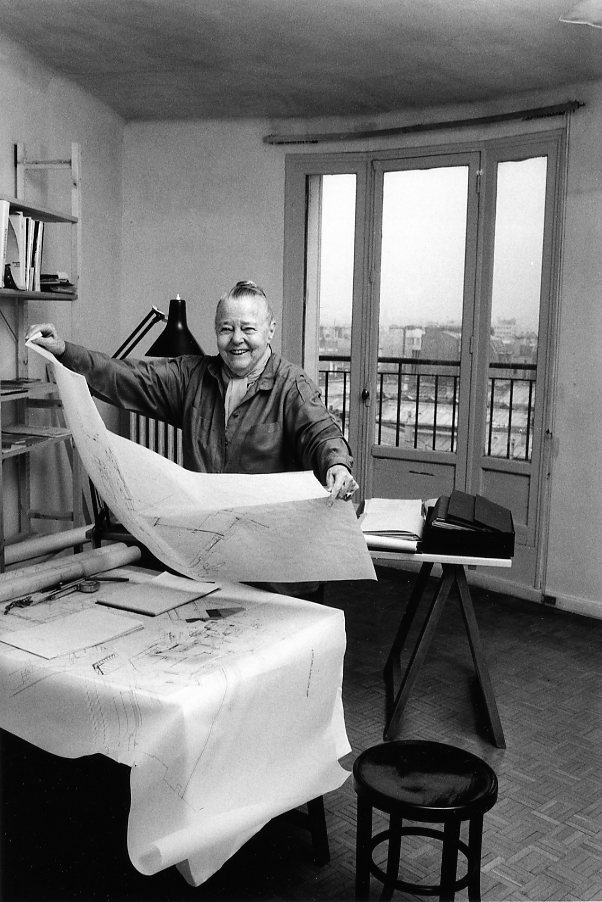
A trailblazer for women designers, Charlotte Perriand always found a way to reinvent her work with the ever-changing aesthetics of interior design and architecture in the 20th century. She forged herself as a leader of the avant-garde cultural movement, which influenced new perspectives and values in the design world. Today, as part of our ongoing “Women in Architecture” series, we’re exploring the life of this exceptional designer and some of her most celebrated creations. 

The Life of Charlotte Perriand
Perriand was born in Paris, France in 1903. She lived with her mother, who was a talented seamstress, and her father, who worked as a tailor in the city. Because of the lively energy of her surroundings, Perriand found a deep appreciation for city life but also relished her frequent visits to her grandparents’ home in the French Alps, where the natural environment was peaceful and calm. 

At a young age, Perriand discovered a passion for the arts. As her talents continued to flourish, Parriand’s mother encouraged her to push herself by attending École de l’Union Centrale des Arts Décoratifs in Paris. From 1920-1925 she studied under the renowned artist and decorator Henri Rapin, who helped bring her unique ideas to life. 

During her time at École de l’Union Centrale des Arts Décoratifs, Perriand learned to incorporate popular aesthetics such as ornate patterns, warm materials like wood and soft textiles like cotton. Dissatisfied by the status quo, Perriand pushed her interests and fed her curiosity by enrolling in classes made available through large department stores that housed their own design workshops. Encouraged by the reactions to her creations that incorporated glistening surfaces, reflective metals and blunt geometric forms, she began to submit her work to expositions throughout Paris. Perriand’s most notable entry at the time was Le Bar sous le toit, or Bar in the Attic, at the prestigious Salone d’Automne, in1927. This installation of furniture, finishes and a built-in bar reflected the current machine-age landscape and displayed a bold design featuring nickel and other metals. Emboldened by the reactions of her peers, Perriand quickly began embracing these taboo materials in her work, conveying exciting new interpretations of modern design. 

Maquette of Les Arcs ski resort, French Alps. Credit: B on Flickr Creative Commons. Licensed under CC BY-NC-SA 2.0.

Career and Achievements
After the success from Bar in the Attic, Perriand had a difficult time discovering what her next move should be in the art world. She took advice from a friend, jewelry designer Jean Fouquet, and immersed herself in the intensive literature of Le Corbusier. Dazzled by his work, Perriand reached out with her portfolio for a position at his atelier. After a hasty dismissal, she showed Le Corbusier her acclaimed Bar in the Attic project, which caused him to reverse his decision and hire her on the spot. 

While working for Le Corbusier and his cousin, Pierre Jeanneret, Perriand contributed to the design of some of their most celebrated furniture pieces: the basculant sling chair (known as LC1), the Grand Confort (LC2 and LC3) and the chaise lounge chair (LC4). However, her impact reached far beyond furniture; Perriand brought to life the trio’s vision of modern luxury as Equipment for the Home for the 1929 Salon d’Automne, which included an entire apartment set with a bold kitchen and bathroom. 

Perriand left Le Corbusier’s atelier in 1937 after ten years of extraordinary growth and accomplishment. Her expertise led her across the world, but she eventually traveled back to the French Alps, where her roots enticed her to work on her largest – and final – project, Les Arcs. Composed of three different structures and built over a nearly-20 year period, Les Arcs brought to life a new style of living with an open-plan interior and an exterior integrated into the surrounding natural environment. 

The bedrooms of the famous ski resort were built with minimal design elements. Thoughtful design was instead prioritized in communal spaces, like the great rooms, where windows opened to vibrant sunlight and views of the pristine natural surroundings. 

Throughout her illustrious career, Perriand preferred to look to the future instead of reflecting on her previous work. And on this life journey,Perriand established herself as a fearless forward-facing designer who was eager to reinvent her design philosophy over and over.  

Curated Furniture at Optima Lakeview: the Womb™ Chair

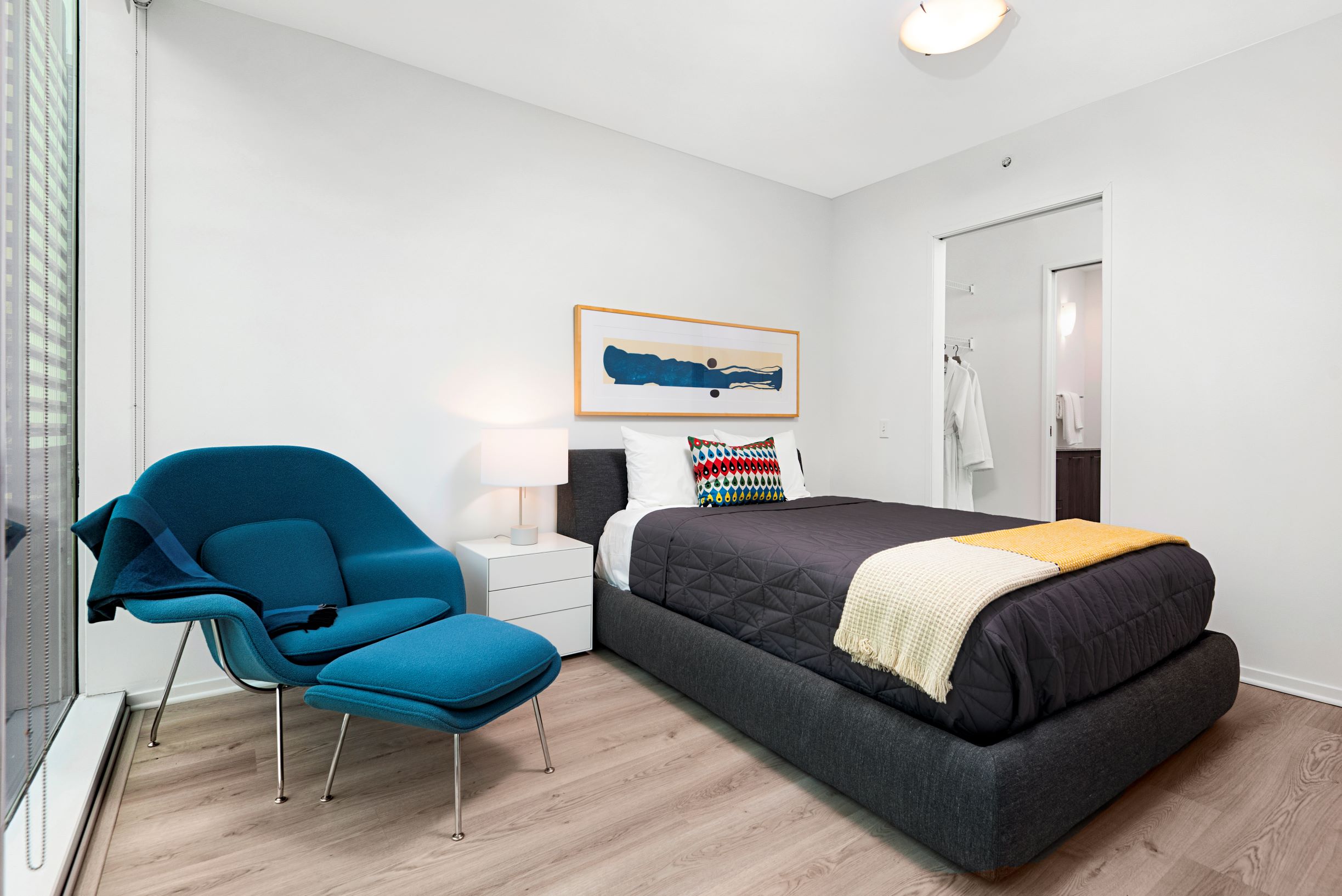
One of the ways we honor the Forever Modern promise and keep it relevant at Optima is by curating both public and residential spaces in our communities with timeless furniture. As we put the finishing touches on the furniture selections for the lobby and model apartments at Optima Lakeview, it’s a perfect time to take a closer look at the Womb™ Chair.

In 1946, Florence Knoll, the pioneering architect who led the furniture empire Knoll Associates with her husband Hans, reached out to friend and fellow architect Eero Saarinen to design a lounge chair for the company. In numerous interviews following the release of the chair, Knoll explained, “I told Eero I was sick and tired of the one-dimensional lounge chair … long and narrow … I want a chair I can sit in sideways or any other way I want to sit in it.” She envisioned “a chair that was like a basket of pillows … something I could really curl up in.”

Originally named No. 70, the chair quickly took on its more intuitive name as people raved about its countless positions and the deep sense of comfort and tranquility it provides. “There seemed to be a need for a large and really comfortable chair to take the place of the old overstuffed chair,” Saarinen explained. “Today, more than ever before, we need to relax.” 

Apart from its novel appearance, the Womb™ chair is also highly innovative from a structural perspective. To achieve a balance between comfort and a modernist silhouette, Saarinen wanted to construct the chair out of a single piece of material. This led him to a groundbreaking new material that had recently been developed to produce minimalistic, yet-durable hulls for Navy vessels during World War II. He then turned to a New Jersey boat builder to use this reinforced-fiberglass-and-resin to produce a prototype of the cropped, folded cone shape he had designed. The final result — a padded and upholstered fiberglass shell that sits on a polished chrome steel frame — combined simplicity of shape with true comfort and flexibility.

A sketch of the Womb™ chair, designed by Eero Saarinen, courtesy of Bob Ewing

Once released, the Womb™ chair quickly became a cultural icon. A 1958 Coca-Cola advertising campaign showed Santa Claus drinking a Coke in a Womb™ chair. The chair also made an appearance in a New Yorker cartoon as well as a Saturday Evening Post cover by American Painter, Norman Rockwell.

Discover the iconic Womb™ Chairs as part of our invitation to “Expect the Extraordinary” when you visit Optima Lakeview. Experience for yourself what it means to lounge in absolute comfort and modernist simplicity, just as Eero Saarinen and Florence Knoll imagined 75 years ago.

Chicago Modernist Gems: A Visit to the Schweikher House

As we continue to discover Modernist treasures in and around Chicago, we came upon the work of Paul Schweikher, a visionary architect who studied, lived and worked in Chicago between 1938 and 1953. It’s a welcome surprise that Schweikher House, his home and professional studio, are listed on the National Register of Historic Places, and are open for public tours.

About the Architect

Paul Schweikher graduated with an engineering degree from the University of Colorado Boulder and moved to Chicago to study at The Art Institute. In the 1930s, he began a collaboration with George Fred Keck, a visionary Modernist architect known for his design of the House of Tomorrow at the Century of Progress International Exposition. Equally impressive, Schweikher’s work was included in a major architectural exhibition at the Museum of Modern Art in 1933, the Work of Young Architects in the Middle West. Schweikher went on to establish an architectural practice in 1934; it was in this practice that he designed some of his most celebrated commissions including the David B. Johnson House (Chicago, 1936), Emerson Settlement House (1939, Hinsdale, IL) and Louis C. Upton House (1950, Paradise Valley, AZ).

After being named chairman of the Yale School of Architecture in 1953, Schweikher became head of the Carnegie Mellon School of Architecture in 1958 and retired in Sedona AZ in 1970.

The Schweikher House

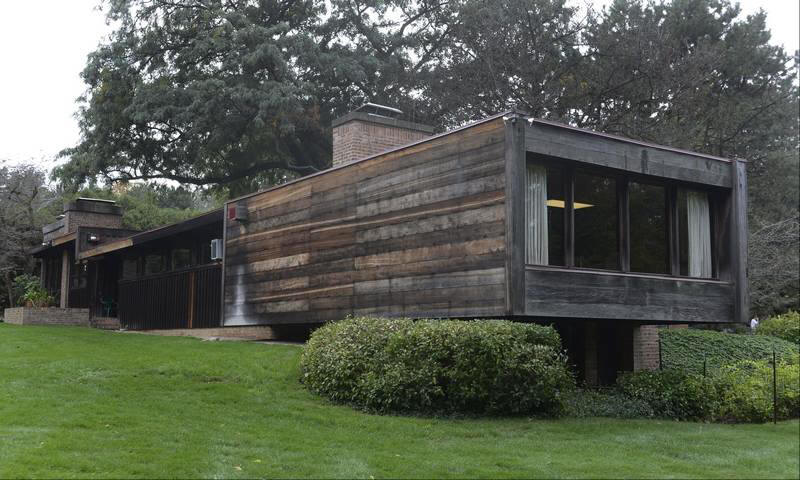
Schweikher built the house in 1937-38, after being inspired on a trip to Japan to study the country’s architecture. As both his private residence and his professional architecture studio, the building reflects a unique amalgam of Prairie, Japanese and vernacular architecture — with a strong modernist underpinning.

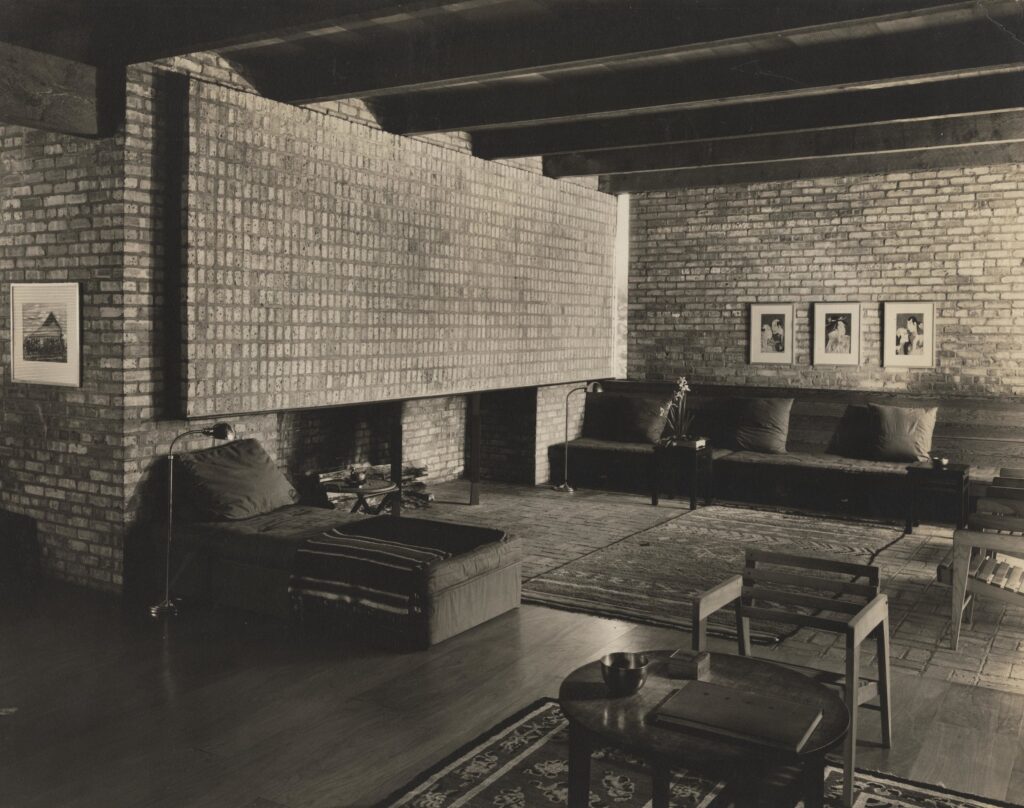
Photo courtesy of the Chicago History Museum/Hedrich Blessing Archive

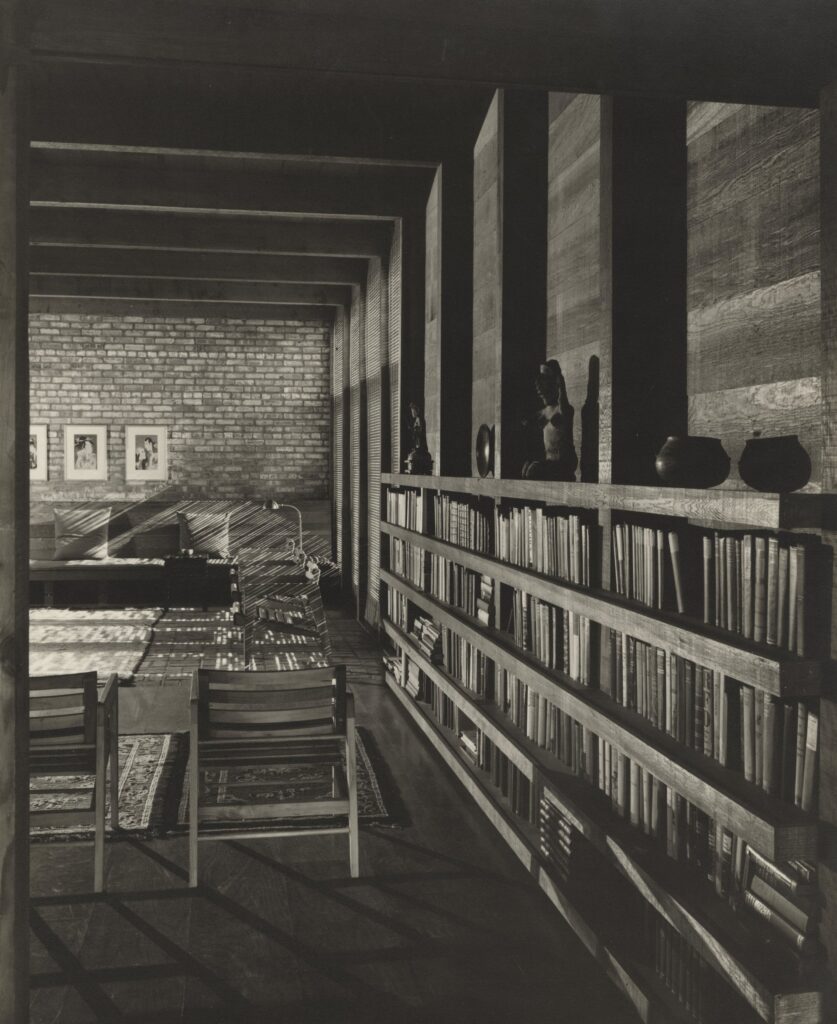
The one-story, T-shaped house was a complete remodel of an old barn situated on a 7-½ acre plot of farmland on the outskirts of Chicago in Roselle, IL. Schweikher chose common materials including brick, red cypress wood and glass to reflect his interests in sustainability and engineering. He designed the interior as distinct areas for sleeping, living and working, connected to allow for a constant flow of natural light and air. He built a massive fireplace in the living room to establish the house’s character, while giving the Chicago common bricks center stage. Inspired by the Japanese minimalist architecture he had seen on his travels, Schweikher included a passive solar room, exposed wood beams, built-in furniture, a soaking tub, concealed storage in the paneling in each of the rooms, and shoji screens throughout the building. 

After nearly a decade of serving as the Schweikher home and studio, the house was featured in the May 1947 issue of Architectural Forum magazine. By that time, the surrounding gardens designed by Franz Lipp, one of the country’s foremost landscape architects, had matured magnificently. In 1948–50, Schweikher made a series of additions including a formal studio that cantilevers over the large back yard and connects by a breezeway to the main building. 

In 1953, when he took up his new position at Yale, Schweikher sold the home to Martyl and Alexander Langsdorf. Over the ensuing decades as owners and occupants, the Langsdorfs maintained the building and grounds with meticulous care, and spearheaded the effort to have it listed on the National Register of Historic Places in 1987. In 1999, they sold the Schweikher House to the Village of Schaumburg in 1999 so it could be preserved as a public house museum, allowing this treasure of timeless architectural value to be experienced, enjoyed and learned from by all.

Photo courtesy of the Chicago History Museum/Hedrich Blessing Archive

Scheduling a Visit

The Schweikher House is located at 645 W Meacham Road in Schaumburg, IL. Tickets to docent-led tours can be purchased online; a reservation is required.

Chicago Skyscraper History: the Merchandise Mart

Chicago has earned its place on the architectural map with endless distinctions, including being home to the tallest building in the world for 25 years and to numerous acclaimed architects like Mies van der Rohe, Frank Lloyd Wright, Marion Mahony Griffin and Jeanne Gang. But did you know that it’s also home to the world’s largest commercial building? Today, we’re taking a look at the history of the city’s beloved Merchandise Mart

How It Came to Be

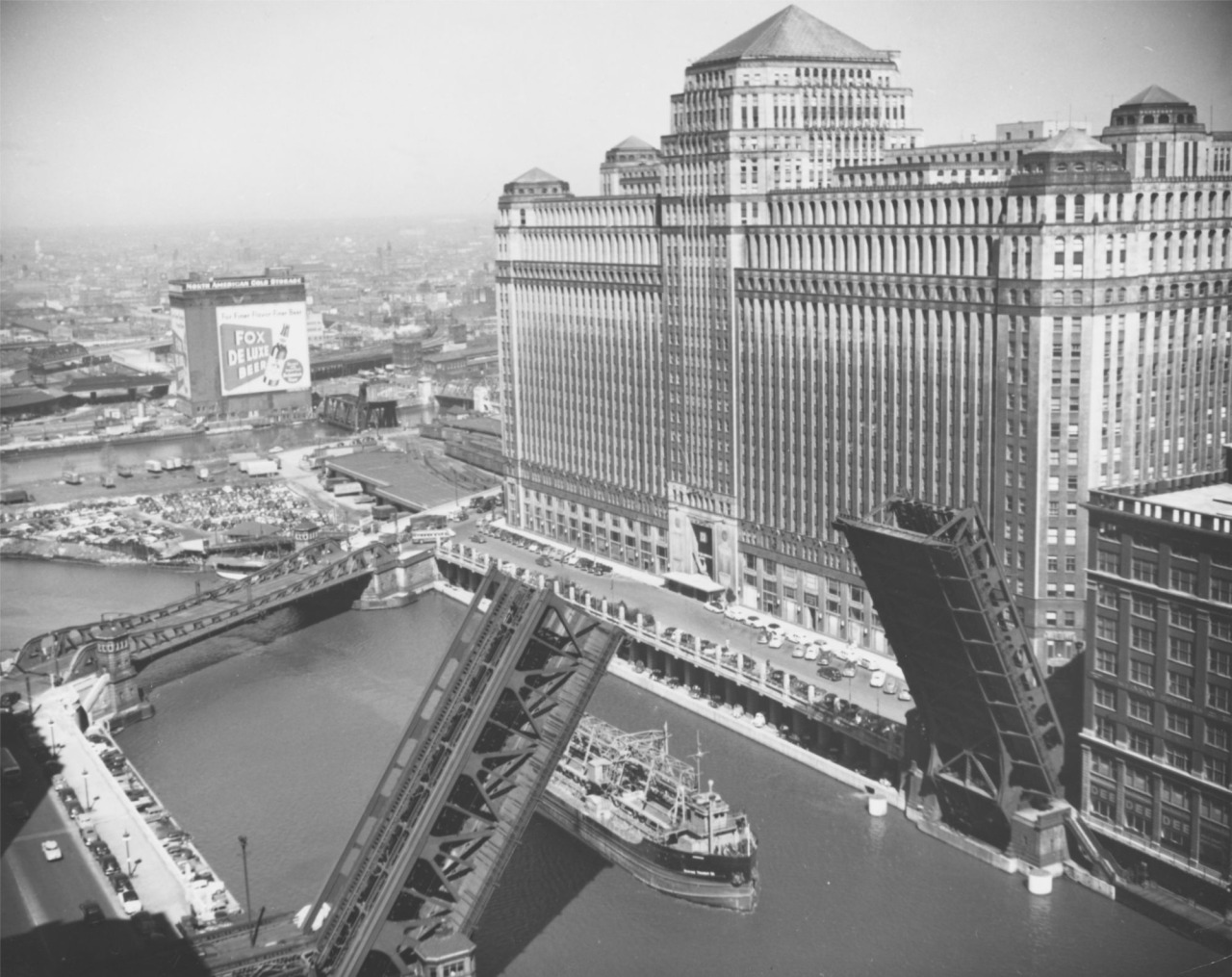
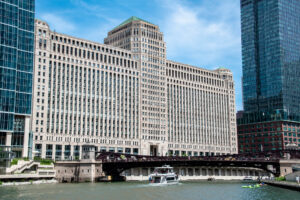
As dated infrastructure (like the abandoned railroad yards in the downtown area) proliferated in the early decades of the 20th century, more and more land development opportunities opened up. In hopes of beautifying the frontage along the Chicago River, Marshall Field & Co. announced their purchase of one of the largest available sites, at the junction of the River’s branches. The company began construction in 1928 and when the Merchandise Mart opened in 1930, it achieved the company’s dream of becoming a dedicated wholesale center for architectural and interior design vendors and trades serving the entire nation. And, with 4 million square feet on 25 floors under a single roof spanning two city blocks, it became the largest building in the world.

TheMART was imagined as a city-within-a-city. Graham, Anderson, Probst & White, the architects behind the structure’s streamlined look, took inspiration from traditional Art Deco architectural elements, including ribbon piers to define windows, setbacks and pavilions atop each corner to disguise the bulk of the building. Marshall Field himself was involved in the building’s design; his love for art inspired him to employ Jules Guerin to create 17 murals on the interior lobby’s frieze. Each mural details trade throughout the world and depicts the products, transportation and architecture of 14 countries.

TheMART was also a monumental experiment in state-of-the-art engineering and modern materials. At a cost of $26 million, it took advantage of construction techniques normally used in the building of big dams and employed nearly 5,700 workers at the height of the Great Depression.

theMART in the Modern Era

Throughout the latter half of the 20th century, theMART faced a handful of modernization projects. One was designed by Helmut Jahn to connect the building with the Apparel Center located across Orleans Street with a pedestrian bridge. The building was LEED Certified Silver in 2007, followed by LEED Gold Certification in 2013 and in 2018.

In recent years, as the contract furniture industry has evolved from a focus on a wholesale hub and independent manufacturer showrooms, the Mart has repositioned itself as a destination for innovation, creativity, technology and entrepreneurship. Rebranded “theMART,” the building remains the world’s largest commercial building, and has become home to a host of changemakers, including Motorola Mobility, 1871, Yelp, PayPal and MATTER, as well as Fortune 500 companies Conagra, Allstate, Kellogg, Beam Suntory, and Grainger.

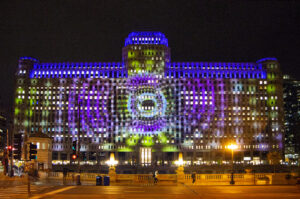
Art on theMart, Art Institute of Chicago’s exhibition, Monet and Chicago, April, 2021
Merchandise Mart
Merchandise Mart. Credit: Brandon Olafsson on Flickr Creative Commons CC BY 2.0 Deed

Today, theMART continues to celebrate an appreciation for architecture and art. The building now hosts a digital art display popularly known for “Art on theMART,” to showcase the work of prominent artists on the south façade of the structure. 

With our love for all things “forever modern” at Optima, we are proud to have this magnificent example of design innovation and tireless reinvention in our midst.

A Guide to Frank Lloyd Wright’s Studios Part 1: Taliesin

Frequently referred to as the father of American modernism through his establishment of the Prairie School of architecture, Frank Lloyd Wright gifted the world with many culturally-significant designs, forever leaving his stamp on American architecture. Many of Wright’s designs are widely celebrated and remain standing today, including Taliesin, one of his most iconic works that altered his life and the lives of those around him while serving as his studio.

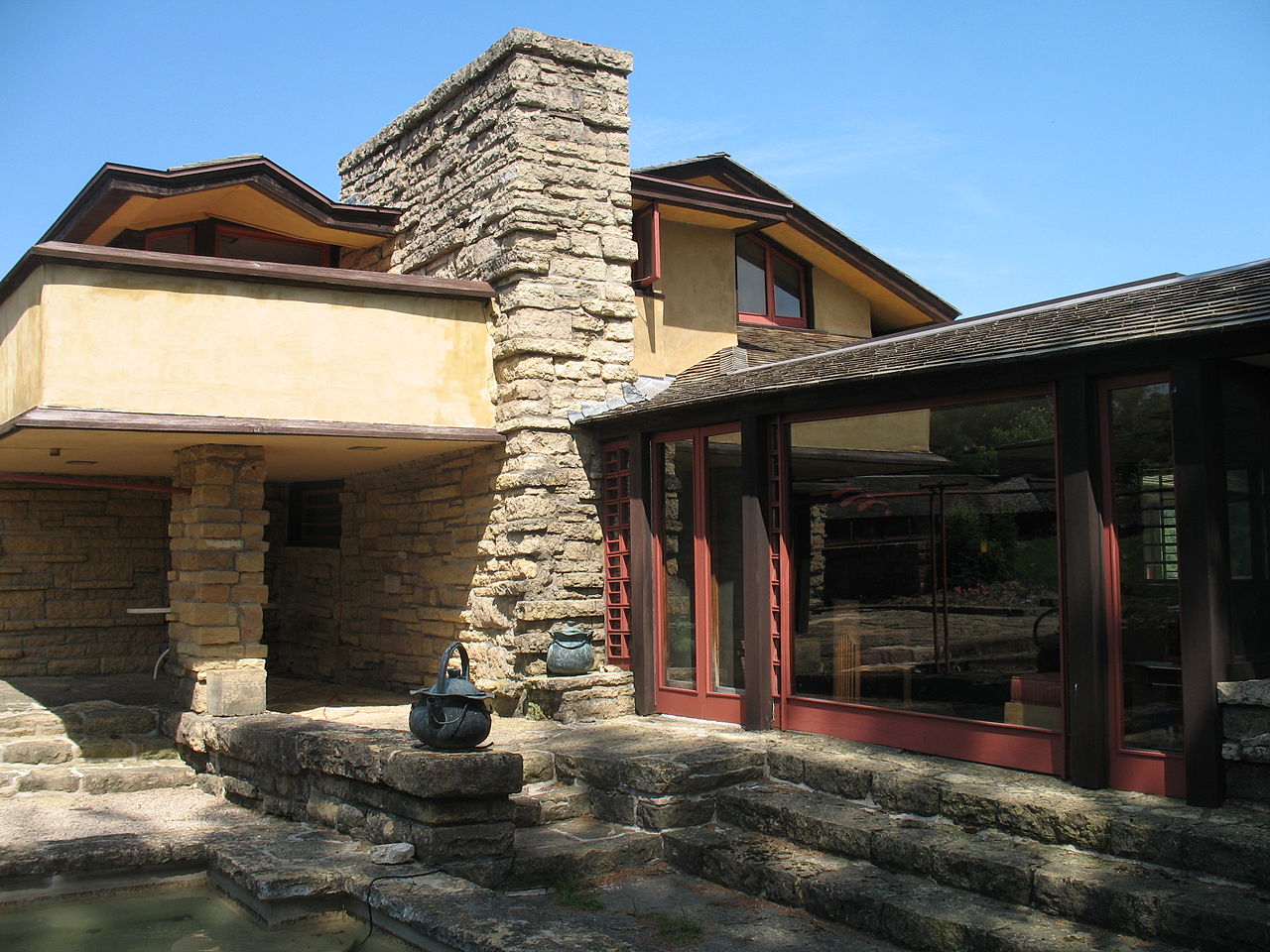
The archetype of Prairie School architecture was built in 1911 by Wright after he had left Oak Park, Illinois to return to his family’s land in Spring Green, Wisconsin. Derived from Welsh mythology, Taliesin was an ancient poet, whose name means radiant brow. Wright built the exemplary estate in a Wisconsin River valley into the brow of his favorite hill from boyhood, hence its name. 

During the process of designing Taliesin, Wright drew inspiration from the patterns and rhythms of his surroundings. He became inspired by the thought of living among his ancestry and the nature that surrounded him as he embodied the idea of organic architecture within his design. Wright refined visions from his previous Prairie School designs, including a lush courtyard and open floor plan, and used local limestone and sand from the Wisconsin River to invite the outdoors indoors — a radical idea at the time. 

Throughout the estate’s history, it suffered a number of accidents, including two fires that sparked Wright to complete two renovations on Taliesin. The first of which, Taliesin II, was completed in 1915 after arson had destroyed one-third of the house, including Wright’s living quarters. The redesign was nearly identical to the architecture in Taliesin I, excluding its new observation deck and, in an attempt to make the estate completely self-sufficient, Wright’s hydroelectric generator. 

Taliesin, Photographed in 1913 before the first of its two fires, Courtesy of Wisconsin Historical Society

Following another destructive fire in 1925, Wright was forced once again to pour new life into Taliesin and went to develop the third rendition of the estate, Taliesin III. Through the devastation, Wright remained committed to his passion for thoughtful architecture and brought a breath of fresh air to the bare structure that surrounded him. While living at Taliesin III Wright also designed some of his more renowned work, including Fallingwater, the headquarters for S.C. Johnson and Jacobs I (the Herberg Jacobs House).

Beginning in 1932, Wright established the Taliesin Fellowship and hosted 50 apprentices at Taliesin on an annual basis, giving them the opportunity to work for him for a lengthy period of time and experience his intensive working environment. Today, the estate is in the hands of the Frank Lloyd Wright Foundation, and the fellowship uses the neighboring Hillside School as its home base. The esteemed property was listed in the National Register of Historic Places in 1973 and was recognized as a National Historic Landmark in 1976. 

Located just a few hours outside of Chicago, the Taliesen estate is the perfect day trip for anyone who appreciates breathtaking architecture and offers visitors a variety of tours designed for every level of interest, which can be booked on their website here

Women in Architecture: Jane Drew

As part of our ongoing “Women in Architecture” series, we’re spotlighting another luminary in the field: Jane Drew. As the spearhead of the Modernist Movement in London, Jane Drew prevailed as a determined leader in a male-dominated profession, as she changed the lives of many by directing her career to explore the intersections of architecture and wellness.

The Life of Jane Drew

Drew was born on March 24, 1911, in Thornton Heath, Croydon, in South London. Her father was a surgical instrument designer and founder of the Institute of British Surgical Technicians, and her mother was a school teacher who greatly encouraged Drew’s interest and appreciation for art and nature. 

After graduating high school, Drew began her study at one of the most prestigious and competitive architectural schools in the world, the Architectural Association School of Architecture in London. Following five years of study, during which she married fellow architect James Thomas Alliston, Drew propelled herself into the architecture world working for Joseph Hill. During her employment, Drew was introduced to Bohemianism, which fostered her musical, artistic, literary and spiritual pursuits and had a lasting impact on her career. 

Following her divorce in 1939, Drew became heavily involved in the International Congresses of Modern Architecture (CIAM), introducing her to Swiss architect Le Corbusier. Eventually, under the guidance of the CIAM, Drew became a principal founder of the Modern Movement in Britain alongside Henry Moore, Elizabeth Lutyens, and her future husband, Maxwell Fry. 

Inspired by the abundance of talent surrounding her, Drew’s illustrious architectural career blossomed in the 1940s. She opened her firm at the beginning of the decade and only employed female architects, giving them a unique platform for professional and creative pursuit. Due to constraints posed by World War II, much of Drew’s work was limited to London. However, in 1944 she was appointed as the assistant town-planning advisor to the resident minister for the British West African colonies, which would change the trajectory of her career forever. 

Career and Accolades

Alongside the great heartbreak, World War II brought to London came new opportunities, especially for Drew and her husband, who had established a new firm in London: Fry, Drew and Partners. In 1947 she began designing a series of new schools in Ghana and Nigeria. With cultural appreciation in mind, Drew and Fry worked around the unique topography to incorporate native motifs and create a new architecture style for the new nation, now known as Tropical Modernism. 

In 1951, Indian Prime minister Pandit Nehru approached the couple in hopes they would develop the new capital of the Indian state Punjab, Chandigarh. The couple eagerly accepted his offer and began working with Le Corbusier to create their most celebrated architectural work. The couple experimented with new forms of design in the country and discovered methods to integrate schools, health facilities, and swimming baths into housing structures, affecting the future of housing designs throughout India.

Drew’s triumphant accomplishments didn’t stop there; she garnered even greater acclaim during the latter half of her career. Some of her most renowned works included designing the interior of London’s Institute of Contemporary Arts building (an organization that she helped establish), the School for the Deaf in Herne Hill, London, and buildings for the Open University in Milton Keynes, England. 

Drew continued her involvement in architecture after her retirement in 1973 and served on the Council of the Royal Institute of British Architects, of which she was a lifelong fellow. And, shortly before her death in 1996, she was awarded Dame Commander of the Order of the British Empire. 

Throughout her distinguished career, Drew’s passion for conscious design prevailed through her modern work. With every new project, Drew took away an abundance of new knowledge, forever shaping her future work and fashioning the process of thoughtful decision-making that remains in architecture today. 

Meet the Winner of the Redesign the World Contest

As champions of leading-edge, thoughtfully-designed spaces built to inspire communities, we enjoy sharing the visionary work of others who continue to impact the world’s landscape. In early 2021, Dezeen, the internationally-acclaimed architecture, interiors and design magazine, launched its Redesign the World 2021 competition. More than 100 firms submitted their ideas for rethinking planet Earth, and Dezeen has provided a platform to showcase the 15 most visionary, radical solutions to ending environmental issues. 

Dezeen launched the contest in partnership with Epic Games and architectural visualization tool Twinmotion. The competition sought revolutionary solutions and asked contestants several ambitious questions, including: where and how will everyone live; how will vital ecosystems flourish; and most importantly, what would a redesigned planet resemble? 

Each proposal consisted of an in-depth narrative, still images and a short video animation depicting the landscape. And, following more than two months of deliberation, Dezeen published all of the top submissions here, including the winning entry: Fernando Donis’ Frame City.

Donis, a celebrated architect known for designing CCTV Headquarters and managing the international architect firm Donis, constructed an idealized environment in which nature and humanity coexist. In his design, Donis established new forms of topography formed by terrace-like structures made of timber, depicting a vibrant natural landscape filled with lush greenery intended to house millions of people. The inspired landscape takes advantage of the most sustainable transportation methods and produces an environment where diverse networks of cultural exchange would thrive.

Like Optima, Donis envisions a world where nature and infrastructure become one, and innovative, thoughtful design leads the direction for an excelling world. You can read more about Fernando Donis and his vision behind Frame City here.  

Optima Lakeview Brings WiredScore Certification to Chicago Multifamily Developments

As employment and living spaces continue to blur, residents are seeking communities that foster technology for both entertainment and work purposes, empowering them to define the way they live. At Optima, we are proud to share that our newest multifamily development, Optima Lakeview, meets those demands and is the first multifamily development to achieve the WiredScore Home Gold certification in North America.

“At a time when people are working from home more than ever before, Optima Lakeview is proud to be a leader in ensuring residents can access a fast and reliable wireless connection throughout the building – whether they are in their home or using one of the many amenity areas,” said David Hovey Jr., AIA, President. “People’s reliance on technology has only increased since the pandemic, so we’re excited to show our residents our commitment to meeting their technology needs in their new home. At Optima Lakeview, residents and their guests can confidently use their devices wherever and whenever as they’ll always have strong connectivity.”

In 2019, WiredScore launched its first Home certification in the UK, and after great success, they expanded, launching WiredScore Home in North America in June 2021. Optima’s partnership with WiredScore began prior to the formal launch in September 2020. Since then, they have provided essential guidance on leading technology features that matter most for our residents’ experiences, leading to the exceptional standards of a high-quality, resilient digital network that Optima Lakeview meets.

We sat down recently with Michelle Eichengrun, Client Success Manager at WiredScore, to talk about the experience working with the Optima team. “Achieving WiredScore Home Gold certification acknowledges Optima’s position as a leader in innovation,” Eichengrun explains, “and recognizes the vast technological and digital connectivity advancements that Optima Lakeview offers its residents. The road to certification was an intense one, grounded in a rigorous evaluation process that focused on five essential aspects of modern living: masterplanning, infrastructure, services, monitoring and innovation. Every step of the way, we were impressed with the responsiveness of the Optima team, the excellence of their design, and their commitment to investing in future-proof technology for their residents.”

Residents in Optima Lakeview will benefit from best-in-class digital connectivity features accessible across the entire seven-story development. The building will be home to a cellular repeater system to improve mobile performance even in the most confined locations. Three internet connectivity providers will be available to tenants: AT&T, RCN and Comcast. With same-day sign-up and speed options available, residents will be able to stream movies, play games, digitally communicate with loved ones and start remote work the moment they move in. 

Fast and secure Wi-Fi will stretch throughout Optima Lakeview’s extensive amenity areas, allowing tenants to remain connected throughout the whole building. Each residence will also contain dedicated and protected media panels for telecommunications equipment. 

“In today’s world, connectivity is no longer the renter’s problem; it’s now the owner’s responsibility to provide them with the best technological experiences,” Eichengrun says, “and Optima Lakeview has taken the responsibility to provide seamless and aspirational digital technology features for residents — so they don’t have to.” 

We continue looking towards the future, designing each of our multifamily properties with exceptional programming, service and technology in mind, and WiredScored’s Gold Certification of Optima Lakeview is a reflection of our commitment to these values. To learn more about Optima Lakeview visit our website. To learn more about WiredScore Certification, please visit wiredscore.com.

A Brief History of the Skylight

One of Optima’s hallmark design principles is bridging outdoor and indoor environments through thoughtful architecture. Throughout history, many features of design have supported that same principle. Today, we’re exploring an ancient feature of architecture that continues to evolve with time and make its mark in delightful new ways — the skylight. 

History 

The concept of using natural light to brighten a room isn’t new. The skylight’s origin can be traced back to Ancient Roman architecture and design. The extravagant feature was regularly included in many Roman construction feats and was often referred to as an oculus. One of the most famous skylights of its time, the oculus at the Pantheon in Rome, still welcomes vibrant rays into the church today.

Over time, glass became a sought-after resource for use in grand development features like the skylight. As the industrial revolution began, more and more innovative architectural advancements came into play, including the fabrication of architectural glass work, allowing a growing number of architects to experiment with skylight design.

Architects around the world began incorporating skylights in their designs, which allowed them to play with volume, natural light and interior space in exciting new ways — much to the delight of their patrons who commissioned their work. Many of the most celebrated buildings erected from the mid-18th century through the early 19th century featured skylights, including the opulent Palace of Versailles and the elegant arcades of the Galerie Vivienne and Passage Jouffroy.

Optima Lakeview

Our newest luxury residential development, Optima Lakeview, is dedicated to pushing the boundaries to offer a fresh, elevated sense of home; as part of the vision, we chose to orient the entire building design around a seven-story atrium, replete with a fixed in place, geometric skylight fabricated from steel and coated in our signature Optima Red.  Beyond the design itself, the use of skylights floods the interior volume with natural light, offering residents and visitors a constant boost to their health and wellbeing. 

Natural light floods into the atrium and other extraordinary amenity spaces at Optima Lakeview

Today

The skylight has continued to evolve and expand its purpose. Modern adaptations, benefitting from new design thinking coupled with sophisticated engineering and materials, allow for more observable connections to outdoor environments and sustainable building standards, including energy and temperature conservation. 

Today’s design professionals working on projects ranging from commercial buildings to retail centers to private residences continue to break new ground with skylights that provide exciting new features such as roof windows and other retractable roof lights that expose the outdoors. And with the ongoing research and interest in natural light’s many health benefits by scientists and architects alike, there is no doubt that the iconic skylight will continue evolving, with forward-thinking architects pushing the boundaries.

person name goes here

Maintenance Supervisor

Glencoe, IL


    Acceptable file types: *.pdf | *.txt | *.doc, max-size: 2Mb