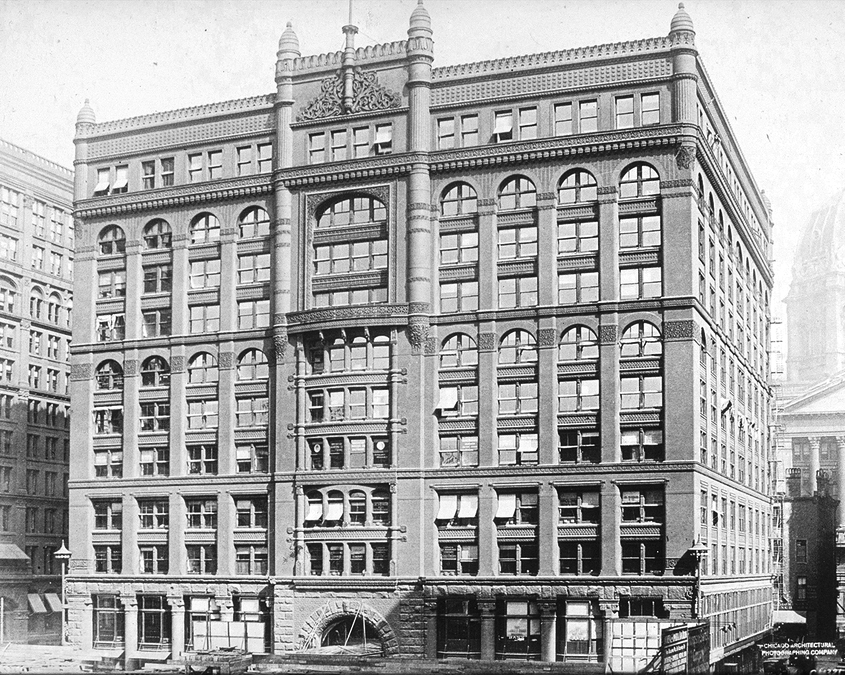
Chicago Skyscraper Spotlight: Rookery Building

Highly regarded as one of the most historically significant buildings in Chicago, it’s only natural that we would include the Rookery Building in our ongoing Chicago skyscraper spotlight series. So what does it take for a building to earn such an esteemed title – especially in a city with a skyline marked by its architectural diversity and richness? Let’s take a look.

Big Shoulders Indeed

The Rookery Building was completed in 1888 by architects Daniel Burnham and his partner John Wellborn Root, under their firm Burnham and Root. Overall, the structure is considered one of their masterpiece buildings and was even once the location of their offices. Standing at twelve stories high (188 feet total), it’s also considered the oldest standing high-rise in Chicago.

The Rookery Building rose from the ashes of the Great Chicago Fire. Burnham and Root were part of the Chicago School of Architects who worked to rebuild the city during that time, utilizing modern industrial techniques combined with traditional techniques and design, resulting in a truly unique product.

The unique name, too, comes with a story: only a water tank was left standing from the original structure after the fire. A temporary structure was built around this tank, and was nicknamed the “rookery” – in part because of the pigeons and crows that perched on its exterior, but also in part because of the crooked politicians it housed within.
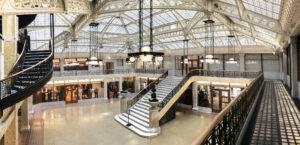
The Rookery, Chicago
Light Well and Mezzanine at The Rookery. Credit: Alan on Flickr Creative Commons CC BY-NC-ND 2.0 Deed

The Rookery Building in the Modern Era

Burnham and Root weren’t the only big names to call the Rookery Building home. At one point, Frank Lloyd Wright once held offices there as well. In fact, Wright even remodeled the building’s lobby in 1905. Just a few decades ago, from 1982 to 1992, a massive renovation project was completed to restore the lobby to this original Wright design once again.

These days, the building is home to tenants such as US Bank, Brooks Brothers, Perkins Eastman and Interactive Brokers Group. Both the Frank Lloyd Wright organization and the Chicago Architectural Society offer tours inside the building, so that lovers of great architecture today can continue to appreciate its history, story, and gorgeous features.
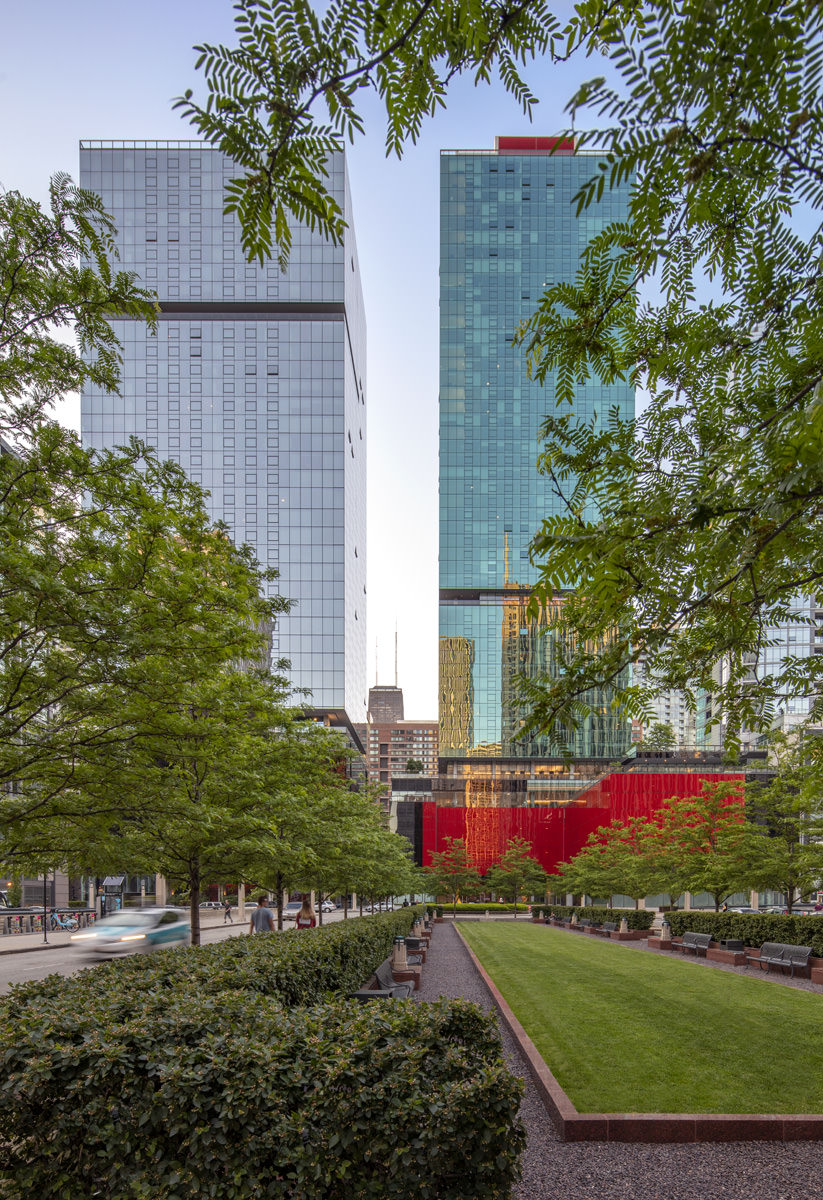
Green Space Spotlight: Optima Signature

In a dense urban area like Chicago, green space might look a little different. With all of our projects, we design our residences to welcome the outdoors indoors; at Optima Signature, that meant making sure residents could still get outside in the city. The green space at Optima Signature takes advantage of landscaping and contemporary, urban recreational design to embrace downtown Chicago living.

On the ground level, Optima Signature is surrounded by greenery with an inviting plaza. Lush landscaping features benches and seating areas, as functional for residents as they are for passersby or pedestrians. Kiwi, an original sculpture designed by David Hovey, Sr., adds visual movement and a playful quality to the entrance of the building.

Once inside, Optima Signature features an impressive 1.5 acres of amenity space, many of which are designed to bring residents outdoors. Heated swimming pools, outdoor terraces, herb gardens for resident use, fire pits and outdoor entertaining all contribute to making residents feel as if they’re in an outdoor oasis in the middle of the city. Strategic landscaping, plants and trees ensure a sense of privacy, despite sharing the amenities with other residents. Designed for residents in all walks of life, Optima Signature also includes an outdoor dog park and play areas for children (although there are indoor options for when the Chicago weather inevitably turns cold). In a concrete jungle, Optima Signature brings residents a bit closer to nature.

When moving to a city, many assume they’ll have to give up access to generous outdoor space. The residences, amenities and green space at Optima Signature offer the best of both worlds, all within a beautifully designed, Modernist tower that overlooks Chicago’s energetic downtown.

Chicago Skyscraper Spotlight: Willis Tower

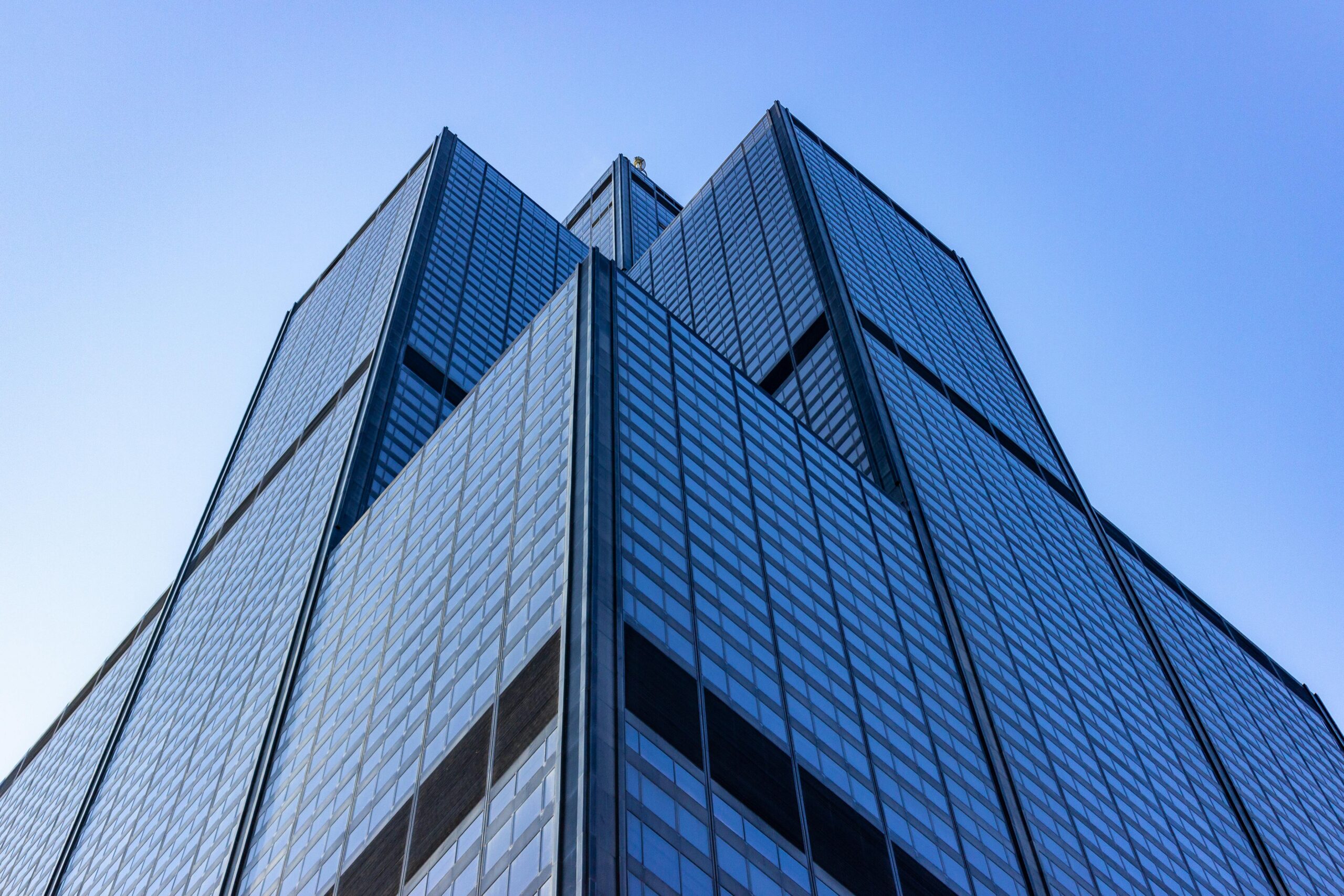
If you ask anyone – Chicago native or tourist – to name one building in the city, odds are they’ll say Willis Tower (or perhaps Sears Tower, since the name only recently changed). This goliath skyscraper towers over the skyline, standing as a landmark beacon from vantage points even miles away. But how much do you really know about the famed Willis Tower? Today, we take a closer look at the building’s rich history.

The History of Willis Tower

One of the most contentious debates among Chicagoans this millennium has been whether they’ll call Willis Tower by its new name – or stick to tradition and refer to it as the Sears Tower. The tower was first envisioned in 1969 by the department store and its original namesake, Sears and Roebuck Company. Needing a place to house their 350,000 employees, the leading retailer commissioned architectural firm Skidmore, Owings and Merrill to complete the task.

And complete the task they did. Groundbreaking on the superstructure occurred a year later in 1970, and when the tower was completed three years later, it stood proud and tall at 108-stories as the world’s tallest building (surpassing even the World Trade Center in New York City). This soaring frame was made possible by a steel-framed bundled-tube construction, and boasts being the first building to use this structurally efficient and economic method.

Though Sears and Roebuck Company sold the tower and moved out eighteen years later, the newly-named Willis Tower continues to host companies such as United Airlines (its largest tenant) and its new namesake, Willis Towers Watson.

Chicago Willis Tower skydeck
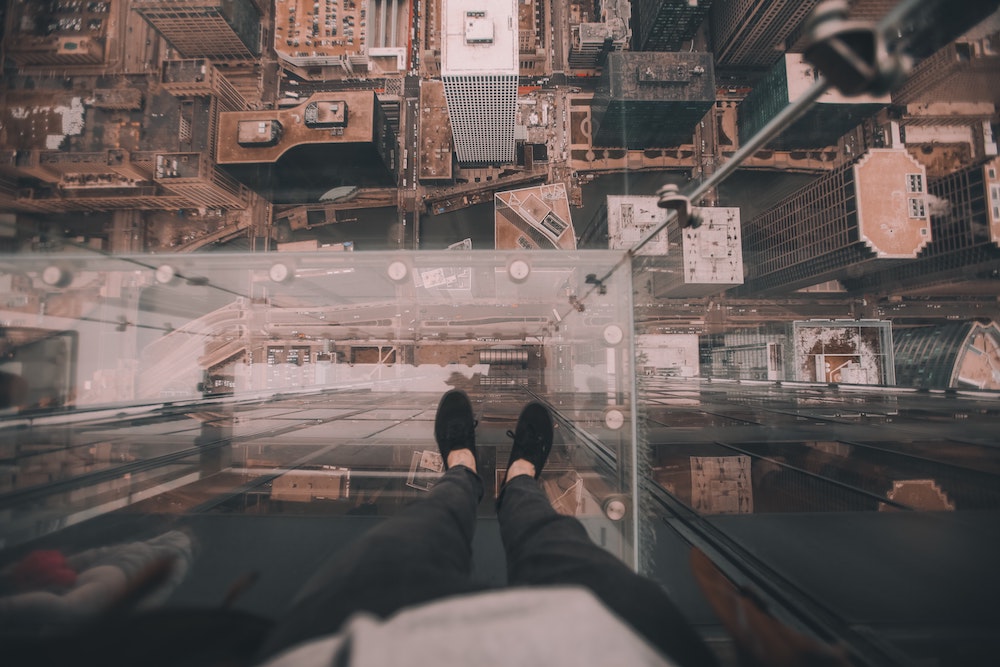
Looking down from The Ledge at Willis Tower

Not Your Average Office Building

Having held the title of the world’s tallest building until being unseated from the throne in 1998, Willis Tower naturally had to welcome visitors to come witness the outstanding views. The building’s world-renowned observation deck, the Skydeck, has been open since 1974. Located on the 103rd floor and standing at an elevation of 1,353 feet, visitors (on a clear day) can see as far as Indiana, Michigan and Wisconsin as they feel the building sway in the wind. 

In 2009, the same year as the building’s name change, the Skydeck underwent renovation to now include glass boxes that jut four feet out over the skyline, informally dubbed “The Ledge.” Thrill-seeking visitors experience the sensation of floating above the city skyline while enjoying the famous view – a view which draws in 1.9 million visitors annually.

Naturally, such a structure attracts thrillseekers of a different kind as well. In 1981, a man named Dan Goodwin donned a Spiderman suit, some suction cups, camming devices and skyhooks scaled the entire tower. The attempt took him seven hours, despite the Chicago Fire Department’s best attempts to stop him, and he was arrested when he reached the top. In 1999, another Spiderman impersonator, Alain “Spiderman” Robert attempted the same journey as his predecessor, this time with only his bare hands and feet… he was mostly successful.

If that last paragraph tempts you to try your own risky ascent, know that an annual charity event, named SkyRise Chicago, legally allows visitors to climb the tower’s 103-story staircase, making it the world’s tallest indoor stair climb.

Whether it’s from a passing car on Lakeshore Drive, peering up into the sky as you traverse downtown, or running up a 103-story staircase, there’s many ways to appreciate the rich history and beautiful views the Willis Tower brings to Chicago’s city skyline.

Chicago Skyscraper Spotlight: The Wrigley Building

As part of our Chicago Skyscraper History series, we’re exploring some of the architectural feats that have defined Chicago, and buildings across the world. The Wrigley Building, established in 1924, was one of the first major office buildings north of the Chicago River — paving the way for many workplaces that followed. And that wasn’t all that set this show stopping skyscraper apart… 

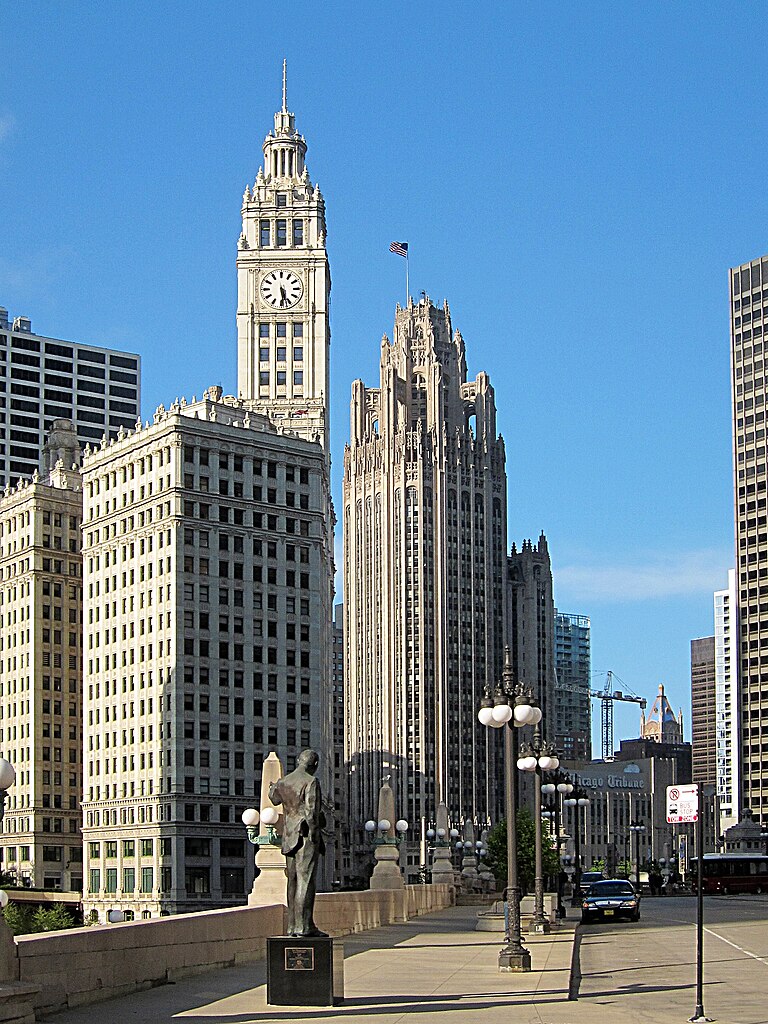
The Wrigley Building is located at 400-410 North Michigan Avenue on the southernmost end of the Magnificent Mile, directly across from the Tribune Tower. As mentioned above, at the time of the building’s groundbreaking in 1920, there were no other major office buildings north of the river. Chewing gum magnate William Wrigley Jr. hand selected the oddly shaped lot for the headquarters of the Wrigley Company. Unbeknownst to Wrigley, this would set off a building boom in the area, and eventually lead to the establishment of a strip of Chicago’s finest skyscrapers.

The Wrigley Building certainly set the tone for those who followed. Designed in the Spanish Colonial Revival style by architect Graham, Anderson, Probst and White, the building is a luminous beacon recognizable to locals and tourists alike. The building facade is made of six shades of gleaming white terra cotta, getting lighter and more luminescent as the structure climbs into the sky. This coloration was a choice made by Wrigley himself, having seen the famed White City display at the World’s Columbian Exposition years ago in 1893, and having never forgotten the shining hues. The Wrigley Building is cleaned regularly to maintain its sparkling white stature. 

The building’s southern tower went up in 1920, and the northern tower followed in 1924. These two towers are connected by two separate bridges (one on the 3rd floor and one on the 14th floor), another defining feature of the renowned architectural gem. The 14th floor bridge, which was constructed in 1931, was added to connect the two disparate offices of a bank in accordance with a City of Chicago statute. 

The Wrigley Building has since earned landmark status in 2012, and although the Wrigley Company is long gone, they’ve no doubt left their mark on Chicago’s skyline.

Chicago Skyscraper History: Tribune Tower

Chicago is home to a diverse array of styles and voices that have forever marked architecture in the city, and in the world. In our Chicago Skyscraper History series, we’re taking a magnifying lens to the skyline and looking at the unique buildings and stories that define it. Today, our focus is on the iconic Tribune Tower.

A Historic Landmark and Event

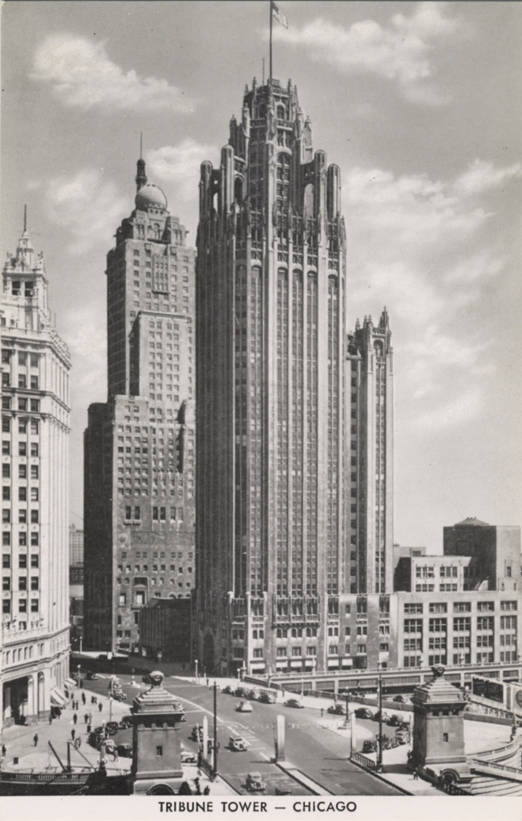
While the original Tribune Tower was built in 1868, it was destroyed in the Great Chicago Fire in 1871. The iconic neo-Gothic tower as we know it today rose from the ashes of that tragedy. Hoping to replace the home they’d lost, the Chicago Tribune hosted a design competition in 1922 inviting architectural firms internationally to submit proposals for their new headquarters, in celebration of the paper’s 75th anniversary. The first prize proposal would receive $50,000 for “the most beautiful and distinctive office building in the world.”

In total, 260 entries were received by architectural greats such as Finnish architect Eliel Saarinen and Bauhaus-founder Walter Gropius. While many entries received critical acclaim during the widely-publicized competition (and are archived today at the Art Institute of Chicago), the first-prize spot went to New York architects John Mead Howells and Raymond Hood.

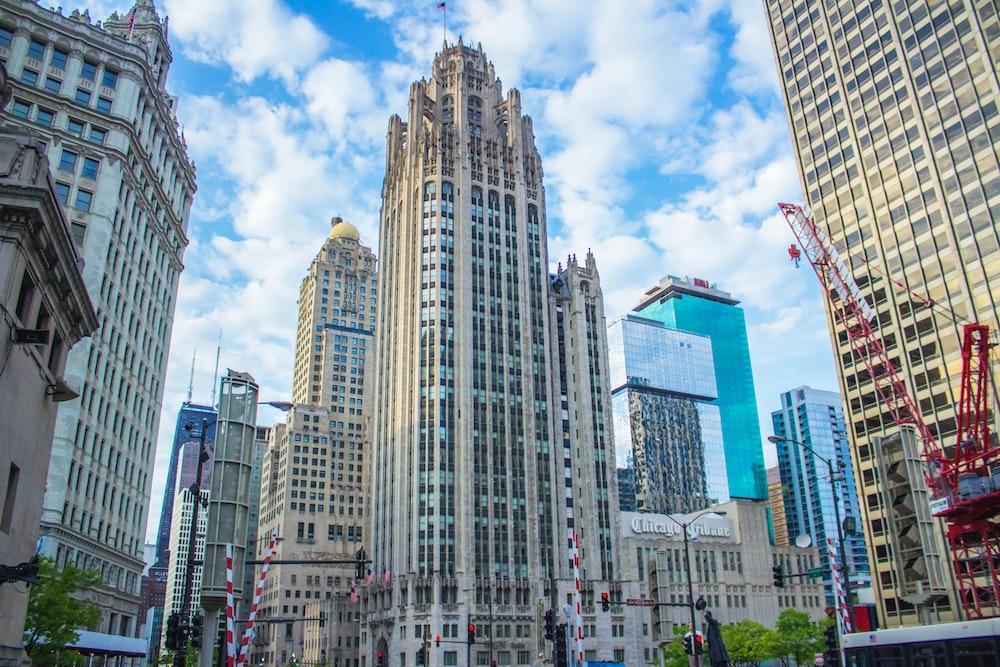
The neo-Gothic design from Howells & Hood features ornate buttresses at the peak of the tower, which can be seen peeking out above the city skyline, illuminated at night. The highly decorative tower features details such as carved images of Robin Hood (representing architect Raymond Hood) and howling dogs (representing architect John Mead Howells), as well as countless gargoyles — one of which is a frog.

Tribune Tower, with Optima Signature and Optima Chicago Center visible to its right

The lowest levels of the building also feature rocks and bricks from numerous historically significant sites across the world. These 149 special fragments include stones from the Great Pyramid, Abraham Lincoln’s tomb, Notre Dame de Paris, the Great Wall of China, Taj Mahal and even petrified wood from the Redwood Forests. From 1999-2011, the building even featured a Moon rock, brought by Buzz Aldrin on loan from NASA.

The tower, which is a Chicago landmark and part of the Michigan-Wacker Historic District, has been home to the Chicago Tribune, Tribune Media, Tribune Publishing and WGN Radio. Most recently in early 2018, work began to convert the entire office building into ultra-luxury condominiums. The building’s neighborhood, Streeterville, is also home to our Optima Signature and Optima Chicago Center residences. We’re biased, but we love the history and significance the neighborhood holds to the city. 

No matter its function, the Tribune Tower will always remain a remarkable part of architectural history, in both Chicago and the world.

The Subsects of Modernist Architecture Part III

As part of our “Subsects of Modernist Architecture” series, we’re continuing to explore the many trickle-down pockets of Modernist design throughout the years. Picking back up where we last left off in Part II, European Modernism continued to spread globally and set the precedent for the next wave of architectural movements that emerged. Here’s what followed:

International Style

The International Style (sometimes also referred to as internationalism) emerged in the 1920s and 30s. Originated in post-World War I Holland, France and Germany, the style quickly caught on worldwide, eventually becoming the dominant architectural style in the 1970s. According to the Getty Research Institute, “the style is characterized by an emphasis on volume over mass, the use of lightweight, mass-produced, industrial materials, rejection of all ornament and colour, repetitive modular forms, and the use of flat surfaces, typically alternating with areas of glass.” 

Major figures in the International Style movement include Bauhaus Founder Walter Gropius, as well as Bauhaus Director Ludwig Mies van der Rohe and Le Corbusier. Both Gropius and Mies van der Rohe were instrumental in introducing the International Style to Chicago’s architecture — leaving a lasting impact on the city’s skyline that can still be seen and appreciated today.

Metabolism

Like many subsects of Modernist architecture, Metabolism emerged in response to the post-war period in Japan. First introduced during a Congrès Internationaux d’Architecture Moderne (International Congresses of Modern Architecture, or CIAM) meeting in 1959, the movement became fully-fledged just a year later when young architects Kiyonori Kikutake, Kisho Kurokawa and Fumihiko Maki released the Metabolism manifesto during the 1960 Tokyo World Design Conference.

The style was marked by its dynamic fusion of megastructures and organic biology. Metabolism was also heavily influenced by the Marxist philosophies of the time. The architects behind the movement envisioned a more flexible form of urban planning, one where modular towers could be easily installed. They even went so far as to propose vast cities that could float on the ocean, with these modular structures as their foundation. The most successful examples of Metabolism include the site of the 1970 World Exposition, designed by Kenzō Tange, and the Nagakin Capsule Tower, designed by Kisho Kurokawa.

Brutalism

Brutalism, also called Brutalist architecture or New Brutalism, emerged in the 1950s in the UK during post-war construction. The word Brutalism is derived from the Swedish phrase nybrutalism, as well as being associated with the French phrases béton brut (“raw concrete”) and art brut (“raw art”). It’s easy to see the connection: the style is characterized by monolithic forms, rigid geometric styles, and unusual shape, and commonly makes use of bare or raw materials being exposed in monolithic color palettes. 

Influenced by socialism, Brutalist architecture was often employed in the UK to create utilitarian, low-cost housing solutions or government buildings. Perhaps for this reason, the style received widespread criticism and was often regarded as “cold” or “soulless.”  Nevertheless, many Brutalist structures have left a strong impression on architecture today and remain the cornerstone of universities and public institutions worldwide. 

Stay tuned for more features on the subsects of Modernist architecture.

The Architecture of Bertrand Goldberg

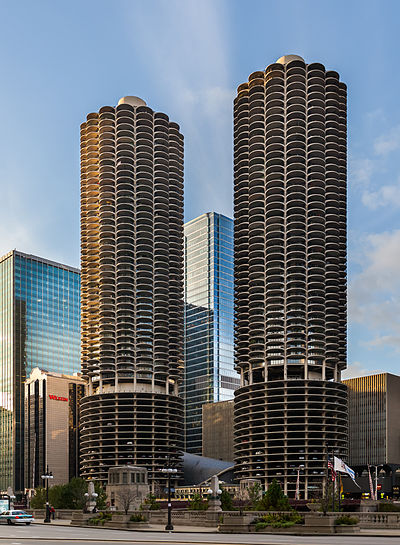
Chicago is home to a vast array of architectural diversity, from Modernism to Prairie School and beyond. Although no two city skyscrapers are the same, Marina City is one building that particularly stands out. Built by American architect Bertrand Goldberg, the industrial series of towers represent his unique mark on Chicago architecture. Today, we’re taking a closer look at Goldberg’s life and work.

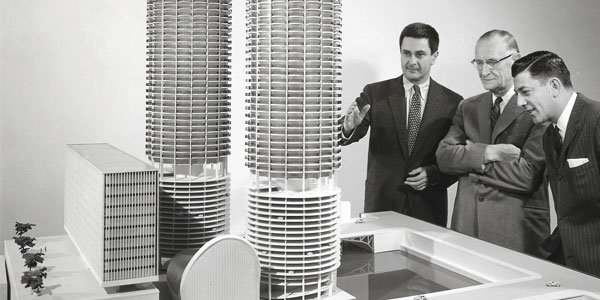
Bertrand Goldberg presenting a model of Marina City; photo courtesy of BertrandGoldberg.org

Early Life and Architectural Beginnings

Born local to Chicago in 1913, Bertrand Goldberg left the US for Germany at the ripe young age of eighteen in 1932. There, he studied at the Bauhaus and worked at the small architectural office of Bauhaus director Ludwig Mies van der Rohe. Like many others studying and working in Germany during that period, Goldberg eventually had to flee the country under mounting political pressure and civil unrest. After a brief stint in Paris, Goldberg returned to his hometown in Chicago to continue his career.

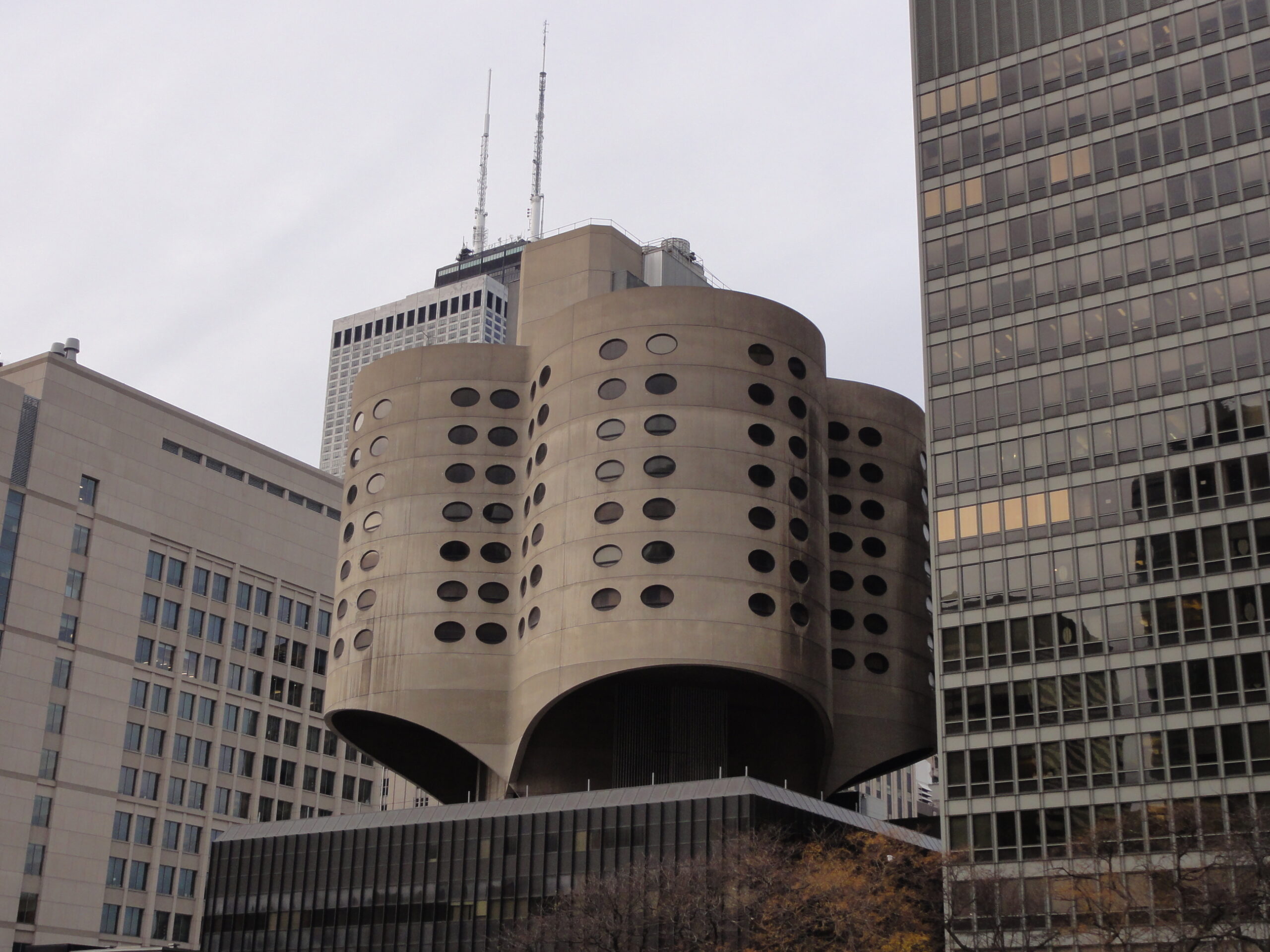
Prentice Women’s Hospital, designed by Bertrand Goldberg, in Chicago, IL

The Work of Bertrand Golberg

At only 23 years old, Goldberg opened his own architectural office in Chicago. He was most known for his innovative structural solutions to complex problems, with commissions that included designing an easily transportable structure for the North Pole chain of ice cream shops as well as many prefabricated projects and mobile vaccine laboratories for the US government. 

His work was always experimental, testing out ways to create unconventional forms through extremely conventional and mundane materials. His most popular project is Marina City, often referred to as the “corn cobs,” which stand out in sharp relief against the Chicago riverfront. 

Marina City is a mixed-use complex of five concrete towers, built in 1961-1964, that has continued to change and evolve over time. Goldberg’s original plan was complete with an office building, theater, public pedestrian plaza, an active rail line, a marina, an ice skating rink and a bowling alley. Though the rail line and skating rink are no longer standing, the theater remains, converted in the Chicago House of Blues venue.

The success and critical acclaim of Marina City inspired many of Golberg’s later structures, including River City in Chicago and several hospital structures across the country. Though Goldberg died in Chicago in 1977, he has built a lasting legacy and forever left his mark on the Chicago skyline.

Office Collaboration Spotlight

From the big picture to the day-to-day details, Optima’s success depends on our team communicating and working together. We sat down with two members of our architecture team, Pete Foerster and Colin O’Donoghue, to learn more about how Optima’s office collaboration creates engagement, cohesion and community. 

With architecture teams based in two locations, what keeps you all connected and engaged? 

Pete: “When the Arizona office opened in 2000, we wanted the two teams to be symbiotic and to have the same processes. Our processes, policies and standards remain the backbone of how we all operate.” 

Colin: “The most natural and easy way to collaborate is when one office has a demanding schedule that requires more help. When a project in a specific location has a demanding schedule, we can all jump in and help out. This gives us a chance to speak daily, if not hourly, with our team in Arizona.”

How has your experience at Optima shaped the way you work with other architects?

Pete: “Working at Optima for almost 20 years, many of my historical best practices have come from how long I’ve worked with David Hovey Sr. I understand and take pride in the company philosophy and I’m happy to teach it to others. My door is always open for anyone on my team.”

Colin: “Our architecture team embraces Optima as a family-owned and design-led business. We really see ourselves as family members. You’re able to let your guard down internally and to learn from each other. At Optima, you have to think more holistically and problems actually get solved quicker.”

Can you share a specific example of when collaboration yielded surprising or exciting results?

Pete: “When the Arizona office opened in 2000, we wanted the two teams to be symbiotic and to have the same processes, but that’s hard to accomplish. Our team had to create new standards to keep things running efficiently. Having our core values helped remind people of what’s important.” 

Colin: “With the roof deck at Sonoran Village, there are a lot of systems coming through the roof, but we had to divert them to accommodate amenity spaces. We had a very elaborate duct system that was tricky to resolve, but working with the field team, we were able to solve the problem together so it wouldn’t affect the roof terrace.”

With a talented group of people across two offices, our architecture team is an inspiring example of how collaboration works within Optima. As Pete says, “every day can be a surprise and every day can be a learning opportunity.”

person name goes here

Maintenance Supervisor

Glencoe, IL


    Acceptable file types: *.pdf | *.txt | *.doc, max-size: 2Mb