The Sculpture Garden at Optima Sonoran Village

At Optima, our appreciation and curiosity about materials — and how those materials are expressed — extends beyond architecture and into the artistic medium of sculpture. The sculpture garden at Optima Sonoran Village is home to several original sculptures by Optima founder David Hovey Sr., and exemplifies how art can influence and impact the space it resides within.
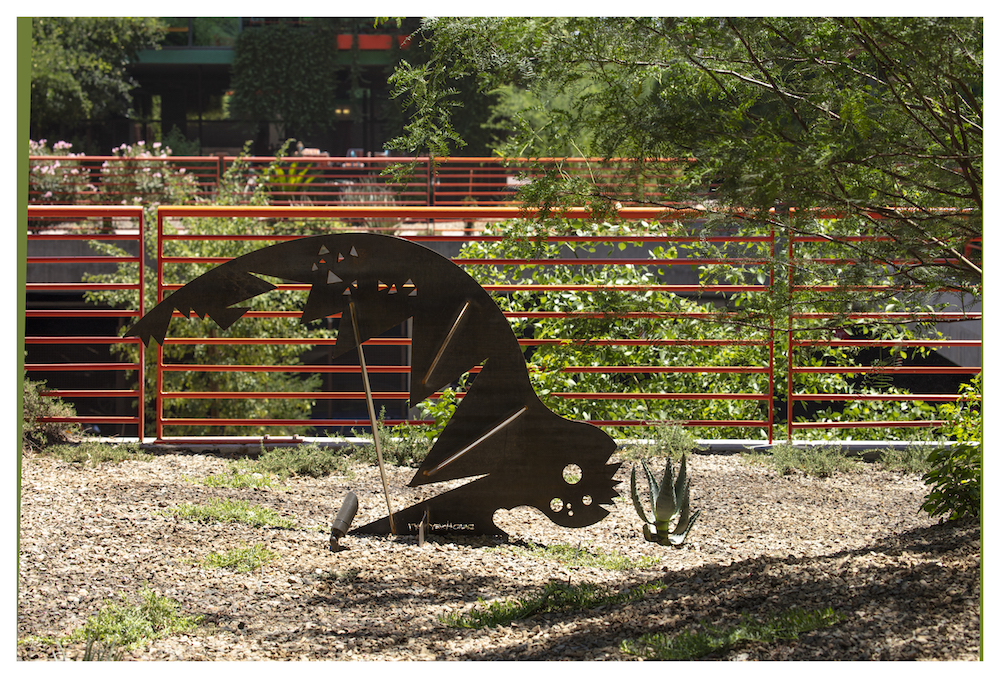
Silver Fern, an original Optima sculpture by David Hovey Sr.

The garden includes five original David Hovey Sr. sculptures: Curves and Voids, Silver Fern, Triangles, Intersecting Arches and Duo. Originally created as a large and monumental sculpture, Duo is crafted out of steel to create a striking silhouette alluding to a man and a woman gazing at one another. Meanwhile, Curves and Voids expresses steel and its potential through grand, sweeping curves. The voids are laser cut within the sculpture’s steel planes; the holes provide gaps and textures that contrast and play off of the sculpture’s curves.
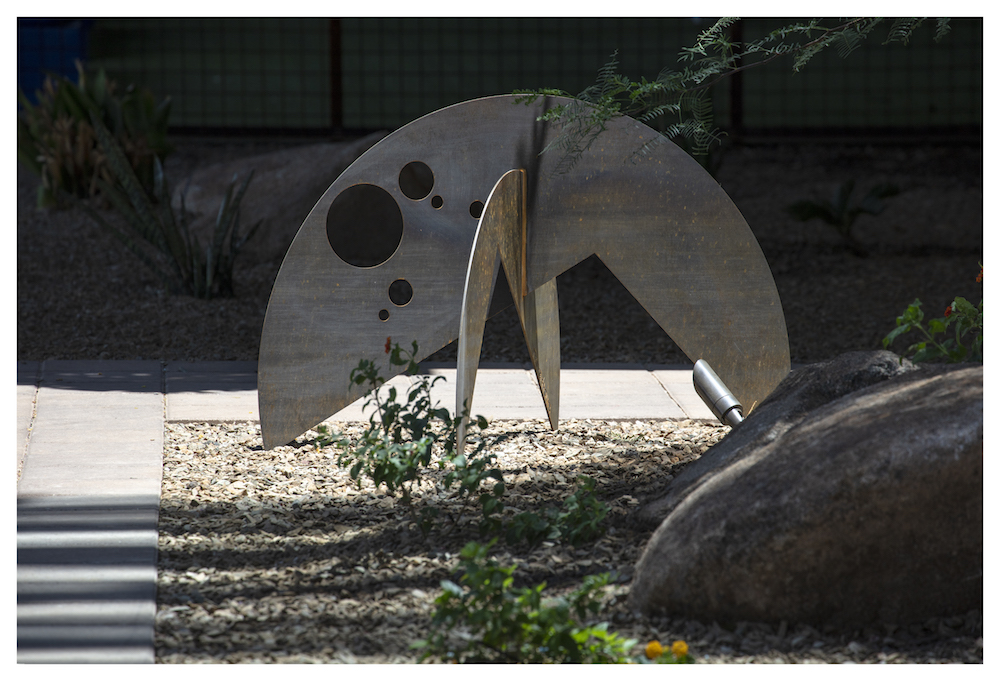
Intersecting Arches, an original Optima sculpture by David Hovey Sr.

Each original sculpture within the garden is just one of many variations of a design. David Hovey Sr. often experiments with color, size and orientation within his sculpture designs to breathe new life into the same form, placing these iterations across Optima communities. At the sculpture garden at Optima Sonoran Village, Hovey Sr. chose to use Corten steel rather than coat the sculptures in bold hues. He did so to ensure that rather than competing with the building’s vibrant facade, the sculptures would complement the community. Of the five sculptures, Curves & Voids is large-scale, and the other four remain of modest size. 

We invite anyone who visits Optima Sonoran Village to take a stroll through the sculpture garden, to immerse themselves in the art form and to discover how sculpture can transform the space it’s within. 

Ray Eames: A Pioneer in American Architecture

A talented artist, designer and filmmaker, Ray Eames is a well-known name throughout the architecture and design industries. The name Eames itself carries weight; Ray Eames was half of the husband-and-wife duo that made an enormous impact on modern design. Though her husband, Charles, received most of the praise and spotlight during their partnership due to the gender conventions of their time, Ray was a powerful voice and creative in her own regard. Today, we look back on her life and contributions to the world of design.

Born in Sacramento, California in 1912, Ray was passionate about art from an early age, expressing interest in dance, illustration and art history. After pursuing art as a student for years, Ray eventually found her way to New York, fully immersed in the abstract art scene. By 1940, she decided to pursue a holistic approach to art and design at the Cranbrook Academy of Art, in Michigan, where she then met her husband, Charles. Upon meeting Charles, Ray took her strengths in color, form and structure and applied them to furniture design, and the two began a creative and life partnership that would thrive for decades.

Although Charles had a more public profile, Ray worked full-time and was equally devoted to their work. Together, they explored new, inventive designs for furniture, products, short films and architecture. Their own house is arguably the greatest representation of their architectural work. A structure of steel and glass, the Eames House is an iconic piece of modern architecture, with Ray’s background in abstract art informing the Mondrianesque panels on the front façade.

Eames House. Credit: IK’s World Trip on Flickr Creative Commons, CC BY 2.0 Deed

The Eameses worked as partners from 1941 until 1978 when Charles passed away. Their collaboration and creative vigor continues to inspire to this day, and is even reminiscent of our own David Hovey Sr. and Eileen Hovey, who have built Optima while also building a life and family together. 

To read more about the life and work of Ray Eames, check out a recent feature by The New York Times

Chicago’s Public Art: The Calder Flamingo

Sculptures are art made architectural; dramatic corners, inventive materials and a consideration of space and its voids. At Optima, our appreciation for sculpture runs deep, with Optima co-founder David Hovey Sr. expanding the design reach of Optima to include his own original sculptures. Indulging in our love for the craft, we’re exploring Chicago’s public art, piece-by-piece. This week, it’s all about Alexander Calder’s famous Flamingo.

The Calder Flamingo

Though you might not notice it immediately as a flamingo, every Chicagoan is familiar with the long and graceful arcs of the famous red Flamingo sculpture designed by Alexander Calder. Calder is a seminal Modernist multi-media artist perhaps best known for his many whimsical mobile creations.

The Flamingo, however, is the antithesis of his mobile sculptures set apart by their dynamic motion — he referred to the goliath sculpture as a “stabile,” a freestanding abstract sculpture made in the style of a mobile but sitting rigid and stationary. It is this peculiar approach that gives The Flamingo an inevitable feeling of potential energy, instilling an almost alien vitality to the Federal Plaza where it lives.

Weighing in at 50 tons and made of steel, the sculpture feels anything but heavy in the space it occupies. Its arches and voids invite passerby to walk beneath and through the art on their way to surrounding office buildings in the plaza  — including the Ludwig Mies van der Rohe-designed Kluczynski Federal Building.

The sculpture was designed specifically for this space, to add a lightness and balance to the severity of the Federal Building’s Modernist lines. Unveiled on October 25, 1974, at the same time that Calder’s Universe mobile was unveiled at the Willis Tower, the momentous, art-filled occasion was declared “Alexander Calder Day” and even featured a circus parade. 

The festivity, spirit and joy of this sculpture and its history are apparent to all that visit it on display in Chicago, adding yet another meaningful and momentous sculpture to our city’s iconic and artful culture.

Chicago’s Public Art: The Picasso

Sculptures are the ultimate exploration of materials and their expression. With Optima Co-Founder David Hovey Sr. having expanded the design reach of Optima to include sculpture, the medium is one that hits close to home for us. To indulge in our love for the craft, we’re exploring Chicago’s public sculpture art, piece-by-piece. First up is an iconic staple in Chicago: The Picasso.

The (Chicago) Picasso

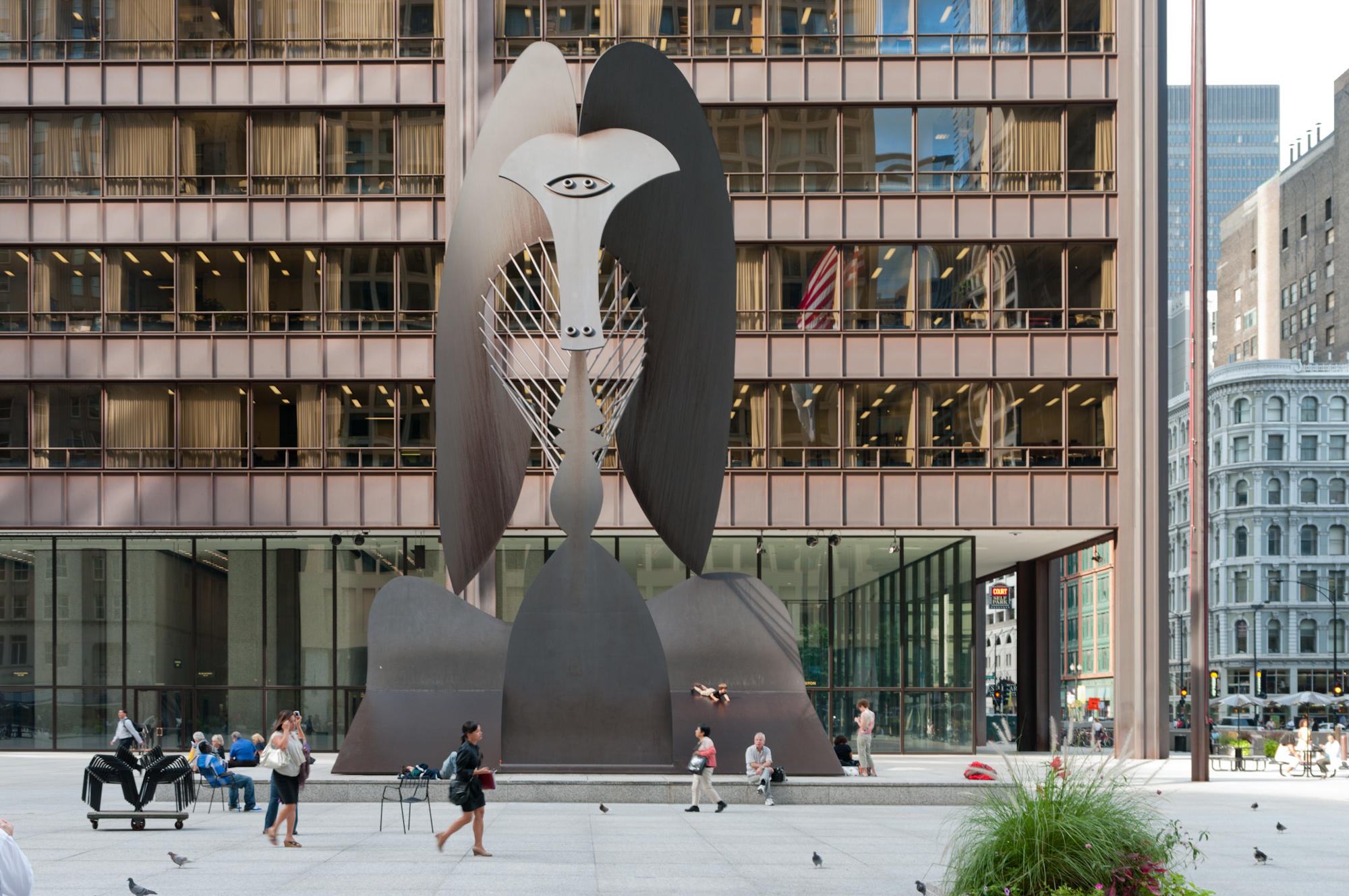
The monumental, larger-than-life sculpture created by Pablo Picasso situated in downtown Chicago goes unnamed by the artist. However, the work is affectionately referred to as The Picasso and even The Chicago Picasso. The sculpture is now a globally-renowned landmark, standing 50 feet tall and weighing in at 162 short tons.

The Chicago Picasso was commissioned by the architects of The Richard J. Daley Center in 1963. Occupying the beloved Daley Plaza alongside the skin-and-bones International Style Modernist skyscraper, the sculpture stands out as a whimsical and abstract piece that invites plaza visitors to jump, climb and slide upon its smooth, COR-TEN steel surface. The interactive sculpture cost the modern day equivalent of $2.8 million, with three charitable foundations shouldering the cost. And although Picasso himself was offered $100,000, he refused the payment, insisting that he wanted to make the work as a gift.

Picasso’s inspiration remains a mystery, though some muse that the armadillo-esque figure is actually an abstracted portrait of the French woman, Sylvette David – now known as Lydia Corbette. The sculpture’s abstract nature was met with tough criticism initially. In a city where most sculptures were famous figures, some didn’t take kindly to the strange public art newcomer. But it was only a matter of time before The Chicago Picasso rightly became a revered piece of Chicago’s vibrant public art collection, brightening the Daley Plaza and the city with its presence. 

Taking Art Online: How to Visit Fan-Favorite Museums Digitally

As art enthusiasts, we know a trip to the museum can provide much needed inspiration and solace. While many physical cultural institutions have closed their doors as we shelter-in-place, their doors remain very much open online. Today, we’re sharing how our favorite museums have been taking art online, and how you can visit iconic global institutions digitally.

J Paul Getty Museum

Take a trip to sunny LA with digital museum tours offered by the J Paul Getty Museum in Los Angeles, California. Their expansive collection of 6,000+ works makes the museum worth the visit on any ordinary day, but through Google Arts and Culture, you can actually physically “mouse” your way through the galleries via an interactive online museum tour, or scroll through three online exhibits and 15,000+ artistic works.

Vatican Museums

While sheltering-in-place, the options for online exploration are limitless. Traverse internationally across the interwebs to place yourself via computer into the Vatican Museums in Rome, Italy. Explore the Sistine Chapel, impressive architectural details, intricate murals and an astounding array of artwork via their online virtual tours featuring expansive, 360-degree views. Afterwards, you can even take an “outdoor stroll” around the Vatican City with You Visit.

Picasso Museum

In keeping up with our love of Picasso, we recommend spending a few hours online at the Picasso Museum in Barcelona, Spain. A seemingly-endless digital archive of Pablo Picasso’s most renowned works is accompanied by some of the best-preserved Medieval architecture in Barcelona. Enter the museum through its ancient and rustic patios to discover the digital treasures within via this digital interactive tour.

Art Institute of Chicago

Missing visits to your local favorite? Have no fear, because the Art Institute of Chicago is bringing the comforts of a familiar gallery to your couch. Their array of online resources include ways to surf the entire museum collection, new and highly-detailed interactive features, a digitized version of their current special exhibit and more. 

As we continue to spend our days at home, virtual trips to explore the arts and culture provide a much needed vibrant reprieve. Stay tuned for more Optima features on how to stay engaged, connected and inspired at home. 

The Work of Pablo Picasso

One of the world’s most iconic creators, Pablo Picasso is globally known as one of the most influential artists of the 20th century. His brightly-colored work adorns the walls of our Optima buildings, and today we dive into his life and work.

Pablo Picasso
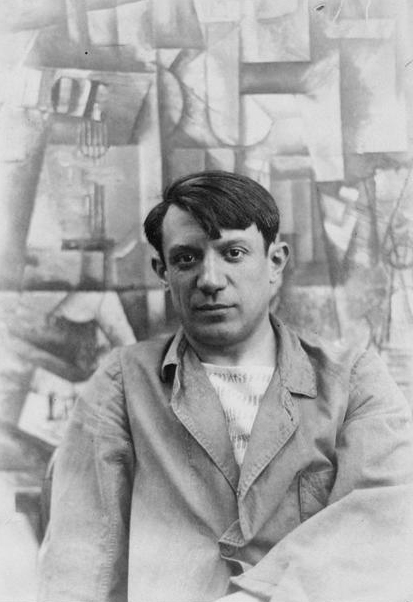
Pablo Picasso, 1912. Photo in Public Domain

A Promising Start

Born in Spain in 1881, Picasso was a gifted artist from a young age, receiving lessons early on from his father, who was also a painter. While trained and mentored in academic realism, by the time Picasso was sixteen, his interpretation of Modernism began to attract attention within the art world. Picasso struggled with the close influence of his father, who he fought with frequently, and eventually bounced back and forth between Spain and France to pursue his own distinguished style.

An Expansive Body of Work

Throughout his life, Picasso became known for his range of distinctive styles and contributions to various art movements. His work covered Cubism, Surrealism, Neoclassicism, as well as his famous Blue Period and Rose Period. Having lived in Europe through both World Wars, Picasso’s work is reflective of a world changing rapidly and drastically. While living in a German-occupied Paris during World War II, Picasso continued to create paintings and sculptures, despite the fact that his work did not fit the Nazi ideal of art. By the time Paris was liberated, he was already an international celebrity within the art world, a reputation that continued to grow.

Picasso sculpture in Daley Plaza, 1967. Credit: Dan DeLuca on Flickr Creative Commons, CC BY 2.0 Deed

A Lasting Legacy

Throughout his life, Picasso refined his mastery of painting, sculpting, printmaking, ceramics and stage design, while also dabbling in poetry and film. His art came with a turbulent personal life, including a web of muses, mistresses, wives and grandchildren, which proved complicated when it came to his estate after he passed away in 1973. His legacy was one of rigorous exploration and zealous creativity, solidifying his name as one of the world’s greatest artists.


Sculpture Spotlight: Windsong

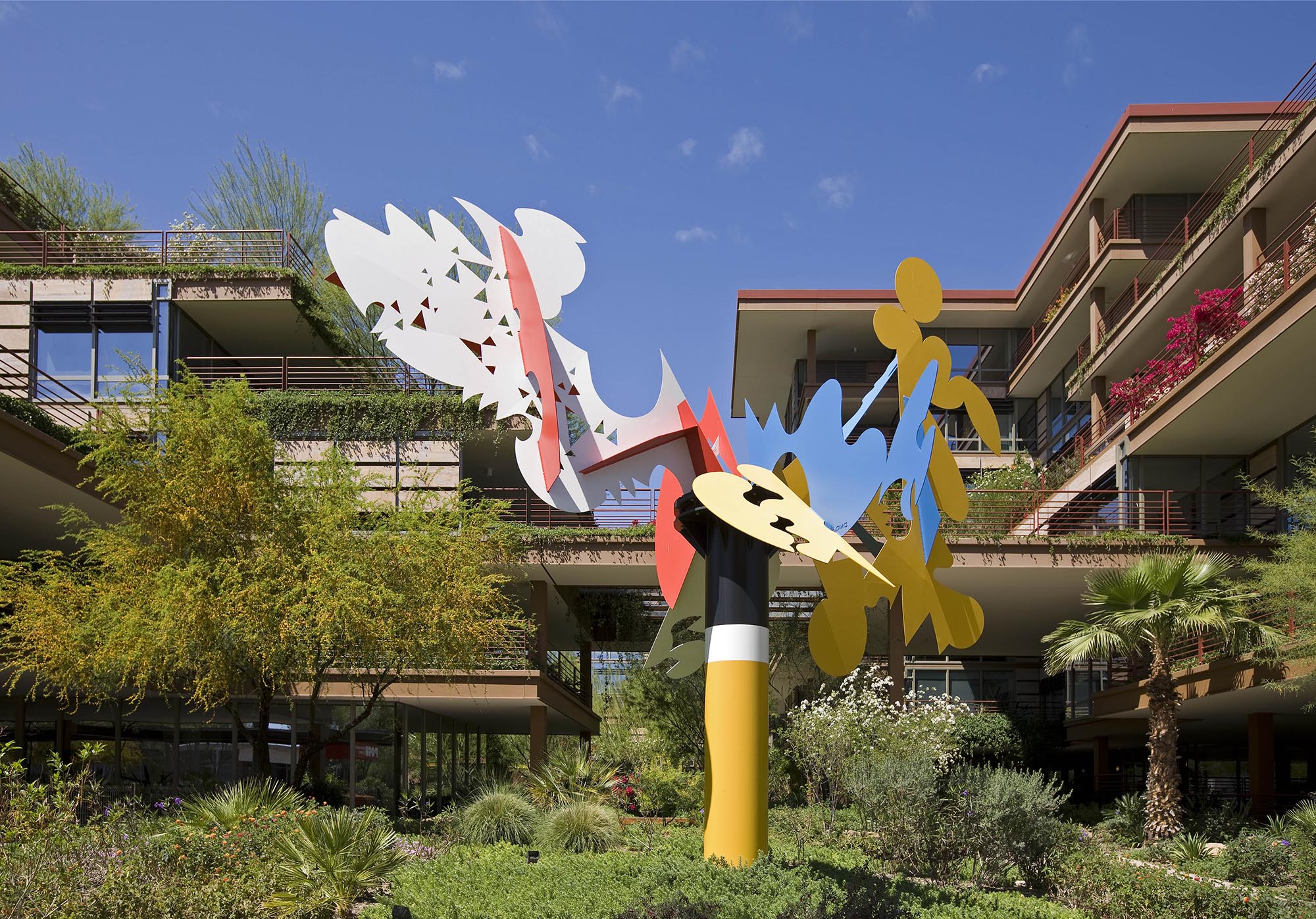
A striking piece that complements the surrounding green space at Optima Camelview Village, Windsong creates a bold statement that both contrasts with and engages its environment. As with Kiwi, Duo and other original Optima sculptures, Windsong was designed by David Hovey Sr., and today we dissect its form and how it integrates into a larger context.

To stand out against its colorful backdrop, Windsong stands more than 15 feet tall, providing a dramatic addition to the Arizona desert foliage. The sculpture is oriented around a rotating turntable, allowing the top pieces to move with the flow of the wind. Through movement and size alone, Windsong celebrates and embraces the elements, subtly alluding to Scottsdale’s connection to and love of nature. 

With a mixture of color and shapes, Windsong also evokes a playful and enthusiastic energy. Each piece of the sculpture is composed of both sharp corners and rounded edges, a culmination of form that emits joy. 

Optima’s passion for public art, both inside and outside our building, is a reflection of our dedication to engaging, beautiful spaces. Whether it’s through architecture, design or sculpture, we’re in constant pursuit of creating meaningful homes that have a lasting impact. 

The Work of Le Corbusier

Modernism is an approach that has roots going all the way back to the 1920s. Modernist architecture was pioneered by the inventive and contentious Le Corbusier, a Swiss-French architect, urban planner, painter and furniture designer. To better understand Modernism, we’re diving deep into his life, and highly controversial work.

A Controversial Figure

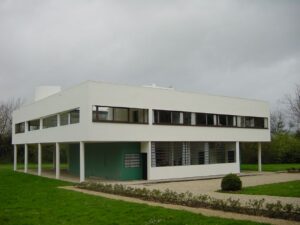
Born Charles-Eduoard Jeanneret-Gris, architect Le Corbusier built chiefly with steel and reinforced concrete, paring design down to its simplest, elemental geometry and form. He developed his famous theory of modern form and minimalist materials when envisioning affordable, prefabricated housing to help rebuild communities after World War I. His vision for prefabrication was only the tip of a strong, nearly utopian, approach to urban planning and architecture.

Villa Savoye Exterior
Villa Savoye in Poissy, Le Corbusier. Photo Timothy Brown, Flickr Creative Commons

His architectural philosophy was groundbreaking and completely contrary to the dominant narrative of the 1920s. Once he established his ideas, he shared them by publishing the seminal L’Espirit Nouveau (1920), where he revealed his famous “five points of architecture.” Three years later, he published Vers une architecture (Towards a New Architecture) (1923), in which he espoused a new, modern architecture informed by applying principles of cars, planes and ships to buildings. Le Corbusier embraced the conflict that arose to his ideas head-on, making bold declarations such as “a house is a machine for living in” and “a curved street is a donkey track; a straight street, a road for men.”

Chair designed by Le Corbusier at Optima Camelview Village

Form, Function, Furniture

Le Corbusier also designed furniture, his approach following suit to his approach to architecture. His furniture, co-designed with Pierre Jeanneret and Charlotte Perriand, utilized tubular steel that projected a new rationalist aesthetic. Le Corbusier broke down furniture into three types: type-needs, type-furniture and human-limb objects. His rational approach was not without romanticism, as he said, “Certainly, works of art are tools, beautiful tools. And long live the good taste manifested by choice, subtlety, proportion and harmony.” 

At Optima, we employ Le Corbusier furniture in our communities, like those in each of the three building lobbies at Optima Old Orchard Woods in Skokie. The furniture functions just as the artist would’ve wanted — as bold, artistic statement pieces, and as functional, rational furniture.

Modern Design at Optima with Knoll

Design permeates every corner of our communities. Across our multi-family properties, we utilize furniture designed by globally renowned Knoll to craft spaces that are sleek, modern and comfortable. Not just purveyors of elegant and stunning design, Knoll also has a history entangled with our own, beginning back in 1938.

Modernist Roots

Knoll was founded in 1938 by Hans G. Knoll, a German immigrant based in the United States. Familiar with the seminal Bahaus School of Design and Modernist masters like Ludwig Mies van der Rohe, he founded Knoll on the belief that modern architects would need functional, modern furnishings.

Later, Hans Knoll engaged with (and then literally got engaged to) Florence Schust, who studied with Mies van der Rohe at the Armour Institute in Chicago, and worked in the architectural offices from Gropius and Breuer in Boston. Her understanding of Modernist architecture, and the Bauhaus and Walter Gropius himself, transformed the Knoll approach to furniture design, placing new focus on offering objects that represented design excellence, technological innovation and mass production.

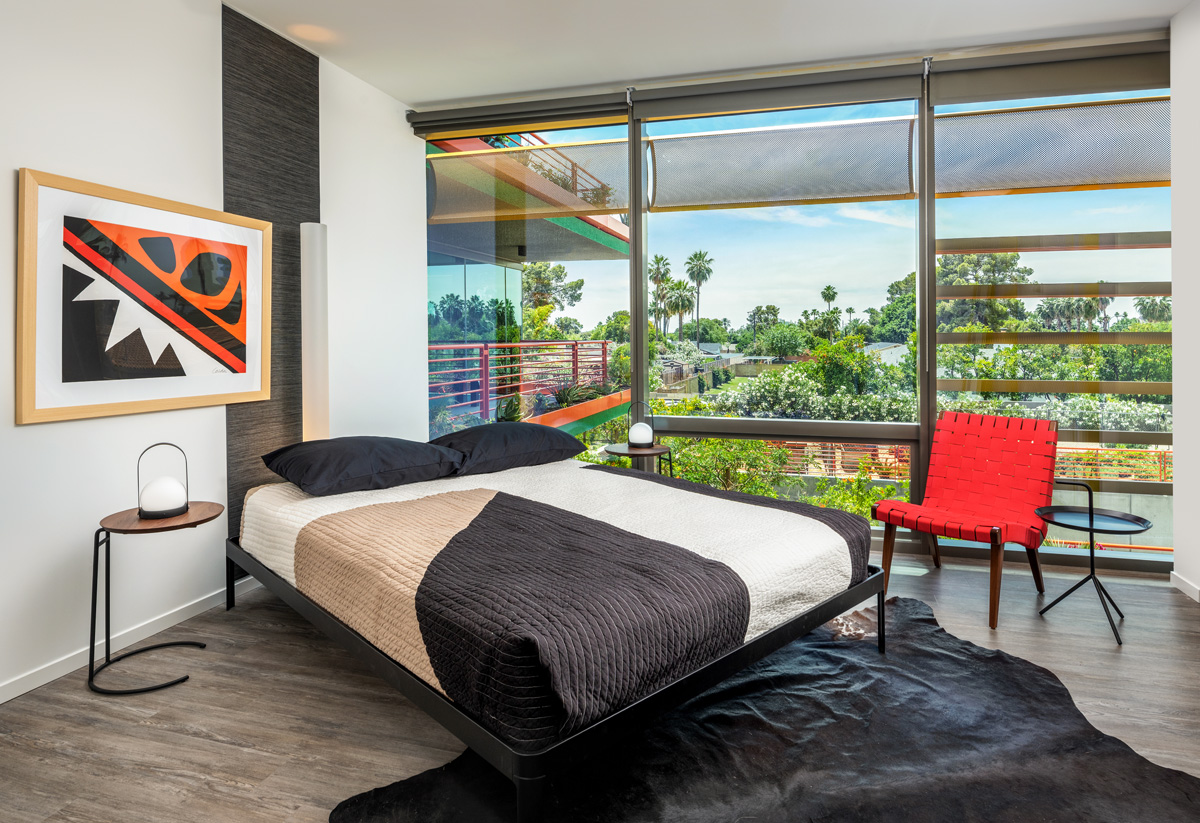
The Risom arm chair designed by Knoll at Optima Sonoran Village

Their strong vision attracted high-profile collaborators, such as Isamu Noguchi, who contributed to a collection of furnishings now heralded as classics in the pantheon of modern design. With a repertoire of pieces spanning including the Wassily chair, the Barcelona chair, the Tulip chair; over 40 Knoll designs can be found in the permanent design collection of The Museum of Modern Art in New York City. 

As seminal collaborators with the Modernist architecture discipline, Knoll is a natural fit for our modern residential and commercial spaces. Their executive designs embody elegance, craftsmanship and emblematic details across seating, tables and desks. The thoughtful and artistic creations of Knoll bring expansive history, elevated design and of course, comfort, to our communities.

The Life and Work of Henri Matisse

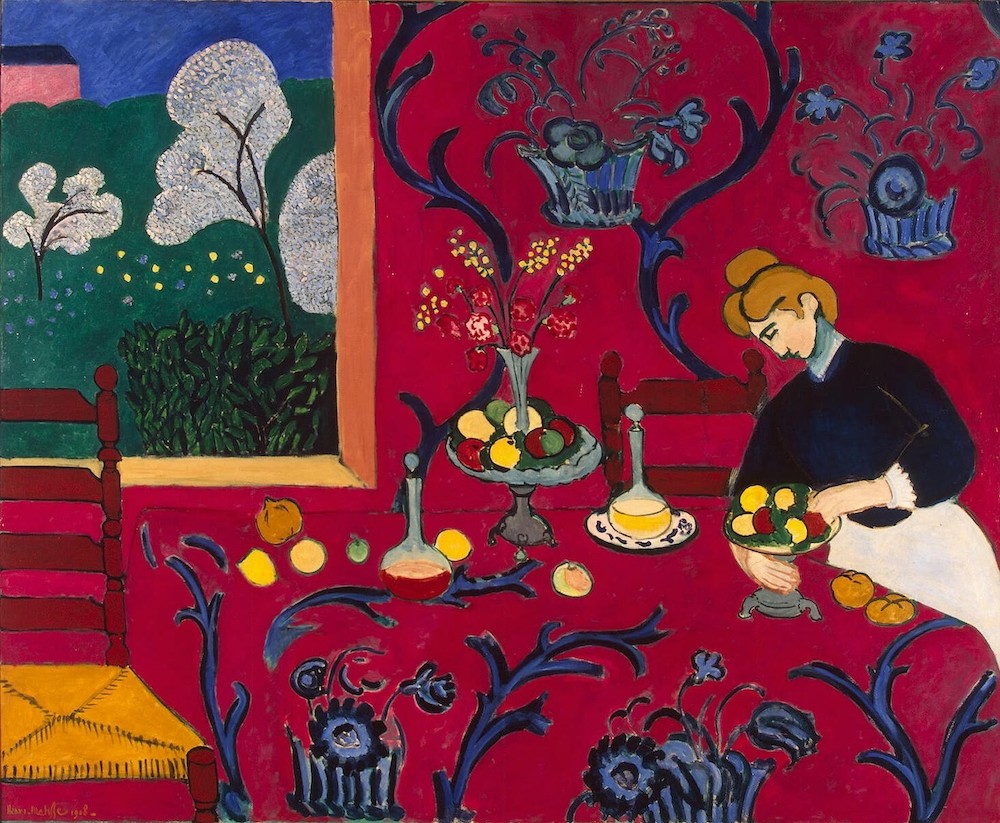
Henri Matisse is often regarded as the most important French painter of the 20th century. Leader of the Fauvist movement, his work was expressive, colorful and rigorous, often depicting flattened forms and decorative pattern. He operated with a unique way of seeing, stating, “I don’t paint things, I only paint the difference between things.” To understand the influential work of one of art history’s greatest minds, we first examine his life.

Matisse’s Early Life

Henri Émile Benoît Matisse (1869 to 1954) was a draughtsman, printmaker and sculptor, most renowned for his work as a painter. Born to a wealthy grain merchant in Northern France, he first studied law before finding his calling as an artist. His mother gifted him art supplies during his recovery from appendicitis. Through the gift, Matisse discovered “a kind of paradise” in creation, and made the decision to abandon law for a lifelong pursuit in art. 

In the last decade of the 19th century, Matisse studied art in Paris, and was influenced by the work of early masters and modern artists such as Jean-Baptiste-Siméon Chardin and Éduoard Manet. However, an 1896 trip to the island of Belle Île introduced Matisse to Australian painter John Russell, who then introduced Mattisse to Impressionism and the work of Vincent van Gogh, Russell’s dear friend. Seeing the vibrancy of Impressionism and van Gogh’s work, Mattisse’s style transformed with brilliant hues. Of his experience with Russell, Matisse said he, “explained colour theory to me.” 

The Red Room (1908), Henri Matisse.

The Art of Matisse

After time spent learning from Russell, Matisse was plunged into the world of Fauvism at the turn of the century. The style began around 1900, continuing beyond the first decade. Part of an innovative group later dubbed “Fauves,” Matisse explored his new understanding of color through paintings with tones bright, clashing and dissonant from those natural to their subject. Even though he helped to pioneer Fauvism, Matisse never really fit in with the crowd due to his conservative appearance and strict bourgeois work habits. And although the radical movement eventually declined, Matisse nevertheless forged on. 

The work that Matisse created during this period set the stage for the work he would create for the rest of his career. His focus on color continued, explored through what he called “construction by colored surfaces.” Even as his style and subject matter changed from abstract, to decorative interiors, to cut-out paper collages at the end of his life, this approach remained the same.

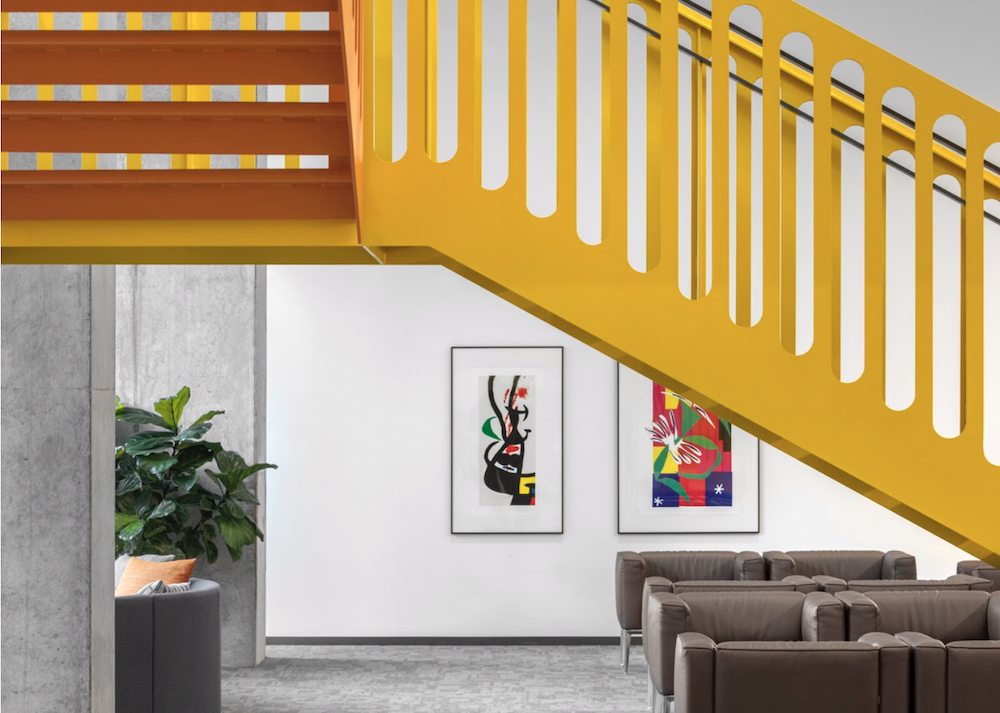
We are lucky to hang the work of Henri Matisse in our own communities. His consideration of form and color is reflective of our own thought process, and serves as a reminder that while style may change over time, a well-formed approach will always shine through.


person name goes here

Maintenance Supervisor

Glencoe, IL


    Acceptable file types: *.pdf | *.txt | *.doc, max-size: 2Mb