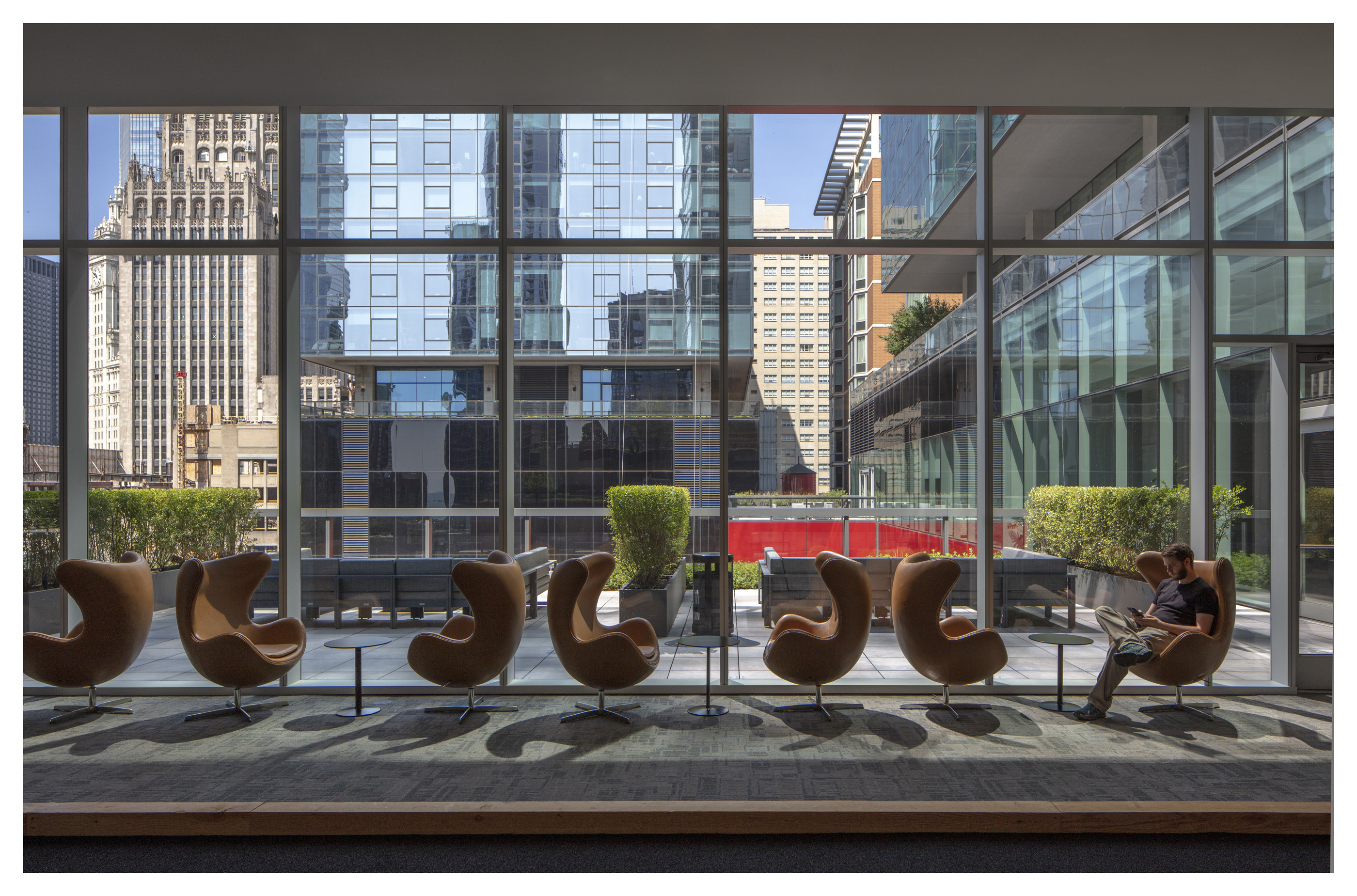
Of the many interior design pieces within our buildings, the egg chair is arguably the most distinct. Its round shape, curved edges and cocoon-like nature are as inviting as they are fascinating. A staple accent in many Optima projects, the Egg chair has its own colorful past that has led it to its present-day prominence throughout the world of interior design.
A Scandinavian Start
In the mid-1950s, the Scandinavian Airlines System enlisted Arne Jacobsen to design downtown Copenhagen’s Royal Hotel. Jacobsen, a Danish architect and designer, is one of the best-known designers of the 20th century and one of the pioneers of Danish modern design. He was a crucial contributor to architectural Functionalism and his keen sense of proportion is most well-known throughout his wide range of furniture designs.
In designing the Egg chair, Jacobsen kept in mind both function and form with a chair that would allow travelers passing through the hotel to relax, swivel and recline. The high, curving sides allowed for a bit of privacy, a much-needed amenity after a long journey. The chair was lightweight at only 17 pounds, allowing the hotel staff to move and rearrange them as necessary. Even 60 years after its first debut, the Egg chair is still an iconic piece of design history, beloved by both residential and commercial spaces.
Optima Old Orchard Woods | Skokie, IL
The Eggs at Optima
Throughout our residential spaces, Egg chairs serve as a complementary accent piece to our Modernist buildings, reflecting the same passion for form and function. The curvaceous seat is adaptable, pairing well with everything from white walls to colorful surroundings. As they did when they were first designed, egg chairs serve a variety of functional purposes: a fresh pop of color, a nod to the Modernist style, a place to relax at the end of the day or a cosy reading spot to enjoy your favorite book. However they’re utilized, these design icons are a Modernist staple and one of our favorite pieces of unique furniture.
Our story is influenced and molded by those that came before us. The vision for Optima was seeded during David Hovey Sr.’s time at the Illinois Institute of Technology (IIT), where he studied under the program built by modern architectural legend, Ludwig Mies van der Rohe. To understand where modern design is today, it’s insightful to look back on the legacy of Mies van der Rohe.
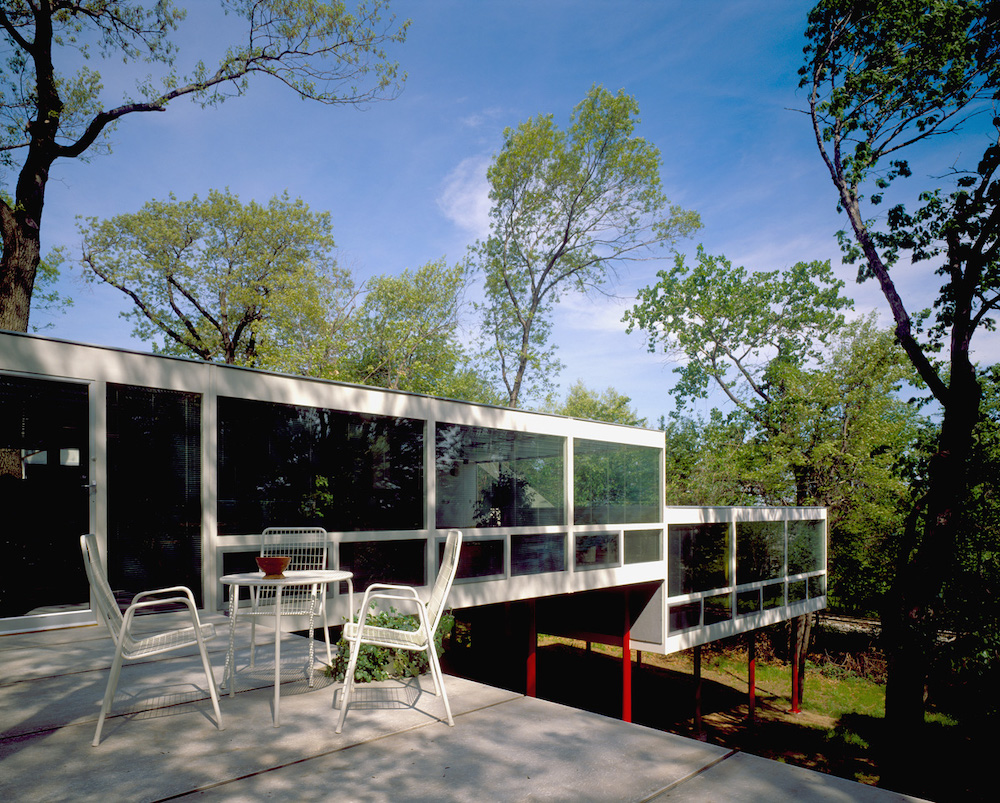
Ludwig Mies van der Rohe’s Farnsworth House, designed and constructed between 1945 and 1951. Credit: Victor Grigas on Wikimedia Commons, licensed under the Creative Commons Attribution-Share Alike 3.0 Unported license.
Mies van der Rohe
Mies was a German-born architect and educator, born in 1886 in Aachen, Germany, with Chicago becoming his adoptive hometown later in life. One of the 20th century’s greatest architects, he designed with an emphasis on open space and revealing materials. His steel-and-glass aesthetic defined modern architecture; he himself referred to it as “skin-and-bones architecture.” Mies didn’t design with style in mind, but rather, considered the philosophy of design within the frame of functionalist and industrial concerns at the time. “Less is more,” the legendary aphorism, was first said by Mies in reference to his architectural work.
Destined for greatness, Mies’ first commissioned project (Riehl House) came to him at the age of 21 while he was working for Bruno Paul. What really set his design aesthetic apart, however, was the Barcelona Pavilion. Designed for the 1929 International Exposition in Barcelona, Spain, the temporary structure was the most powerfully pared-down building imaginable. Consisting of horizontal and vertical slab elements, it fulfilled the minimum requirements to define space — nothing has ever personified “less is more” in quite the same way. As Mies garnered attention, he became the director of the Bauhaus school of design in Germany in 1930. He remained there until the school closed in 1933 under the mounting pressure of the Nazi regime, and it was at this point in time that Mies took his leave from Europe.
An Educator and Architect in America
Mies arrived in the US in 1938, heralding in a new era for his life and the life of architecture in Chicago. He was head of the architecture department of IIT from 1938-1958, and when Mies’ position was announced, he was introduced by the one and only Frank Lloyd Wright himself. It was virtually unheard of for Wright to admire the work of another architect — and vocalize his admiration no less — but in his introductory speech, Wright said of Mies: “I admire him as an architect, respect and love him as a man. Armour Institute, I give you my Mies van der Rohe. You treat him well and love him as I do. He will reward you.”
Wright knew what an influence Mies would have on IIT and on architecture. The period of transition allowed Mies to entirely redesign the school’s program and campus both — he “rationalized” the curriculum by returning to the basics. At IIT, students focused first on learning to envision and draw their creations, then master the features, functions and materials involved in building, in order to finally evolve as architects whose discipline was enmeshed with the fundamental principles of design and construction.
A Lasting Legacy
Mies has left his mark in many places — along the Chicago skyline, across the IIT campus and on our work here at Optima.The fundamental principles behind Modernist design influence how we create and think here, and the innovative and groundbreaking thinking of Mies is something that we seek to embody in our everyday operations. To this legend, we say thank you for paving the way and inspiring us all.
At Optima, we are in perpetual pursuit of integrating the fundamentals of design while exploring new approaches. Our design process is rooted in the Modernist tradition, whose own roots go back to the middle of the 17th century.
The First Modernist Structure
The Crystal Palace, designed by Joseph Paxton in 1851, is often regarded as the first Modernist structure. Created to house the Great Exhibition in Hyde Park, London, the exhibition palace showcased the premier components of Modernist architecture design: a sheet glass and structural metal exterior.
The Modernism Movement
However, the Modernist movement developed in the highly tumultuous and rebellious times of the early 18th century. Many people were disillusioned by the control and stagnancy of European culture, where the 19th century academic belief system reigned supreme. Much of art, architecture, literature and philosophy were rooted at that time in reality, with the highest and most respected forms of art being those that most closely mirrored realism in style.
Modernism embraced disruption, particularly of realism and a culture bogged down by academic truths. Inspired by the groundbreaking philosophy of Freud and even by Einstein’s theory of relativity, Modernism sought to dismantle traditional forms and seek truth in new and progressive ways. Most important to Modernists was their freedom of artistic expression.
Modernism in Architecture
In architecture, progressive and liberated artistic expression came in the form of rejecting ornament and embracing minimalism. In direct contrast to the ornate stylings of Victorian architecture, Modernist architecture demanded that form follows function. Modernism in architecture was first and foremost a design principle, with style following after. Architects came at projects with an analytical approach to the function of buildings, and how they could create a structure to meet its purpose using rational, affordable materials. For this reason, many architects at the time believed Modernism could be the housing solution to end urban poverty.
One of the most renowned Modernist architects is Ludwig Mies van der Rohe—the man who changed the architecture program at IIT where Optima founder David Hovey Sr. studied. Mies was known for designing with clarity and simplicity, utilizing industrial steel and plate glass to define interior spaces. His minimal framework created unobstructed, free-flowing open space in his buildings.
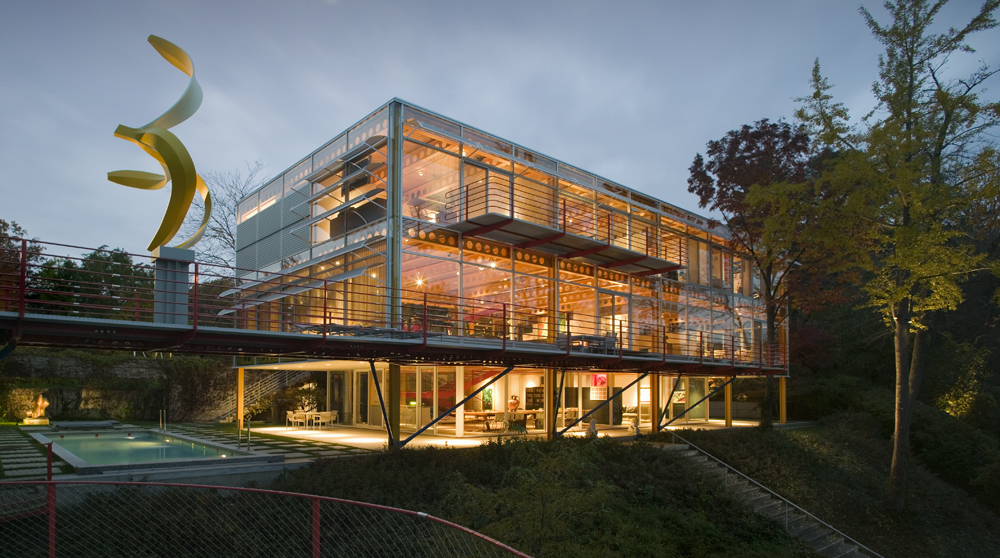
At Optima, we are constantly inspired by the Modernist design philosophy. A large part of our design process is the utilization of ready-made materials, because as the owner, architect, developer and general contractor of all our own projects, function has never been more important. But most important to us is the idea of freedom — the freedom to innovate and express design in new and exciting ways. And like in Modernism, style inevitably follows.
Optima buildings are distinguished by our Modernist design, and by our signature pops of color. Because color can influence design, and in turn, influence those that experience our design, the color decisions we make are purposeful and serve to enhance and activate our architecture and the spaces around it.
Theory and Psychology
Color is fundamental to the Modernist tradition. Much of color theory was born out of the Bauhaus modernist art school, where four artists changed the way we talk about color today: Johannes Itten, Wassily Kandinsky, Paul Klee and Josef Albers. Itten, particularly, created the color sphere with primary, secondary and tertiary tones, was the first to determine warm and cool tones, and was a pioneer in associating different colors with emotions.
Today, the study of color and their relationship to human emotion is called color psychology. In the first 30 seconds of viewing an object, our brains make a quick judgment and react to what we see. Color plays a large part in this response; for people, tones and hues are tied to specific emotions and feelings. On a biological/physical level, when we see colors, that vision is transferred over to the brain, which in turn signals to our endocrine system to release specific hormones that create a correlating feeling or mood to what we’ve seen. Armed with this insight, we integrate color into our design solutions to create an emotional impact. But our use of color goes beyond.
Color in Optima Design
In our Arizonian desert residences, we select hues to complement the vegetation of the desert, seamlessly blending our architecture with its environs; indoor with outdoor. At Sterling Ridge, concrete walls merge with the earth, making the home an extension of the land. The result is a harmonious design, one that enhances our building and the land around it. Orange and red color details serve to give an exciting pop of color against a cohesive, blended pallet.
In many of our condos and multifamily residences, we use color in the exterior facade to compliment the surroundings of the building. At Optima Sonoran Village, orange, yellow and green details are drawn from actual colors found in the surrounding lush landscaping. The hues were inspired by the area’s desert flowers, serving to draw out the naturally occurring colors of the terrain.
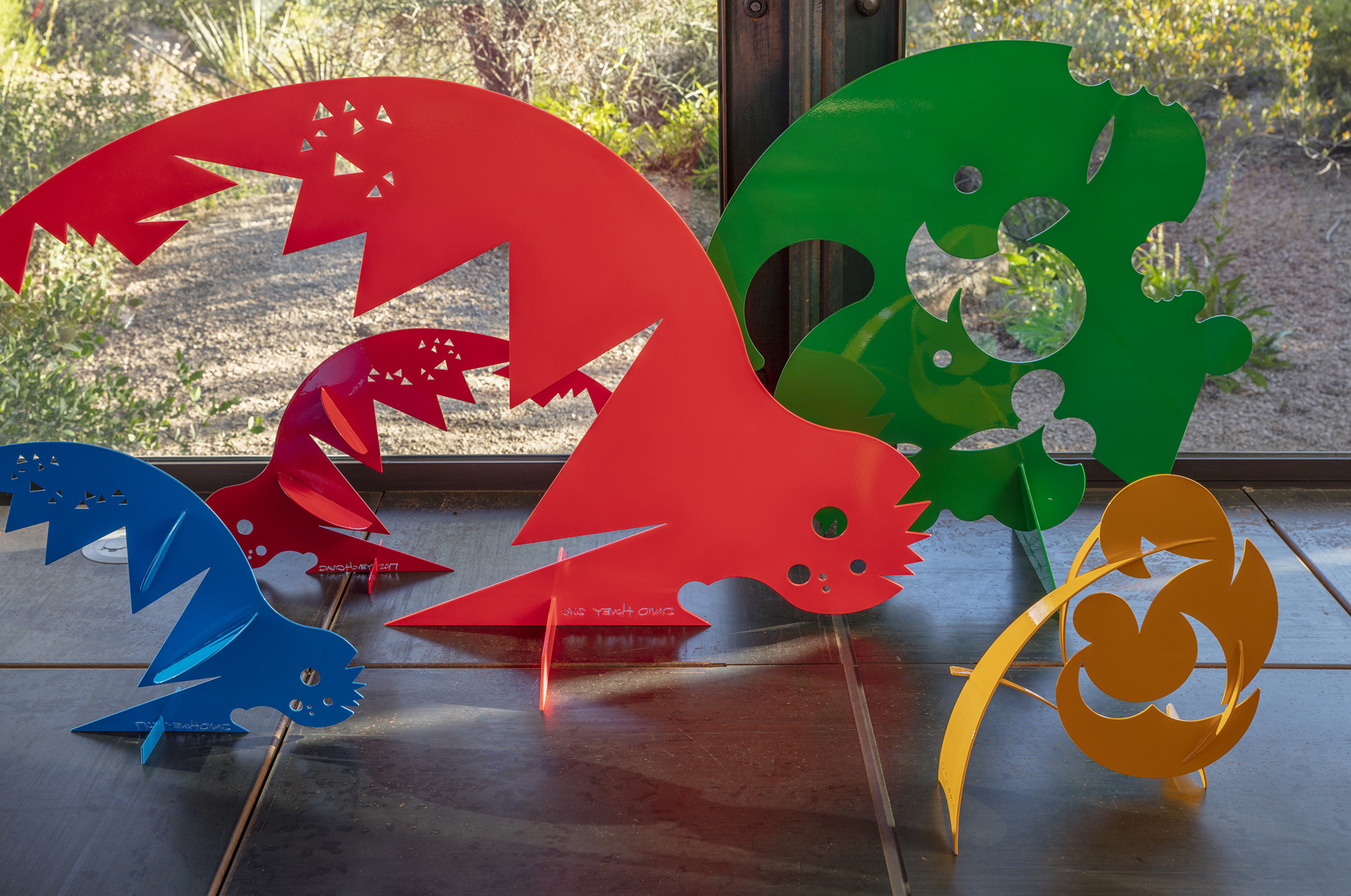
Color isn’t just important in our building design — we incorporate color into all of our design practices, including experimental color play with our sculptures. Often executed in different colors depending on the surrounding space, sculpture is another facet to Optima in which we experiment with shades and hues. Color has a long and storied history, but for us, it’s a continuing exploration that has us learning more each day.