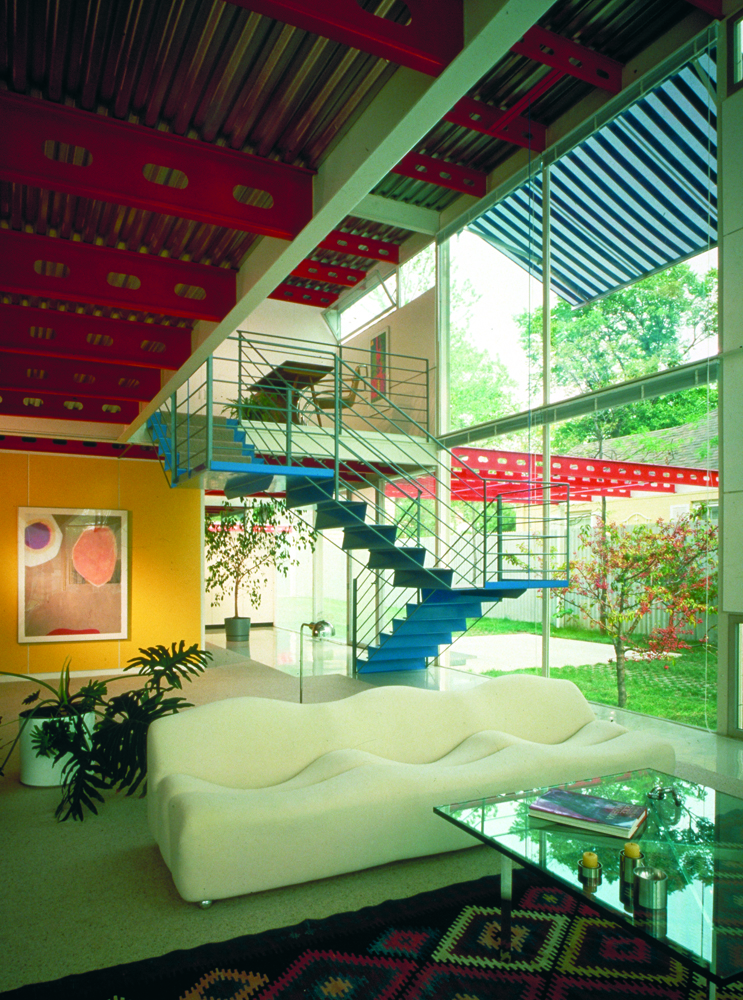
David Hovey Sr., FAIA, A Modernist Philosophy Emerges

As we continue to explore the new David Hovey Sr., FAIA catalogue raisonné, it’s a pleasure to linger over the expansive, thoughtful essay penned by distinguished architecture writer and long-time associate, Cheryl Kent. This examination of Hovey’s career entitled, “The Achievement,” provides new perspectives on his career that give us greater appreciation for what he has cared deeply about, and the impact he has made.

In speaking about Hovey’s core beliefs, Kent explains:

“David Sr. continues as CEO and a principal architect. Now in his mid-seventies, he is beginning to pull back and leave more responsibility to his heirs. Still, he continues to work every day, ‘helping’ as he says ‘wherever I’m needed.’ In 2004, Optima opened an Arizona office but it has been building in the Phoenix-Scottsdale area since 2000. Today, Optima projects routinely gross over one million square feet and sometimes more than two. Over the course of the company’s existence, it has built nearly six thousand residential units with another 950 now in the works. And the pace has picked up. In its early years, the firm did approximately one project a year; now it is likely to have projects in construction in both markets at the same time, and sometimes more than one in each.
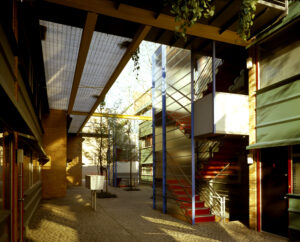
840 Michigan was a 24-unit complex in suburban Evanston built in 1985.

“It is significant that Hovey accomplished this over decades when his design philosophy, modernism — and he does embrace it as a philosophy — was out of step with the architectural mainstream. When many architects had embraced postmodernism beginning in the 1970s arguing for conventional historical references non-cognoscenti could understand and still other architects turned to deconstructivism that no one could understand, Hovey was steadfast in his belief in the tenets of modernism, in the future, in technology, in material honesty, in structural expression, and in architecture’s ability to improve life for people. Architecture, Hovey insists, must be expressive of its time and employ the latest technology. He has made a highly successful career of well-designed housing in a modernist idiom.”
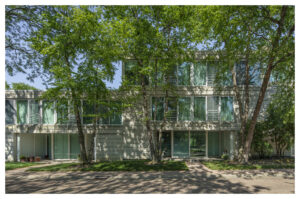
When Hovey tackled North Pointe on the site of an old warehouse in Evanston in 1990, he used a dynamic plan to include 118 townhouses with penthouses and two mid-rise condominiums.

The projects in the early years of Hovey’s career allowed him to hone his practice by continuing to take on greater challenges in location, scope, size and materials — all the while staying true to his core beliefs and principles.
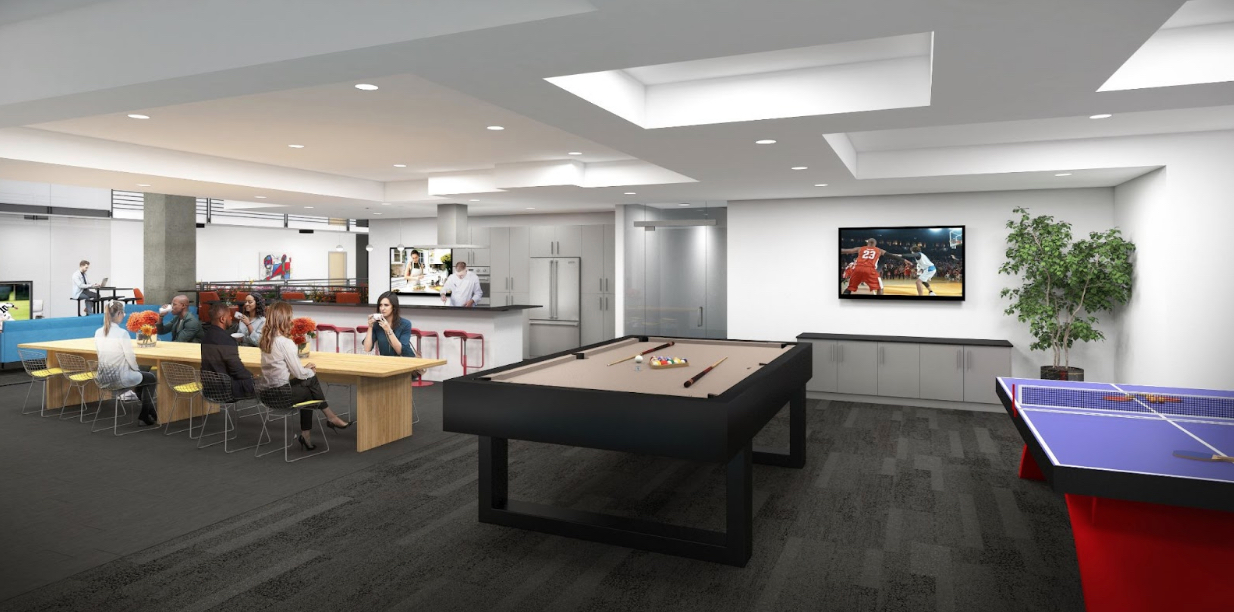
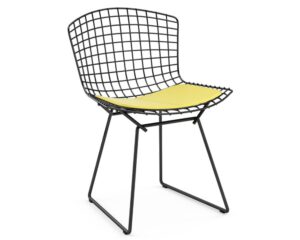
Curated Furniture at Optima Lakeview: the Bertoia Side Chair

Our love of mid-century classic furniture can be found throughout all of the Optima communities. And with our soft spot for iconic seating, it’s no surprise that the famed Bertoia Side Chair is a staple in many of our amenity spaces. Let’s take a closer look.

About Harry Bertoia
Born in San Lorenzo, Italy in 1915, Bertoia built an international reputation as an artist, sound art sculptor and modern furniture designer. After leaving his home at the age of 15 to join his older brother Oreste in Detroit, Harry embarked on a career that centered on the exploration of modernist ideas and ideals, often in collaboration with some of the greatest thinkers and visionaries of that era.

In 1936, a one-year scholarship to the School of the Detroit Society of Arts and Crafts allowed Harry to study painting and drawing. He entered and placed in many local art competitions, said to be the most awarded student up until that time. The following year, another scholarship took him to the Cranbrook Academy of Art in Bloomfield Hills, Michigan. Working among some of the most famous artists and designers of the modernist age, including Eero and Eliel Saarinen, Charles and Roy Eames and Florence Knoll, Bertoia’s creativity and mastery of materials flourished.

Bertoia as Furniture Designer
Bertoia was first exposed to furniture design at Cranbrook when Eero Saarinen and Charles Eames entered and won the Organic Furniture Design Competition sponsored by the Museum of Modern Art. In fact, Bertoia developed his initial chair design ideas while working with Charles Eames and others in California in the late 1940s, which he later incorporated into his work.

Bertoia eventually left Eames to join the Point Loma Naval Electronics Laboratory. While there, he learned how to study the human body to design control panels and knobs that focused on comfort for reach and grip. This sensitivity to ergonomics contributed significantly to Bertoia’s fascination with designing well-fitting practical chairs.

In 1950, at the invitation of former classmate Florence Knoll and her husband Hans, Harry moved to eastern Pennsylvania to work at their emergent furniture company Knoll, Inc. Florence had seen Harry’s work at Cranbrook, heard he had left Eames, and knew that he had enormous promise as a furniture designer. The Knolls offered him the opportunity to design what he wished with full credit and complete recognition of his work, which was their policy with all designers.

About the Bertoia Side Chair
Once on staff at Knoll, Bertoia was asked to develop hospital furniture, but he preferred to work with healthy bodies. He gravitated towards metal as his material of choice, and he continued to experiment with it until he landed on the concept of the wire grid, which could be shaped at will. with it until arising at the wire grid concept that could be shaped at will to conform to the human body. This was a radical departure from the use of rigid wood, which was characteristic of the late 1940s and early 1950s furniture. He not only created the airy welded metal design of the chairs, but also devised the production molds used for mass manufacture. 

Knoll produced the first Bertoia chairs in 1952 — an amazing collection of furniture that reflects a profoundly beautiful study in space, form and function. As with other designers of his time, including Mies van der Rohe, Bertoia found infinite elegance in an industrial material, elevating it beyond its utility into a work of art. 

Today, the Bertoia collection remains one of the great achievements of mid-century modern furniture design by one of the master sculptors of the last century and a proud part of the Knoll heritage.

person name goes here

Maintenance Supervisor

Glencoe, IL


    Acceptable file types: *.pdf | *.txt | *.doc, max-size: 2Mb