Urbanize has toured Optima Lakeview, Optima’s newest luxury rental apartment building in Lakeview. Located at 3478 N. Broadway, the project’s site was originally home to a shuttered Treasure Island Foods grocery store.
Optima LakeviewLukas Kugler/Urbanize Chicago
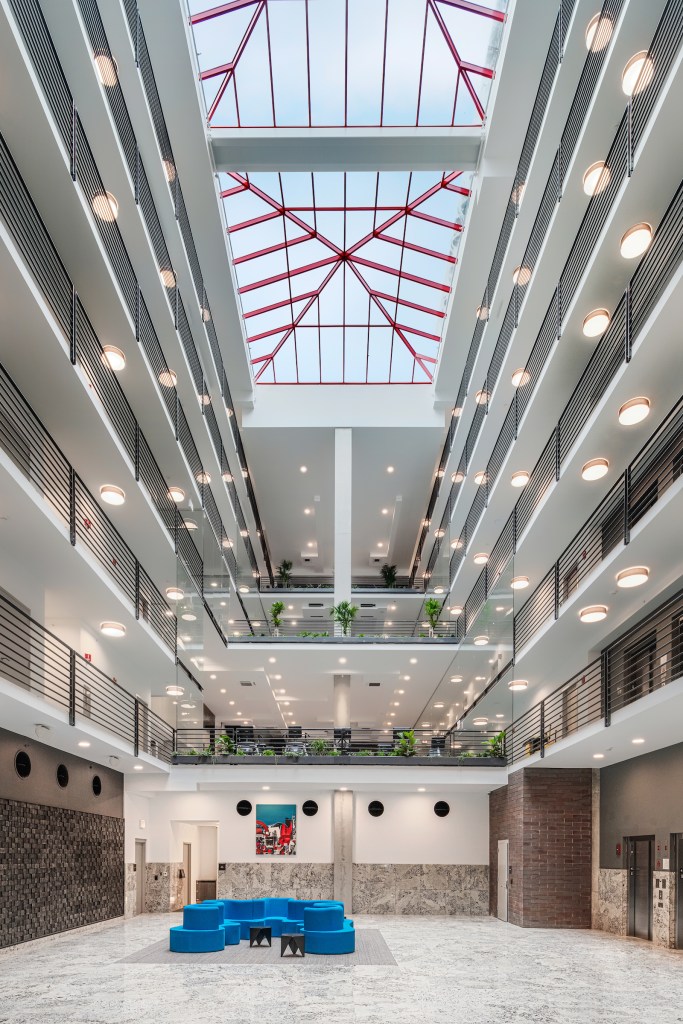
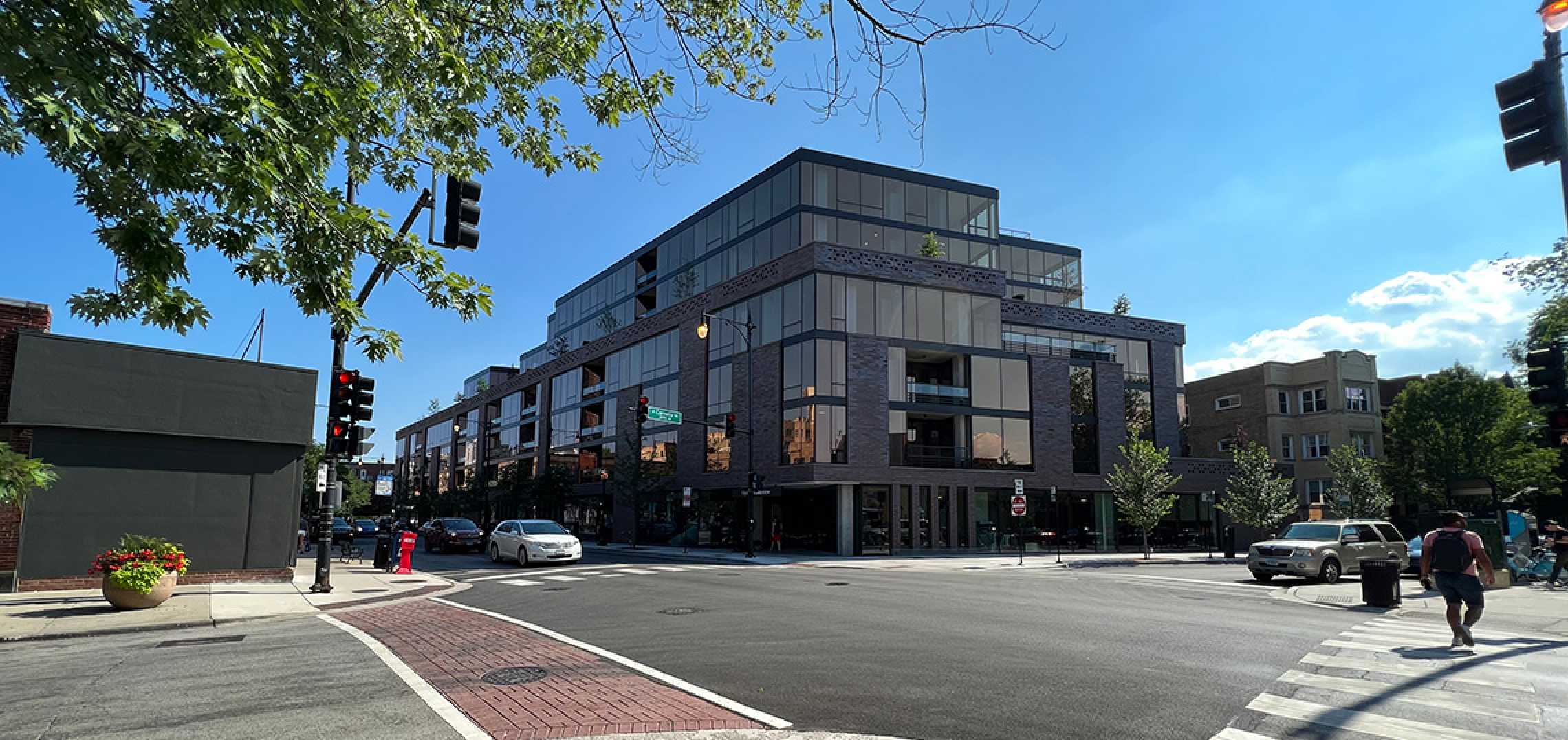
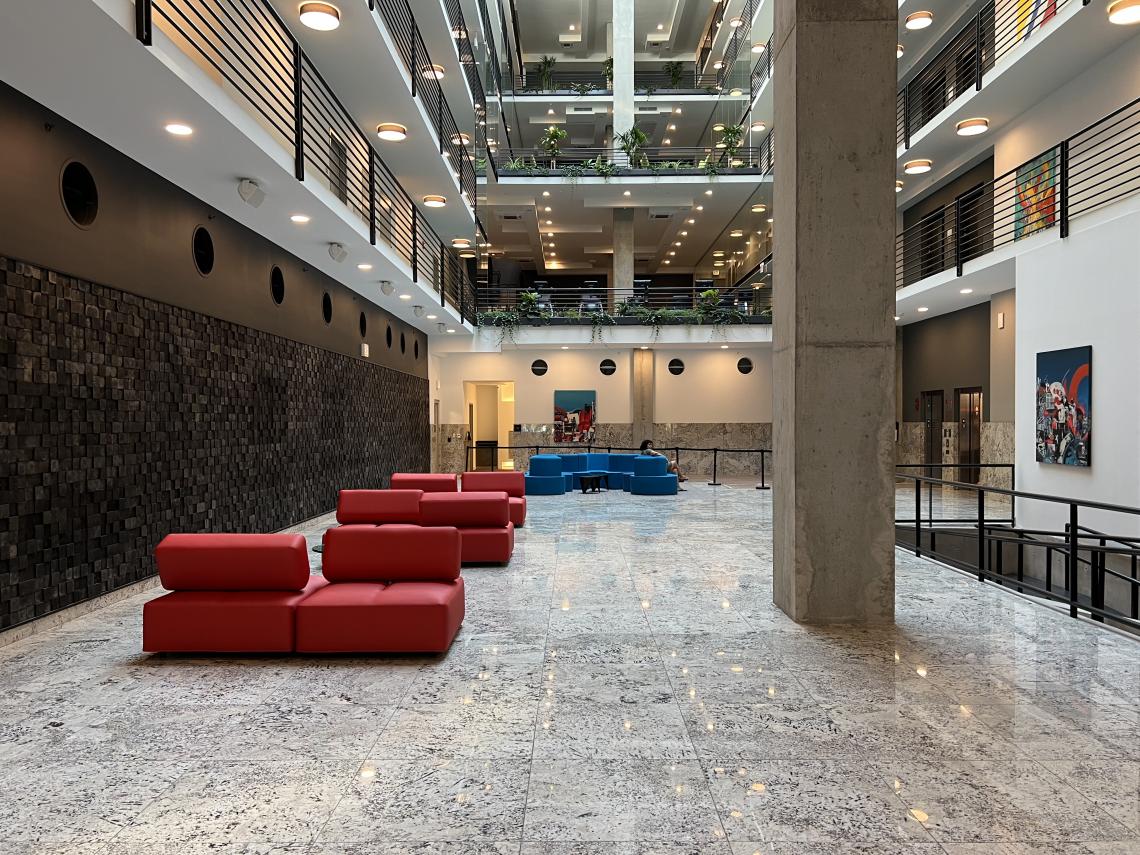
Designed in-house by Optima’s team, the building stands as a luxury apartment community, from its modern exterior – made with a palette of transparent bronze glass and dark brick to complement the architecture of the surrounding neighborhood – to its unique interior, which includes a seven-story atrium that runs through the core of the building and features vertical landscaping to flood the space with natural light and foliage.
Optima LakeviewLukas Kugler/Urbanize Chicago
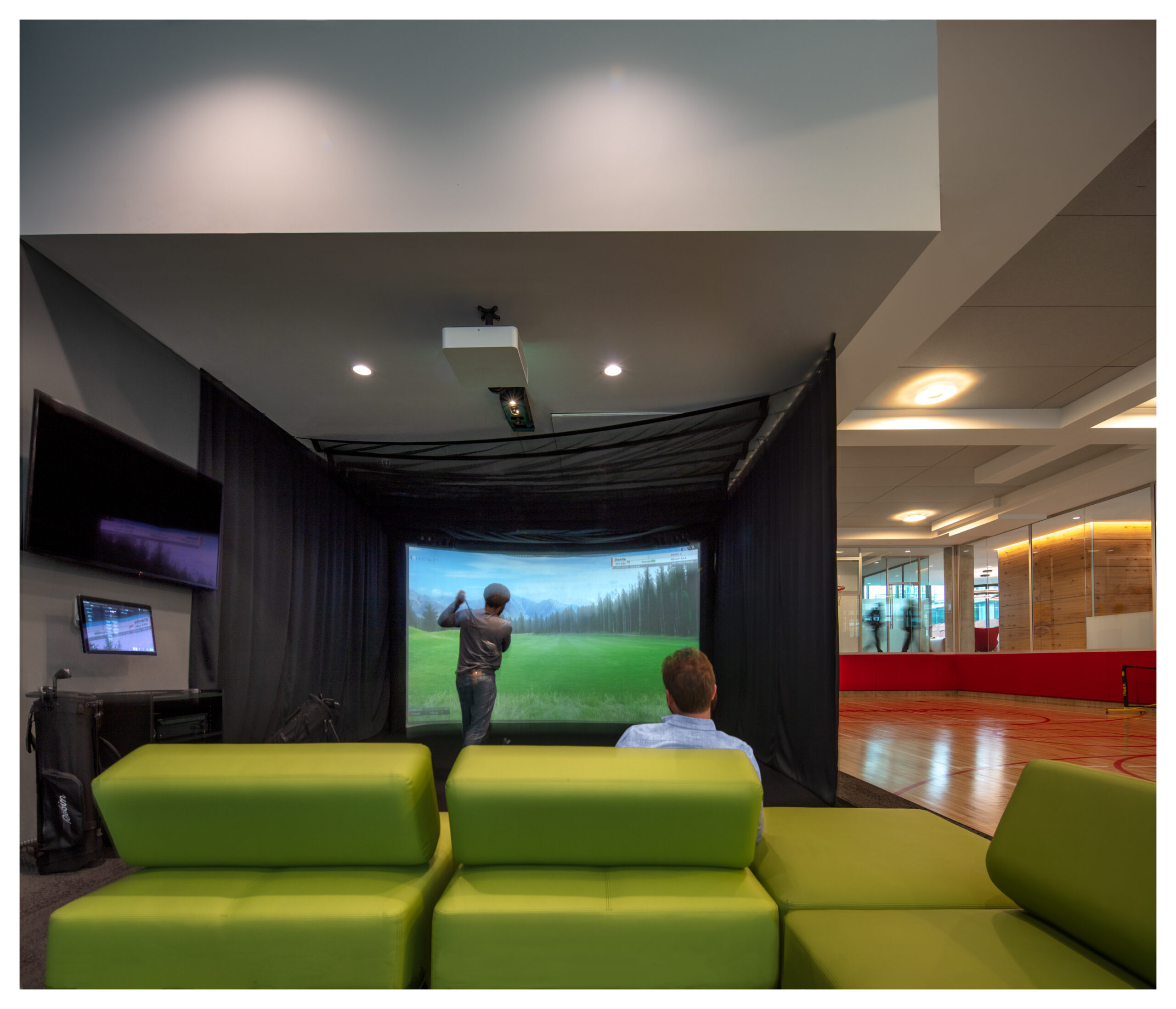
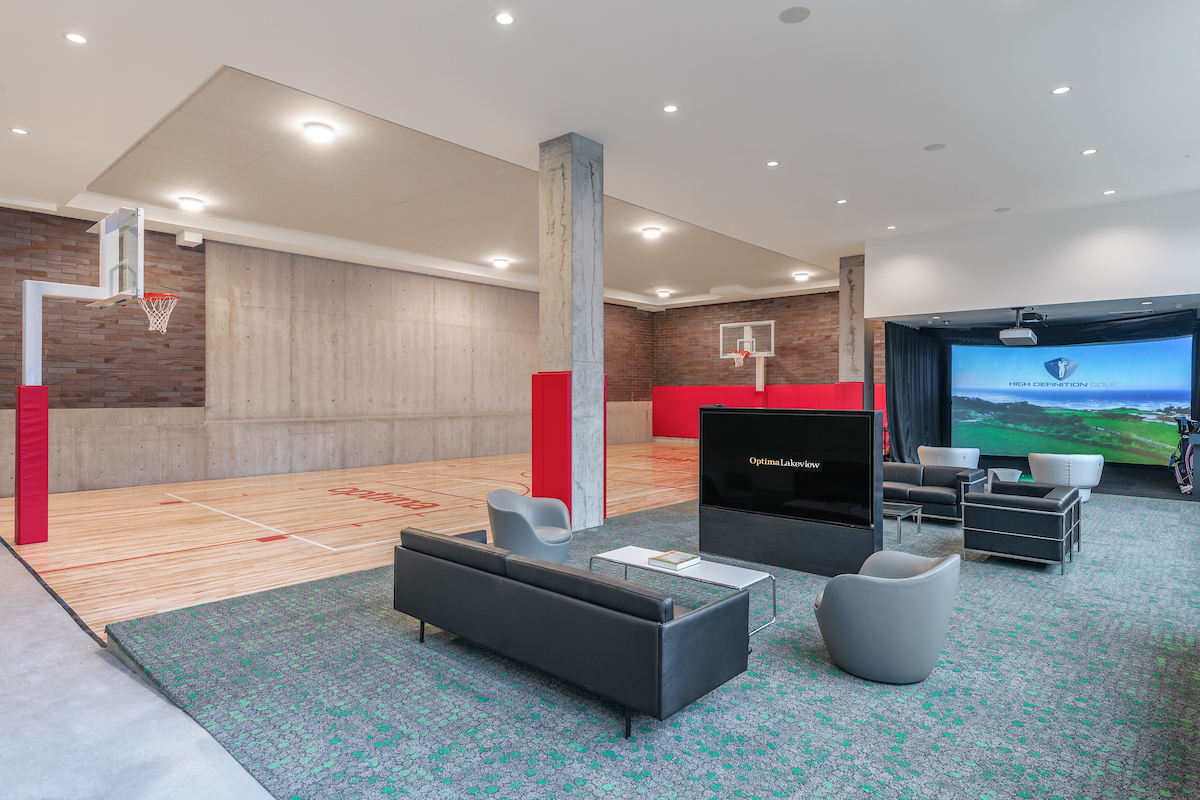
The tour began in the lobby which sits within the large atrium in the center of the building. Light flooded in from above, illuminating the walkways on each floor for the residential access. Off to the side on the ground floor, the building’s sports lounge offers a basketball court and golf simulator.
Optima LakeviewLukas Kugler/Urbanize Chicago
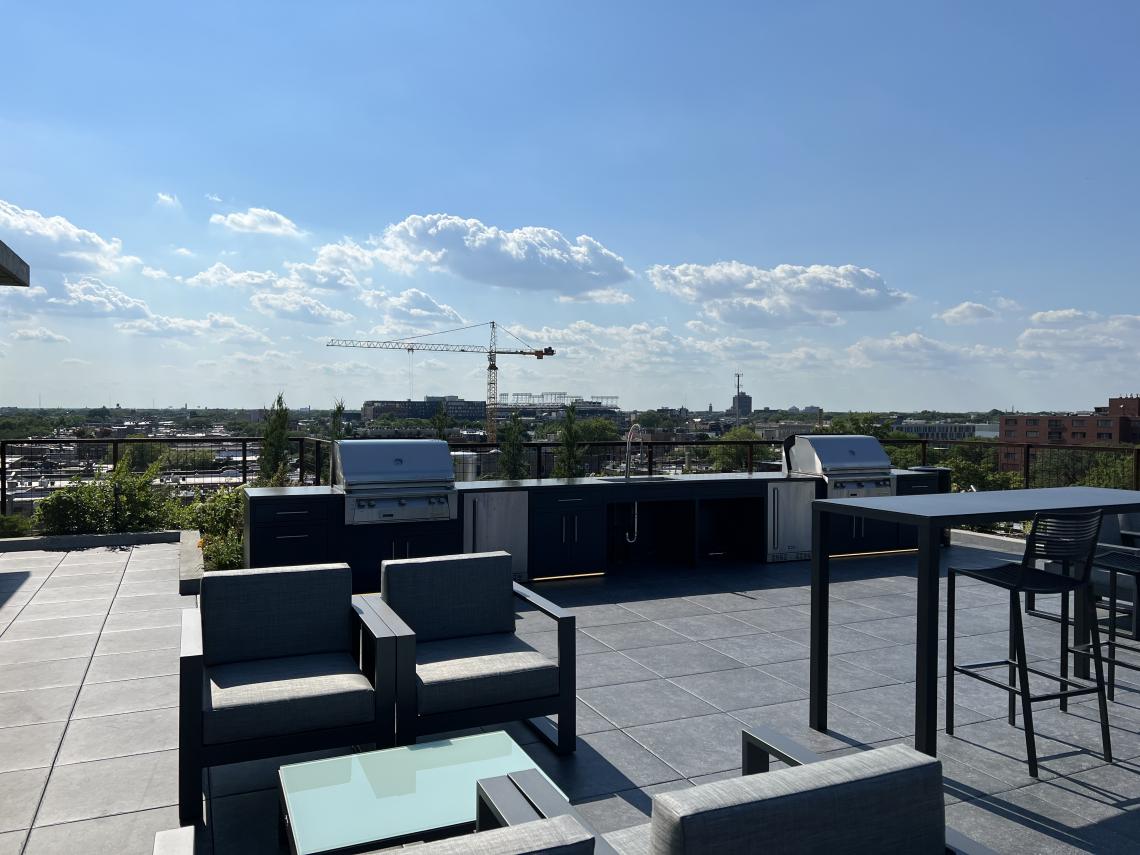
Taking the elevator to the top floor, the 8th floor hosts a party room with full kitchen space. On the outdoor deck, residents have access to a heated pool deck and spa as well as grilling stations. With Optima Lakeview being one of the taller buildings in the area, views are uninterrupted looking in every direction, including towards the lake and to Wrigley Field.
Optima LakeviewLukas Kugler/Urbanize Chicago
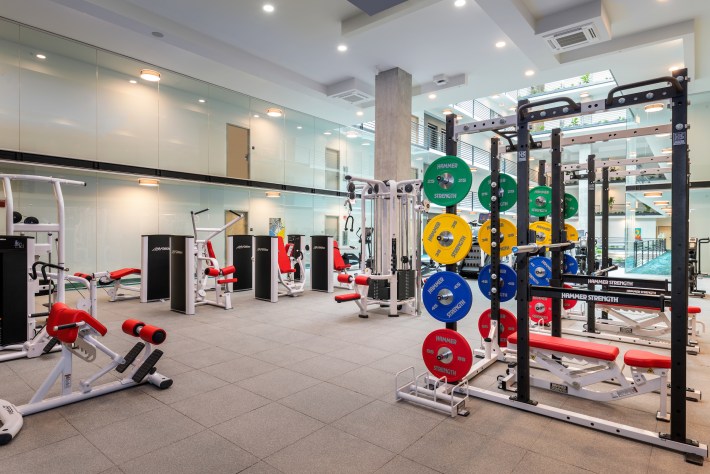
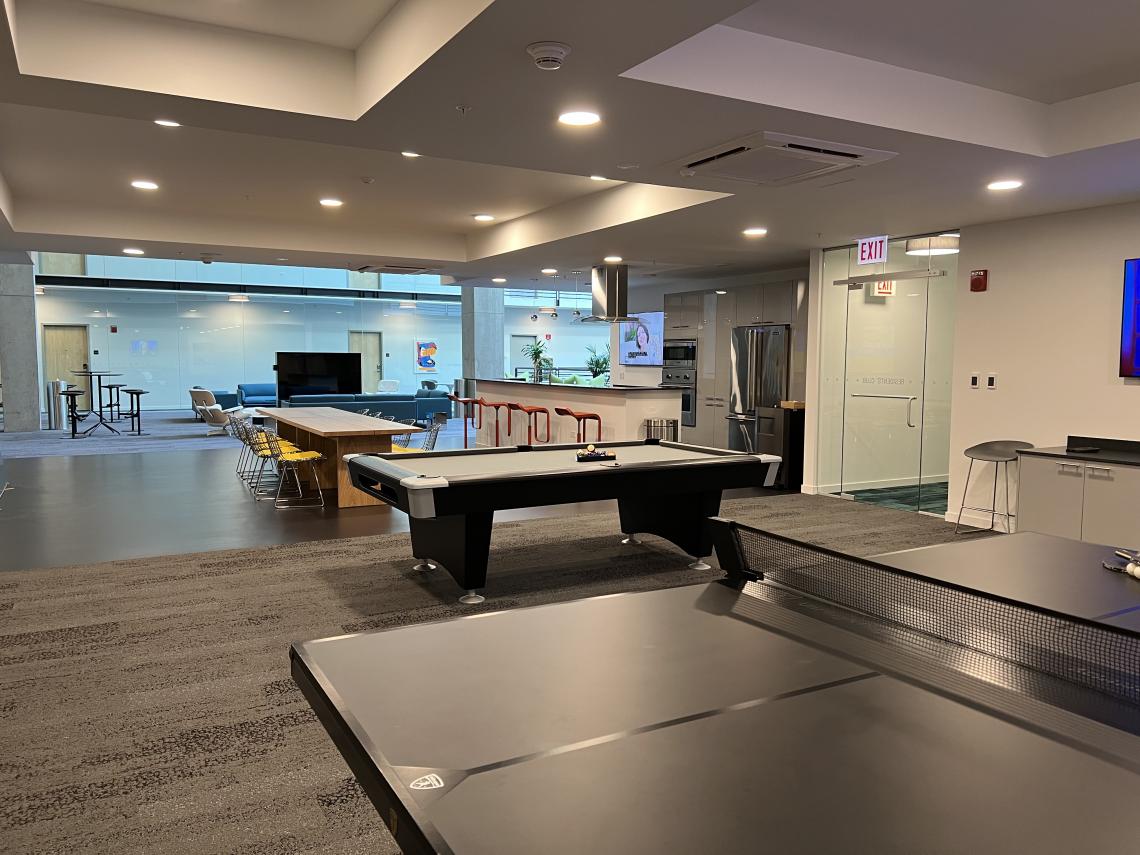
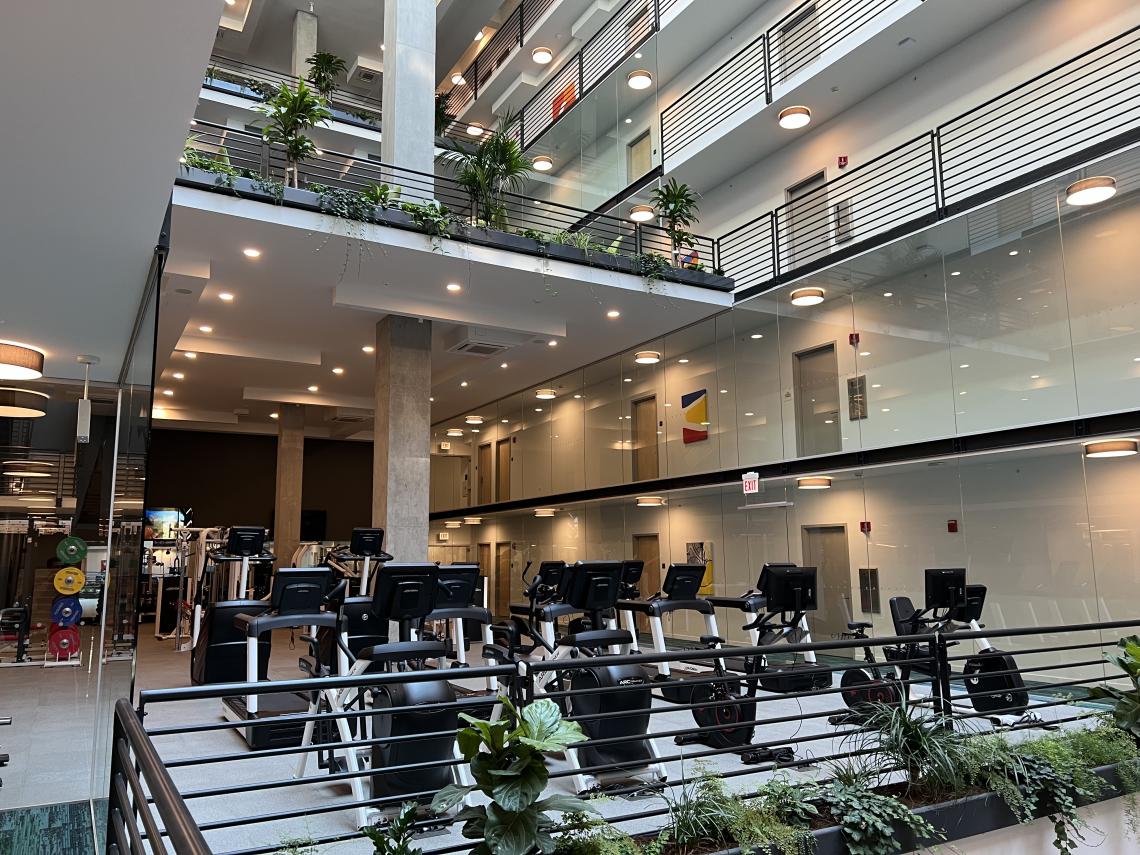
Working our way down, we visited the business center on the sixth floor which offers furniture intended for residents to be able to work in the space. On the fourth floor, the resident lounge offers gathering space as well as another full kitchen and game room. Enclosed conference rooms are also included. On the third floor, a sauna room overlooks the second-floor fitness center with locker rooms also accessible to tenants. The final amenity space inside the center atrium was the fitness center on the second floor. The space has been outfitted with all the equipment residents would need to truly quit their gym.
Optima LakeviewLukas Kugler/Urbanize Chicago
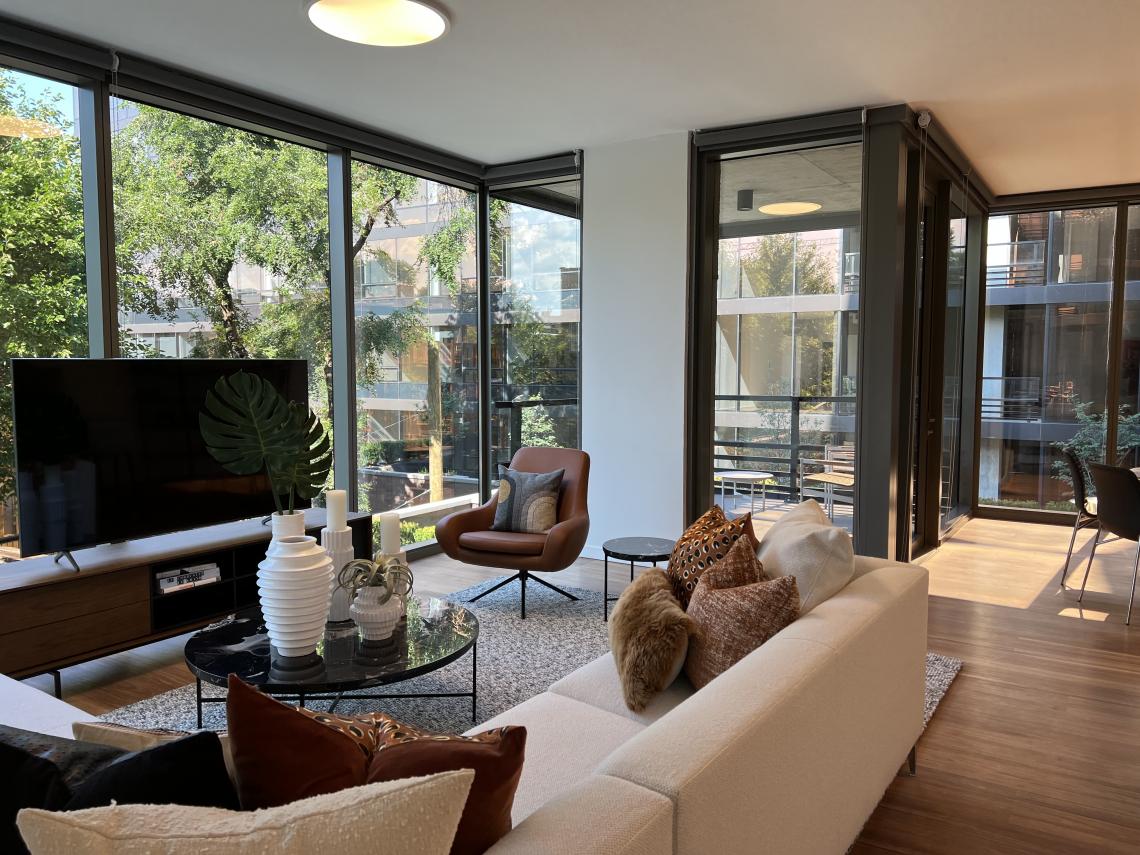
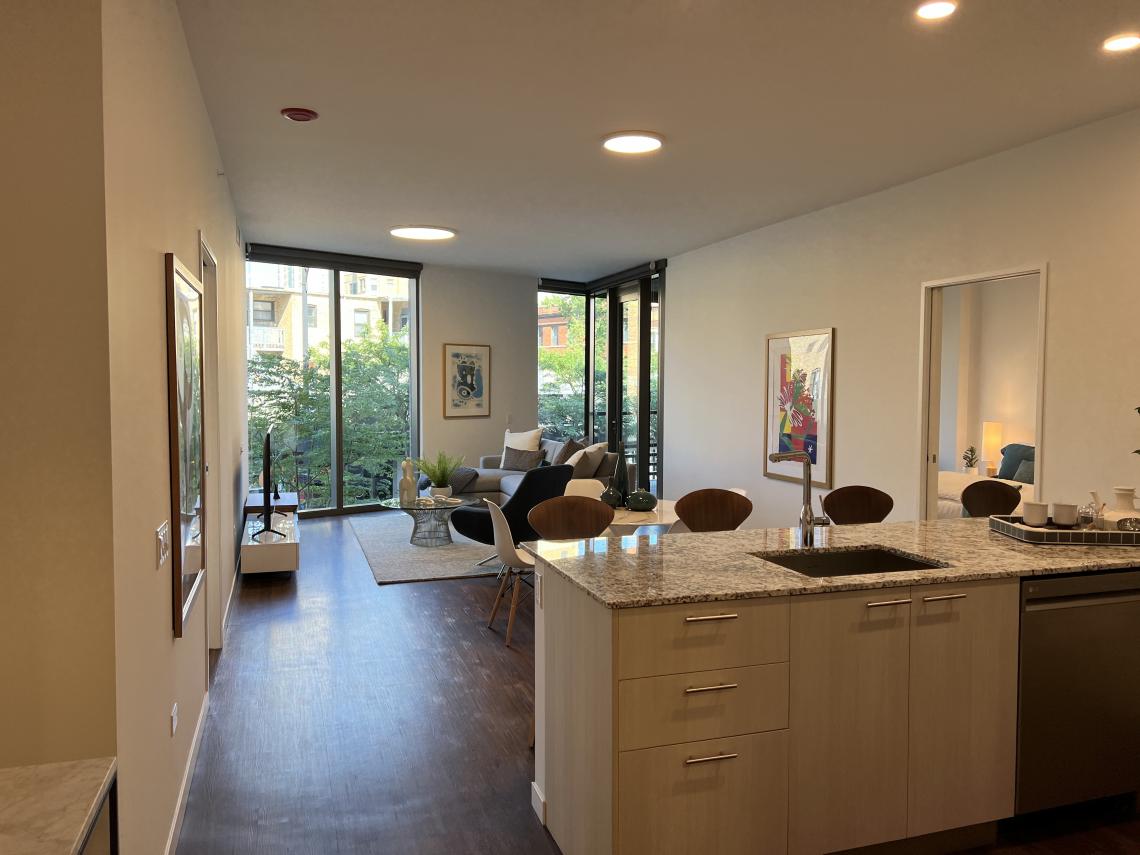
In between seeing the amenity spaces, Urbanize toured select model units within the building. Located in the rear wing of the building, the first model unit was a three-bedroom, 1,940 square foot unit. Overlooking the dog park from the third floor, the unit features a large open plan living space. A theme throughout the units, the floor plans have been designed to maximize storage opportunities.
Optima Lakeview 3 Bedroom ModelLukas Kugler/Urbanize Chicago
The second unit toured was a two-bedroom, 1,396 square foot floor plan. The floor plan features a split bedroom layout with a large living room and storage space at the entrance of the unit. Accessed from the living room, an inset balcony overlooks activity on the street. The final model unit was a one-bedroom configuration looking south out of the building. Planned with a borrowed light bedroom, the bedroom sits inboard of the living space, using a partial height wall between the kitchen and bedroom to allow light to reach the bedroom space.
Optima Lakeview 2 Bedroom ModelLukas Kugler/Urbanize Chicago
Currently 46% leased, Optima Lakeview offers one-, two- and three-bedroom floor plans. Remaining units include floor plans renting at $2,600 – $4,700 for one bedrooms, $4,900 – $6,400 for two bedrooms, and $7,100 – $9,800 for three bedroom configurations. The first move-ins for tenants began back in April 2022.
A 198-unit apartment building that replaced a grocery store on Chicago’s North Side is for sale, adding to an already lengthy shopping list for multifamily investors in the city.
JLL brokers have been hired by developer Optima to seek a buyer for the Optima Lakeview building at 3478 N. Broadway, according to a marketing brochure.
The offering adds to a slew of large apartment buildings already on the market downtown and on the North Side. A dearth of new construction in the city has fueled strong rent growth relative to other markets, leading to some high-dollar sales and prompting other property owners to test the market.
Optima, a Glencoe, Illinois-based real estate development and design firm, completed the glassy, eight-story building on the former Treasure Island grocery store site in 2022.
That project came after the local grocery chain abruptly went out of business in 2018.
It’s unclear how much Optima is expecting in a sale. The firm did not immediately respond to a request for comment from CoStar News on Tuesday.
Overall Chicago-area sales have totaled $2.3 billion so far in 2025, compared with $3.9 billion for full-year 2024 and $4 billion in 2023, according to CoStar data.
Properties that have gone on the market for sale in recent months include The Mason, a 363-unit tower in Fulton Market; the 451-unit Left Bank tower at 300 N. Canal St., just east of Fulton Market; and the 275-unit Milieu tower along the edge of the Greektown and Fulton Market neighborhoods.
From groceries to residents
Optima bought the vacant grocery store for $12.85 million in July 2019, according to Cook County property records.
The firm knocked down the grocery store and secured a nearly $63.3 million construction loan from Village Bank & Trust to kick off the project. Optima refinanced the property in March, taking out $56 million in permanent debt from PNC Bank and paying off the construction loan, property records show.
JLL is marketing the property as the opportunity to buy a new building in a high-density neighborhood where large apartment developments are relatively rare.
Optima Lakeview includes large outdoor areas such as private balconies and a large rooftop deck with a pool, spa, party room, fire pits and grilling stations. There also is a fitness center, indoor basketball and pickleball courts and sports lounge with putting green.
The property is more than 91% leased, with asking rents of $4,372 per unit and $4.13 per square foot, according to CoStar data.
North Side demand
Large sales on the North Side this year have included the nearly $114 million sale of the 191-unit Elevate Lincoln Park and the nearly $87 million sale of the 292-unit Cobbler Square complex in Old Town.
Amid high borrowing and construction costs, some developers are teeing up smaller projects to meet high demand in Lakeview.
Optima will lead property management and leasing services at its 490-unit Optima Signature mixed-use development in Chicago’s Streeterville neighborhood, the under-construction 198-unit Optima Lakeview in Chicago’s Lakeview neighborhood and its upcoming 109-unit building in downtown Wilmette along Chicago’s North Shore. While Optima has served as the owner, architect, developer and general contractor for its properties in Chicago and Arizona for more than 40 years, the firm had also assumed property management services at its Scottsdale, Arizona, rental communities, which contain more than 1,000 units.
Optima, Inc. has launched pre-leasing for its 198-unit Optima Lakeview luxury rental apartment building, which includes 14,000 square feet of street-level retail at 3478 N. Broadway in the North Side’s Lakeview neighborhood. First move-ins are scheduled for April.
Designed by Optima CEO and founder David Hovey Sr., and built by Optima’s in-house construction team, Optima Lakeview offers one-, two- and three-bedroom floor plans with high-end finishes and smart home technology. Rents start at $2,400 per month.
“Optima Lakeview is a true original for the area in that it offers the best of both worlds – the same Class A management service, innovative design and deep amenity package of our Optima Signature high-rise in downtown Chicago, but in a more intimately sized building within one of the city’s most beloved neighborhoods and just blocks away from historic Wrigley Field,” said David Hovey Jr., president, COO and principal architect of Optima.
The new Optima Lakeview, a 198- unit luxury rental community in Chicago’s Lakeview neighborhood, offers on-site room service, a chef’s kitchen, landscaped terraces, an indoor basketball/pickleball court, a 2,000-sf heated dog park, and a 25×35-foot heated rooftop pool. David Hovey Sr., FAIA, CEO and founder of developer/contractor Optima Inc., was design architect and AOR. On the team: WSP USA (SE), F.E. Moran (mechanical), IMEG (electrical), and Warren F. Thomas Plumbing (plumbing). Photo: Michael Duerinckx Photography
Kimley-Horn, Langan, Thornton Tomasetti, and WSP head the ranking of the nation’s largest apartment and condominium engineering and engineering/architecture (EA) firms for 2022, as reported in Building Design+Construction’s 2022 Giants 400 Report.
Top 65 Apartment + Condominium Engineering + EA Firms for 2022 – BD+C Giants 400 Rankings
U.S. population growth is slowing and expected to continue declining over the next decade. At the same time, demand for multifamily rental units continues to be robust, a trend Fannie Mae predicts will continue over the long term.
Can both things be true at the same time? They can, say the professionals who keep a close watch on the demographic trends shaping the multifamily industry. Shifting demographic factors—including delayed household formation, aging renters, and lifestyle-driven mobility—are redefining who rents and why. And as developers and investors grow more savvy about parsing their rental pool and technology makes it easier than ever for REITs to align their portfolios using artificial intelligence (AI)-driven demographic strategy, they’re rethinking everything from geographical choices to unit mix to amenity strategies.
Younger generations are waiting longer to form households—the average marriage age has increased more than four years since 1990—while housing costs are driving outsized demand for rentals, says Roberto Casas, senior managing director for JLL. That means the renting population now spans a larger age demographic than it ever has, and this has been a big factor in pushing multifamily from 0% of the Open End Diversified Core Equity Index in 1980 to 32% today, he says.
“Aging demographics and structural changes, such as delayed marriage and a rise in the share of single households, are the biggest changes we’ve come across in both our proprietary data as well as third-party data sources,” says TJ Parker, senior vice president of market research and data analytics for multifamily investment and management firm Bell Partners. “On demographics, we are seeing a flattening of the curve across age cohorts, which means demand is spread out across both younger and older age cohorts.”
As mortgage rates decline, some millennials and Gen Zers will leave the rental market to buy homes, Parker says, but, at the same time, Bell is seeing more demand from older renters who are choosing the convenience of renting over the upkeep of owning a home. “But, of course, real estate is very local in nature,” she adds. “The demographic composition may vary widely across communities and different Bell markets, which adds complexity in terms of providing services that cater to those needs from a property management perspective.”
For Mary Cook, president of Chicago-based design firm Mary Cook Associates, getting demographics right means looking beyond things like average age and income. Cook’s team susses out “the who” of new projects by exploring the area’s key employers, figuring out where people are migrating from, and visiting nearby retail stores and coffee shops.
Cook says she realized, for example, that her design for a property located between Harvard University and the Massachusetts Institute of Technology in Cambridge, Massachusetts, had better be next-level tech savvy when she stumbled across a neighborhood coffee shop with an electric board that displayed how long her order would take based on an algorithm tracking how many people were in the store. For a property in Princeton, New Jersey, proximity to a pharmaceutical company that employed many people from East India prompted Cook’s team to include lock boxes in the mailroom for passports, visas, and green cards.
“The ‘who’ is what informs every aspect of our design, the strategy behind how we dedicate space, and how we prioritize space,” Cook says. “The aesthetic ends up coming last.”
Gen Z: Renting as a Lifestyle
On a macro level, Gen Z—which now comprises 27% of the workforce and 30.5% of all renters—is driving the rental market. Because this cohort had the unfortunate timing of starting their professional lives just as housing costs soared to unattainable levels, about 85% of them are renting, says George Ratiu, vice president of research for the National Apartment Association.
But young adults aren’t renting simply because they can’t afford to buy. Many simply prefer it. In a June poll, Entrata and Qualtrics found that 72% of Gen Zers said they believe renting is financially smarter than owning a home, 83% said renting helps them save for other priorities, and 37% said they prefer the ease of on-call maintenance over the burdens of home ownership.
This generation is also geographically nimble, much more willing than older generations to move in search of a better or more affordable lifestyle. They’ll pay a little more to live in walkable neighborhoods with parks, coffee shops, and restaurants, and they’re flocking to smaller, more affordable metros in the Midwest like Ann Arbor, Michigan; Lincoln, Nebraska; and Des Moines, Iowa—places their parents fled.
Developers are responding to Gen Z demand in these cities with amenity-rich properties in downtown hubs. In Des Moines, Double Eagle Development is building a $50 million, 202-unit complex on an urban infill site near restaurants and a growing entertainment district. In Ann Arbor, 4M recently opened a 216-unit, mixed-use mass timber complex powered by a natural gas fuel cell system and other environmentally friendly features that appeal to climate-conscious Gen Zers.
In addition to location and sustainability, these new developments are targeting tech-native, wellness-oriented Gen Zers with amenities like lightning-fast connectivity, coworking accommodations, and social spaces and programming that build belonging and address mental and emotional well-being. To counteract the amount of time this generation spends on screens, Cook says, Gen Z-focused properties “need to be really activated with all sorts of activity rooms to keep people more engaged with each other.”
Projecting a highly curated, authentic spirit, The Sadie in Fort Worth, Texas, targets those who not only appreciate art and culture but live it in their everyday lives. (Interiors by Mary Cook Associates, developed by Toll Brothers Apartment Living )
Not Your Father’s Senior Housing
Gen Z is not the only flexible, mobile, and digitally fluent generation to embrace renting. Their parents and grandparents—baby boomers—are chasing many of the same amenities, including walkability, access to transit and public services, and climate-responsive and resilient design. As such, boomers have become a desirable growth market for luxury properties.
Make no mistake—the number of 80-plus renters is growing at ever-accelerating rates, pushing net absorption for senior housing to record highs. But Doug Ressler, manager of business intelligence for Yardi Matrix, points out that the pool of potential tenants for senior housing is limited to people who can afford the high price of assisted living. Younger seniors who can’t see themselves moving into age-restricted, health care-oriented housing until they’re 85—if ever—are a ripe market, Ressler says.
Adults in the 65 to 85 age range often have pets and may still be working. They want space, but they don’t want the hassle of maintaining it, which is why they’re a driving force in the growing build-to-rent single-family rental market, Ressler says. They’re also not averse to living among young adults in apartment complexes. “The nature of generational conflict is not near where it used to be,” he says.
“Boomers and Gen Z actually cohabitate pretty well,” Cook says, “because you don’t have the kid factor.”
This trend started to emerge in the early 2010s, when developers who built Class A urban apartments to capture affluent millennials realized a lot of baby boomers were moving in, too, says rental housing economist and consultant Jay Parsons. “That demographic is not necessarily looking for something that’s geared toward a senior adult,” he says. “They’re maybe looking for something that makes them feel younger.”
“Renting has become an increasingly popular option for active seniors who aren’t interested in age-restricted housing but seek a maintenance-free lifestyle in an accessible building,” says David Hovey, president of Optima, a company that designs, develops, builds, and manages multifamily communities in Arizona and Illinois. “With single-level homes and residences with elevators in particularly high demand and short supply, luxury rentals offer a practical and appealing solution with the flexibility and peace of mind to age in place.”
With the number of renter households headed by people 65 and older increasing by more than 1 million between 2019 and 2024, according to a Harvard University Joint Center for Housing Studies report, boomers are lucrative at both the luxury and affordable ends of the market.
“With the oldest baby boomers turning 80 in 2026—an age when more people turn to renting—a wider range of affordable rental options for older adults will be required to accommodate their changing needs,” the report states. “Renting will be an especially attractive option for older adults who want to age in their community, reduce their maintenance responsibilities, and access the shared spaces for social interaction and accessibility features more common in multifamily buildings.”
Development firm Optima, Inc. will lead property management and leasing services at three Chicagoland Class A rental buildings – its 490-unit Optima Signature mixed-use development in downtown Chicago’s Streeterville neighborhood, the under-construction 198-unit Optima Lakeview in the North Side’s Lakeview neighborhood, and its upcoming 109-unit building in downtown Wilmette, IL, along the North Shore.
While Optima has served as the owner, architect, developer and general contractor for its properties in Chicago and Arizona for more than 40 years, the firm primarily focused its property management services at its Scottsdale, AZ rental communities.
“As we expand our portfolio in the Chicago area with two new luxury apartments in development, it is a natural progression to bring management in-house, enabling us to provide the same level of exceptional service we’ve perfected at our Arizona communities,” said David Hovey Jr., AIA, president and COO of Optima, Inc.
The COVID-19 pandemic has altered many renters’ lifestyles, and multifamily developers and owners have responded through their amenity offerings—from connectivity and additional co-working space for the work-from-home crowd to enhanced fitness spaces for health and wellness.
Multifamily Executive caught up with several multifamily developers and owners—including Lissette Calderon, CEO of Neology Life Development Group; David Hovey Jr., AIA, president of Optima, Inc.; and Stuart Zook, principal and chief Investment officer at Monument Capital Management, an A-Rod Corp company—to see what’s new in their communities and how they are pivoting their amenities to meet renters’ needs and wants.
MFE: Are you planning to introduce any new indoor amenities at your properties in 2022?
Hovey: Our communities celebrate the fundamental connection between design and nature, and Optima Lakeview’s design will reflect that with a striking atrium that runs through the core of the seven-story building. The building’s two-story fitness center will feel especially spacious given that it will be flooded with natural light from the atrium. This design also allows us to spread out equipment and encourages good air flow, which will add to the wellness aspect for our residents.
Executive assistant Michelle Feuillerat, left, with her dog Sunshine, and head of underwriting Lynn Seitler, with her dog Muddy, work together at Zurich American Insurance in Schaumburg on Aug. 29, 2022. The headquarters for Zurich North America uses a hybrid strategy where most people only come in a few days per week. One of the perks for employees returning to the office is the option to bring their dog with them on Mondays and Fridays. (Erin Hooley / Chicago Tribune)
Michelle Feuillerat works remotely most days but makes a special effort to come into the office on Mondays or Fridays, which her firm, Zurich North America, dubs bring-your-dog-to-work days.
The executive assistant loads Sunshine, her yellow Labrador retriever, into the car and drives from her home in northwest suburban Crystal Lake to the insurance company’s Schaumburg headquarters, where Sunshine cavorts with other employees and their dogs.
“I have a great group of cubicle mates who love my dog,” she said. “It brings a real sense of community and everyone has been excited about the opportunities to meet new people and new dogs.”
Company officials believe pet dogs bring a touch of home to the office. It’s all part of an effort to change workplace culture and encourage employees to return to the office, at least for several days per week.
“We have been very focused on making sure employees are comfortable with the environment,” said Zurich North America Chief Human Resources Officer Laura Rock. “It’s not just an office where you sit in front of your screen doing Zoom calls.”
Legal bill representative Artur Fugiel, with his dog Bella, works at Zurich North America in Schaumburg on Aug. 29, 2022. (Erin Hooley / Chicago Tribune)
Most Chicago-area firms are adapting to COVID-19 the same way. Instead of giving employees hard deadlines to leave comfy home offices, most are enticing people back with new amenities and perks, including the option to stay home for a portion of the week.
It’s a big change from how the return to the office was first envisioned, according to market experts. Many companies planned to make a sharp break with the past after the Labor Day holiday, designating it as the date when workers finally returned. Similar hopes were pinned to the first two Labor Days of the pandemic.
But the tight labor market, and the difficulty in recruiting new hires, means popular work-from-home options are here for the foreseeable future. That leaves uncertainty hanging over a market already plagued by high vacancies, because it could take office users months to calculate just how much space they will need in the future.
“The conversations over the past couple of years has gone from ‘We’re going to return when it’s safe’ to ‘We’re going to do what the employees want to do,’” said Jim Adler, executive vice president of commercial real estate firm NAI Hiffman. “So, there is a little bit of a tug of war going on, but (employees) have been shaping the return to the office.”
Zurich North America began allowing dogs in April, and over the past six months brought other new touches to its gleaming, 11-story complex, first opened in 2016 and familiar to anyone driving through Schaumburg on I-90. The company broke down some walls on the 11th floor to create more open spaces, and the facility also now includes a cafe that serves beer and wine in the late afternoons, new outdoor patio furniture and a fire pit.
But it’s the dog days that Feuillerat, who started with the firm in April, said she finds special. Feuillerat doesn’t have a set schedule of in-office days but does come in when she needs to meet someone in person, and if it’s a Monday or Friday, Sunshine makes it easy to break up the routine and get to know other dog lovers.
“I meet people from different departments that I probably would never get a chance to meet, but we all bring and bond over our dogs and also learn about each other’s lives,” she said.
Feuillerat said eliminating her commute on most days also makes it easier to juggle work responsibilities while taking care of Sunshine, other pets and her two children.
“I find myself being more productive because I don’t have that 35-to-40-minute drive from Crystal Lake,” she said.
Only a tiny number of the 2,200 employees assigned to Zurich’s Schaumburg headquarters now come in four or more days a week, according to Rock. Roughly 30% of its 9,000 employees across the nation work remotely because they’re out in the field meeting clients, and the rest visit their office between one and three days per week.
People hang out in the coffee shop area of Zurich North America in Schaumburg on Aug. 29, 2022. The headquarters uses a hybrid strategy where most people only come in a few days per week. (Erin Hooley / Chicago Tribune)
Zurich isn’t setting hard deadlines for office workers who don’t show up often, Rock said. Remote working has been largely successful for Zurich, with high productivity, so leaders will be content if employees starting after Labor Day return more frequently over an extended period as their comfort increases, eventually forging new routines, with working hours split between work and home.
“Post-pandemic, it’s just how we work,” Rock said. “Employees are expecting that level of flexibility from their employers.”
Insurance firm Allstate Corp. took an even bigger step than Zurich. In 2021, company officials announced they were selling Allstate’s 2 million-square-foot headquarters in suburban Northbrook for $232 million and moving to a much smaller building in Chicago’s Loop because so many employees were working remotely.
According to a 2022 Pew Research Center survey, 61% of those working from home now prefer it over their office jobs. That’s a big shift from early in the pandemic, when 36% of those surveyed said they chose to work at home, with the remainder doing so simply because their offices had closed.
Commercial real estate firm JLL surveyed office employees this year and found that most want jobs with work-from-home options, with technology and finance workers stating that such flexibility is the equivalent of a 10% salary increase. JLL also forecasts that more than half of companies will offer remote working to all employees by 2025.
“I was with a financial client yesterday who has 60 positions to fill,” Adler said. “And they told me the first question from every job applicant is what the hybrid schedule looks like.”
The tight job market means employers have good reason to be accommodating, for now at least, said Cassandra Francis, principal of Kariatid, a Chicago-based real estate planning and management firm. And with so many employees loving the freedom of working from home and skipping long commutes, whether companies can successfully lure people back is still unknown.
“We’re in this strange place where even though we’ve had high inflation and rising interest rates, employment is still high, so it’s very hard to find people,” Francis said. “Employees still have more leverage and just a bit more say.”
Mike Spanos works in the offices of McHugh Construction in the South Loop on Aug. 29, 2022. (Brian Cassella / Chicago Tribune)
U.S. Bureau of Labor Statistics data show the U.S. economy created 528,000 new jobs in July, and the unemployment rate sank to 3.5%, reaching the pre-pandemic rate and tied for the lowest unemployment rate since 1969. August was another solid month, with 315,000 jobs created.
But young people and new hires are likely to be required by many corporate leaders to spend more time in the office, Adler said.
“I think there are some strong opinions that workers, especially ones in their 20s and 30s, need to be in the office more than they realize,” he said.
Rock said she agrees. Zurich fills many of its apprenticeships with young people just out of high school, and both this group and other new hires will spend significant time at headquarters, meeting with coaches and mentors to learn how the insurance industry works.
“There is a certain value to doing that in person,” she said.
Other Chicagoland firms are adopting similar strategies. Discover Financial Services decided that the first cohort of 75 hires for its new data analytics center will work at the firm’s downtown Chicago office at 350 N. Orleans St. for three days a week, according to spokesperson Matthew Towson. A new cohort of at least 75 will join the program in 2023.
Workers did return to Chicagoland offices in greater numbers over the course of this year. According to Kastle Systems, a security firm that tracks card swipes, the metro region’s office occupancy hit 42.5% on August 24, almost equal to the national average and up from 27.1% in January.
But large-scale use of remote working seems likely to continue for a long time at firms such as Discover.
“The company overall continues to employ a hybrid work model where employees have the option to work fully remote or in the office,” Towson said. “This applies to new hires as well who are not part of the (new data analytics) program.”
Working at home, with all the conveniences and comforts, is just too alluring to give up, said Desmond Lathan, a property manager and leasing agent who runs a four-person team for Chicago’s Fulton Grace Realty.
“Prior to the pandemic, I was in the office every day, but it’s changed the way I look at going to the office,” Lathan said. “I’ve run my business from my home for two years now, and I’ve found that people are equally productive at home.”
Lathan said moving into Optima Lakeview, a seven-story apartment complex that opened earlier this year in the Lakeview neighborhood, made working at home even easier. Like an increasing number of apartment developers, Optima provides its residents, many of whom work from home, with high-tech conference rooms and a business center, among many other amenities.
“When it’s time for our weekly meeting, I’m saying: Where do I want to be, in my office, in my home or in Optima’s conference center?” Lathan said. “Everybody has choices now.”
At the Optima Lakeview apartment building on Broadway in Chicago, Fulton Grace Realty property manager Desmond Lathan, left, and administrative assistant Autumn Myer work in a conference room that tenants in the building can use. (Terrence Antonio James / Chicago Tribune)
Other large corporations claim they’re also all-in when it comes to mixing remote and in-office work.
“We know that the workplace has changed as a result of the global pandemic and we see a flexible hybrid work schedule as the future and new normal for Groupon,” said Nicholas Halliwell, spokesman for the Chicago-based daily deal company, which has about 800 Illinois-based employees and still occupies office space at 600 W. Chicago Ave. on the Near North Side.
“While it’s still early, many Grouponers have favored a remote working environment, although some are also adopting a hybrid approach,” he added. “We’ve also made the decision to open up most of our open U.S.-based roles to remote work, which is showing some promising, early returns in our efforts to recruit the best, diverse talent.”
Even companies committed to bringing people to the office almost every day recognize the need for some remote work. About 60 people work at the South Loop headquarters of James McHugh Construction Co., and other than during the initial COVID-19 emergency in early 2020, most are in the office every weekday, according to company President Michael Meagher, largely to show solidarity with their construction workforce, which is in the field on job sites.
“Our office culture is that we’re here to support the field,” Meagher said. “And it’s hard for us to support them effectively and then turn around and say, ‘we can work wherever we like.’”
The company does allow a limited amount of remote working, but typically it’s just one day per week.
“We think we needed to do that to be more competitive in the marketplace,” Meagher said.
Earlier this year, rental housing economist and consultant Jay Parsons parsed renter data released by multifamily REITs and found income levels rivaling those of middle-class homeowners—Equity Residential reported typical renter income of $169,000; Essex Property Trust, $131,000; and Camden Property Trust, $120,000—and rent-to-income ratios ranging from 19% to 22%.
This data proves that developers and policymakers need to update their perceptions about who today’s renters are and why they rent, Parsons says. “The bottom line is that there are a lot of people who are making good incomes and want to be renters.”
The Harvard University Joint Center for Housing Studies found that the number of renter households with incomes of $75,000 or more has risen 43%, to 13.5 million, since 2010. The number of affluent renters is also growing in 35 of the 50 most populous U.S. metros, according to a Redfin analysis of the U.S. Census Bureau, MLS, and county records. In San Jose, California, and Orlando, Florida, about 11% of renters are wealthy; in New York and Seattle, approximately 10% are, the analysis found.
Jessica Perri, marketing director for residential property developer and manager Habitat, says the assumption that people see renting primarily as a transitional phase before homeownership has shifted. More residents are choosing to rent long term because it better aligns with their financial goals, lifestyle, and desire for flexibility, she says.
“This shift has challenged us to think beyond traditional property management and to create communities where renters can truly put down roots, build connections, and feel invested in where they live,” Perri says.
Optima president David Hovey says renters by choice are drawn as much by a sense of community as they are to concierge support, in-home package delivery, and private chefs. Optima is meeting those needs with things like expansive residents’ clubs, rooftop decks, and reservable guest suites.
“For many, what begins as a practical and often temporary decision to rent evolves into a long-term lifestyle preference,” Hovey says.