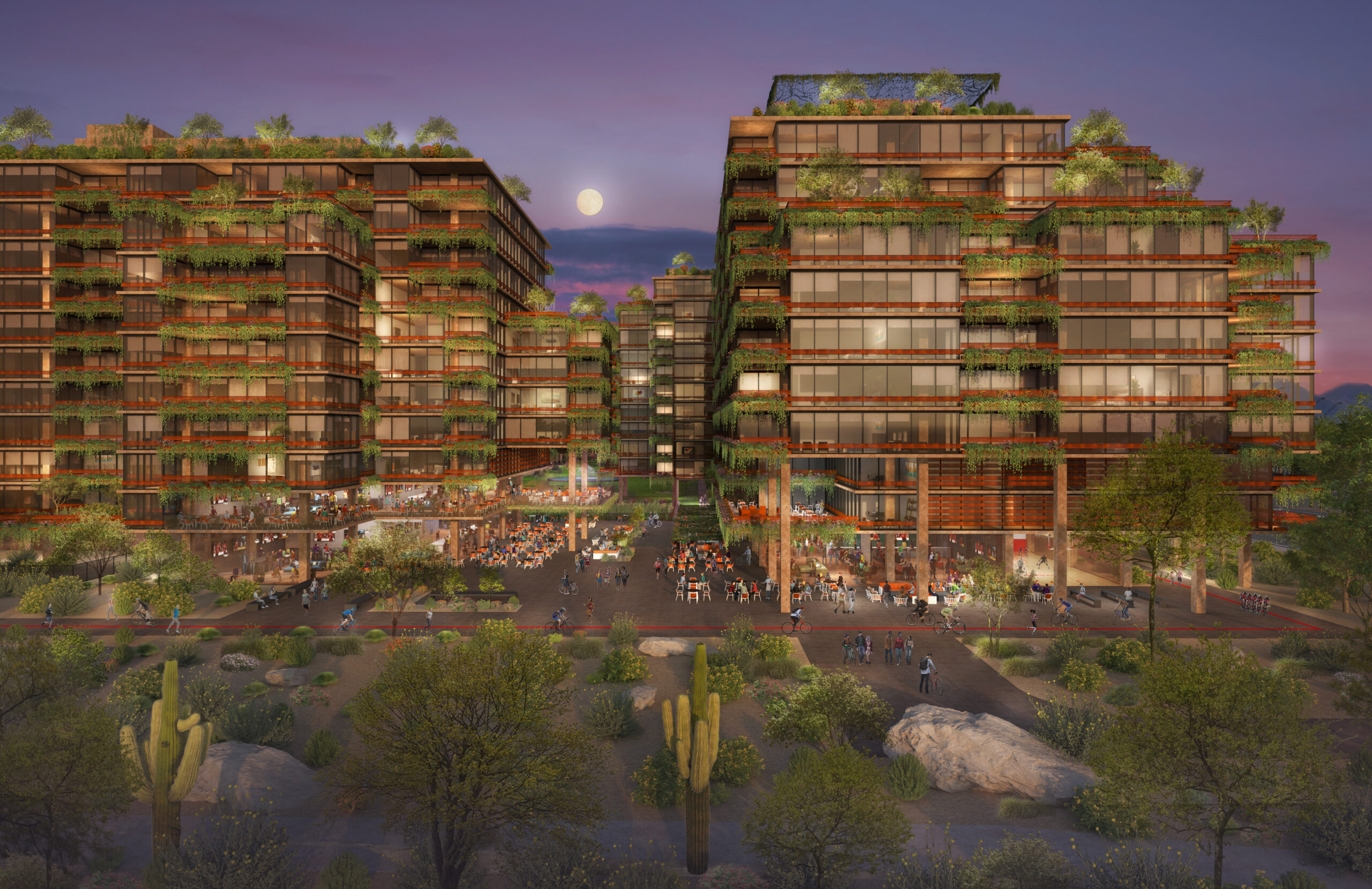
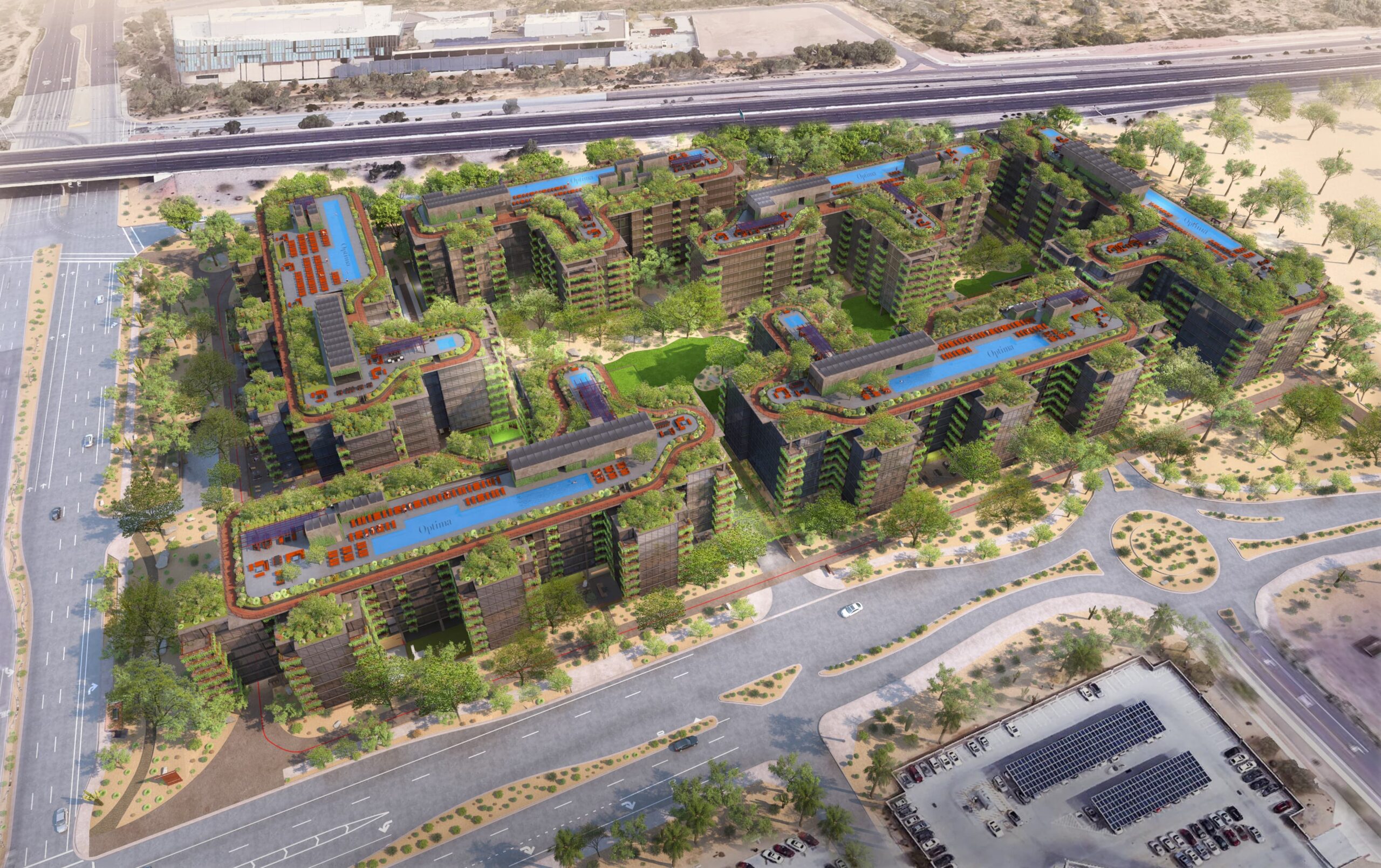
Optima, a luxury real estate developer, has launched sales for the first condominium tower at its $1 billion Optima McDowell Mountain community in North Scottsdale, marking the company’s return to Arizona’s for-sale residential market after a four-year hiatus.
Located on a 22-acre site at Scottsdale Road and Loop 101, the community had already generated nearly $27 million in early reservations as of mid-June, reflecting strong demand for the amenity-rich and architecturally distinctive homes.
The debut tower, named 7230, will include 196 luxury condominiums ranging from 728 to 2,204 square feet. Floor plans will include one-, two- and three-bedroom options, with starting prices estimated in the $600,000s. Residences will feature floor-to-ceiling glass, landscaped private terraces,
smart-home integration and designer kitchens. Buyers will have the option to personalize finishes or combine units into larger custom residences—a feature that has driven more than 60% of early reservations.
“This is a significant milestone for Optima,” said David Hovey Jr., AIA, president of Optima. “We’re bringing everything we’ve learned over the past four decades into this new community.”
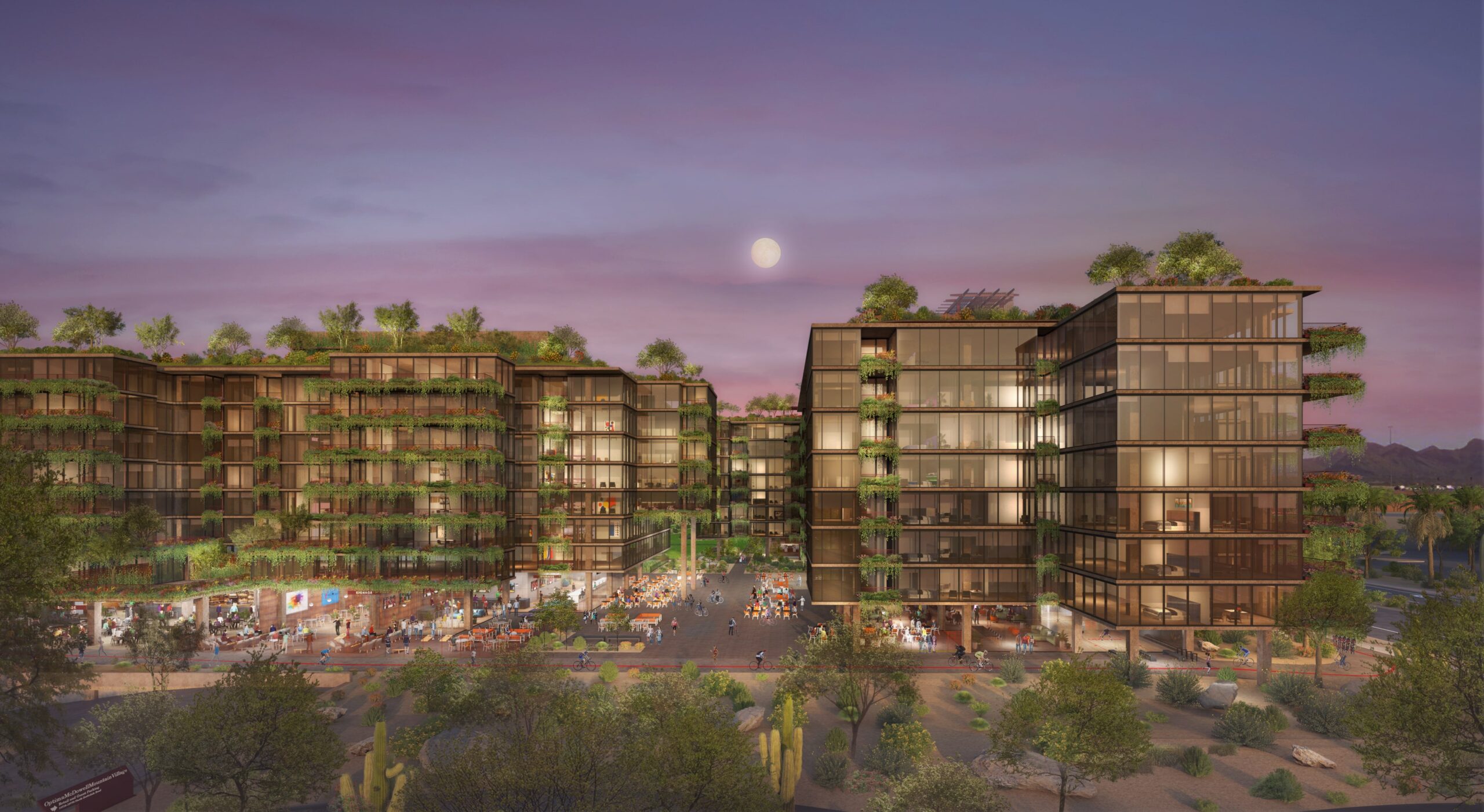
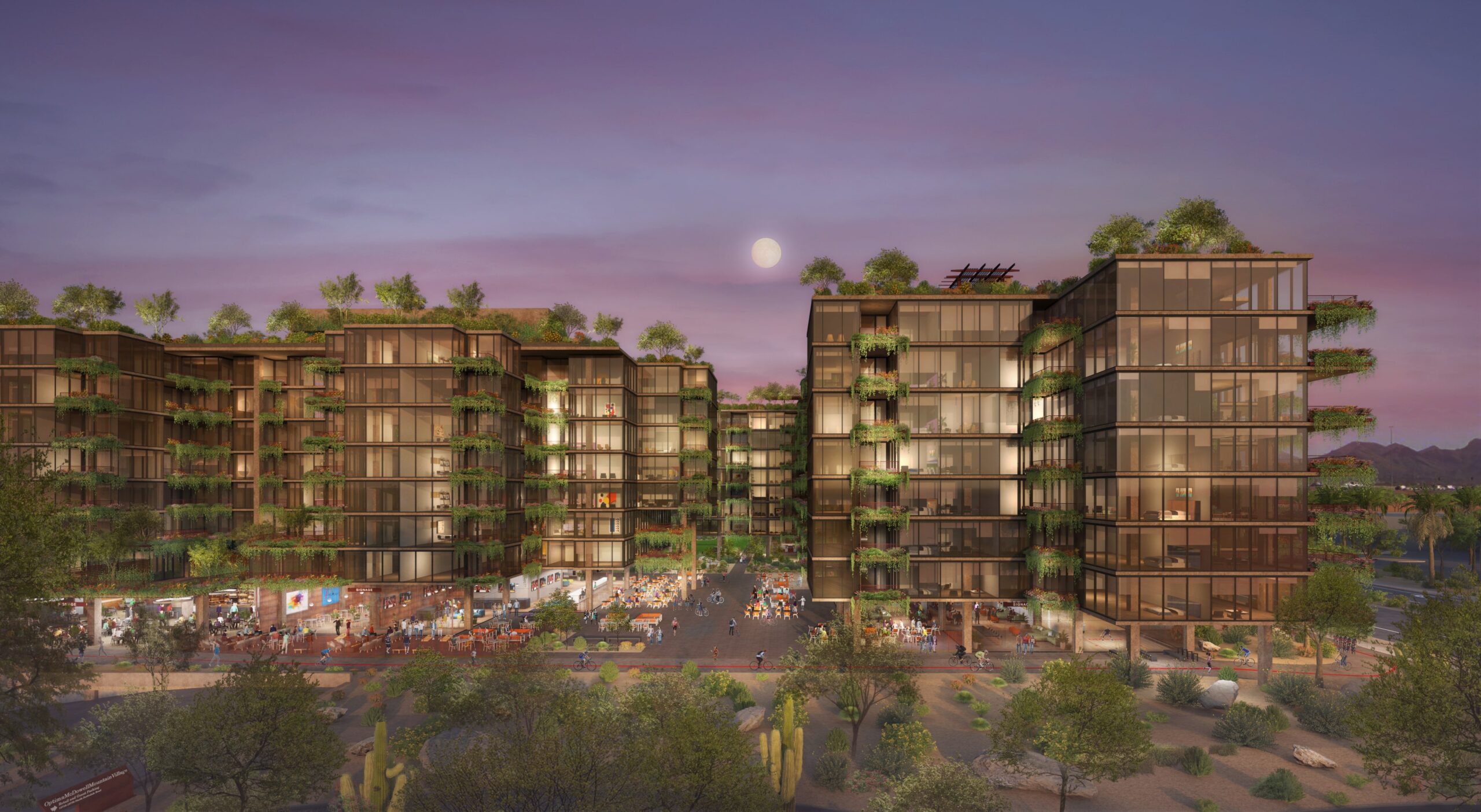
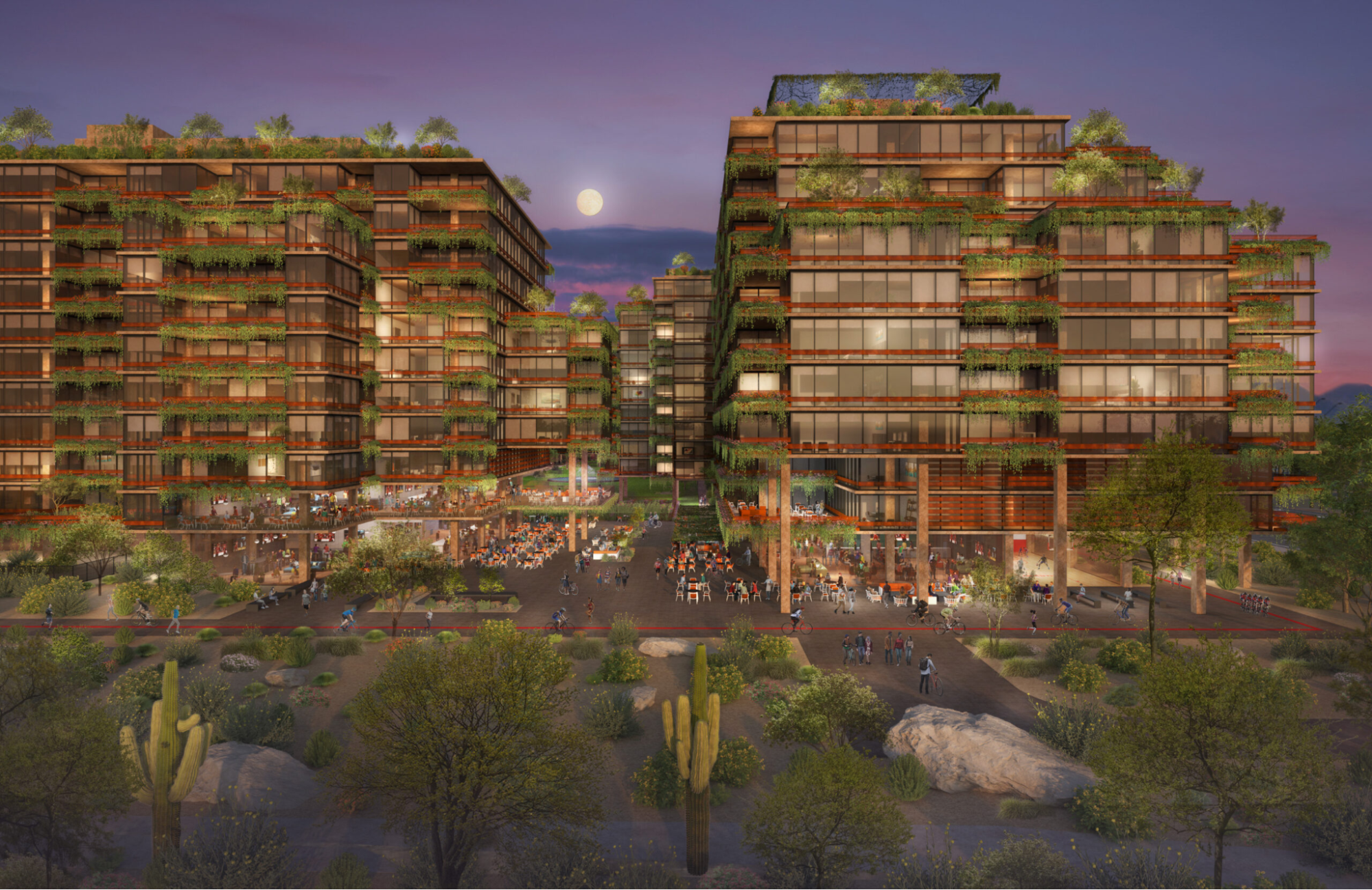
The full development will include six eight-story towers featuring a mix of for-sale condominiums and rental apartments, along with 36,000 square feet of retail and dining space. Approximately 75% of the site—about 16 acres—will be dedicated to open space, including landscaped areas, walking
and biking trails, and a 10-acre central park.
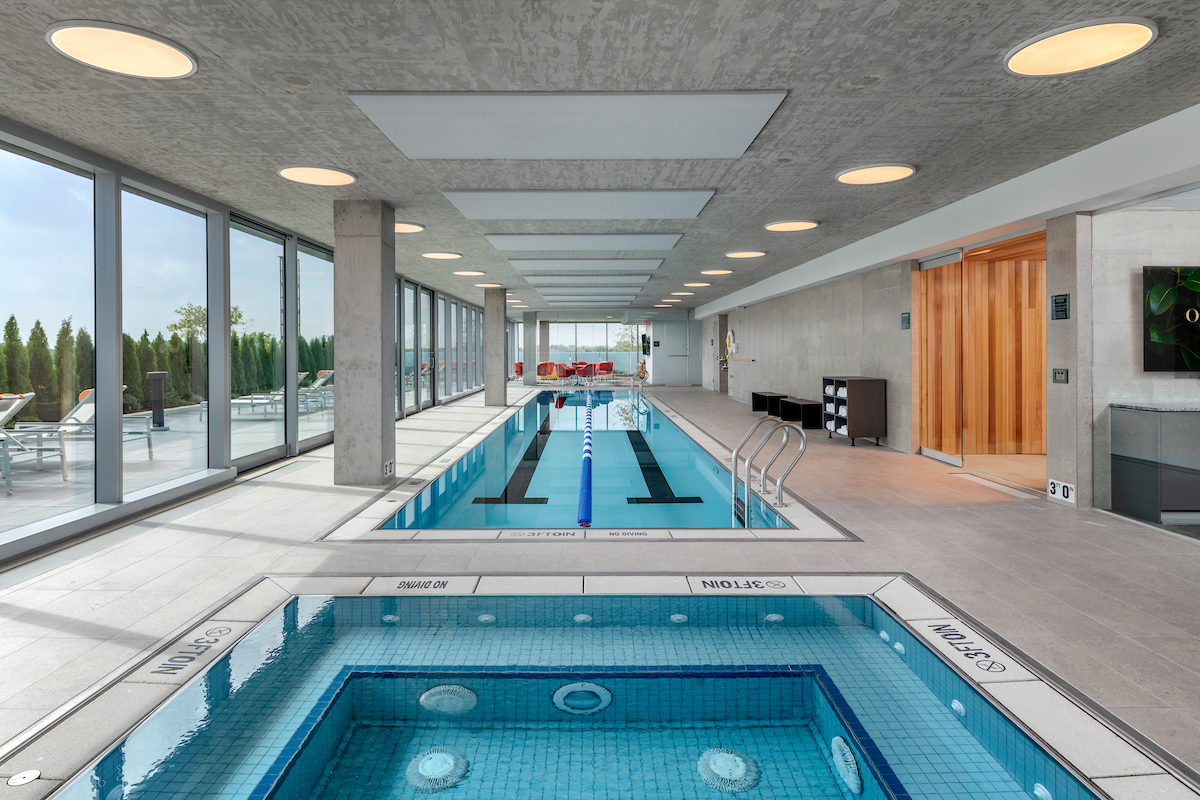
Each building will offer roughly 1.5 acres of rooftop and ground-level amenities. The 7230 tower will include a Sky Deck with panoramic views of the McDowell Mountains, a 50-meter heated lap pool, rooftop running track, spa, saunas, fire pits and indoor-outdoor entertainment areas. Additional
amenities will include a fitness center, pickleball and bocce courts, golf simulator, movie theater, coworking spaces, pet spa and children’s play areas.
The community also embraces sustainability with what is expected to be the nation’s largest private rainwater harvesting system, capable of storing 210,000 gallons for irrigation. It will be the first project in Scottsdale built under the new International Energy Conservation Code and Green
Construction Code. Additional green features include solar panels, self-irrigating vertical gardens, 100% underground parking to reduce surface heat, and electric vehicle charging stations.
The first apartment tower is expected to open in fall 2025, with the condominium tower scheduled to follow in summer 2027. The Optima McDowell Mountain Sales Gallery is open by appointment.
SCOTTSDALE, ARIZ. — Real estate development firm Optima has received city approval for Optima McDowell Mountain Village, a $1 billion apartment and condominium project in North Scottsdale.
Plans call for six buildings comprising 1,330 luxury units as well as 36,000 square feet of commercial and retail space. Construction is scheduled to begin in spring or summer 2023.
Each of the six buildings within the development will contain its own amenity offering, including a rooftop deck with Olympic-length pool, sauna, spa, running track, outdoor kitchen and lounge seating. Each rooftop will offer views of the McDowell Mountains.
The ground floor of each building will be outfitted with a lobby, fitness center, yoga studio, steam room, game room, theater, indoor basketball and pickleball court, golf simulator, massage room, business center and dog park.
The project will be the largest private rainwater harvesting site in the U.S., according to the developer. The residences are expected to use half as much water as the average Scottsdale multifamily residence and a quarter as much water as the average Scottsdale single-family home. Optima is also providing the city with 2,750 acre-feet of water that will be deposited into the Scottsdale water system.
The community will also be the first project in Arizona to be built under both the new International Energy Conservation Code and International Green Construction Code. A few of the sustainable features include: 75 percent open space that will be a combination of artificial turf, xeriscape landscaping and native plants; high-performance mechanical systems and solar panels; 100 percent underground parking to mitigate the heat-island effect; and Optima’s signature vertical landscape system.
The vertical landscaping system features self-containing irrigation and drainage. Plants at the edge of each floor grow up and over the edge of the building. The plants help protect homes from the sun and create additional privacy.
Optima McDowell Mountain Village will be Optima’s most sustainable project to date, according to David Hovey Jr., president and COO.
Optima is a privately held development firm with offices in Arizona and Illinois.
Optima is planning to develop the Optima McDowell Mountain Village on the southeast corner of Scottsdale Road and the Loop 101 freeway in Scottsdale. It will include six eight-story concrete-framed apartment buildings containing 1,500 units that will be a mix of rental units and condominiums. The complex will include 31,000 sq ft of commercial space and underground parking. Each building will have a rooftop pool and running track, solar panels and a vertical landscaping system with self-contained irrigation and drainage systems. Construction is expected to start in August. The project is valued at $1 billion. Optima, 7157 E. Rancho Vista Drive, Scottsdale, 85251. DR#22-00556369.
ARIZONA
Pew & Lake is planning to build the PHX Surf Park in Maricopa. It will include water slides, a lazy river, real sand beaches, an infinity pool, spa, concert stage, an RV park and hotel space. The project is valued at between $25 million and $50 million. Pew & Lake, 1744 S. Val Vista Drive, Mesa, 85204. DR#21-00652849.
ARIZONA
The Arizona Dept. of Transportation is planning to carry out an improvement project to State Route 101 in Scottsdale. The project entails adding one lane in each direction for five miles between Princess Drive/Pima Road to Shea Boulevard. The project is valued at $143 million. Arizona Dept. of Transportation, 1655 W. Jackson St., Phoenix, 85007. DR#21-00664604.
ARIZONA
The city of Phoenix is planning to carry out Phase 1 of a rehabilitation project at the 91st Avenue wastewater treatment plant in Tolleson. The project entails replacing solids treatment equipment, including centrifuges, pumps, motors, heat exchangers, cake pumps, sludge hoppers, boilers, piping, valves and control instruments. PCL Construction Inc. was chosen as the construction manager. The project is valued at $46.1 million. City of Phoenix Water Services, Attn: John Masche, 305 W. Washington St., Phoenix, 85003. DR#19-00835270.
NEVADA
The Washoe County Regional Transit Commission is planning to carry out Phase 2 of the Sparks Boulevard improvement project in Sparks. The project will add roadway capacity by widening the boulevard between Greg Street and Baring Boulevard and add bicycle and pedestrian facilities. Construction is expected to start in March 2024. The project is valued at $60 million. Washoe County Regional Transit Commission, Attn: Jeff Wilbrecht, Project Manager, 1105 Terminal Way, Reno, 89502. DR#17-00710839.
The sustainable residential neighborhood Optima McDowell Mountain Village in North Scottsdale has broken ground on its first building, which will be one of many within the development to offer unique desert living in the prime location of Scottsdale.
Located on 22 acres on the southeast corner of Scottsdale Road and the Loop 101 freeway, Optima McDowell Mountain Village is the newest Arizona residential development of award-winning real estate development firm, Optima, and is set to provide state-of-the-art homes, as well as all-inclusive, health-based amenities for residents and visitors.
Optima has partnered with real estate company Mitsui Fudosan America, Inc. (MFA) to develop the residential community’s first building, which broke ground this month and will consist of 210 rental residences. When complete, the entire Optima development will comprise six, eight-story apartment and condominium buildings that will include 1,330 luxury residences and 36,000 square feet of commercial and retail space.
“We are very excited to begin this partnership with an organization of the caliber of Mitsui Fudosan America that shares our commitment to exceptional design, the highest quality construction, resident-centric property management, and the creation of sustainable neighborhoods,” says David Hovey Jr., AIA, president and COO of Optima, Inc.
Designed by David Hovey Sr., FAIA, and David Hovey Jr., AIA, each of the six buildings will feature the sophisticated architectural detail that characterizes Optima’s Arizona projects, along with resort-style amenities, including: a rooftop sky deck with a 50-meter Olympic-length swimming pool; a sauna, spa and cold plunge; a running track following the perimeter of the roof; outdoor fire pits; lounge seating; outdoor kitchens with barbecues and dining spaces; and sheltering arbors covered with vines. Every rooftop will offer spectacular views of the McDowell Mountains to the east, vibrant sunsets to the west, Pinnacle Peak to the north and Camelback Mountain to the south.
The ground-floor level of each building will boast spacious, well-appointed lobbies in addition to a fitness center and yoga studio looking out to a lushly landscaped courtyard; a sauna and steam room; a residents’ club with game room and theater; an indoor basketball and pickleball court; an outdoor pickleball arena; a golf simulator; an outdoor putting/chipping area; indoor and outdoor kids’ play spaces; a massage room; a dog park and pet spa; and a business center and conference room.
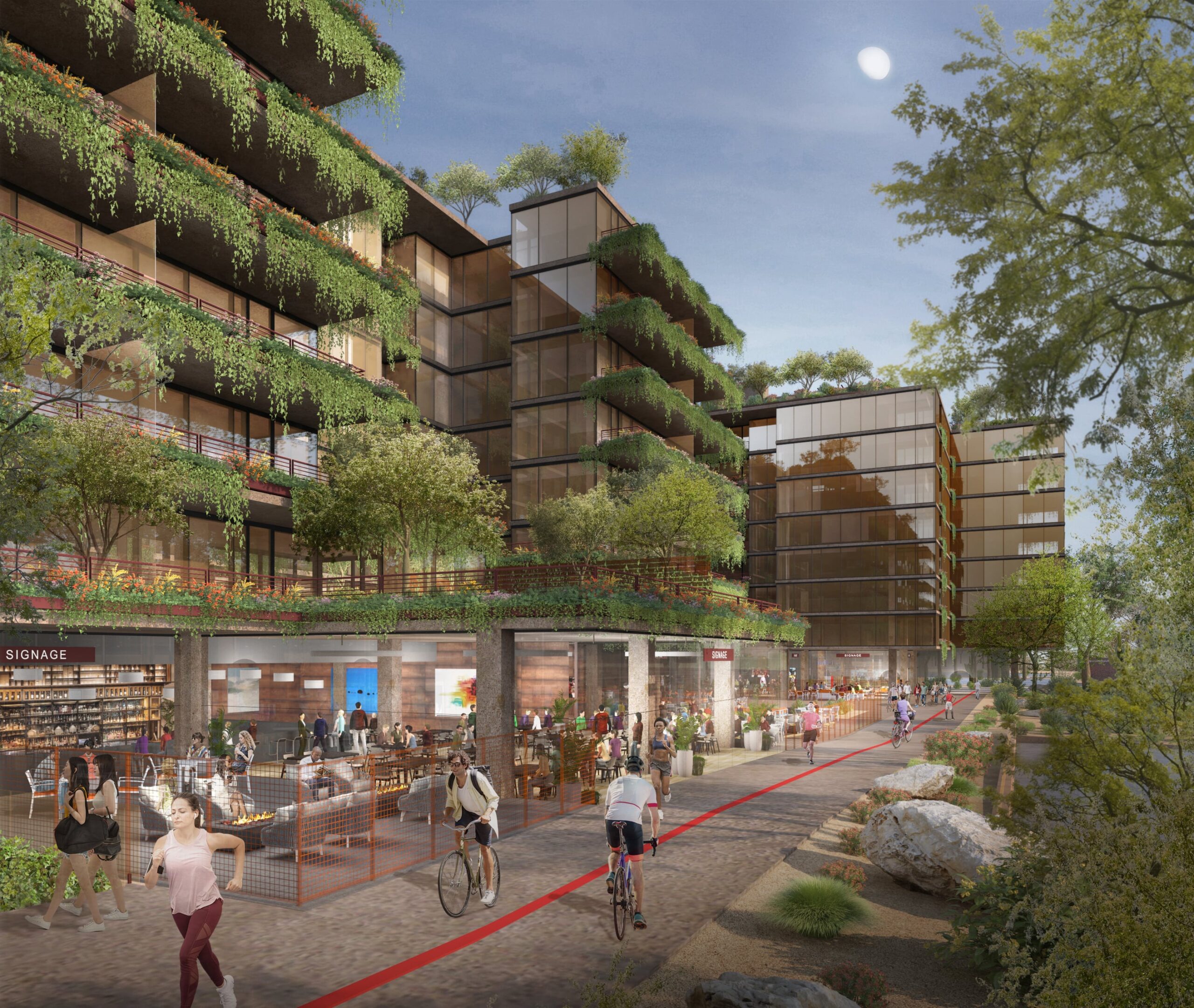
In addition to premier Scottsdale living, Optima McDowell Mountain Village will provide residents with 36,000 square feet of commercial and retail space. The residential community is also ideally located near the shopping, dining and entertainment of Scottsdale Quarter and Kierland Commons and easily connects to Downtown Phoenix, Glendale, Old Town Scottsdale, Tempe, Mesa and Phoenix Sky Harbor Airport.
The community will be the first project in Arizona to be built under both the new International Energy Conservation Code (IECC) and International Green Construction Code (IgCC). Sustainability features include 75% open space that will be a combination of artificial turf, xeriscape landscaping and native plants; high-performance mechanical systems and solar panels; 100% underground parking to mitigate the heat-island effect; and the largest private rainwater harvesting system in the U.S.
The development will also feature Optima’s signature vertical landscape system, which provides self-containing irrigation and drainage and allows for sustainable shading using vibrantly-colored plants that create additional privacy, protect homes from the sun, filter the air and lower ambient temperature.
As Optima McDowell Mountain takes shape in North Scottsdale, award-winning real estate firm Optima is setting a new benchmark for sustainable luxury with its $1 billion mixed-use community, featuring meticulously designed residences, cutting-edge green building techniques, expansive open space and community-driven amenities designed for modern desert living.
Designed by internationally acclaimed, award-winning architects David Hovey Sr., FAIA, and David Hovey Jr., AIA, Optima McDowell Mountain marks a significant leap forward in sustainable design and development, positioning itself as a national model for water conservation and green building. Home to the largest private rainwater harvesting system in the U.S., the project is designed to collect rainwater for all on-site irrigation and reduce residential and commercial water consumption. Additionally, through a partnership with the City of Scottsdale, Optima has secured 2,750 acre-feet of immediately available water—equivalent to over 30 years of full residential and commercial occupancy—ensuring a reliable water supply for the city.
It will also be Scottsdale’s first development built under the newly adopted International Energy Conservation Code (IECC) and International Green Construction Code (IgCC), setting a new standard for responsible growth while safeguarding natural resources and fostering a vibrant, future-focused community. The project reflects decades of collaboration between Optima President David Hovey Jr., AIA, and Anthony Floyd, AIA, who founded the City of Scottsdale’s Green Building Program in 1998. Floyd has left an indelible mark on green building and sustainability practices in both the Valley and Optima.
“Optima McDowell Mountain is the culmination of everything we’ve worked toward over the past four decades regarding sustainability, architecture and community integration,” said Hovey Jr., AIA. “From the largest private rainwater harvesting system in the country to 75% open space at grade level, paired with architecture that embraces and celebrates the beauty of the Sonoran landscape, we believe this project will set a precedent for sustainable design and architecture in the Valley and will be a testament to what’s possible when innovation, architecture and sustainability work in harmony.”
Among its most notable environmentally friendly initiatives, Optima McDowell Mountain will feature:
The largest private rainwater harvesting system in the U.S.: A state-of-the-art system designed to capture and store approximately 210,000 gallons of rainwater in an underground concrete vault, repurposing it for irrigation and minimizing overall water use.
75% open space: The development will incorporate 14 acres of open space, with over 70% available to the public and 30% reserved for residents. The landscape will include a combination of native xeriscaping, shaded seating areas, putting greens and a network of pedestrian and bicycle pathways.
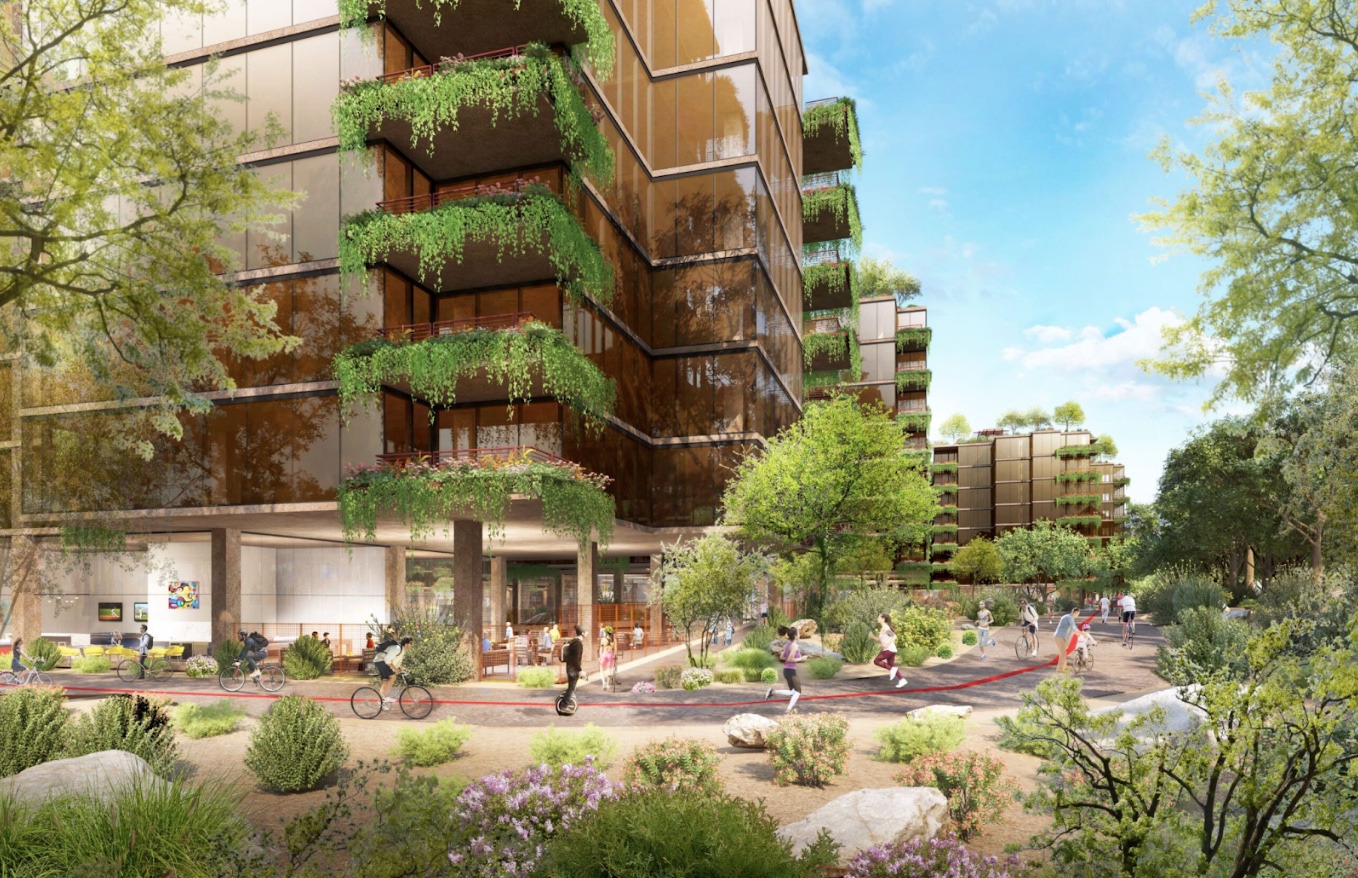
Optima’s signature vertical landscaping system: This self-sustaining system allows lush, drought-resistant plants to cascade down the facades of the buildings, providing natural insulation, filtering air pollutants and reducing the urban heat island effect.
Advanced energy-efficient building systems: The buildings will incorporate solar panels on the roof, high-performance VRF heating and cooling systems, induction cooktops in the residences and EV charging for residents and guests in the parking garage.
100% underground parking: By moving all parking below ground, the development mitigates heat retention at the surface level, further enhancing its sustainability profile.
Green codes: The community will be the first project in Scottsdale to be built under both the recently adopted International Energy Conservation Code (IECC) and International Green Construction Code (IgCC).
With construction well underway on the first residential tower, Optima McDowell Mountain spans 22 acres on the southeast corner of Scottsdale Road and the Loop 101 Freeway. It will be comprised of six concrete-framed, eight-story buildings, offering a mix of up to 1,330 luxury condominiums and apartments and 36,000 square feet of commercial, retail and restaurant space. With a focus on wellness and community, each of Optima’s six buildings has been uniquely refined with its own abundance of amenities, including fitness centers, basketball courts, pickleball courts and residents’ clubs. Six separate rooftop decks feature 50-meter Olympic-length swimming pools, running tracks and outdoor fireplaces. At the heart of the community will be an expansive 10-acre central park, designed to foster a sense of connection with nature, while a network of biking and walking paths will seamlessly link to nearby trail systems and Scottsdale’s Bicycle Master Plan.
The first condominium tower is expected to begin selling this spring, with the first rental tower welcoming new move-ins in September. Registration is open to be among the first to learn about upcoming sales and leasing opportunities. For more, visit OptimaMcDowellMountain.com.
See photos of a Scottsdale penthouse suite with unobstructed sunset and mountain views that hit the market at a time when some homeowners are downsizing and looking for the lock-and-leave condo lifestyle.
Real estate development firm Optima recently announced plans to move ahead with its next Arizona residential development, Optima McDowell Mountain Village, in north Scottsdale after receiving the city’s approval for the $1 billion sustainable mixed-use community.
Breaking ground spring/summer 2023, the 22-acre site, located on the southeast corner of Scottsdale Road and the Loop 101 Freeway, Optima McDowell Mountain Village is comprised of six concrete-framed, eight-story buildings that will include 1,330 luxury residences and 36,000 square feet of commercial and retail space, a press release explained.
The development will be a mix of condominiums and apartments.
Optima McDowell Mountain Village will create an environmentally friendly, residential neighborhood in the burgeoning area of north Scottsdale with a state-of-the-art, all-inclusive, health-based, amenity-rich community. Most notably from a sustainability perspective, it will be the largest private rainwater harvesting site in the U.S.
The residences within the community are expected to use half as much water as the average Scottsdale multi-family residence and a quarter as much water as the average Scottsdale single-family home. Optima is also providing the City of Scottsdale with 2,750 acre-feet of water that will be deposited into the Scottsdale water system.
“We are especially excited about the location of Optima McDowell Mountain Village being in north Scottsdale so close to the spectacular McDowell Mountains and the proximity to the Loop 101 Freeway as well as current and future major employers” said David Hovey Jr., Optima’s president and COO, in the release.
“Architecturally this project will be unique with over 75% open space with six buildings surrounding a central sheltered courtyard comprised of a combination of xeriscape, drip irrigation and artificial turf,” Hovey continued. “This will be our most sustainable project to-date and will include the largest private rainwater harvesting system in the United States, as well as the next evolution of our vertical landscaping system and active roof decks.”
The community will be the first project in Arizona to be built under both the new International Energy Conservation Code and International Green Construction Code.
A few highlights of the sustainable features include 75% open space that will be a combination of artificial turf, xeriscape landscaping and native plants; high-performance mechanical systems, solar panels; 100% underground parking to mitigate the heat-island effect, and Optima’s signature vertical landscape system.
The release explained that the vertical landscaping system, with its self-containing irrigation and drainage, enables a palette of vibrantly colored plants at the edge of each floor to grow both up and over the edge of the building.
The integration of enhancements to the vertical landscape and architectural shading systems protects homes from the sun and creates additional privacy, while filtering the air and lowering ambient temperature.
Optima McDowell Mountain Village will create an environmentally friendly residential neighborhood in the burgeoning area of North Scottsdale with a state-of-the-art, all-inclusive, health-based, amenity-rich community. Most notably from a sustainability perspective, it will be the largest private rainwater harvesting site in the U.S. The residences within the community are expected to use half as much water as the average Scottsdale multifamily residence and a quarter as much water as the average Scottsdale single-family home. Optima is also providing the City of Scottsdale with 2,750 acre-feet of water that will be deposited into the Scottsdale water system.
Type of Project: Mixed-use Location: Corner of Scottsdale Rd. and Mayo Blvd. Developer:Optima Inc. Architect: Optima Inc. Size: Situated on a 22-acre site, Optima McDowell Mountain Village is comprised of six concrete-framed, eight-story buildings that will include 1,330 luxury residences and 36,000 square feet of commercial and retail space. The development will be a mix of condominiums and apartments. Date Completed: Not broken ground yet.
Real estate development firm Optima has partnered with Mitsui Fudosan America, Inc., for the development of the first building within its newest Arizona residential development, Optima McDowell …
Every year since 1970, on April 22, the world is celebrating Earth Day. The global movement has grown into a meaningful platform for environmental awareness, uniting people in their shared commitment to sustainability. This year’s theme is “Our Power, Our Planet” and it serves as a reminder that the choices we make today will shape the future of generations to come.
Image generated with AI. Image by K silver/stock.adobe.com
From addressing climate change and biodiversity loss to promoting renewable energy and sustainable practices, Earth Day is a rallying cry for individuals, communities, businesses and governments to take meaningful steps toward preserving our planet.
Multi-Housing News asked professionals from the multifamily industry to share details about the energy-saving techniques they use or plan to implement to positively change the lives of their residents, while also improving the health of our planet overall.
Starting point: assessing building performance
The first step in improving the energy efficiency of a multifamily building is understanding how its envelope and systems are performing. With energy efficiency codes only becoming stricter across the country every year, developers and property owners are urged to invest in high-efficiency HVAC systems, electrification, better insulation, LED lighting, smart energy management systems and other energy-saving technologies that make properties more efficient and sustainable in the long term.
“Many communities start by conducting energy audits or assessments to identify inefficiencies in HVAC, lighting, insulation and building controls,” said Breana Wheeler, director of operations at BREEAM U.S., particularly because these systems have a direct impact on both energy consumption and residents’ experience.
Benchmarking is another way to understand how properties are performing, according to Thomas Stanchak, managing director of sustainability at Stoneweg US, a real estate investment firm with a focus on sustainable multifamily assets. It’s the foundation that helps make a data-driven investment plan. Without it, even well-intentioned upgrades can miss the mark.
“You risk putting dollars in the wrong places and falling short on energy savings and financial return. The math matters,” Stanchak said.
Bright Power EnergyScoreCard monitors energy usage
When performing energy audits and electrification feasibility studies, Bright Power evaluates the performance of existing fossil fuels-based equipment, such as the building’s boiler. All images courtesy of Bright Power
Adding a solar photovoltaic system and solar battery storage solution can provide significant energy efficiency savings.
Bright Power team member updating ventilation equipment on a roof in NYC.
Bright Power EnergyScoreCard monitors energy usage
When performing energy audits and electrification feasibility studies, Bright Power evaluates the performance of existing fossil fuels-based equipment, such as the building’s boiler. All images courtesy of Bright Power
Sealing the building
Before investing in actual energy upgrades, it’s crucial to address the building envelope—insulation, windows, roof—to identify areas for improvements, according to Theresa Backhus from the Institute for Market Transformation. If the building envelope is leaking, even the most advanced heat pumps and control systems will struggle to maintain comfortable temperatures, leading to higher energy use and increased strain on electrical infrastructure.
Duct sealing in older buildings represents one of the most cost-effective energy-efficiency measures, Thomas Holmes, northeast commercial business manager at Aeroseal, told MHN. “By first sealing ductwork and reducing air leakage in walls, ceilings and floors, building operators are seeing above 30 percent reductions in HVAC energy use, often before replacing a single piece of equipment,” he noted. This also means that smaller, more affordable HVAC systems can be installed during upgrades, leading to additional long-term savings.
While at it, property owners can also invest in ventilation upgrades, such as energy recovery ventilators and demand-controlled ventilation, which ensure that buildings maintain healthy indoor air quality without excessive energy waste.
Energy-saving techniques that work
Once the building’s envelope has been attended to, various energy-saving inclusions can be implemented. The most common one is LED retrofits, which is a low-cost, high-impact energy-saving upgrade. Lighting accounted for 26 percent of an apartment’s energy consumption as of April 2020, according to the U.S. Department of Energy, with LED lighting driving down operating costs while also improving the building’s aesthetics.
Meanwhile, space heating accounts for 56 percent of electricity consumption in multifamily buildings, data from the Joint Center for Housing Studies shows. Though somewhat more expensive, HVAC upgrades make a big difference.
“While residents typically cover these costs, improving HVAC efficiency benefits both parties—lowering expenses for residents, reducing maintenance costs for operators—enhancing the resident experience by preventing system failures and reducing the building’s environmental footprint,” said Sean Miller, chief revenue officer with service provider Lessen.
HVAC system tune-ups can be difficult in multifamily buildings with unitized systems, but it’s important to coordinate with residents to check them. “Lowest-hanging fruit includes ensuring air filters are replaced, coolant is not leaking, seasonal tune-ups are performed,” according to Backhus.
Another energy-saving technique comes from ENERGY STAR. “We use ENERGY STAR Portfolio Manager for every location in our portfolio, it’s an incredible tool,” said Stanchak. “That alone removes most barriers for companies that are just getting started. You just need to invest a little time and be open to learning something new.” ENERGY STAR Portfolio Manager is free of charge and has been available from the Environmental Protection Agency for 30 years. In addition, it comes with no cost for training and support.
Meanwhile, occupancy sensors are also gaining popularity, as they help reduce energy usage when a unit or space is empty. Additionally, smart thermostats that can be tailored around when the space is occupied can provide residents with savings of 10 percent or greater, said Miller.
The vertical closed-loop geoexchange system at The Riverie will reduce annual carbon emissions from heating and cooling by 53 percent compared with typical residential systems.
Lendlease included rooftop solar panels at Clippership Wharf, a 478-residence community in Boston. All images courtesy of Lendlease
Clippership Wharf was completed in March 2021 and sets a new standard for resilient and sustainable waterfront development.
Lendlease recently topped out Habitat, a 260-unit mixed-use project in Los Angeles that is expected to be net zero carbon in construction and operations. It will include an integrated 125kW solar array, 64 dedicated electric vehicle parking spots, natural ventilation and lower-carbon concrete.
Slated for completion in 2026, Habitat will include 260 apartments, a 253,000-square-foot office building, and 2,900 square feet of retail and restaurant space. Lendlease is aiming to make the commercial building the first new-construction creative office development in Los Angeles to achieve LEED Platinum.
Developed by Lendlease, The Riverie is an 834-unit multifamily development in Brooklyn, along the waterfront in Greenpoint. A third of the project’s apartments are designated as affordable housing under the Affordable New York Housing Program.
The vertical closed-loop geoexchange system at The Riverie will reduce annual carbon emissions from heating and cooling by 53 percent compared with typical residential systems.
Lendlease included rooftop solar panels at Clippership Wharf, a 478-residence community in Boston. All images courtesy of Lendlease
Meanwhile, fine-tuning building equipment operation through retro-commissioning is another highly effective strategy for reducing energy waste and improving overall system performance, according to Monica Beall, director of sustainability with Lendlease. Other emerging solutions include automation, predictive maintenance technologies, advanced air sealing and insulation products, and integrated energy management systems. Onsite generation like solar and battery storage is also gaining ground.
Some companies even offer residents the opportunity to participate in community solar programs, while also sourcing renewable electricity for its properties. “Every property in our portfolio is enrolled in green tariff programs to further support clean energy adoption,” disclosed Beall.
Community solar can be accessed both as a community solar host and as a community solar subscriber. While it provides multifamily properties with a way to access the financial benefits of clean energy even without suitable roof space, “onsite solutions often offer even greater economic advantages, where feasible,” shared Gabe Phillips, CEO & founder of Catalyst Power.
While interest in community solar is on the rise, adoption is lagging due to high upfront costs and property-specific constraints. But as panel technology advances—becoming more compact, resilient and cost-effective—community solar will likely become a more viable long-term investment, particularly in Sun Belt states, believes Miller. Benefits include lower energy costs, increased property value and improved ESG performance, but this method remains “very much incentive-driven to be realistically included in a project,” according to Brad Lutz, director of multifamily design for Baker Barrios Architects.
Saving water saves energy
To save energy, managing water usage is also critical—smart hot water controls regulate consumption while ensuring residents always have hot water when needed, explained Sarah Merricks, co-founder & chief strategy officer at Global Network for Zero. Detecting leaks early can help save both water and money, while low-flow fixtures, drought-tolerant plants and weather-monitoring irrigation systems contribute to water conservation efforts both in individual units and within the broader property.
Optima Verdana features a private courtyard in the heart of the building, which serves as a lush oasis for residents and features 7’ high garden walls, verdant trees, restful seating and more than 1,500 light-filled square feet. Image by Bill Timmerman via Optima Inc.
Optima McDowell Mountain, a multi-phase community currently under construction in Scottsdale, Ariz., will feature the largest private rainwater harvesting system in the U.S. to significantly reduce water consumption. Image courtesy of Optima Inc.
The community is being built to the latest energy-efficient and sustainable building standards by integrating solar panels, high-efficiency mechanical systems, underground parking to mitigate the heat-island effect and Optima’s signature Vertical Landscaping System, which provides solar shading, evaporative cooling and improved stormwater management. Image courtesy of Optima Inc.
The community will be the first project in Arizona to be built under both the new International Green Construction Code and the new International Energy Conservation Code, which provides for an additional 9 percent energy savings over the previous code. Image courtesy of Optima Inc.
Optima Verdana is a 100-unit community in Wilmette, Ill.. For its construction, the developers utilized green concrete, all-electric VRF heating and cooling systems, induction cooktops and outdoor electric grills to improve efficiency and reduce emissions. Image by Bill Timmerman via Optima Inc.
Residents responded positively to these enhancements, particularly the shift to induction cooking, which offers higher performance and greater temperature control than gas counterparts. Image by Bill Timmerman via Optima Inc.
Optima Verdana features a private courtyard in the heart of the building, which serves as a lush oasis for residents and features 7’ high garden walls, verdant trees, restful seating and more than 1,500 light-filled square feet. Image by Bill Timmerman via Optima Inc.
Optima McDowell Mountain, a multi-phase community currently under construction in Scottsdale, Ariz., will feature the largest private rainwater harvesting system in the U.S. to significantly reduce water consumption. Image courtesy of Optima Inc.
For Stoneweg, attention to water conservation and hot water energy efficiency is paying off, Stanchak told MHN. Hot water heating accounts for nearly 20 percent of total energy use across the company’s portfolio. Last year, Stoneweg completed several water conservation projects at Texas properties with central natural gas-powered boilers and saw a roughly 9 percent drop in natural gas consumption in just the first few months.
“Our secret to success is keeping top of mind that efficiency isn’t about using less, it’s about using the right amount,” he said.
Heat pumps are also gaining popularity, according to Caitlin Rood, senior national account manager at Bright Power. They are more efficient than other home climate-control and water heating systems because they absorb and move ambient heat rather than burning fuel or using energy-hungry electric resistance to generate it.
“Compared to the 80 to 95 percent efficiency we see with gas equipment, heat pumps operate at 300 to 400 percent efficiency, which makes electrification appealing,” Rood said, adding that heat pumps can render incredible potential savings—depending on the cost of electricity and the cost of gas in a given area—and a significant reduction on environmental impact.
Multifamily’s energy-saving drivers
Cost reduction remains the most important driver of any decision made by property owners and operators, especially with high volatility in energy costs. In dense urban areas, the adoption of sustainable standards and the implementation of local building performance laws, such as NYC’s Local Law 97 and BERDO, play a big role in shaping how owners and managers think about and approach energy efficiency. Building performance standards are spreading across the country, setting clear targets for energy reduction, and direct incentives from local utilities have proven to be an effective motivator for property owners to invest in efficiency upgrades, Beall mentioned.
But motivations have become more sophisticated, with resilience emerging as a primary driver, according to Phillips. The ability to maintain critical operations during power outages is increasingly valuable once grid disruptions become more common.
Property differentiation is another factor that makes owners and operators invest in energy-saving items. Buildings with visible sustainability features and lower utility costs attract both renters and investors. Furthermore, these features are part of the way many owners are responding to ESG commitments from their capital partners or preparing for evolving regulatory requirements.
Multifamily’s energy-saving headwinds
Cost drives the adoption of energy-saving techniques, and cost is the main hurdle to overcome in improving energy efficiency at multifamily properties, according to Merricks, as major retrofits can be expensive upfront. In addition, there is also hesitation around new technology and concerns about disrupting residents, which steers many property owners to opt for smaller upgrades instead of full-scale efficiency overhauls.
Another major challenge is that with multifamily residents often controlling their own utilities, it can make it difficult for owners to gather whole-building energy data and measure the impact of energy efficiency initiatives at their properties.
“In markets like California, where whole-building energy data disclosure is mandated, owners have a clearer picture of the impact of efficiency measures across an entire asset,” said Wheeler. “With this in mind, expanding mandates around data access in more markets and municipalities would be a valuable step forward.”
A similar challenge is linked to upgrading apartment interiors—especially for things like windows or lighting. It’s difficult to implement changes beyond common areas, according to Phillips.
Grid capacity can also be an impediment to more sustainable buildings, stated Rood. “Not all buildings have enough electric capacity to host electrification, and there is not enough capacity on the grid for mass electrification.” For now, California is leading the country when it comes to electrification because it offers substantial incentives in multifamily affordable housing that help offset these expenses. Catching up are Boston, New York City, D.C. and Denver, as each have adopted performance standards that are forcing buildings to electrify.
Achieving improved energy efficiency requires sustained focus, and “that’s going to be the real challenge for much of the industry,” believes Stanchak. “Most headwinds aren’t technical, they’re self-imposed. Lack of planning, lack of prioritization and fear—these are the bigger obstacles.”