Optima Communities introduced a new collection of condominium floor plans for the 7230 building at Optima McDowell Mountain, its mixed-use development in North Scottsdale.
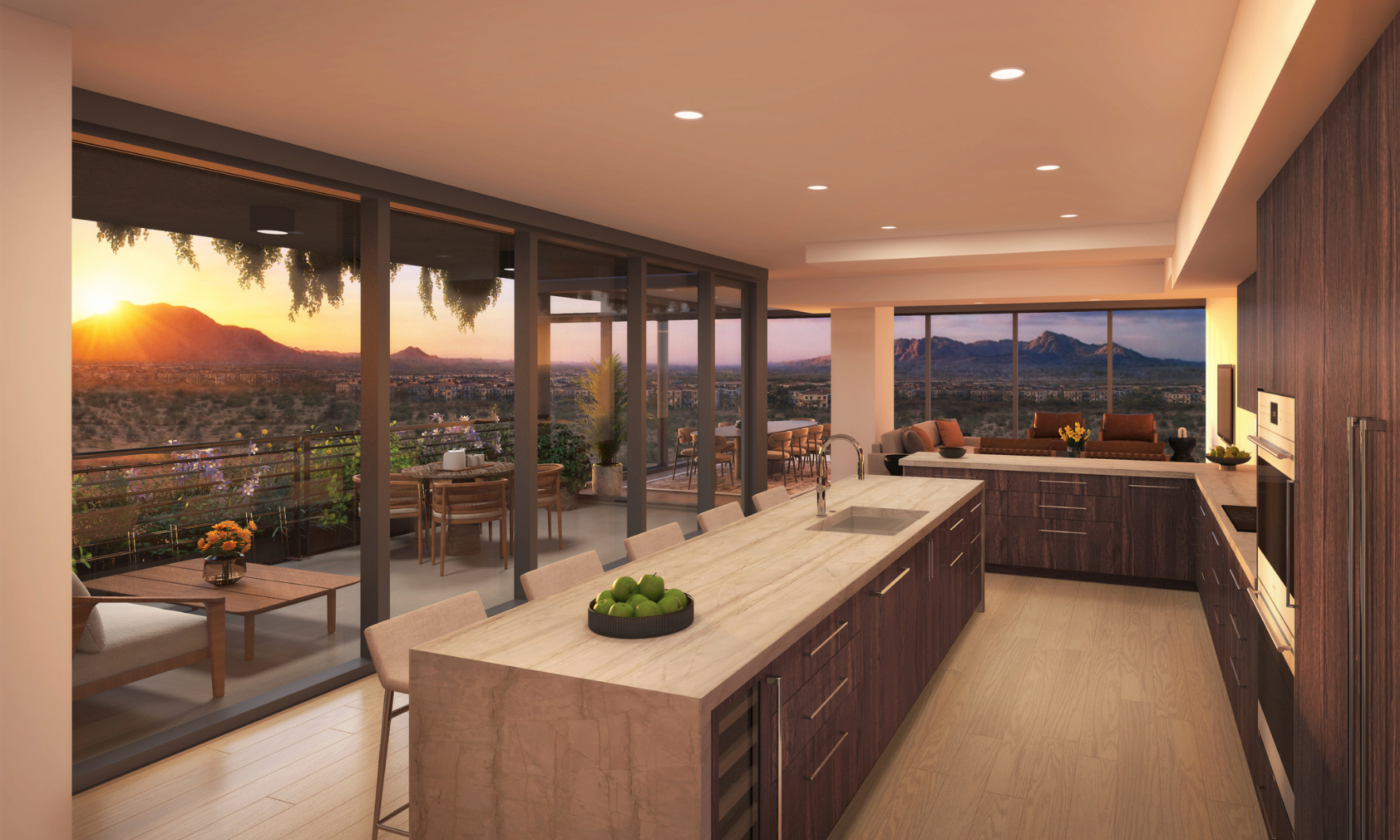
The developer’s new Signature Collection includes four three-bedroom homes up to 3,283 square feet in size. Luxury residences feature 10-foot ceilings, two private terraces, floor-to-ceiling windows, walk-in closets, custom cabinetry and luxury kitchens with Sub-Zero and Wolf appliances and walk-in pantries.
Pricing for the collection ranges from $2.75 million to over $3.295 million.
“The Signature Collection reflects a natural evolution of how people want to live today,” David Hovey Jr., president of Optima, told Phoenix Agent. “We saw early demand from buyers who were combining residences to create larger, more personalized homes, which signaled a clear desire for greater scale without giving up the convenience of a lock-and-leave lifestyle. In response, we designed homes that feel expansive and highly tailored, while still offering the benefits of a connected, amenity-rich community.”
Upon completion, the 22-acre Optima McDowell Mountain community will feature 1,300 residences across six eight-story buildings, with a mix of for-rent and for-sale options available. Each building will feature amenities like an Olympic-sized pool, running track, fitness center, pickleball courts and an outdoor golfing green.
Plans for the community also include the largest private rainwater harvesting system in the country.
Optima has locked up all the needed approvals and will start work on its one billion dollar mixed-use community called Optima McDowell Mountain Village.
The project, located at Scottsdale Road and the Loop 101 Freeway will include six concrete-framed, eight-story buildings that will consist of 1,330 luxury residences and 36,000 square feet of commercial and retail space. The development will be a mix of condominiums and apartments.
Each of the six buildings will include a rooftop deck with an Olympic-length swimming pool; a sauna, spa, and cold plunge and a running track that will follow the perimeter of the roof. Indoor amenities consist of a fitness center and yoga studio that look out over the lushly landscaped courtyard; a sauna and steam room; a residents’ club with game room and theater; an indoor basketball and pickleball court; an outdoor pickleball arena; a golf simulator and an outdoor putting/chipping area.
Optima McDowell Mountain Village is putting an emphasis on sustainability, including rainwater harvesting and solar panels liberally scattered throughout the project.
From architecture to agriculture to wildlife preservation, these Valley residents are proving that caring for the environment can be a part of our everyday lives.
David Hovey Jr.
President, chief operating officer and principal architect, Optima David Hovey Jr.’s passion for sustainability runs in the family. “My parents started doing green roofs back in the 1980s,” the architect says, referring to Eileen and David Hovey Sr., who founded Optima in 1978. Hovey, who joined the firm right after earning his masters degree in architecture, says sustainability is a driving force at Optima. “It’s a design approach that keeps the people and the environment at the forefront,” he says. The company’s latest project, Scottsdale’s Optima McDowell Mountain Village, will be the first residential development in the Southwest to be built under the International Green Construction and International Energy Conservation codes, and will have the nation’s largest private rainwater harvesting system. And, in keeping with the firm’s mission, it will make heavy use of biophilic design. “Biophilic is a trendy term right now, but it’s simply about connection to nature,” Hovey says. “So, green roofs, floor-to-ceiling glass, terraces, our signature vertical landscaping—those are all biophilic design.”
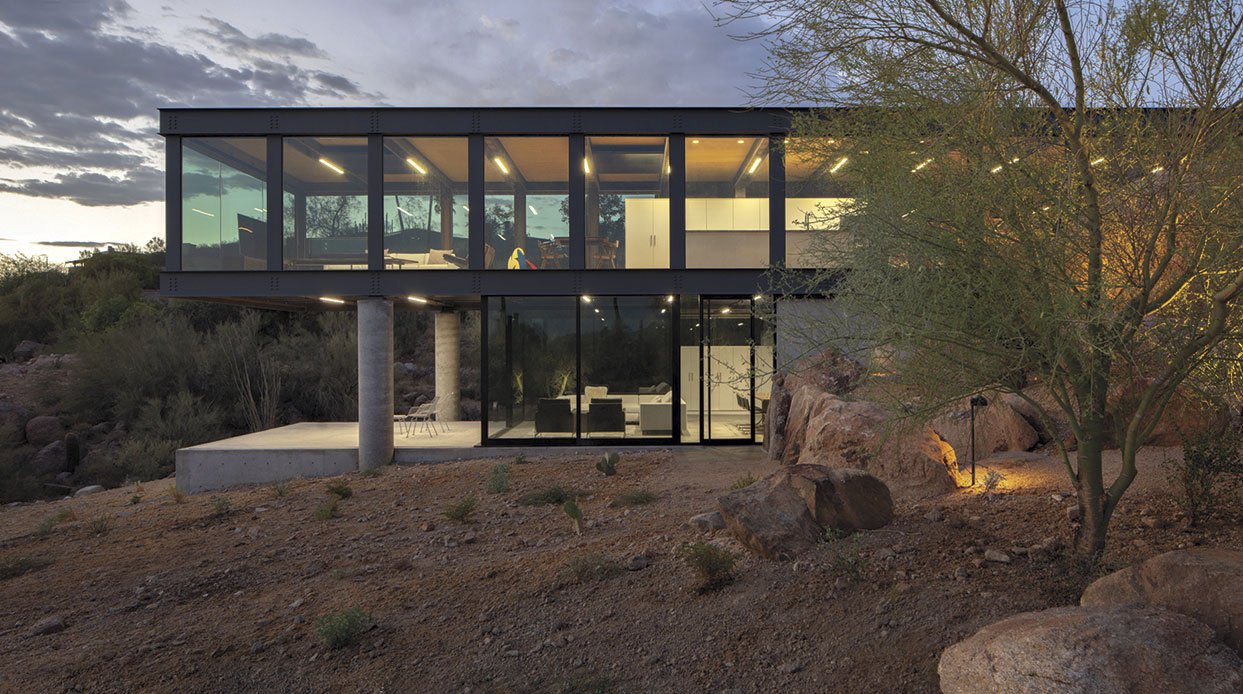
A modular prefabricated—meaning manufactured in an off-site factory—home by architects David Hovey Jr., AIA, and David Hovey Sr., FAIA, rests lightly on the land. With limited onsite construction, it was possible to maintain more than 90% of the boulders and vegetation. The system used to build this dwelling is sustainable up to the LEED Platinum level and can be built quickly and efficiently in any location, climate or terrain.
Award-winning real estate development firm, Optima is partnering with Mitsui Fudosan America, Inc. for the development of the first building within its newest Arizona residential development, Optima McDowell Mountain, located on 22-acres on the southeast corner of Scottsdale Road and the Loop 101 Freeway in North Scottsdale.
The first building will consist of 210 rental residences, which just broke ground this month and is located on the southwest corner of the site. The overall development will comprise six, eight-story apartment and condominium buildings that will include 1,330 luxury residences and 36,000 square feet of commercial and retail space.
Local development and design studio Optima has announced the six-tower residential McDowell Mountain development in Arizona, designed to harvest up to 210,000 gallons of rainwater in an underground vault.
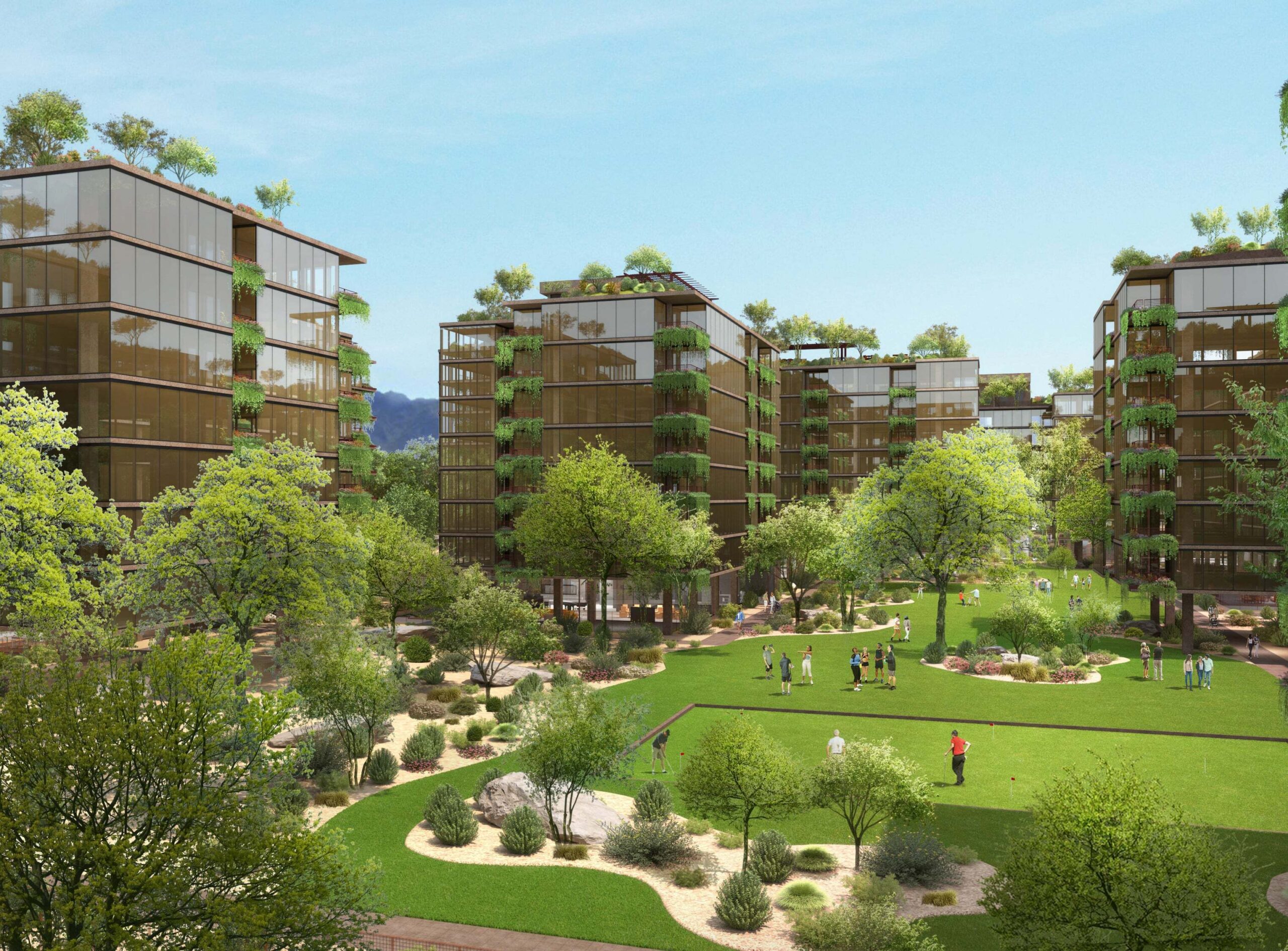
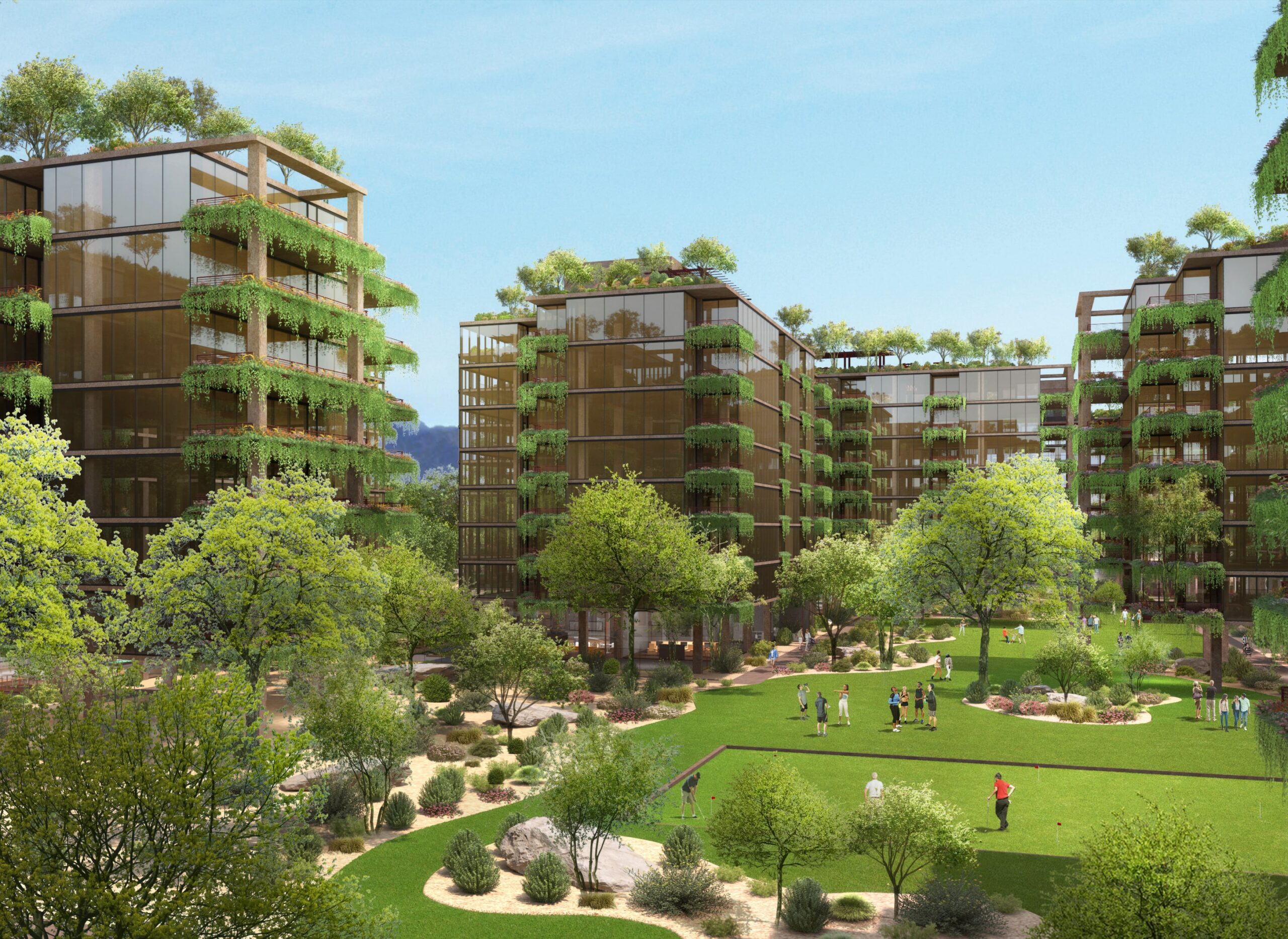
Currently under construction in North Scottsdale, McDowell Mountain will contain six, eight-storey residential buildings clustered around a 10-acre yard.
Optima has designed a six-building apartment complex in Scottsdale
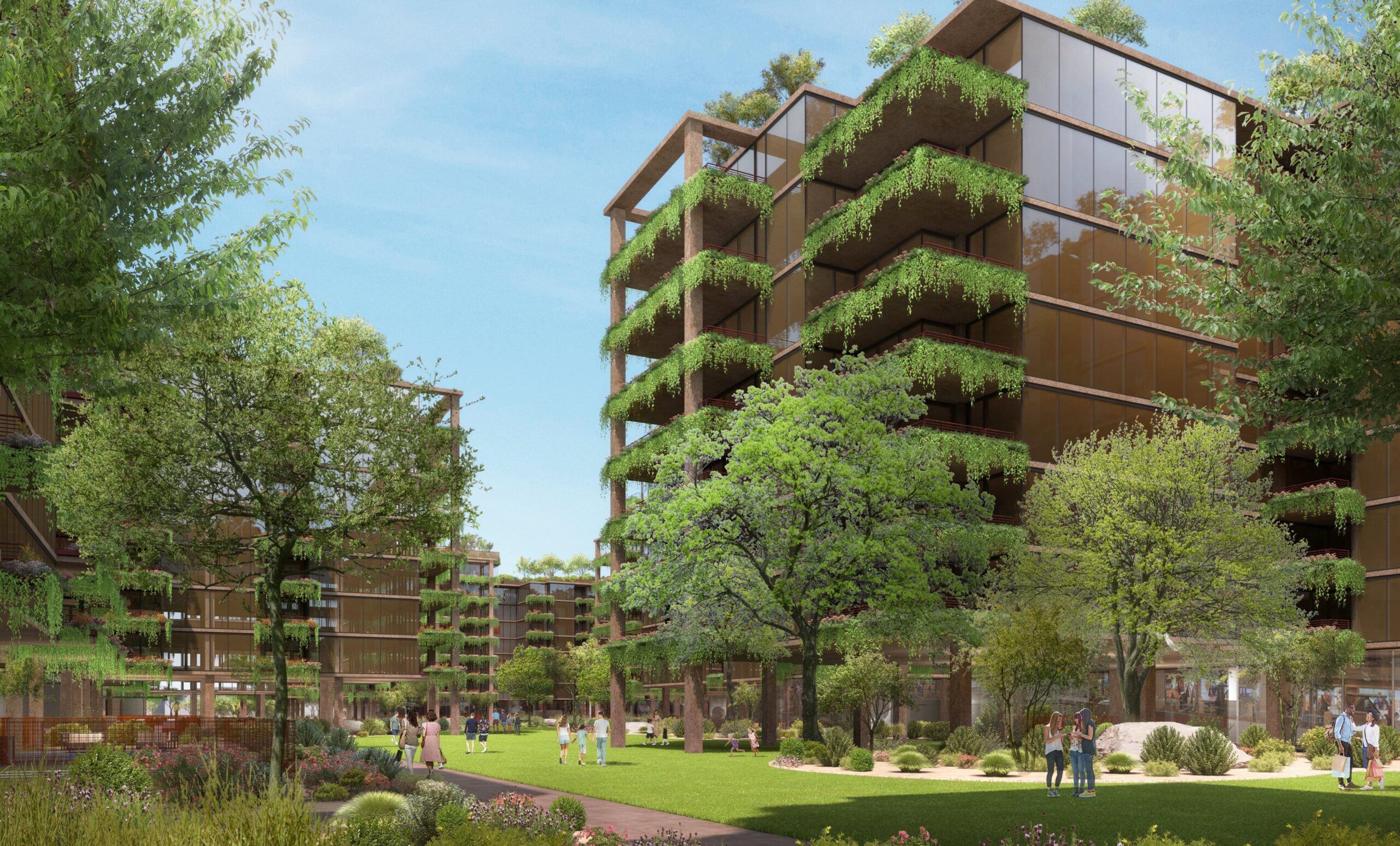
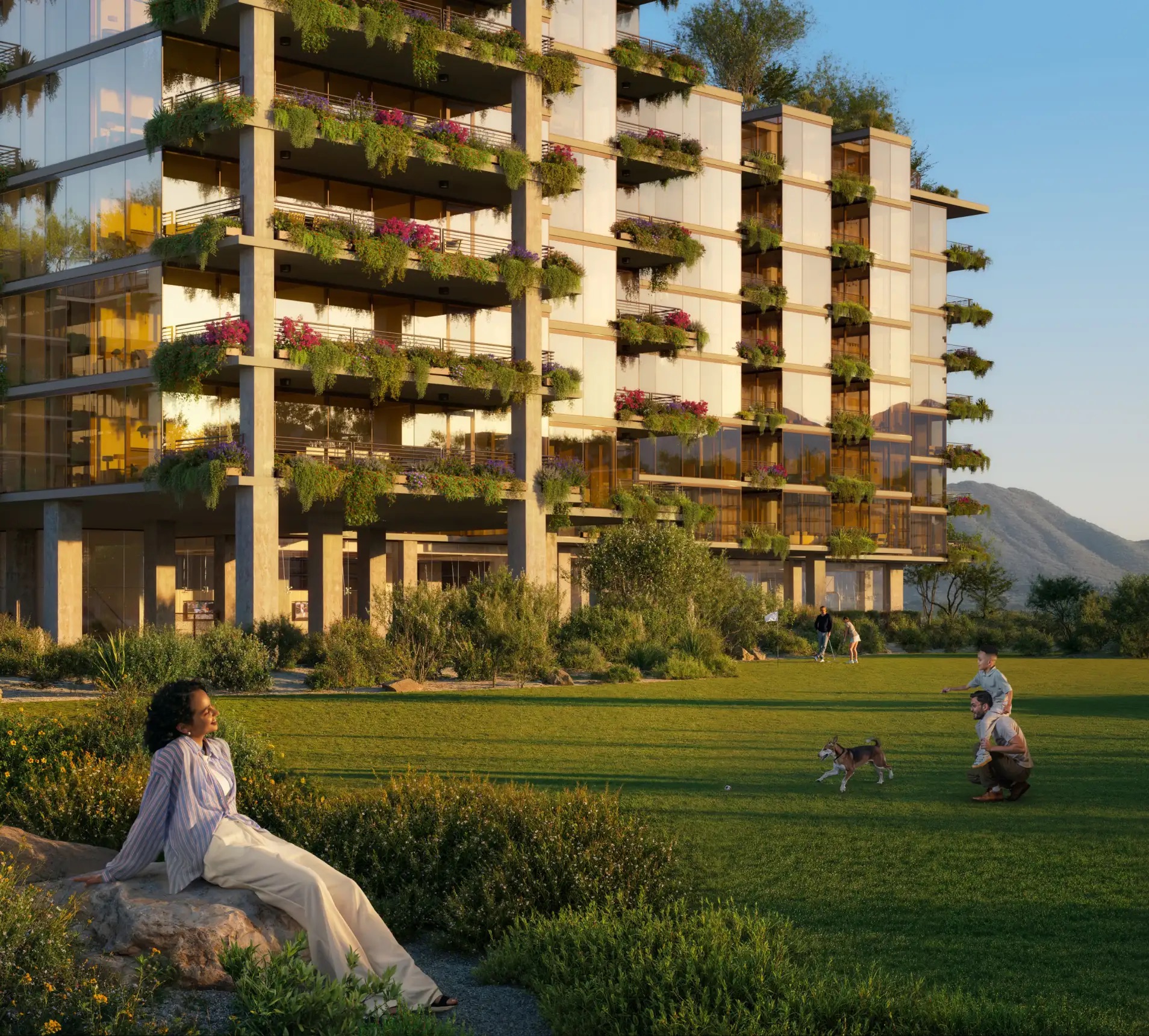
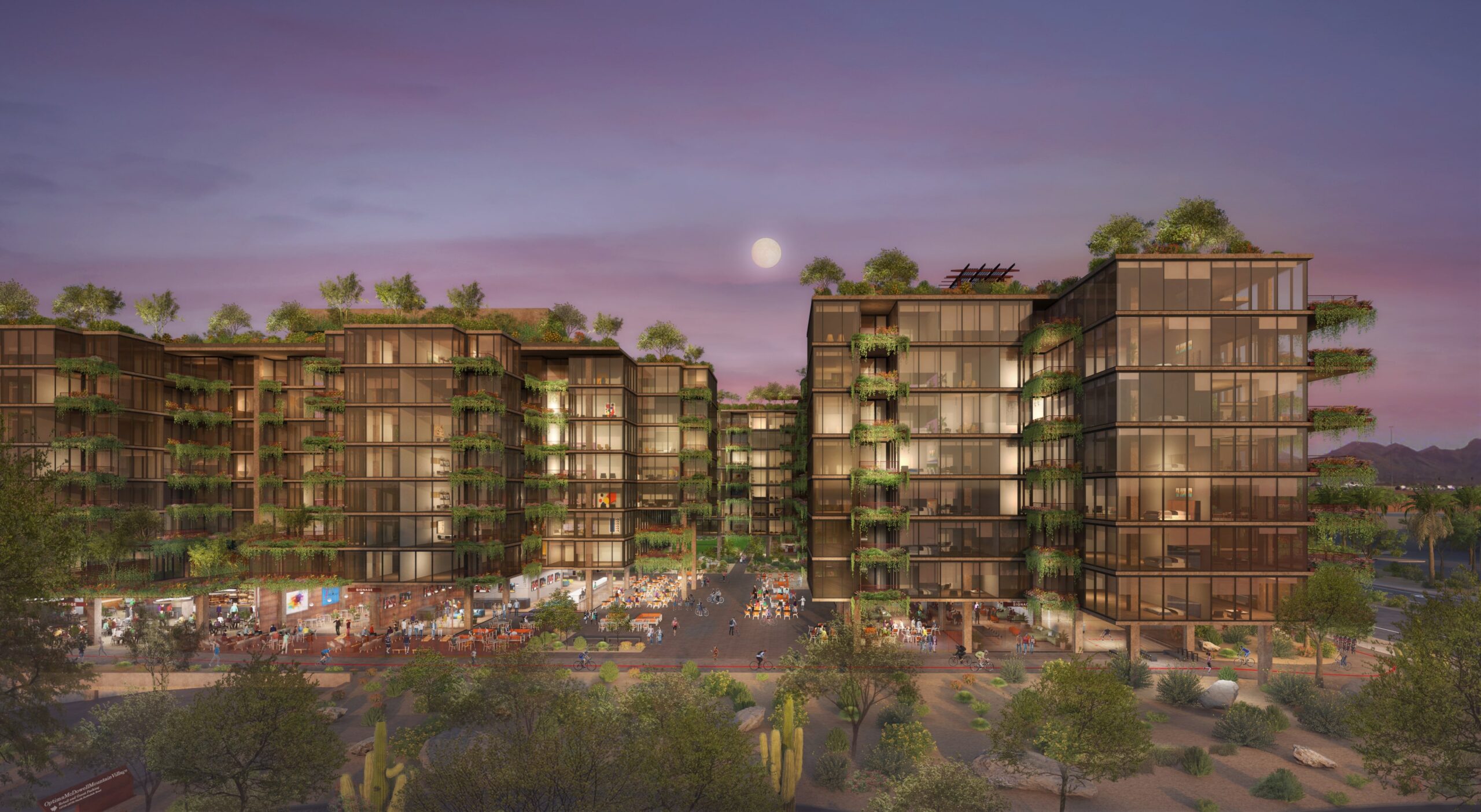
Renders show the buildings clad in brown-tinted glass with plants cascading off balconies. The buildings are mainly rectangular, although certain sections jut out towards the central green space to portion off the large central space into more discrete plazas.
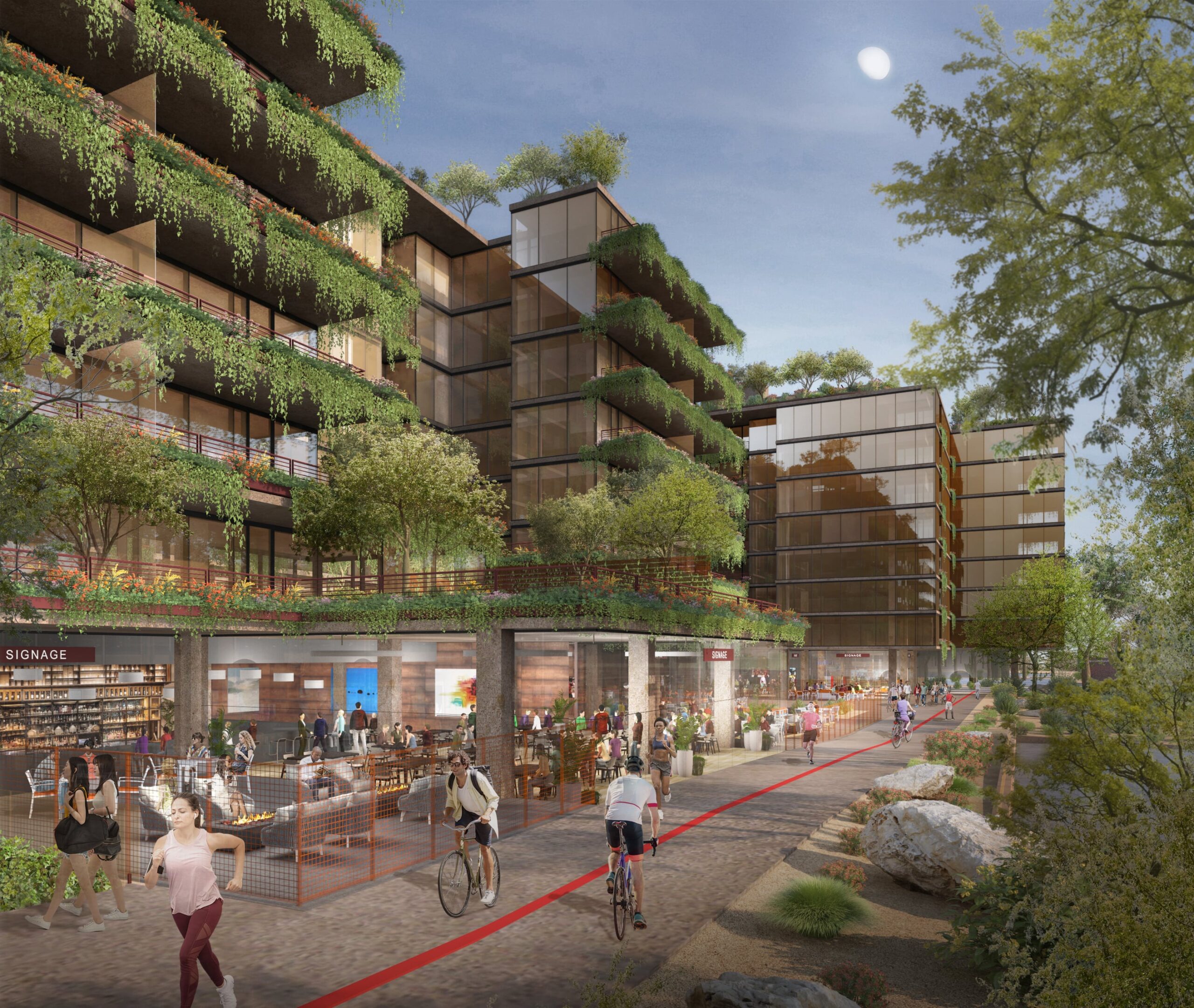
The buildings will be elevated on pillars, with programming such as dining and seating areas pictured underneath. Roofs will be landscaped with trees and low-lying bushes, as is the large, central yard.
The buildings enclose a central greenspace
The concrete-framed residential buildings will contain 1,330 condominiums, as well as a slew of outdoor amenities such as Olympic-length swimming rooftop pools, running tracks and pickleball courts.
According to Optima, the development is the “next evolution in environmentally friendly, state-of-the-art, all-inclusive residences” and includes a number of sustainable strategies, such as rooftop solar panels, high-efficiency heating and cooling and direct connections to surrounding bike paths.
The development will use a rainwater harvesting system for its irrigation
The development’s irrigation system will also be powered by a private rainwater harvesting system, which is planned to be the “largest in the US” according to the studio.
“Home to the largest private rainwater harvesting system in the US, the project is designed to collect rainwater for all on-site irrigation and reduce residential and commercial water consumption,” said the team.
Although Optima has designed and built three other similar residential developments in Scottsdale, this will be the first to incorporate such a large rainwater harvesting system.
According to Optima architect David Hovey Jr, who designed the project with David Hovey Sr, the harvesting system was incorporated into the design while Scottsdale was undergoing a drought.
The project’s design concept was developed during a drought
The retention system was designed as part of a deal to enable the development, along with aquaphor credits purchased by the developer for the city.
“There are two water concepts that we gave to the city as part of zoning,” Hovey Jr told Dezeen. “One was that we actually just gave [water] to [the city], and then we also put the tank on site, which handles all of our irrigation.”
The development will attempt to be “water neutral”
“For this particular development, this water solution came from the fact that we were in the middle of a drought. It really pushed us to think creatively about how we can get the elected officials who are making the decision on this project comfortable with another 1,330 units.”
Water rights in the desert landscape of the American Southwest are complicated, as decades-long political battles have ensued over its main water source, the Colorado River.
It is currently in phase one of construction
The water body has been divided into several basins, which provide commercial, residential and agricultural water to surrounding cities and towns.
These municipalities each have their own regulations regarding water rights, and as such, developers such as Optima address these issues using different approaches.
“I was really happy with the way the city was able to listen to us and to come up with a creative solution to enable housing to keep up with the population growth that we’re having out here, [but] have a water sustainable solution,” said Hovey Jr. ”
McDowell Mountain is currently in phase one of construction, with the first tower set to open in Fall 2025 for move-ins.
Optima, a luxury real estate developer, has launched sales for the first condominium tower at its $1 billion Optima McDowell Mountain community in North Scottsdale, marking the company’s return to Arizona’s for-sale residential market after a four-year hiatus.
Located on a 22-acre site at Scottsdale Road and Loop 101, the community had already generated nearly $27 million in early reservations as of mid-June, reflecting strong demand for the amenity-rich and architecturally distinctive homes.
The debut tower, named 7230, will include 196 luxury condominiums ranging from 728 to 2,204 square feet. Floor plans will include one-, two- and three-bedroom options, with starting prices estimated in the $600,000s. Residences will feature floor-to-ceiling glass, landscaped private terraces,
smart-home integration and designer kitchens. Buyers will have the option to personalize finishes or combine units into larger custom residences—a feature that has driven more than 60% of early reservations.
“This is a significant milestone for Optima,” said David Hovey Jr., AIA, president of Optima. “We’re bringing everything we’ve learned over the past four decades into this new community.”
The full development will include six eight-story towers featuring a mix of for-sale condominiums and rental apartments, along with 36,000 square feet of retail and dining space. Approximately 75% of the site—about 16 acres—will be dedicated to open space, including landscaped areas, walking
and biking trails, and a 10-acre central park.
Each building will offer roughly 1.5 acres of rooftop and ground-level amenities. The 7230 tower will include a Sky Deck with panoramic views of the McDowell Mountains, a 50-meter heated lap pool, rooftop running track, spa, saunas, fire pits and indoor-outdoor entertainment areas. Additional
amenities will include a fitness center, pickleball and bocce courts, golf simulator, movie theater, coworking spaces, pet spa and children’s play areas.
The community also embraces sustainability with what is expected to be the nation’s largest private rainwater harvesting system, capable of storing 210,000 gallons for irrigation. It will be the first project in Scottsdale built under the new International Energy Conservation Code and Green
Construction Code. Additional green features include solar panels, self-irrigating vertical gardens, 100% underground parking to reduce surface heat, and electric vehicle charging stations.
The first apartment tower is expected to open in fall 2025, with the condominium tower scheduled to follow in summer 2027. The Optima McDowell Mountain Sales Gallery is open by appointment.
Scottsdale, Arizona’s planning board has approved plans for a developer to reduce 1.3 million square feet of planned commercial space in favor of more condos.
Belgravia Group, the builder behind two condo projects at One Scottsdale, could move forward on additional homes.
The mixed-use development is home to life sciences and medical office users, condos and luxury apartments.
The developer behind the One Scottsdale mixed-use project plans to trade more than 1 million square feet of planned commercial space in favor of 350 for-sale condominiums.
DMB Associates cleared a checkpoint from Scottsdale, Arizona’s planning board to rethink roughly 27 acres of the more than 100 acres at One Scottsdale. That portion, which was once slated to hold 2.8 million square feet for commercial use, was reduced to about 1.5 million square feet and could accommodate 350 additional condo units, a Marriott Autograph Collection hotel, and a public events plaza.
The next phases of the Chicago-based Belgravia Group’s condos could join the development as a result of the amended project vision.
The retooling for more housing results from changing market conditions stemming from the COVID-19 pandemic, said John Berry, an attorney representing One Scottsdale, at a May 13 Scottsdale Planning Commission meeting. Berry added the planned Arizona Cardinals’ team headquarters and new performance center, which is also directly to the west, to the request.
Activity in surrounding area brings out need for more housing
The area is located off the Loop 101 freeway within the Desert View neighborhood in north Scottsdale, where average home values have jumped more than $170,000 over a five-year period.
High-traffic retail centers, a growing number of corporate users, new home communities and luxury residential developments call this stretch of the freeway home. Across the street from One Scottsdale is the emerging Optima McDowell Mountain development. Active listings range from about $700,000 to over $3 million.
In total, 55 condos are available for sale immediately north and south of Loop 101 and Scottsdale Road, where One Scottsdale is located.
With rising commercial activity in the area, DMB is looking to restock its condo supply at One Scottsdale, as a limited number of units remain from its initial developments.
Belgravia is close to finishing up Atavia, an 88-unit condo development — the group’s second project in One Scottsdale. The firm entered Arizona with Portico, which has 112 for-sale units at the development.
In a December 2025 interview with Homes.com News, Belgravia’s co-founder and chairman, Alan Lev, expressed interest in expanding the firm’s pipeline within One Scottsdale as Atavia enters the later stages of development.
Sizable condos are expected to be part of the plans
The 88 units in Atavia are a mix of two-, three- and four-bedroom units, priced from $860,000 to $1.7 million. Units range in size from 1,570 to 3,015 square feet. Each unit comes with two-car garages and individual entries into the home.
As of March, roughly half of those units were claimed by future residents. The first residents are expected to move in this winter.
Prior to the vote, Berry added that the average size of the future condos at One Scottsdale will have 2,200 square feet of livable space.
The commission voted to recommend approval of the reconfigured vision on May 13, and the city council will have the final sign-off for the plans.
One Scottsdale, located at the intersection of the Loop 101 and Scottsdale Road, is home to life sciences and medical office users, condos and luxury apartments.
SCOTTSDALE, ARIZ. — Real estate development firm Optima has received city approval for Optima McDowell Mountain Village, a $1 billion apartment and condominium project in North Scottsdale.
Plans call for six buildings comprising 1,330 luxury units as well as 36,000 square feet of commercial and retail space. Construction is scheduled to begin in spring or summer 2023.
Each of the six buildings within the development will contain its own amenity offering, including a rooftop deck with Olympic-length pool, sauna, spa, running track, outdoor kitchen and lounge seating. Each rooftop will offer views of the McDowell Mountains.
The ground floor of each building will be outfitted with a lobby, fitness center, yoga studio, steam room, game room, theater, indoor basketball and pickleball court, golf simulator, massage room, business center and dog park.
The project will be the largest private rainwater harvesting site in the U.S., according to the developer. The residences are expected to use half as much water as the average Scottsdale multifamily residence and a quarter as much water as the average Scottsdale single-family home. Optima is also providing the city with 2,750 acre-feet of water that will be deposited into the Scottsdale water system.
The community will also be the first project in Arizona to be built under both the new International Energy Conservation Code and International Green Construction Code. A few of the sustainable features include: 75 percent open space that will be a combination of artificial turf, xeriscape landscaping and native plants; high-performance mechanical systems and solar panels; 100 percent underground parking to mitigate the heat-island effect; and Optima’s signature vertical landscape system.
The vertical landscaping system features self-containing irrigation and drainage. Plants at the edge of each floor grow up and over the edge of the building. The plants help protect homes from the sun and create additional privacy.
Optima McDowell Mountain Village will be Optima’s most sustainable project to date, according to David Hovey Jr., president and COO.
Optima is a privately held development firm with offices in Arizona and Illinois.
Optima is planning to develop the Optima McDowell Mountain Village on the southeast corner of Scottsdale Road and the Loop 101 freeway in Scottsdale. It will include six eight-story concrete-framed apartment buildings containing 1,500 units that will be a mix of rental units and condominiums. The complex will include 31,000 sq ft of commercial space and underground parking. Each building will have a rooftop pool and running track, solar panels and a vertical landscaping system with self-contained irrigation and drainage systems. Construction is expected to start in August. The project is valued at $1 billion. Optima, 7157 E. Rancho Vista Drive, Scottsdale, 85251. DR#22-00556369.
ARIZONA
Pew & Lake is planning to build the PHX Surf Park in Maricopa. It will include water slides, a lazy river, real sand beaches, an infinity pool, spa, concert stage, an RV park and hotel space. The project is valued at between $25 million and $50 million. Pew & Lake, 1744 S. Val Vista Drive, Mesa, 85204. DR#21-00652849.
ARIZONA
The Arizona Dept. of Transportation is planning to carry out an improvement project to State Route 101 in Scottsdale. The project entails adding one lane in each direction for five miles between Princess Drive/Pima Road to Shea Boulevard. The project is valued at $143 million. Arizona Dept. of Transportation, 1655 W. Jackson St., Phoenix, 85007. DR#21-00664604.
ARIZONA
The city of Phoenix is planning to carry out Phase 1 of a rehabilitation project at the 91st Avenue wastewater treatment plant in Tolleson. The project entails replacing solids treatment equipment, including centrifuges, pumps, motors, heat exchangers, cake pumps, sludge hoppers, boilers, piping, valves and control instruments. PCL Construction Inc. was chosen as the construction manager. The project is valued at $46.1 million. City of Phoenix Water Services, Attn: John Masche, 305 W. Washington St., Phoenix, 85003. DR#19-00835270.
NEVADA
The Washoe County Regional Transit Commission is planning to carry out Phase 2 of the Sparks Boulevard improvement project in Sparks. The project will add roadway capacity by widening the boulevard between Greg Street and Baring Boulevard and add bicycle and pedestrian facilities. Construction is expected to start in March 2024. The project is valued at $60 million. Washoe County Regional Transit Commission, Attn: Jeff Wilbrecht, Project Manager, 1105 Terminal Way, Reno, 89502. DR#17-00710839.
The sustainable residential neighborhood Optima McDowell Mountain Village in North Scottsdale has broken ground on its first building, which will be one of many within the development to offer unique desert living in the prime location of Scottsdale.
Located on 22 acres on the southeast corner of Scottsdale Road and the Loop 101 freeway, Optima McDowell Mountain Village is the newest Arizona residential development of award-winning real estate development firm, Optima, and is set to provide state-of-the-art homes, as well as all-inclusive, health-based amenities for residents and visitors.
Optima has partnered with real estate company Mitsui Fudosan America, Inc. (MFA) to develop the residential community’s first building, which broke ground this month and will consist of 210 rental residences. When complete, the entire Optima development will comprise six, eight-story apartment and condominium buildings that will include 1,330 luxury residences and 36,000 square feet of commercial and retail space.
“We are very excited to begin this partnership with an organization of the caliber of Mitsui Fudosan America that shares our commitment to exceptional design, the highest quality construction, resident-centric property management, and the creation of sustainable neighborhoods,” says David Hovey Jr., AIA, president and COO of Optima, Inc.
Designed by David Hovey Sr., FAIA, and David Hovey Jr., AIA, each of the six buildings will feature the sophisticated architectural detail that characterizes Optima’s Arizona projects, along with resort-style amenities, including: a rooftop sky deck with a 50-meter Olympic-length swimming pool; a sauna, spa and cold plunge; a running track following the perimeter of the roof; outdoor fire pits; lounge seating; outdoor kitchens with barbecues and dining spaces; and sheltering arbors covered with vines. Every rooftop will offer spectacular views of the McDowell Mountains to the east, vibrant sunsets to the west, Pinnacle Peak to the north and Camelback Mountain to the south.
The ground-floor level of each building will boast spacious, well-appointed lobbies in addition to a fitness center and yoga studio looking out to a lushly landscaped courtyard; a sauna and steam room; a residents’ club with game room and theater; an indoor basketball and pickleball court; an outdoor pickleball arena; a golf simulator; an outdoor putting/chipping area; indoor and outdoor kids’ play spaces; a massage room; a dog park and pet spa; and a business center and conference room.
In addition to premier Scottsdale living, Optima McDowell Mountain Village will provide residents with 36,000 square feet of commercial and retail space. The residential community is also ideally located near the shopping, dining and entertainment of Scottsdale Quarter and Kierland Commons and easily connects to Downtown Phoenix, Glendale, Old Town Scottsdale, Tempe, Mesa and Phoenix Sky Harbor Airport.
The community will be the first project in Arizona to be built under both the new International Energy Conservation Code (IECC) and International Green Construction Code (IgCC). Sustainability features include 75% open space that will be a combination of artificial turf, xeriscape landscaping and native plants; high-performance mechanical systems and solar panels; 100% underground parking to mitigate the heat-island effect; and the largest private rainwater harvesting system in the U.S.
The development will also feature Optima’s signature vertical landscape system, which provides self-containing irrigation and drainage and allows for sustainable shading using vibrantly-colored plants that create additional privacy, protect homes from the sun, filter the air and lower ambient temperature.