The Charles M Harper Center at the University of Chicago Booth School of Business ties the historical architecture of its neighboring structures with state-of-the-art technology and modern design.
Completed in 2004 by Rafael Viñoly, the Charles M Harper Center sits across from the Rockefeller Chapel, a masterpiece of gothic architecture, and Frank Lloyd Wright’s Robie House, considered one of the greatest feats of Prairie style architecture. The Charles M Harper Center serves as a mirror to both structures while creating its own mark on the landscape of the University of Chicago campus.
The Harper Center serves as a favorite gathering place on campus for both researchers and students alike. The building fits into the aesthetic of the university’s campus while also providing updated technology and study spaces for the community.
Rothman Winter Garden
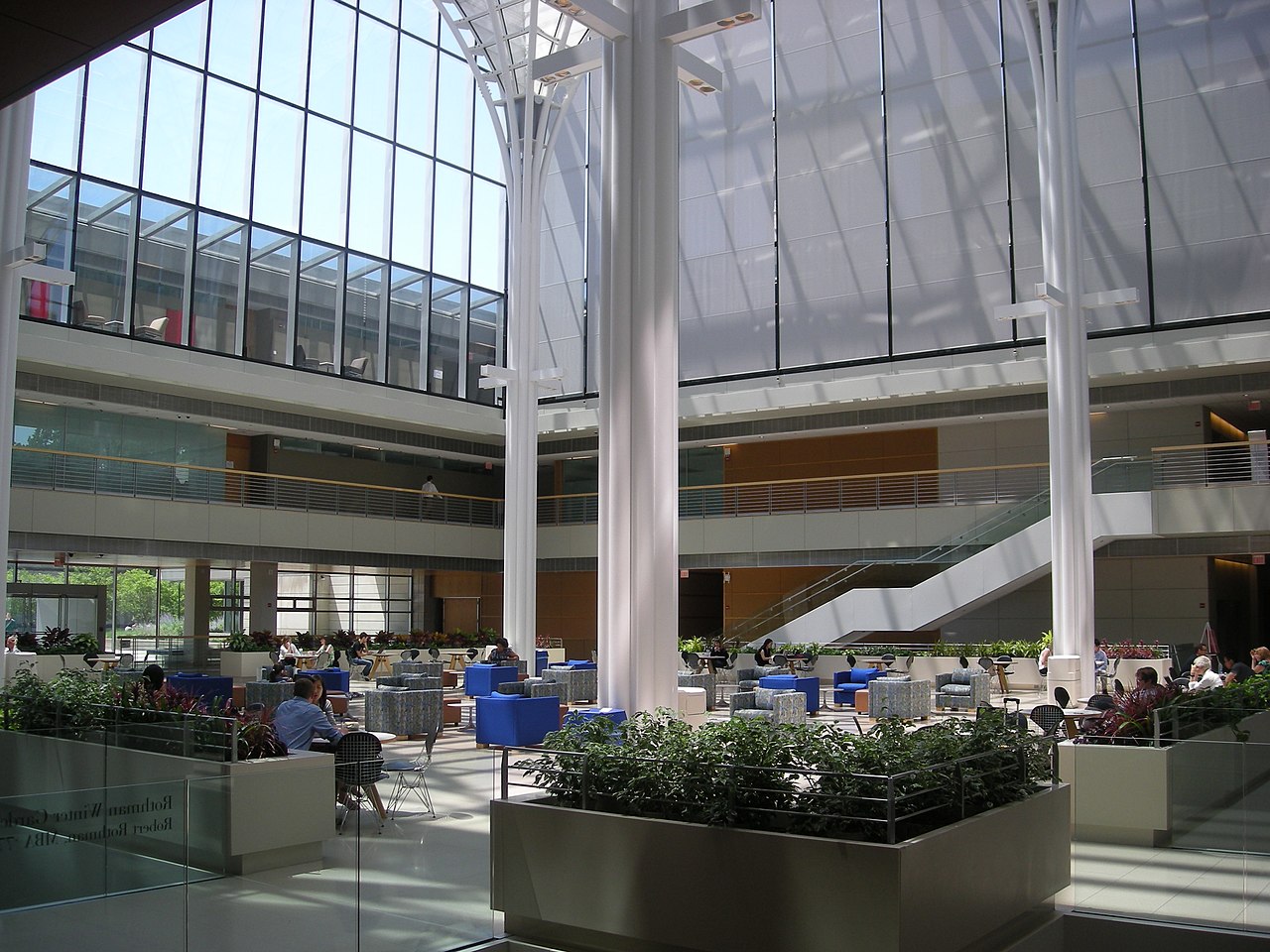
The Harper Center boasts a six story atrium at its center, dubbed the Winter Garden, covered with arched glass ceilings that mimic the Gothic arches of Rockefeller Chapel to the building’s south. The roof, made of light-filtering glass, serves as an ode to the glass roofs of the Robie House while also providing students with a bright, clean study space.
Charles M Harper Center at the University of Chicago, designed by Rafael Viñoly. Credit: Michael Barera on Wikimedia Commons, licensed under the Creative Commons Attribution-Share Alike 4.0 International license
Stone
Much of the University of Chicago’s campus is composed of grey stone, and the Harper Center’s mix of glass and grey stone exterior celebrate the historic structures of the campus. Stone facades mimic the straight lines of the Robie house while also celebrating the Gothic design that composes the campus quad.
Parts of the building are open to the public, so next time you find yourself in the Hyde Park neighborhood, make sure to experience this cutting-edge and unique piece of architecture for yourself.
The New York Times Style Magazine released an article in early August compiling a curated list of twenty-five of the most significant works of postwar architecture. Of the buildings selected, three hold deep connections to Chicago and the city’s architectural legacy; The Farnsworth House, Amanda Williams’ “Color(ed) Theory,” and the Johnson Publishing Company Building.
Farnsworth House
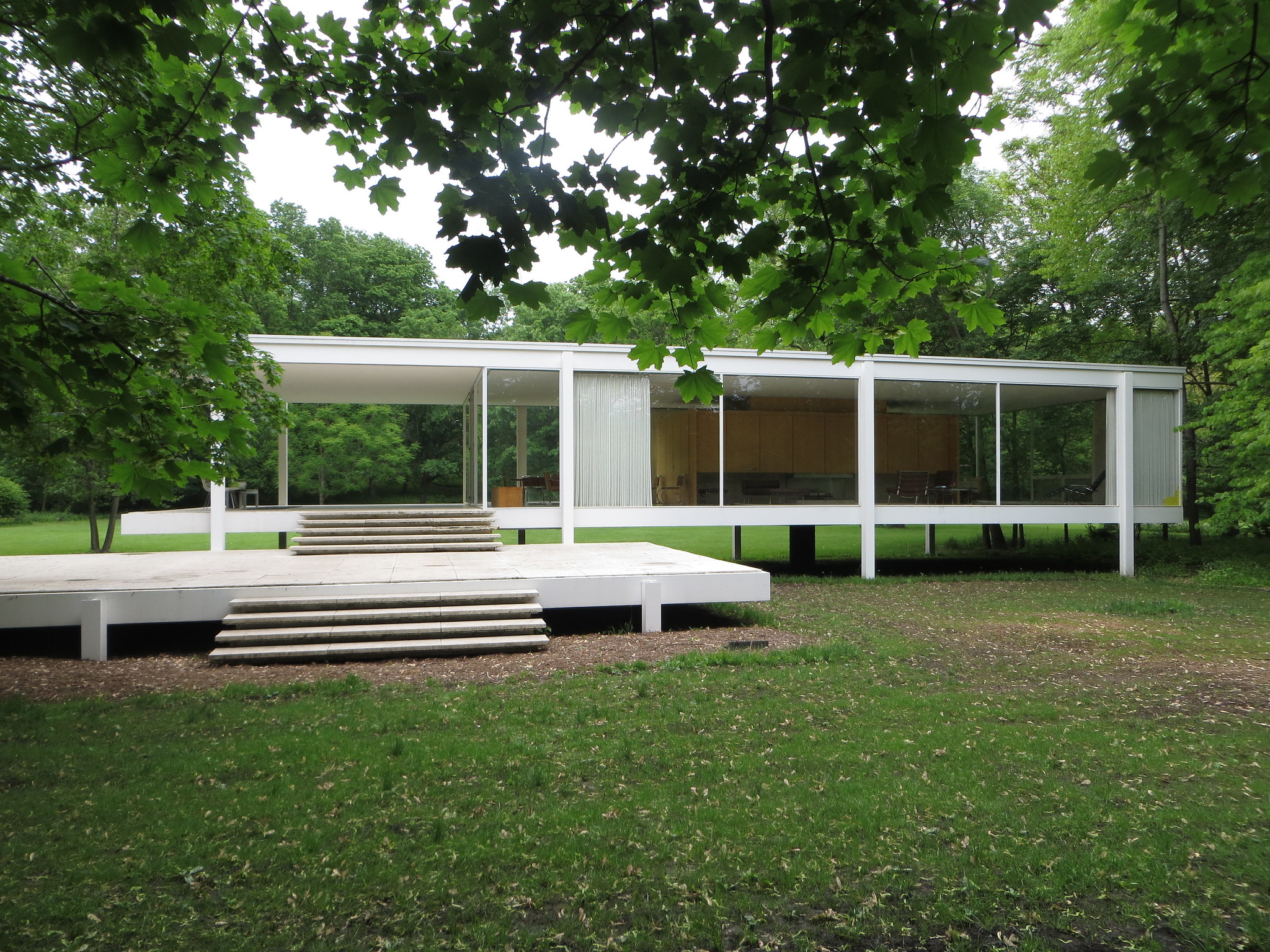
The Farnsworth House, considered one of Ludwig Mies van der Rohe’s masterpieces, sits on the isolated floodplains facing the Fox River in Plano, Illinois. Designed in 1945, the house was used as a retreat from the urban world for Edith Farnsworth, a native Chicagoan. The Farnsworth House was brought up repeatedly by the New York Times Style Magazine jury as many of its members admired the discipline displayed by the house’s design.
Color(ed) Theory: Ultrasheen, Amanda Williams, 2014-2015. Credit: Art Institute of Chicago
Williams spent two years on the South Side of Chicago painting abandoned and condemned houses based on colors she found in products targeted towards Black communities. The series provokes observers to think about the many complex forces that shape cities and their relationship to color. Using vibrant violets, teals, and turquoise, Williams metamorphosed the almost destroyed houses into works of art. The eight illuminating houses continue to encourage future discussions on the complexities of race, place, and value in Chicago today.
Johnson Publishing Building, 820 South Michigan Avenue, Chicago, designed by John Moutoussamy. Credit: Paul R. Burley on Wikimedia Commons, licensed under the Creative Commons Attribution-Share Alike 4.0 International license.
Johnson Publishing Company Building
John W. Moutoussamy’s 1971 Johnson Publishing Company Building located in downtown Chicago also made the New York Times Style Magazine list. The eleven-story building housed the offices of iconic magazines including Jet and Ebony, which represented the culture and style of America’s black community in the late nineties. The interior of the Johnson Publishing Building is filled with an art collection as well as opulent colors and textures reflecting the decorating styles of the 70s. Even today, the Johnson Publishing Company Building is one of the few urban skyrises designed by a black architect.
The modernist architecture movement gained traction in the late 19th century and was influenced by the post-war notion of practicality and eliminating excess.
Notable modernist architects include Ludwig Mies van der Rohe, Frank Gehry, and Zaha Hadid. Along with designing structures, these architects also designed furniture that would harmonize with their buildings, while making their works more accessible to many.
Prior to the modernist movement, furniture was seen as ornamentation. Rather than taking comfort and practicality into consideration, the value of furniture was determined by the amount of time and level of craftsmanship that went into its production. The Industrial Revolution enabled the mechanization of furniture production, enabling furniture to become affordable and functional rather than ornaments reserved for the wealthy.
Modernist principles of furniture considered the interaction of the design and the user, creating designs that fit with the human form rather than forcing bodies to conform to the furniture.
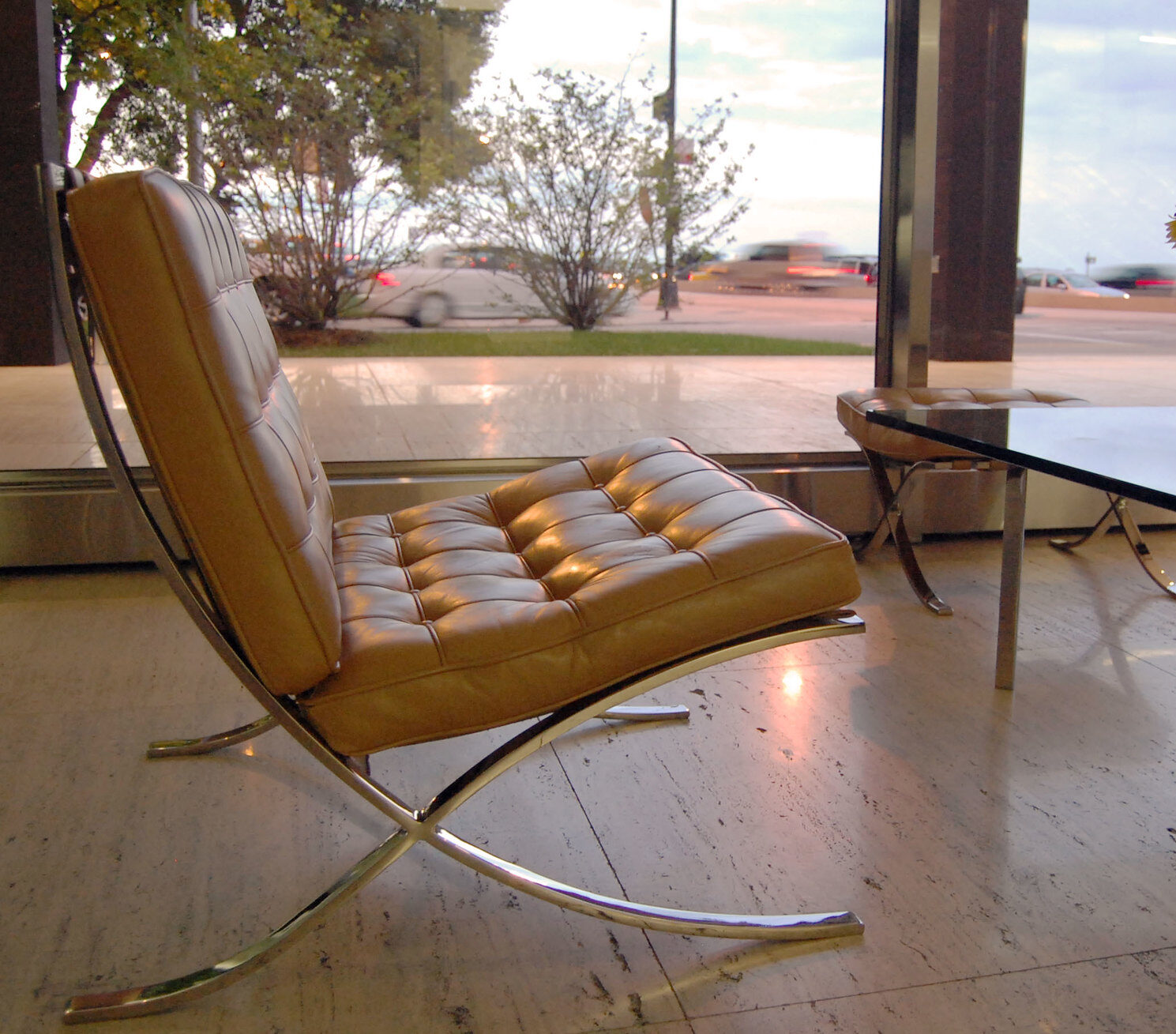
Barcelona Chairs, designed by Mies van der Rohe
Ludwig Mies van der Rohe’s 1929 Barcelona Chair was inspired by the simplicity of ancient folding chairs. Supported on each side by two chrome-plated flat steel bars, the Barcelona Chair is upholstered in leather and combines simple elegance with comfort. Mies van der Rohe designed the Barcelona chair to sit in the lobbies of his buildings, where they accent the architecture and blend in with the surrounding space.
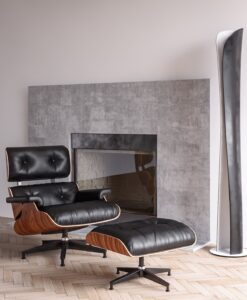
Eames Lounge Chair, designed by Charles and Ray Eames
The Eames Lounge Chair, another iconic piece of modernist furniture, was released in 1956 and designed by Charles and Ray Eames. The Eames Lounge Chair is a rare example of modernist furniture that was not designed to be mass-produced and affordable. Yet, the chair still relied on the principles of simplicity, practicality, and comfort core to modernist furniture design. The chair, inspired by the English Club Chair, is composed of molded plywood and leather and became a cultural icon for its un-design-like appearance that invites sitters to rest for hours within the chair’s leather cushions.
Noguchi Table, designed by Isamu Noguchi
Japanese-American artist and industrial designer, Isamu Noguchi, designed the famed Noguchi Table for the furniture company, Herman Miller. The Noguchi Table is a sleek glass-topped table supported by two curved pieces of wood at the base. The table became popular for its ability to fit both in the domestic and corporate spaces.
The ability for modernist furniture to fit effortlessly into any space combined with its practicality made modernist designs into classic pieces recognized across generations. Modernist furniture can be found in suburban households and steel office buildings alike. Families gather around Noguchi Tables for chess games and curl up into Eames Lounge Chairs with long novels. Business moguls and architects meet in Barcelona Chairs and sign documents over Noguchi Tables. The versatility of modernist furniture and ease with which it is produced revolutionized how the general public views furniture and furniture’s place in the spaces it takes up.
Breaking boundaries as the first woman to be awarded the prestigious Pritzker Architecture Prize in 2004, Zaha Hadid is recognized as one of the most exceptional designers in history, forging a legacy of innovation and individuality. Despite Hadid’s unexpected death in 2016, her legacy continues through the projects she designed.
Born October, 1950 in Baghdad, Iraq, Hadid studied mathematics as an undergraduate and went on to enroll at the Architectural Association School of Architecture. Hadid was advised under Dutch architect, Rem Koolhaas, who would later describe Hadid as one of the most exceptional students he ever taught.After graduating, Hadid moved to Rotterdam where she worked for Koolhaas at the Office for Metropolitan Architecture (OMA). In 1980, after becoming a naturalized citizen of the United Kingdom, Hadid opened her firm, Zaha Hadid Architects, which has developed high-profile and illustrious projects around the world. Hadid and her firm introduced audiences to a new way of conceptualizing modern architecture through extremely detailed sketches rather than postmodern designs.
After graduating, Hadid moved to Rotterdam where she worked for Koolhaas at the Office for Metropolitan Architecture (OMA). In 1980, after becoming a naturalized citizen of the United Kingdom, Hadid opened her firm, Zaha Hadid Architects, which has developed high-profile and illustrious projects around the world. Hadid and her firm introduced audiences to a new way of conceptualizing modern architecture through extremely detailed sketches rather than postmodern designs.
Vitra Fire Station, designed by Zaha Hadid. Credit: Mondo79 on Flickr Creative Commons, CC BY 2.0 Deed
Vitra Fire Station
The very first building complex designed by Hadid was the Vitra Fire Station, eventually launching her career. One of Hadid’s clients, Rolf Fehlbaum, the president-director of the furniture design firm, Vitra, invited her to design a fire station for his design museum. Building from 1991-1993, Hadid used raw concrete and glass that defined the sculptural building. The station, famous for the dramatic effect of its sharp diagonals converging at its center, only remained functional for a short period and now serves as an exhibit space.
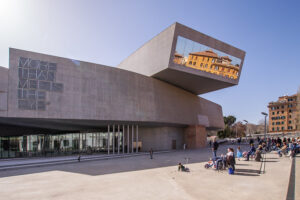
MAXXI Museum, Zaha Hadid, Rome, 2010. Credit: Artur Salisz on Flickr Creative Commons, CC BY-NC 2.0 Deed
National Museum of Arts of the 21st Century (MAXXI)
One of Hadid’s more recent designs, the MAXXI was built between 1998 and 2010. The structure appears to be moving and flowing through space in spots, animated by Hadid’s ambition to create movement through the design. Hadid achieved this movement through curving, white walls and the placement of the building extending precariously out over five, thin pylons. Hadid explained that she wanted the design to invoke “confluence, interference, and turbulence.”
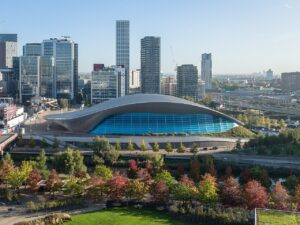
The Aquatic Centre in the Queen Elizabeth Olympic Park in Stratford, designed by Zaha Hadid, used for the 2012 Olympics, London, England, United Kingdom. Credit: Arne Müseler on Wikimedia Commons, licensed under the Creative Commons Attribution-Share Alike 3.0 Germany license
London Aquatic Center
Tasked to design the aquatic center for the 2012 Summer Olympics, Hadid again turned to fluidity, this time the convergence of geometry and liquidity found in water. Hadid’s iconic design covers three stadium pools with a complex roof the shape of a parabolic arch dipping into the center that anyone would recognize. The structure was praised by critics for its success in mimicking the “floating” and “undulation” of water, as stated by Rowan Moore.
In addition to receiving the Pritzker Prize, Hadid was recognized with numerous other prestigious awards, including the Royal Institute of British Architecture’s Royal Gold Metal Award, an honor approved by Her Majesty The Queen, and the Jane Dew Prize; she was also appointed Commander of the Order of the British Empire and was honored with a retrospective at the Guggenheim Museum.
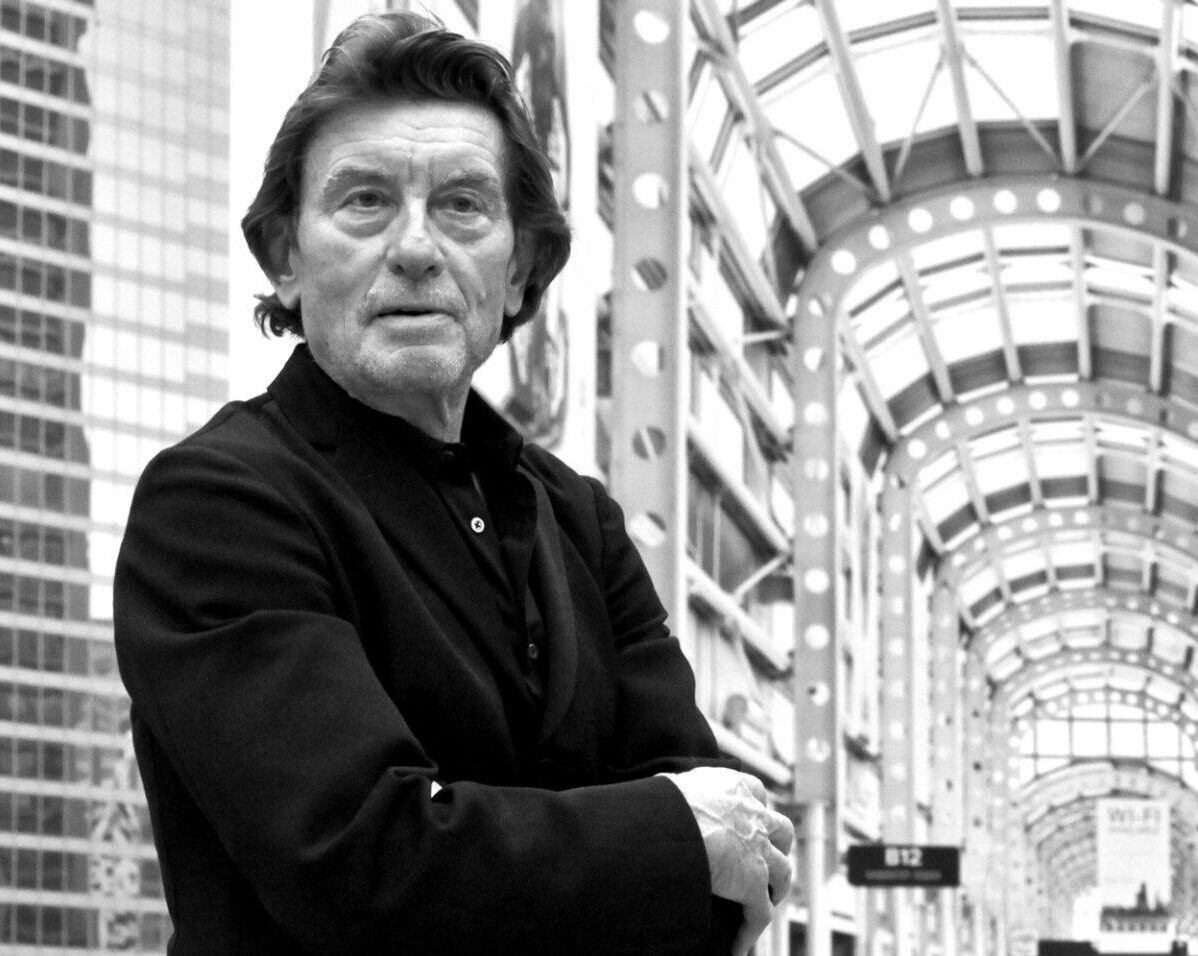
The German-American architect Helmut Jahn, who passed away in May 2021, holds a special place in the hearts of Chicagoans, as he made the city his home throughout his stellar international career. He was also a close friend and colleague of Optima founder, David Hovey Sr., FAIA.
Born in 1940 near Nuremberg, Germany, Jahn witnessed the destruction — and later reconstruction — of the town where he grew up during and after World War II. Because of this intimate and personal experience, he was inspired to study architecture and design as a way to participate in the process of stabilizing and beautifying the places where people live.
Jahn moved to Munich to study architecture, and relocated to Chicago in 1966 to further his studies under renowned architects Myron Goldsmith and Fazlur Khan at IIT. His career was forged when joining C. F. Murphy Associates, which was renamed JAHN in 2012 following Charles Murphy’s retirement.
Much of the work Jahn created took inspiration from the modern aesthetic he adopted while at ITT; he also pulled from the influences of postmodernism, the Art Deco style of the ‘30s and eclecticism throughout his career. In the late 1970s and early ‘80s, Jahn’s mark on architecture really began as he transitioned from smaller projects to legacy-defining skyscrapers.
The Works of Helmut Jahn
James R. Thompson Center, Chicago
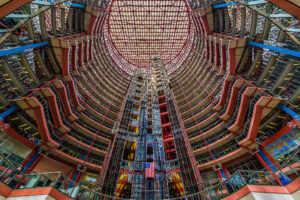
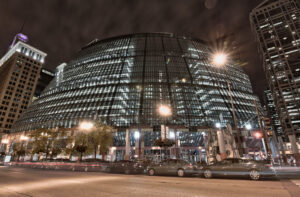
In 1985 Jahn designed the State of Illinois Building (renamed the James R. Thompson Center in 1994), located in Chicago, which serves as the second home to the Illinois state government. From the moment its doors opened to the public, it became one of Jahn’s most controversial designs, with mixed reviews that ranged from unabashed praise to outrage.
The atrium inside the James R. Thompson Center in Chicago, designed by Helmut Jahn
The building, with a grand atrium at its center, has a distinctive circular shape that references the Illinois State Capitol building in Springfield. While the structure was considered futuristic at the time, in part due to the use of advanced architectural tectonics, it also incorporated design elements that were reminiscent of the grandeur of large public spaces of the past.
Over the years, many of Illinois’ most senior officeholders (including governors) have proposed selling the structure, much to the criticism of architects and architecture devotees concerned about the building’s future. And while the future of the building remains in question, the 17-story structure is internationally known and considered a momentous piece of postmodern architecture.
The exterior of the James R. Thompson Center, designed by Helmut Jahn
Sony Center, Berlin
Built in 2000 at the Potsdamer Platz in Berlin, Germany, the Sony Center stands as one of Jahn’s more recent architectural feats. After the city’s ruin during WWII, the original site — the infamous Nazi People’s Court — was stuck in the Berlin Wall’s No Man’s Land, and was left to decay. Once the Berlin Wall fell in 1989, the city looked to rehabilitate much of the forgotten architecture.
Jahn undertook the project of this transformational urban marketplace with a desire to honor the meaning of building on and around abandoned structures. In the process, he successfully blended historic remnants and modern aesthetics to create an open, free-flowing space for all to enjoy.
The grouping of eight buildings that makes up the Sony Center are a mix of residential, commercial and public space. Each structure is enveloped in glass, directing the flow of light and augmenting the feeling of transparency throughout the complex. The 102 meter-long roof that sits atop the complex, built by Waagner-Biro, has become an iconic feature in its own right. The medley of steel, glass and translucent fabrics, which is often illuminated in bright colors, furthers the fluid design that Jahn intended.
A rendering of the Pritzker Military Archives Center in Sommers, Wisconsin, designed by Helmut Jahn
Pritzker Military Archives Center
The Pritzker Military Archives Center located in Sommers, Wisconsin, is one of Jahn’s final projects. The construction, which started in 2020, is taking place in conjunction with the development of a new Memorial Park Center. The center will advance the mission of the Pritzker Museum and Library to restore and preserve their ever-expanding collections.
The state-of-the-art structure will feature an immersive 9,400 square-foot Gallery Center open to the public. The Gallery will house artifacts and exhibits provided by the parent museum and library located in Chicago. The front of the building will feature floor-to-ceiling glass frames that illuminate the interior. Brilliant red steel beams will stretch beyond the facade, creating a dramatic rooftop extending boldly beyond the building’s entrance.
Construction on the Pritzker Military Archives Center is underway and moving swiftly; the entire Memorial Park Center will take nearly a decade to be completed.
The interior forum of the Sony Center in Berlin, designed by Helmut Jahn
Chicago Architecture Center Exhibit
Honoring Jahn’s accomplishments and extraordinary engineering feats, the Chicago Architecture Center (CAC) has curated the exhibit Helmut Jahn: Life + Architecture. The exhibit includes an expansive compilation of ephemera including photography, sketches and models of Jahn’s most iconic works.
For those interested in learning more about Jahn’s exemplary career in architecture and beyond, Helmut Jahn: Life + Architecture is free with admission to the CAC. The exhibit is open from 10 a.m. to 5 p.m. daily until October 31. You can purchase vouchers and learn more about future exhibits here.
American designer, architect, and sculptor, Maya Lin was born in 1959 in Athens, Ohio. Lin rose to national recognition in 1981 as an undergraduate at Yale University when she won a public design competition at 21 years old for the Vietnam Veterans Memorial on the National Mall in Washington DC.
One of 1,422 submissions, including those from established design firms, Lin’s design included a black granite wall with the names of those lost in Vietnam carved into its face. Lin’s design intended to “take a knife and cut into the earth, opening it up, and with the passage of time, the violence and pain would heal.”
Vietnam War Veterans Memorial, designed by Maya Lin. Credit: Wladia drummond on Wikimedia Commons, licensed under the Creative Commons Attribution-Share Alike 4.0 International license
The design was controversial for its lack of tradition and because of Lin’s Asian ethnicity and youth. Today, Lin’s design for the Vietnam Memorial is a pilgrimage site for the friends, family, and comrades of those who died in Vietnam and is an integral part of the National Mall’s landscape.
Upon graduating from Yale, Lin went on to earn a Master of Architecture from the university in 1986. She opened Maya Lin Studio in New York City, her own design firm which has worked on numerous projects including the Civil Rights Memorial in Montgomery, Alabama and the outdoor Wave Field installation at the University of Michigan.
In many ways, Lin identifies as a “designer” rather than an “architect.” Her works focus on the relationship between people and nature, and how people will interact with the space and nature they take up in the future. Lin’s work emphasizes human emotion rather than politics, making the viewer aware of their surroundings in not just a physical, but also psychological way.
Wave Field, Maya Lin, University of Michigan Campus, 1995. Credit: Sharon VanderKaay on Flickr Creative Commons, CC BY 2.0 Deed
Lin’s 1995 design for Wave Field at the University of Michigan is inspired by the motion of fluids and ocean waves. Lin wanted to freeze the motion of water and movement of earth in an interactive earth piece that engaged the viewer more physically than a photograph. Wave Field was Lin’s first piece of earth work and was followed by her 2004 piece, Eleven Minute Line, in Sweden which is composed of a walkway that takes eleven minutes to traverse.
Lin’s architectural works include the plaza for the Claire Trevor School of the Arts at the University of California, Irvine, the design for the Museum of Chinese in America in New York City’s Chinatown, and a renovation of the Neilson Library at Smith College.
Lin’s project, “Ghost Forest” is currently on display in New York City’s Madison Square Park. Composed of a forest of dead or “ghost” trees, the installation gives the viewer an eerie vision of an earth damaged from climate change in the not-so-distant future.
In 2009, Lin was awarded the National Medal of the Arts by President Barack Obama. In 2016, she was awarded the Presidential Medal of Freedom by President Barack Obama. Other awards include the 1999 Rome Prize, an election to the National Women’s Hall of Fame, The American Academy of Arts and Letters, and the 2014 Dorothy and Lillian Gish Prize among numerous other recognitions.
Lin resides in New York City and also has a home in rural Colorado. She is represented by Pace Gallery in New York City and continues to run her own studio.
Born in Bridgend, South Wales in 1955, Amanda Levete is known for her innovative practices and making organic and conceptual designs a reality. Levete studied at the Architectural Association School of Architecture in London and worked at firms Alsop & Lyall and Richard Rogers Partnership before forming her own London-based firm AL_A (formerly Amanda Levete Architecture) in 2009.
Among Levete’s notable works are the current transformation of Paris’s famous Galeries Lafayette department store, Wadham College at Oxford University, the Museum of Art, Architecture, and Technology (the MAAT) in Lisbon for the EDP Foundation, and a new entrance, gallery, and courtyard for London’s Victoria and Albert Museum.
Museum of Art, Architecture and Technology, Lisbon. Credit: Pedro Ribeiro Simões on Wikimedia Commons licensed under the Creative Commons Attribution 2.0 Generic license
Levete is known for her “intuitive and strategic approach to design” which captures the identity of the urban landscape in which a building is located rather than the identity of the building itself. This approach to architecture and design allows Levete’s creations to interact with the space around them and to become a part of a cityscape rather than existing in a vacuum.
An example of Levete’s intuitive and strategic approach to design, one that interacts with its surroundings, is her design of a SEPSA subway station in Naples, Italy. Levete’s station design simultaneously functions as a work of art and a subway station that allows commuters to travel with ease while interacting with a brilliant art piece every day. At the surface level, the station becomes a central element to Naples’ Traino district which has suffered from lack of infrastructure and neglect in past years. A large, smooth metal circle made in collaboration with renowned sculptor Anish Kapoor resides above the entrance, welcoming commuters in while reflecting and highlighting the surrounding architecture of the neighborhood to the viewer. Together Levete and Kapoor celebrate the already existing infrastructure of the district while bringing something new to it through the combination of beauty and functionality.
Similarly, Levete’s work on the transformation of the ‘Cupola’ building of Paris’s Galeries Lafayettes celebrates traditional Haussmann-style architecture in order to create an innovative design in a landmark structure. Levete describes this design as a “metamorphosis,” one that acknowledges the importance Galeries Lafayette has to the daily life of Parisians and the architecture of the city of Paris. The Galeries Lafayette project is still in process and Levete plans to celebrate the original craftsmanship of the building while moving it forward into the lives of future generations of shoppers for years and years to come.
In 2017, Levete was appointed Commander of the Order of the British Empire for services to architecture. In 2018, Levete was awarded the Jane Dew Prize by the Architects Journal and Architectural Review. The Jane Dew Prize is seen as one of the biggest architecture prizes awarded to women and recognizes architects who “raised the profile for women in architecture.” Levete has also been awarded the RIBA Stirling Prize which is presented to “the architects of the building that has made the greatest contribution to the evolution of architecture in the past year.”
Saunas have been health staples in cultures around the world for thousands of years. The oldest saunas, found in Finland, are thought to date from around 2,000 BC and used stones to create high temperatures and dry heat in the winters. In Korea, domed structures often warmed by kilns appeared in literature as early as the 15th century. In the Orkney’s of Scotland, stone structures thought to incorporate the use of steam date back to the neolithic age.
In modern times, the most common saunas used in western culture originate from Northern Europe and have temperatures around 212 degrees Fahrenheit and relatively low humidity. They remain today a staple of health and wellness, and can be found at spas, resorts, poolsides, gyms, and even private homes and bathrooms.
Saunas are known for their numerous health benefits. When an individual spends time in a sauna, the heat causes their heartbeat to increase and their blood vessels to widen, improving circulation. Saunas are comforting, calm spaces that promote relaxation and, paired with the improvement of circulation, can reduce stress levels and improve overall cardiovascular wellbeing.
Dry saunas, especially, are known for their positive impact on heart health. They also reduce the symptoms of rheumatic diseases such as fibromyalgia and rheumatoid arthritis. Dry saunas are known for relieving skin conditions such as the itchiness from psoriasis. There is some evidence that dry saunas also may improve athletic performance.
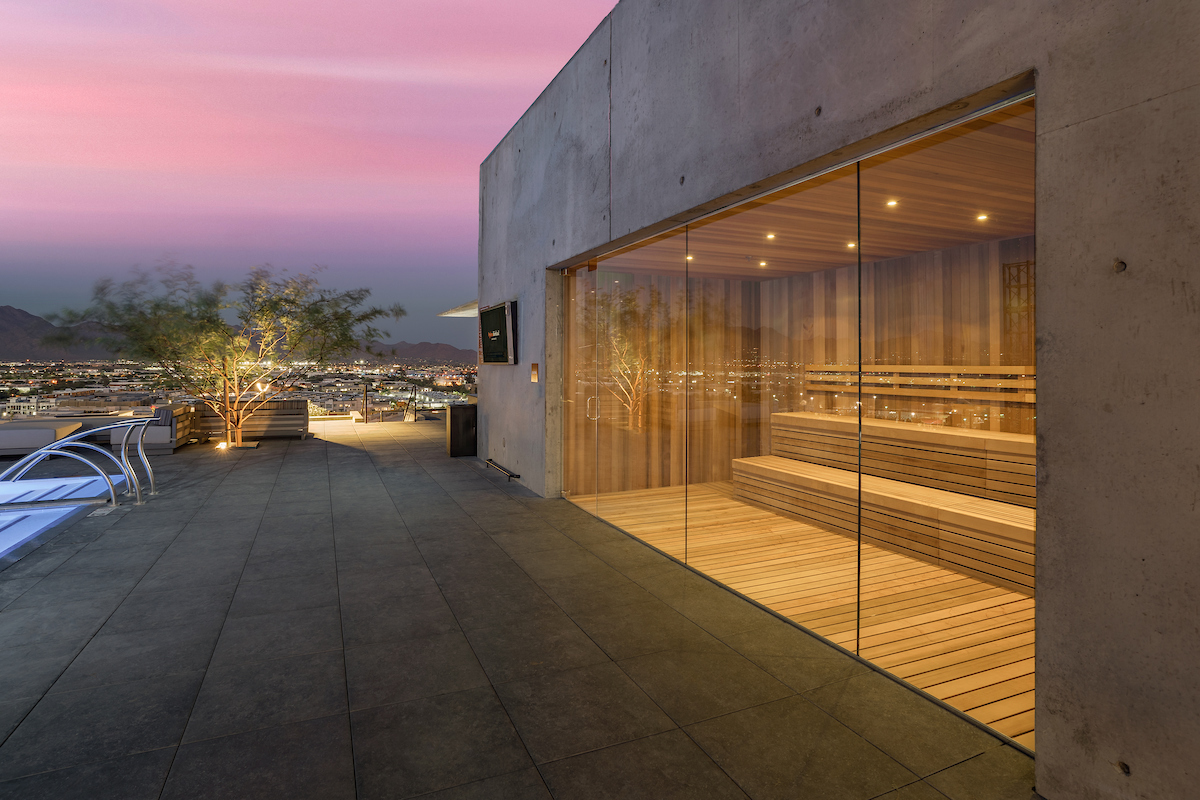
Indoor Sauna at Optima Signature
When it comes to enjoying a sauna, for optimal benefits, most experts recommend around fifteen minutes per sitting and allowing your body time to rehydrate and cool down before resuming normal activities.
Saunas are a wonderful way to relax and boost both cardiovascular and overall health. The use of saunas is an ages-old practice that prioritizes bodily and mental health, spans around the globe, and persists today.
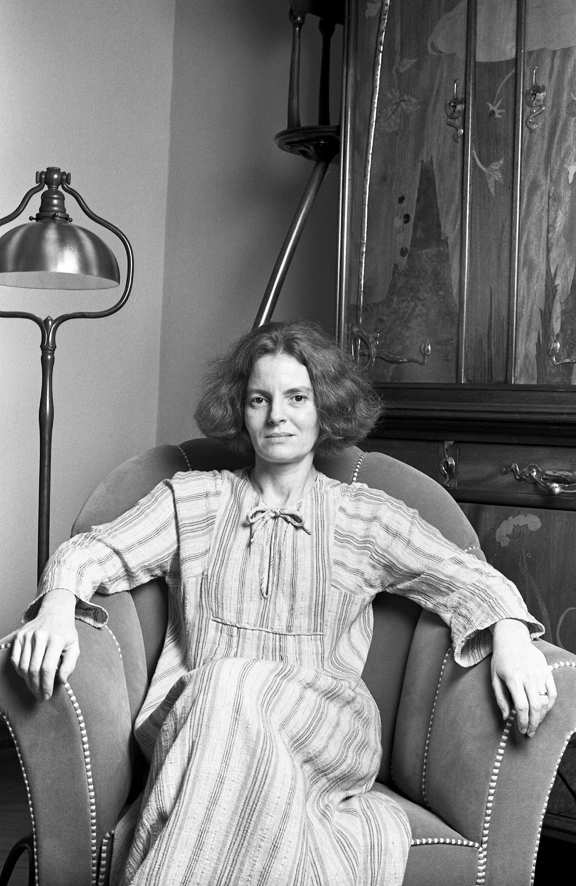
Denise Scott Brown knew from the age of five that she wanted to be an architect. Born in 1931 Northern Rhodesia (now Zambia), Scott Brown pursued her dream by spending her summers working for architects and studying at the University of Witwatersrand in South Africa.
In 1952, Scott Brown moved to London to work for modernist architect, Frederick Gibberd. While in London, Scott Brown won admission to the prestigious Architectural Association School of Architecture before moving to Philadelphia, Pennsylvania in 1958 to study at the University of Pennsylvania’s planning department and obtain a master’s degree in city planning and architecture.
In 1967, Scott Brown joined Robert Venturi’s architectural firm, Venturi and Raunch, where she became principal in charge of planning in 1969. Scott Brown’s approach to architecture with Venturi was to understand a city in terms of social, economic, and cultural perspectives and to use these perspectives a set of complex systems in which to build a structure.
With Venturi, Scott Brown designed the Bryn Mawr College Campus Center as well as a campus plan in 1997 which considered the campus’s physical character as originally shaped by famous planners and architects Calvert Vaux, Frederick Olmsted, Louis Kahn, and more. The student body of Bryn Mawr College, having grown, needed an expanded campus, and Scott Brown planned an expansion that celebrated the campus’s original orthogonal pattern while accommodating the students’ needs.
Another of Scott Brown’s designs is for the Japanese Nikko Hotel chain, in which Scott Brown merged the ideals of western comfort with Japanese Kimono patterns to celebrate the heritage of the hotel chain while catering to the western audience.
In 1989, Venturi and Raunch was renamed to Venturi, Scott Brown and Associates, celebrating Scott Brown’s contributions to the firm. The firm is known as one of the most influential architecture firms of its time and is celebrated for radical theories of design while approaching its practice clearly and comprehensively.
In 1991, Robert Venturi was awarded the Pritzker Architecture Prize, while Scott Brown was not recognized for her contributions to Venturi’s work. Scott Brown boycotted the award ceremony. In 2013, a student organization titled Women in Design started by Caroline Amory James and Arielle Assouline-Lichten at the Harvard School of Design started a petition for Scott Brown to receive joint recognition for the Pritzker Architecture Prize. Though Scott Brown has still not been awarded joint recognition for the Pritzker Prize, in 2017, she won the prestigious Jane Dew Prize.
Throughout her career, Scott Brown struggled to be recognized as an equal partner at a male-dominated firm. In 1975, Scott Brown wrote an essay titled “Room at the Top? Sexism and the Star System in Architecture,” though Scott Brown did not publish the essay until 1989 out of fear of damaging her career. The essay became an immediate hit, and Scott Brown has continued to advocate for women in architecture throughout her life.
Interior of Relic Rock, Optima DCHGlobal, demonstrating the Corbusian principle of the free ground plan
An intricate and technical field, the world of architecture produces a unique dictionary of jargon all its own. At Optima, our team works in a highly collaborative atmosphere where we all, from architects to property managers to construction superintendents, share ideas and hold conversations across disciplines — so naturally we all encounter the lingo of our architects. As part of our ongoing series “An Inside Look at Architect Lingo,” today we continue to decode the secret language that we’ve all come to know and love.
Corbusian
Just like the word Miesian from our previous installment in this series, Corbusian is a homological word that nearly explains itself. It refers to anything of, pertaining to, or characteristic of the Swiss architect Le Corbusier. Of the many narratives and philosophies he published, Le Corbusier famously published the seminal L’Espirit Nouveau in 1920, revealing his famous “five points of architecture.”
These five points include the pilots (a grid of concrete or steel columns replaces the load-bearing walls), the roof garden (vegetation or landscaping that covers a rooftop), the free ground plan (the absence of load-bearing walls allows flexible use of the living space, which can be divided by screen elements), the horizontal windows (cut through the non-load-bearing walls along the facade and provide the apartment with even light), and the free façade (pen and closed sections on the façade enable the separation and connection of the exterior design from the building structure). Anything including these characteristics, then is Corbusian.
Rendering of Optima Verdana
Mullion
As exotic as the word sounds, the definition for mullion is pretty simple. A mullion is any vertical element that forms a division between units of a window, door, or screen. This division can be both functional or purely decorational. When dividing adjacent window units, the primary purpose of a mullion is to provide a rigid support to the glazing of the window.
In Modernist architecture then, where endless glass curtain walls abound, the mullion becomes an integral part of maintaining the structural integrity of these all-glass fixtures.
Muntin
Muntin is not to be confused with the above mullion, though the two do share similarities. Muntin refers to a rabbeted (or recessed) member for holding edges of window panes within a window sash. Muntins are also sometimes called glazing bars or sash bars. These days, muntins are often decorative in nature, ranging from the simple to the complex – often a counterintuitive design element in Modernist disciplines.
However, as you might recall from our blog on the history of glass, at one point in time it was extremely rare to obtain large panes of glass. Everything was built by patching very small and very expensive panes of glass together, and in this context, muntins were extremely critical.
Stay tuned for future features on the world of architecture lingo at Optima.