Making Use of Existing Tennis and Basketball Courts
Before installing dedicated courts, luxury developers can try out pickleball at their facilities for a negligible price. They can add lines to existing tennis and basketball courts and roll out temporary nets.
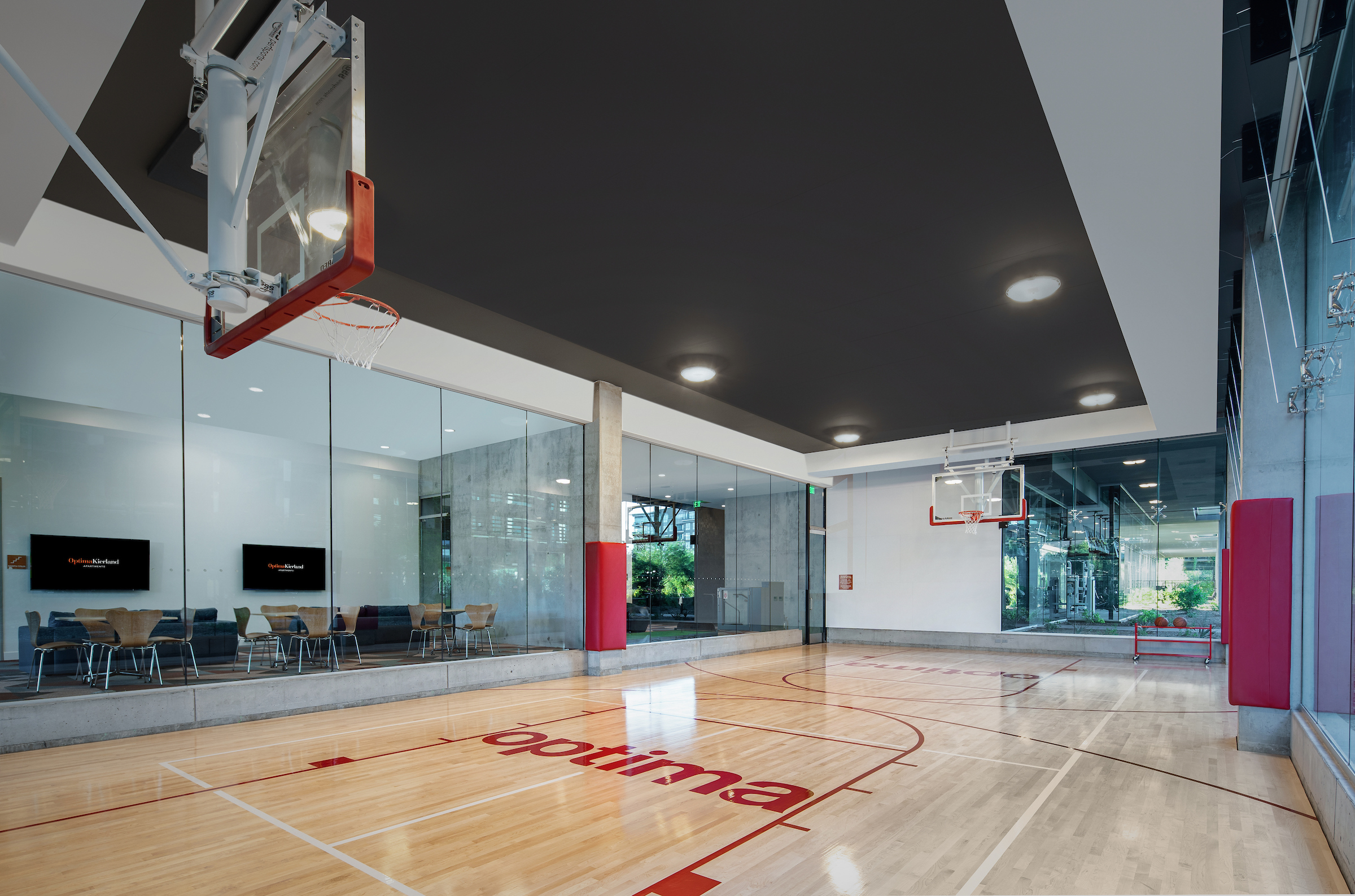
The Abaco Club gauged residents’ interest in the game by adding stripes to its tennis court before committing to the smaller-sized courts. The residential developer Optima Inc., which owns properties in Scottsdale, Arizona and Chicago, did the same by painting stripes on indoor basketball courts.
“The requirements are similar to those of an indoor basketball court, so it’s been an easy addition. The most important thing to consider in planning a pickleball court is space and creating the striping overlay on the existing court in a way that’s cohesive,” said David Hovey Jr., AIA, president, COO and principal architect of Optima, Inc.
To meet demand, they’ve planned an outdoor pickleball stadium at their forthcoming luxury apartment tower, 7190 Optima Kierland. The 216-unit tower is slated to open in 2023 in Scottsdale. “We’re excited to build resident programming around this newest feature, possibly hosting a tournament,” Mr. Hovey said.
For nine years, SRP has used this award to recognize local businesses and organizations that have worked with the utility provider on eco-friendly projects and solutions, the company’s website explains.
Optima Sonoran Village was one of three businesses honored for “Building Communities for Electric Vehicles,” along with apartment brand Acero and home builder Lennar.
According to SRP, this category is for “homebuilders and multifamily developers who build homes or communities to be electric vehicle (EV) ready — complete with pre-wired electrical outlets to support Level 2 chargers or on-property charging stations for residents.”
The Scottsdale Independent reports that the 19 businesses named by SRP received their awards in a ceremony held at the Hyatt Regency Scottsdale Resort. “The event underscores SRP’s 2035 Sustainability Goals related to energy efficiency, demand response, transportation electrification, and electric technologies initiatives,” SRP said in its press release.
Jim Pratt, SRP’s associate general manager of customer operations & chief customer executive, also spoke in support of the award winners’ efforts. “We are thankful to the winners for being valued partners. Their strong commitment to energy efficiency and sustainability is driving meaningful change and demonstrates what’s possible when we work together to keep the [San Tan] Valley and all of Arizona growing and thriving for generations to come,” he said, as reported in the SRP release.
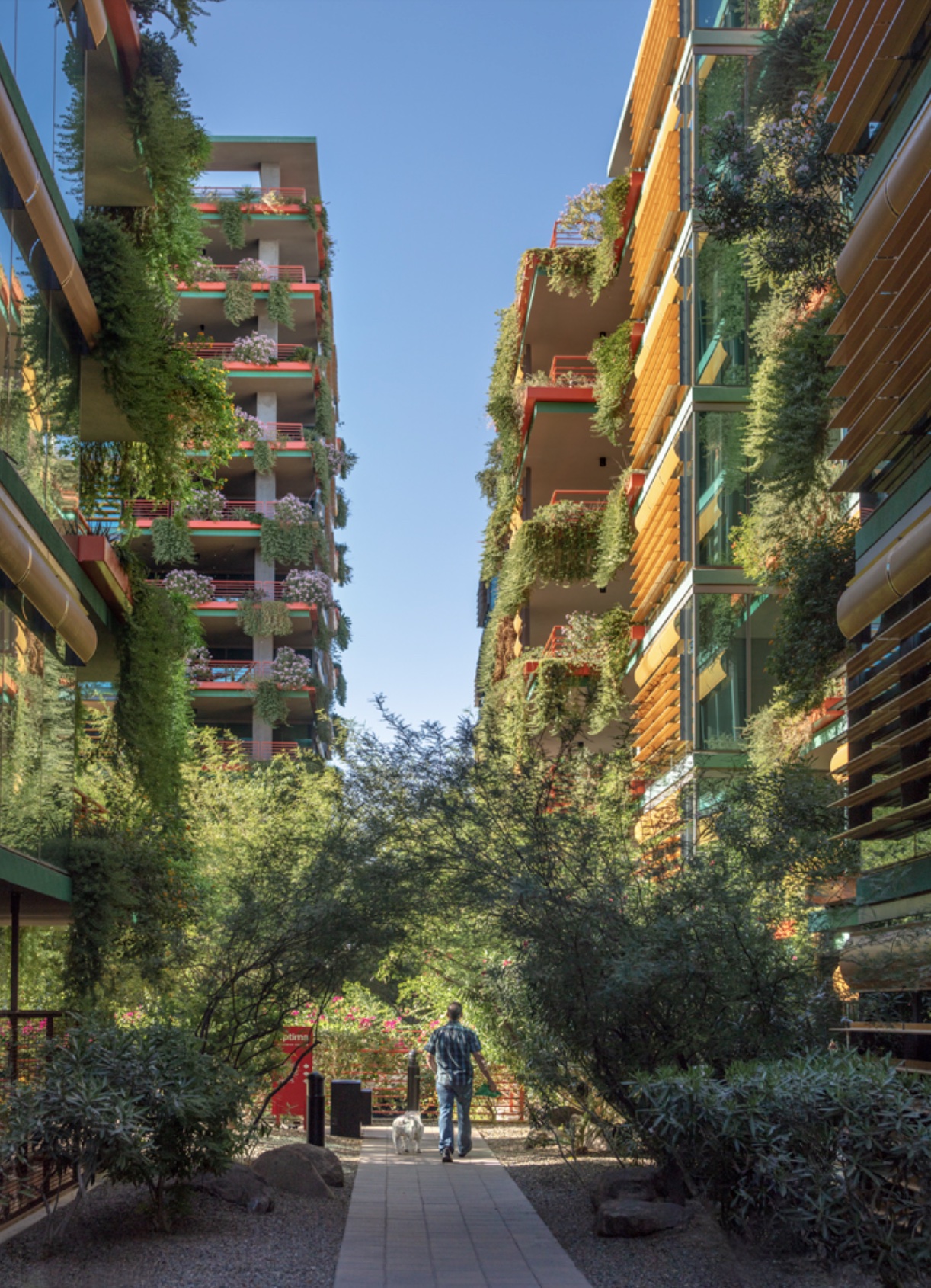
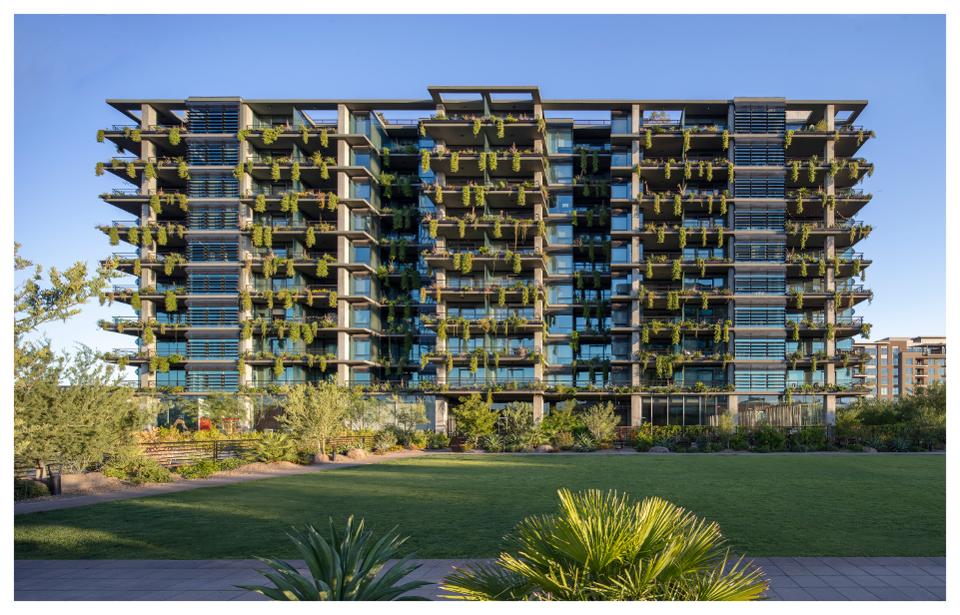
City of Los Angeles civil servant Dan Caroselli took to Twitter to praise Optima Sonoran Village’s design, though he did wonder about the project’s affordability and sustainability. “I have to admit they look really cool and I was surprised by them since basically nothing else looks remotely like this in Phoenix,” he said, and noted that “Everything is plants! Plants! Plants!”
Twitter user Sukrit Ganesh (@SukritGanesh) agreed. “At first I thought this was AI-generated, then I Googled it up. If only more apartment complexes [were] designed like this!”
The rush of commercial real estate development has truly become a statewide phenomenon, and the 2020 Real Estate Development (RED) Awards reflect just how widespread the activity has been in Arizona. From the more than 110 project nominations received this year, 17 were for projects away from the Valley. Projects in Tucson, Marana and Flagstaff can be found in the list of finalists, showing clearly that good work is being done all over the state. This year’s projects were some of the most impactful developments the state has seen in the 2000s, which made narrowing them down to three finalists and, ultimately, only one winner very difficult. The finalists and winners were honored at our 2020 RED Awards event on March 12 at Pointe Hilton Tapatio Cliffs Resort in Phoenix. For tickets, click here.
Here are the finalists for the 2020 RED Awards, by category:
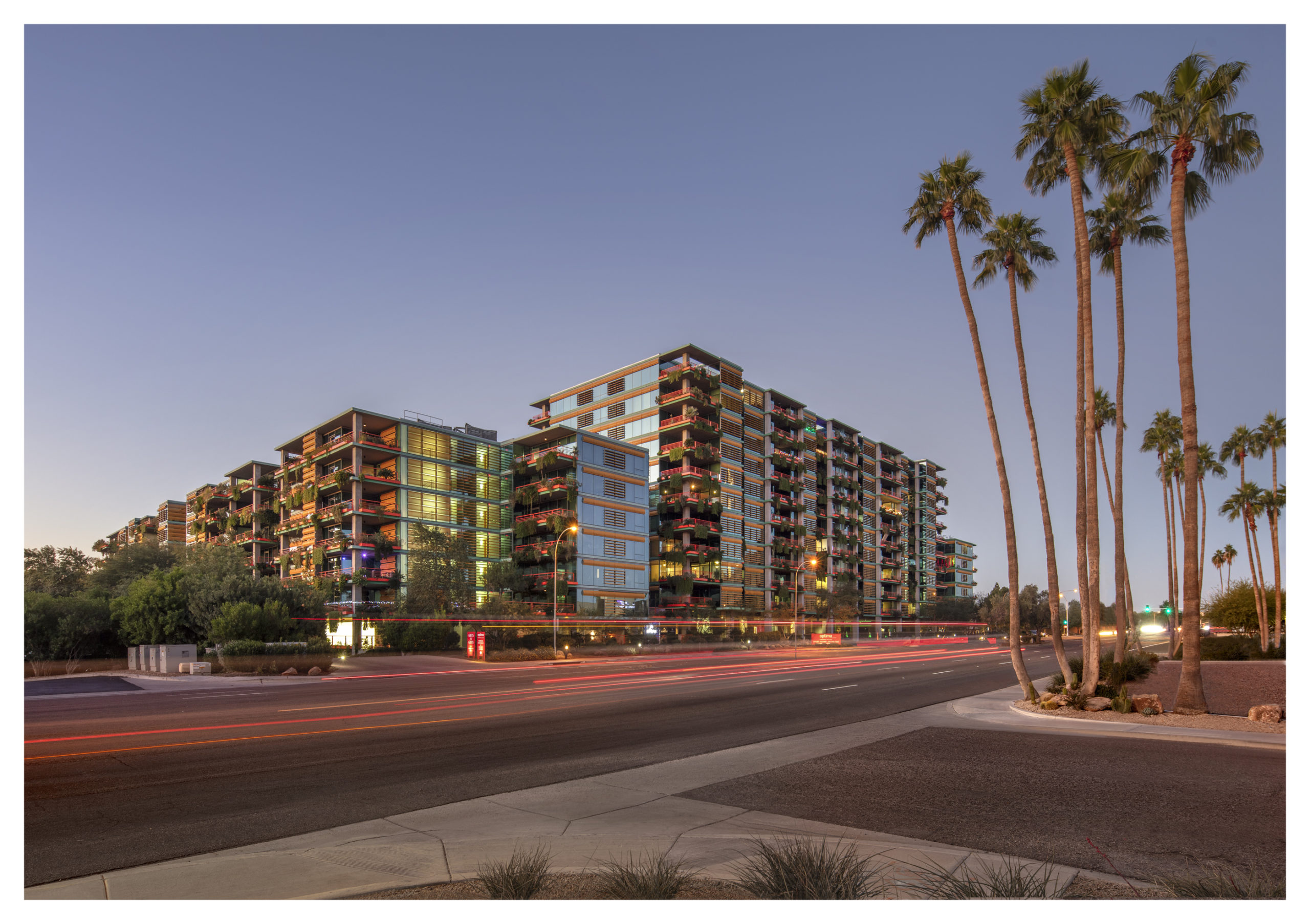
On a sunny winter day, residents of Optima Kierland are pursuing their morning rituals—walking the dog, working out in the fitness room, running on a track around the rooftop pool, powering up a Zoom call in the lounge, heading to the underground garage for the commute to work. But the 1,000-unit condo and rental complex, spread across five towers, is not your typical brown-box-and-a-balcony multifamily project so prevalent around the Valley. Instead, it is a sustainable, architectural tour-de-force, balancing concrete and glass, shade and sunlight, voids and cubic forms, all cooled with lush plantings that defy boundaries between outside and in.
The project is one of the latest achievements by father-and-son architects David Hovey Sr. and David Hovey Jr., who, along with other family members, run Optima, headquartered in Scottsdale and Chicago. Known for their edgy, architecturally striking designs of multifamily complexes and innovative construction techniques and materials, the Hoveys—and their company—have found the secret sauce to success. Optima is a soup-to-nuts company that develops, designs, builds and manages projects, overseeing everything from site selection to specifying kitchen sink faucets.
“I’ve been a fan of the Hoveys’ architecture for a long time,” says architect Anthony Floyd, who heads Scottsdale’s green building program and has worked with the Hoveys on sustainability strategies for several of their projects. “They’ve changed how we view multifamily housing here. What they create is unlike what we’ve seen in Arizona—or even the world.”
The history of this modernist dynasty began with Hovey Sr. Born in New Zealand to a Kiwi mother and a U.S. Marine father, he moved with his family to Chicago when he was 15 years old. “Chicago is the foremost city in the world for modern architecture,” Hovey Sr. says. “Being there sparked my interest in architecture.”
Hovey Sr. enrolled in the Illinois Institute of Technology, where Mies van der Rohe had served as dean and shaped the school’s modernist bent. “Mies was no longer at IIT when I studied there,” he remembers, “but some of us went to his house one night and didn’t leave until 4 a.m. He lived in an old brick apartment—not one of his designs—because he didn’t want to be constantly accosted by clients.”
During college, Hovey Sr. worked as an assistant to the curator of contemporary art at the Art Institute of Chicago, igniting his love of modern art and inspiring his later work in metal sculpture. His first job out of school was with a small firm, but, wanting to experience a larger office, Hovey Sr. signed on with noted Chicago architect Helmut Jahn, working there for four years during the 1970s.
“My son and I are contemporary architects. We are interested in the design, materials and technologies of the 21st century. We’re not interested in allusions to the past.”
David Hovey Sr., FAIA, architect
But there was always an itch to do his own thing. “My IIT professor, Arthur Takeuchi, always said that an architect was the low man on the totem pole when it came to projects,” Hovey Sr. recalls. “He said the best outcome was to be not only the designer but also the developer and client.”
Heeding those words, Hovey Sr. launched Optima in suburban Chicago in 1978, along with his wife, Eileen Sheehan Hovey, who handled the real estate component of their projects. Before long, they were specializing in design-driven multifamily complexes around the city and, later, joined by their children, Tara Hovey, who handles financial strategies for the company, and David Jr., who earned his master’s in architecture at his father’s alma mater and now serves as CEO.
Frequent winter visitors to Scottsdale, the family opened a second Optima office in the desert in the early 2000s, sensing a market that was open to innovative modernist housing. By then, Hovey Jr. was helping push forward Optima’s shape-shifting experimentations with design, materials and construction methods. “When I was working as a construction superintendent on our job sites,” says Hovey Jr., “I observed inefficiencies between architecture and construction that could be improved by prefabrication.”
Though they became known for apartments and condos, the father and son have long experimented with techniques and approaches by building single-family spec homes, completing several over the years in North Scottsdale. “We had to find a new language for architecture here in Arizona,” Hovey Sr. says. “Studying Frank Lloyd Wright’s shelters, we learned to design optimum structures in the desert, ones that celebrated the indoor-outdoor relationship and incorporated sustainable features, such as solar power and passive cooling. We took what we learned from these spec homes and translated that into our multifamily work.”
After completing their first Arizona project, the Biltmore Optima, the Hoveys wanted to include landscaped roofs and terraces for the next site, Optima Camelview. Hovey Jr. worked with ASU to study desert plants in terrace- and rooflike beds at a site in Glendale. “We looked at about 150 kinds of plants and trees,” Hovey Jr. notes. “We learned which survived in extreme sun or shaded spots and which didn’t.”
Optima Camelview, a condominium project, won accolades and awards for its—literal—green design of lushly landscaped terraces, as well as other sustainable strategies, such as shaded glass walls, underground parking and public open space. Optima Sonoran Village, rental apartments in downtown Scottsdale, followed, expanding on the design theme, as did the recently completed Optima Kierland. Under construction now is Optima McDowell Mountain, which will be a six-tower development of rental apartments and condos, mixing in street-level retail and even more amenities and green elements, such as rainwater harvesting, than the previous projects.
As the Hoveys moved forward with projects, they developed relationships with core groups of craftspeople, such as Jerry Barnier, founder of Suntec Concrete. “We started working together about 15 years ago,” says Barnier, “and we found that the Hoveys are very receptive to pushing the design forward efficiently. They understand what works and what doesn’t when it comes to construction. They push everyone to do their best work.”
Despite recent pushback about high-density development in some parts of the Valley, the Hoveys are secure in their place in the desert’s urban landscape. “Having density and height on a site allows us to create open space that’s accessible to the public—and not just our building residents,” Hovey Sr. points out. “It also gives us room to have setbacks that are landscaped. Our McDowell Mountain project is planned around a central park open to everyone.”
Always looking for future possibilities, the father and son prefer to concentrate on one or two projects at a time. “Each development we do is a progression, a journey of how we envision people living in the 21st century.”
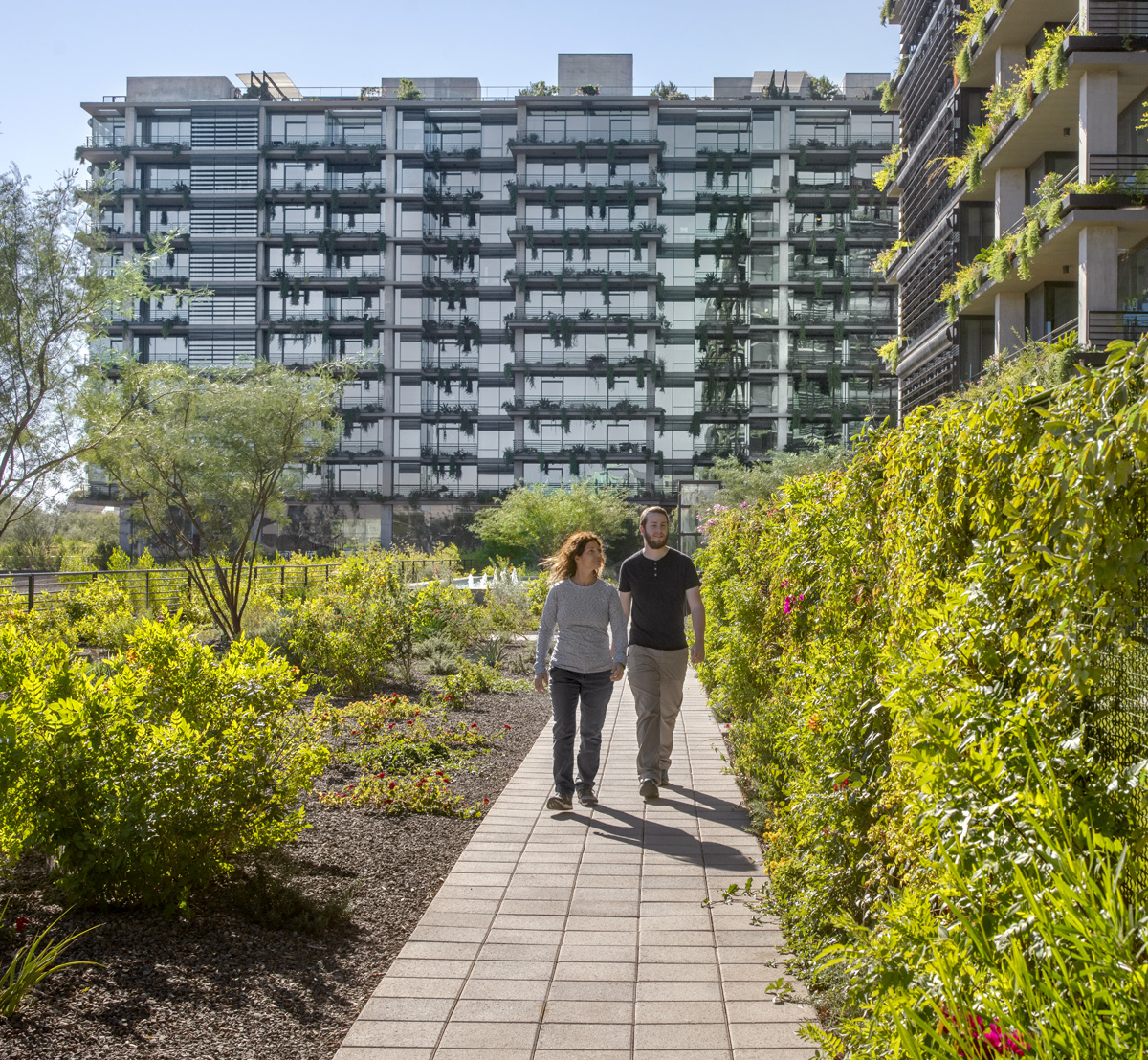
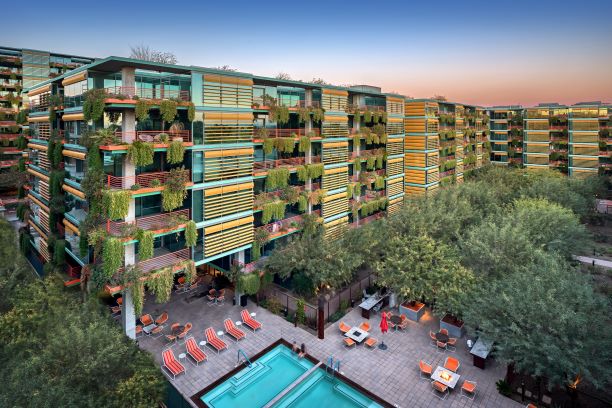
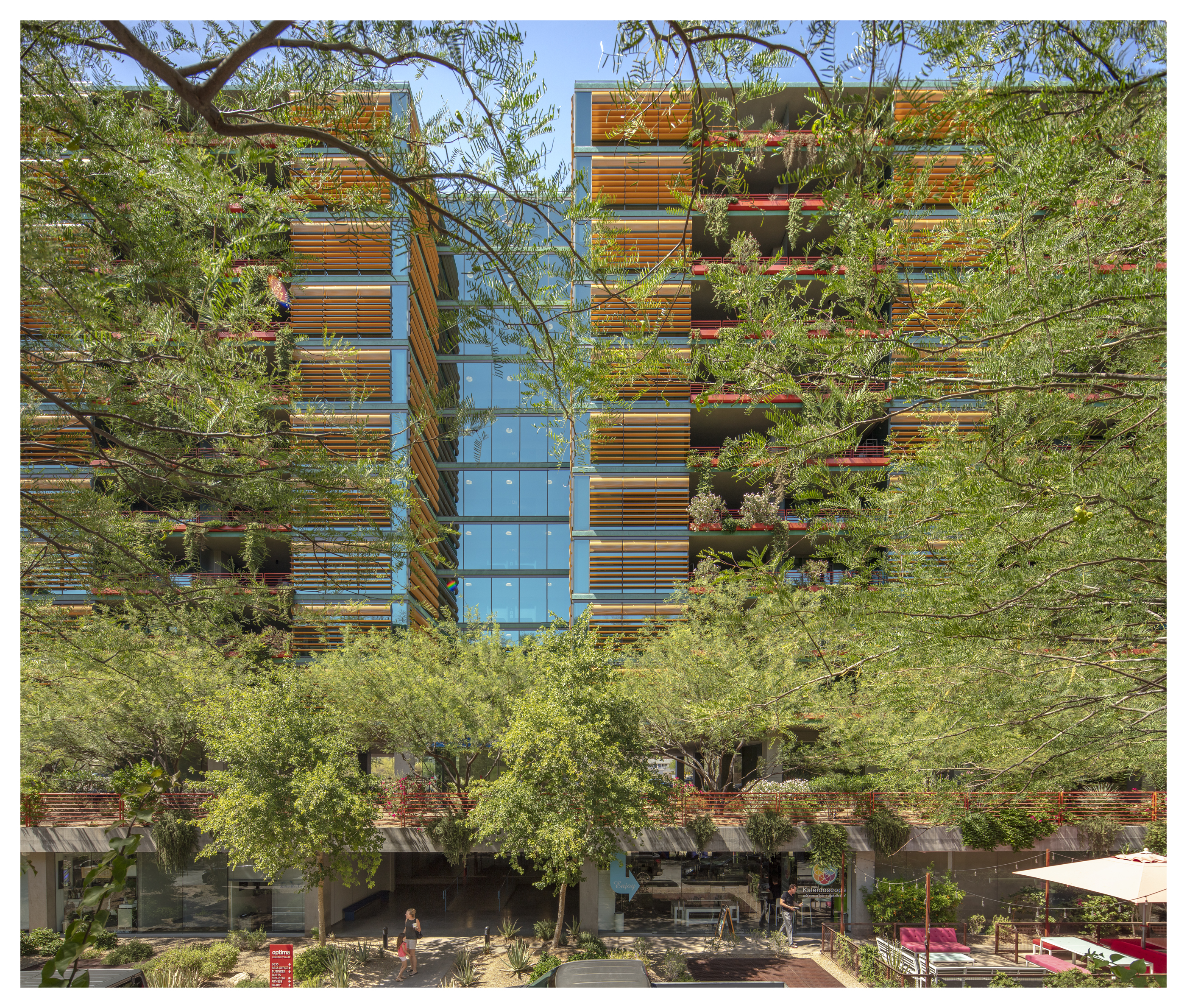
Optima Sonoran Village in downtown Scottsdale has five residential towers set around landscaped courtyards with views of Camelback Mountain. Each apartment has plant-fringed balconies that add to the greenscape.
A stint working at The Art Institute of Chicago sparked David Hovey Sr.’s love of contemporary art and his own work as a sculptor, including “Kiwi,” which graces an Optima project in Chicago.
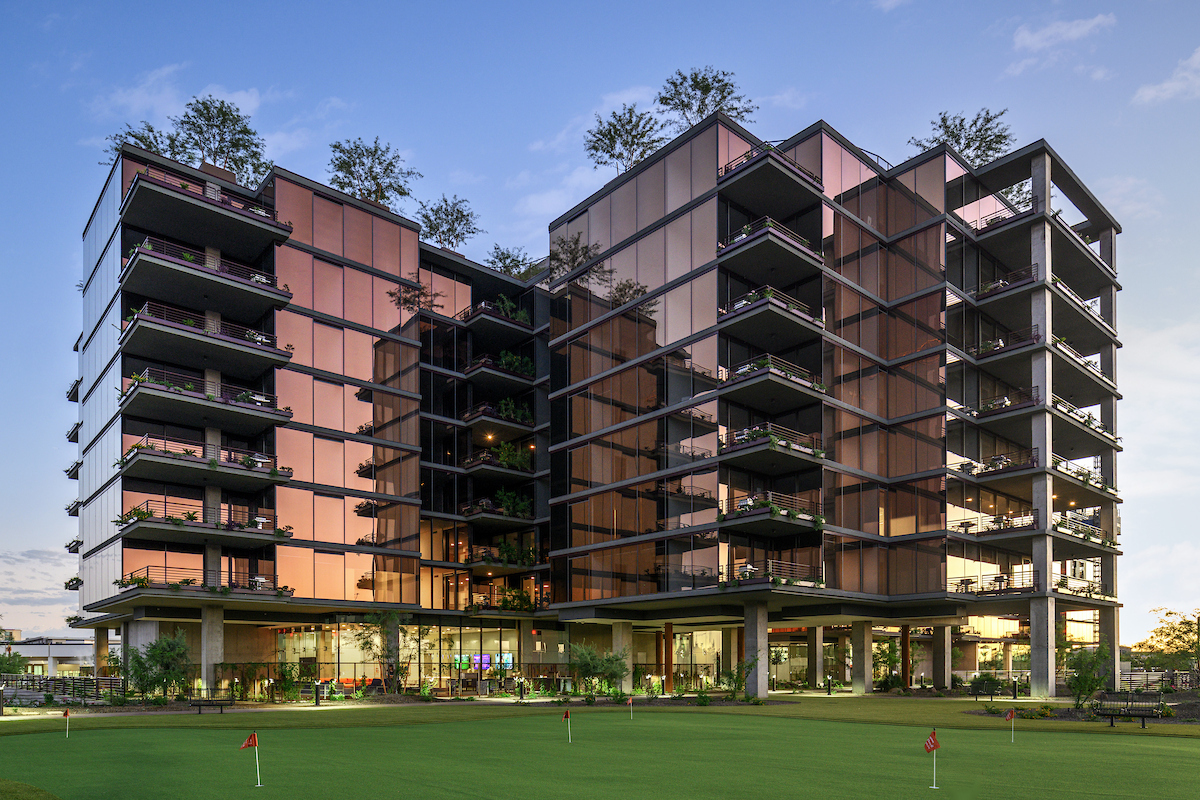
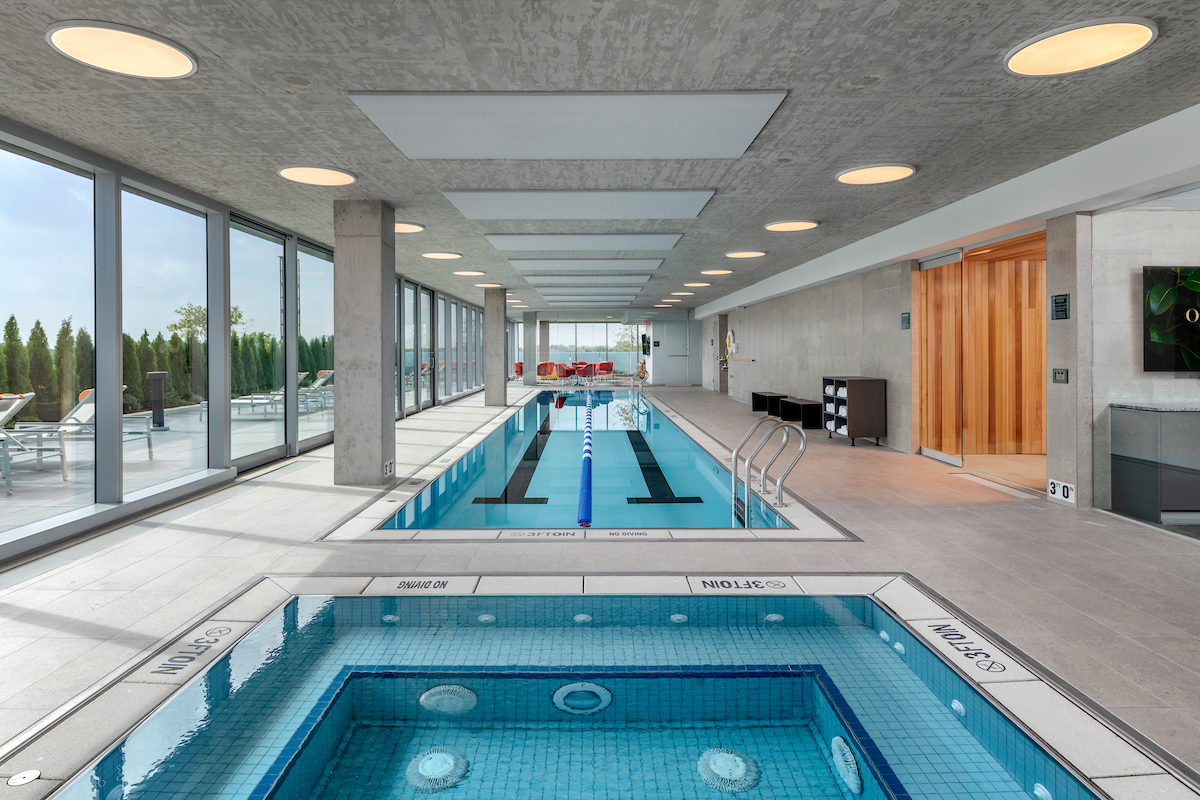
Optima Kierland Center, the Hoveys’ most recent project, is a series of condo and apartment dwellings offering luxe amenities, including cooling landscaping, rooftop pools and running tracks, a golf simulator and a dog “spa” for washing pooches.
In the heart of the Camelback Corridor, Biltmore Towers was the Hoveys’ first foray into the Arizona multifamily market and featured unique design elements, such as recessed balconies, red trellises and orange sunscreens.
Optima Verdana in suburban Chicago includes retail offerings at street level and apartments above.
The Camelview Village condo development put Optima on the local design radar, with innovations such as landscaped balconies and open space, as well as an edgy, modernist design. According to architect and Scottsdale’s green building head, Anthony Floyd, both David Hovey Sr. and David Hovey Jr. lived in units on site. “That’s what I call proof of concept,” says Floyd. “They could see what worked—and what didn’t.”
In downtown Chicago, Optima Signature and Chicago Center includes 42- and 57-story towers, with forms, details and colors inspired by Russian painter Kazimir Malevich and American artist Donald Judd.
Also in Chicago, the Lakeview project features indoor open space as a response to the climate.
“Curves and Voids,” a sculpture by David Hovey Sr., graces the gardens at Sonoran Village.
“Our single-family homes are experimental. They are our ‘Case Study’ projects from which we take ideas and apply them to our multifamily work.”
A cornerstone of community design at Optima Inc. is including green space to seamlessly connect residents to nature. Numerous studies suggest that contact to nature has positive effects for human physical and psychological well-being.
At Optima Kierland Center in Scottsdale, Arizona, a development of luxury rental and for-sale residences, residents have access to lush rooftop landscaping, an outdoor Zen garden and 5.5 acres of lushly landscaped courtyards with fountains.
A multiphase development project, each building within Optima Kierland Center is connected to the others through aesthetic structure and physical pathways amid lush gardens. Within the building, an innovative vertical planting system features self-containing irrigation and drainage, including vibrant and colorful planters at the edge of each floor. The system ultimately culminates into a beautiful rooftop garden.
At Optima Sonoran Village in Arizona, 60 percent of its grounds are open space that not only mediate the harsh desert climate but also create visually stunning landscaped areas to be enjoyed by residents and the community. A Kaleidoscope Juice Bar with patio seating is also on site.
In Chicago, luxury rental tower Optima Signature offers residents and the surrounding Streeterville neighborhood access to a tree-lined public plaza near its front entrance with a short walk to the lakefront and the Riverwalk.
U.S. population growth is slowing and expected to continue declining over the next decade. At the same time, demand for multifamily rental units continues to be robust, a trend Fannie Mae predicts will continue over the long term.
Can both things be true at the same time? They can, say the professionals who keep a close watch on the demographic trends shaping the multifamily industry. Shifting demographic factors—including delayed household formation, aging renters, and lifestyle-driven mobility—are redefining who rents and why. And as developers and investors grow more savvy about parsing their rental pool and technology makes it easier than ever for REITs to align their portfolios using artificial intelligence (AI)-driven demographic strategy, they’re rethinking everything from geographical choices to unit mix to amenity strategies.
Younger generations are waiting longer to form households—the average marriage age has increased more than four years since 1990—while housing costs are driving outsized demand for rentals, says Roberto Casas, senior managing director for JLL. That means the renting population now spans a larger age demographic than it ever has, and this has been a big factor in pushing multifamily from 0% of the Open End Diversified Core Equity Index in 1980 to 32% today, he says.
“Aging demographics and structural changes, such as delayed marriage and a rise in the share of single households, are the biggest changes we’ve come across in both our proprietary data as well as third-party data sources,” says TJ Parker, senior vice president of market research and data analytics for multifamily investment and management firm Bell Partners. “On demographics, we are seeing a flattening of the curve across age cohorts, which means demand is spread out across both younger and older age cohorts.”
As mortgage rates decline, some millennials and Gen Zers will leave the rental market to buy homes, Parker says, but, at the same time, Bell is seeing more demand from older renters who are choosing the convenience of renting over the upkeep of owning a home. “But, of course, real estate is very local in nature,” she adds. “The demographic composition may vary widely across communities and different Bell markets, which adds complexity in terms of providing services that cater to those needs from a property management perspective.”
For Mary Cook, president of Chicago-based design firm Mary Cook Associates, getting demographics right means looking beyond things like average age and income. Cook’s team susses out “the who” of new projects by exploring the area’s key employers, figuring out where people are migrating from, and visiting nearby retail stores and coffee shops.
Cook says she realized, for example, that her design for a property located between Harvard University and the Massachusetts Institute of Technology in Cambridge, Massachusetts, had better be next-level tech savvy when she stumbled across a neighborhood coffee shop with an electric board that displayed how long her order would take based on an algorithm tracking how many people were in the store. For a property in Princeton, New Jersey, proximity to a pharmaceutical company that employed many people from East India prompted Cook’s team to include lock boxes in the mailroom for passports, visas, and green cards.
“The ‘who’ is what informs every aspect of our design, the strategy behind how we dedicate space, and how we prioritize space,” Cook says. “The aesthetic ends up coming last.”
Gen Z: Renting as a Lifestyle
On a macro level, Gen Z—which now comprises 27% of the workforce and 30.5% of all renters—is driving the rental market. Because this cohort had the unfortunate timing of starting their professional lives just as housing costs soared to unattainable levels, about 85% of them are renting, says George Ratiu, vice president of research for the National Apartment Association.
But young adults aren’t renting simply because they can’t afford to buy. Many simply prefer it. In a June poll, Entrata and Qualtrics found that 72% of Gen Zers said they believe renting is financially smarter than owning a home, 83% said renting helps them save for other priorities, and 37% said they prefer the ease of on-call maintenance over the burdens of home ownership.
This generation is also geographically nimble, much more willing than older generations to move in search of a better or more affordable lifestyle. They’ll pay a little more to live in walkable neighborhoods with parks, coffee shops, and restaurants, and they’re flocking to smaller, more affordable metros in the Midwest like Ann Arbor, Michigan; Lincoln, Nebraska; and Des Moines, Iowa—places their parents fled.
Developers are responding to Gen Z demand in these cities with amenity-rich properties in downtown hubs. In Des Moines, Double Eagle Development is building a $50 million, 202-unit complex on an urban infill site near restaurants and a growing entertainment district. In Ann Arbor, 4M recently opened a 216-unit, mixed-use mass timber complex powered by a natural gas fuel cell system and other environmentally friendly features that appeal to climate-conscious Gen Zers.
In addition to location and sustainability, these new developments are targeting tech-native, wellness-oriented Gen Zers with amenities like lightning-fast connectivity, coworking accommodations, and social spaces and programming that build belonging and address mental and emotional well-being. To counteract the amount of time this generation spends on screens, Cook says, Gen Z-focused properties “need to be really activated with all sorts of activity rooms to keep people more engaged with each other.”
Projecting a highly curated, authentic spirit, The Sadie in Fort Worth, Texas, targets those who not only appreciate art and culture but live it in their everyday lives. (Interiors by Mary Cook Associates, developed by Toll Brothers Apartment Living )
Not Your Father’s Senior Housing
Gen Z is not the only flexible, mobile, and digitally fluent generation to embrace renting. Their parents and grandparents—baby boomers—are chasing many of the same amenities, including walkability, access to transit and public services, and climate-responsive and resilient design. As such, boomers have become a desirable growth market for luxury properties.
Make no mistake—the number of 80-plus renters is growing at ever-accelerating rates, pushing net absorption for senior housing to record highs. But Doug Ressler, manager of business intelligence for Yardi Matrix, points out that the pool of potential tenants for senior housing is limited to people who can afford the high price of assisted living. Younger seniors who can’t see themselves moving into age-restricted, health care-oriented housing until they’re 85—if ever—are a ripe market, Ressler says.
Adults in the 65 to 85 age range often have pets and may still be working. They want space, but they don’t want the hassle of maintaining it, which is why they’re a driving force in the growing build-to-rent single-family rental market, Ressler says. They’re also not averse to living among young adults in apartment complexes. “The nature of generational conflict is not near where it used to be,” he says.
“Boomers and Gen Z actually cohabitate pretty well,” Cook says, “because you don’t have the kid factor.”
This trend started to emerge in the early 2010s, when developers who built Class A urban apartments to capture affluent millennials realized a lot of baby boomers were moving in, too, says rental housing economist and consultant Jay Parsons. “That demographic is not necessarily looking for something that’s geared toward a senior adult,” he says. “They’re maybe looking for something that makes them feel younger.”
“Renting has become an increasingly popular option for active seniors who aren’t interested in age-restricted housing but seek a maintenance-free lifestyle in an accessible building,” says David Hovey, president of Optima, a company that designs, develops, builds, and manages multifamily communities in Arizona and Illinois. “With single-level homes and residences with elevators in particularly high demand and short supply, luxury rentals offer a practical and appealing solution with the flexibility and peace of mind to age in place.”
With the number of renter households headed by people 65 and older increasing by more than 1 million between 2019 and 2024, according to a Harvard University Joint Center for Housing Studies report, boomers are lucrative at both the luxury and affordable ends of the market.
“With the oldest baby boomers turning 80 in 2026—an age when more people turn to renting—a wider range of affordable rental options for older adults will be required to accommodate their changing needs,” the report states. “Renting will be an especially attractive option for older adults who want to age in their community, reduce their maintenance responsibilities, and access the shared spaces for social interaction and accessibility features more common in multifamily buildings.”
Optima, a developer based in the dry climate of Arizona no less, has come up with a vertical planting system that has self-contained irrigation and drainage so plants can grow up and over the side of the building. This provides a natural shading system while also creating cleaner air and decreasing the excessive temperatures so common to Arizona. Vertical gardens are one part of their overall greening initiative which aims to be carbon neutral by 2030.
Earlier this year, rental housing economist and consultant Jay Parsons parsed renter data released by multifamily REITs and found income levels rivaling those of middle-class homeowners—Equity Residential reported typical renter income of $169,000; Essex Property Trust, $131,000; and Camden Property Trust, $120,000—and rent-to-income ratios ranging from 19% to 22%.
This data proves that developers and policymakers need to update their perceptions about who today’s renters are and why they rent, Parsons says. “The bottom line is that there are a lot of people who are making good incomes and want to be renters.”
The Harvard University Joint Center for Housing Studies found that the number of renter households with incomes of $75,000 or more has risen 43%, to 13.5 million, since 2010. The number of affluent renters is also growing in 35 of the 50 most populous U.S. metros, according to a Redfin analysis of the U.S. Census Bureau, MLS, and county records. In San Jose, California, and Orlando, Florida, about 11% of renters are wealthy; in New York and Seattle, approximately 10% are, the analysis found.
Jessica Perri, marketing director for residential property developer and manager Habitat, says the assumption that people see renting primarily as a transitional phase before homeownership has shifted. More residents are choosing to rent long term because it better aligns with their financial goals, lifestyle, and desire for flexibility, she says.
“This shift has challenged us to think beyond traditional property management and to create communities where renters can truly put down roots, build connections, and feel invested in where they live,” Perri says.
Optima president David Hovey says renters by choice are drawn as much by a sense of community as they are to concierge support, in-home package delivery, and private chefs. Optima is meeting those needs with things like expansive residents’ clubs, rooftop decks, and reservable guest suites.
“For many, what begins as a practical and often temporary decision to rent evolves into a long-term lifestyle preference,” Hovey says.
Imagine living in a private, beautifully designed community that feels as if it’s been created to fit your every need, providing all the convenient daily services and recreational amenities you could ever want and need. Instead of spending your busy day traveling between the coffee shop, the local gym, and a variety of other errands, you’ll be able to get everything done without ever leaving Optima Sonoran Village.
Optima Sonoran Village is surrounded by Scottsdale’s best shopping, restaurants, culture, arts, and nightlife. Everything within easy reach! When you’re ready to escape the hustle and bustle of the city, you’ll be welcomed home with lush landscaping, sweeping views, thoughtfully designed spaces, and unmatched community amenities.
Residents at our rental community know that contrary to popular belief, you really can have it all – and it’s all waiting for you here. View our luxury one-bedroom floorplans, two-bedroom luxury apartments, three-bedroom floorplans, and luxury studio apartments that are all designed with large outdoor living spaces with floor-to-ceiling windows showcasing gorgeous views. Each apartment includes stainless steel appliances, including a washer and dryer, as well as granite countertops, a modern design, and indoor garage parking.
The new tower at Optima Sonoran Village is the final addition to our community, offering the best in upscale residences and high-end apartment amenities in Scottsdale. Every detail has been considered in the design of this luxury tower, redefining the concept of luxury apartment living. This exclusive tower consists of large, contemporary homes that feature extensive outdoor living areas, going above and beyond the traditional balcony. First-floor units have spacious patio areas and landscaped yards, providing residents with an incredible amount of outdoor space to enjoy the beautiful Arizona weather.
Optima Sonoran Village is now fully complete in Downtown Scottsdale. Developer Optima has completed the final phase of the community, a luxury five-tower apartment community with 768 residences.
The property has leased 77% of its units. Located on the southeast corner of 68th Street and Camelback Road, the now completed Optima Sonoran Village features studio, one-, two-, and three-bedroom luxury apartment homes ranging in size from 776 to 2,089 square feet with rents starting from the $1,700s to over $5,000 per month.
In addition to completion of the apartment community, Optima also launched its new white-glove, in-home concierge program, Optimized Service, at all its Arizona rental properties.