Chicago Skyscraper History: the Merchandise Mart

Chicago has earned its place on the architectural map with endless distinctions, including being home to the tallest building in the world for 25 years and to numerous acclaimed architects like Mies van der Rohe, Frank Lloyd Wright, Marion Mahony Griffin and Jeanne Gang. But did you know that it’s also home to the world’s largest commercial building? Today, we’re taking a look at the history of the city’s beloved Merchandise Mart

How It Came to Be

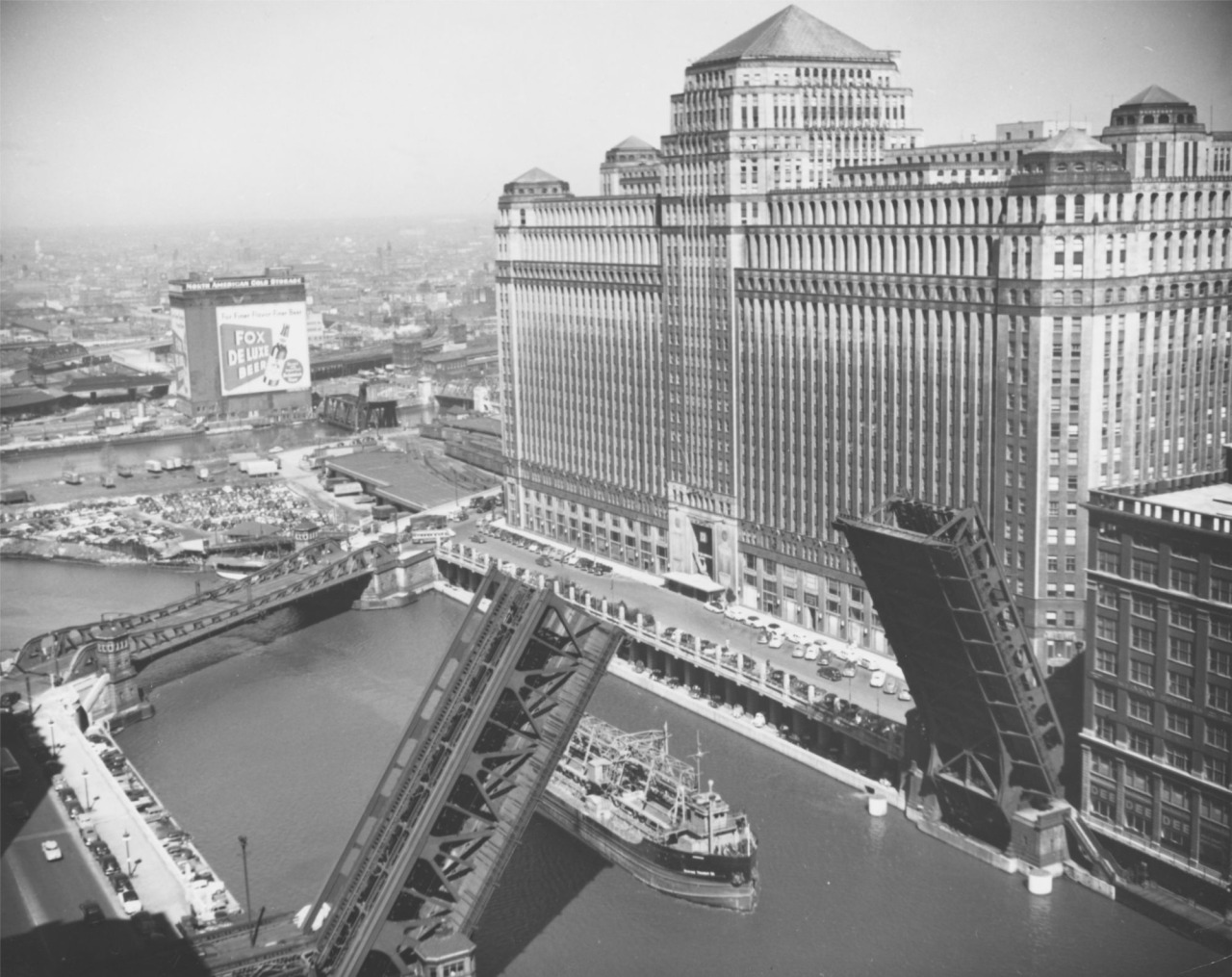
As dated infrastructure (like the abandoned railroad yards in the downtown area) proliferated in the early decades of the 20th century, more and more land development opportunities opened up. In hopes of beautifying the frontage along the Chicago River, Marshall Field & Co. announced their purchase of one of the largest available sites, at the junction of the River’s branches. The company began construction in 1928 and when the Merchandise Mart opened in 1930, it achieved the company’s dream of becoming a dedicated wholesale center for architectural and interior design vendors and trades serving the entire nation. And, with 4 million square feet on 25 floors under a single roof spanning two city blocks, it became the largest building in the world.

TheMART was imagined as a city-within-a-city. Graham, Anderson, Probst & White, the architects behind the structure’s streamlined look, took inspiration from traditional Art Deco architectural elements, including ribbon piers to define windows, setbacks and pavilions atop each corner to disguise the bulk of the building. Marshall Field himself was involved in the building’s design; his love for art inspired him to employ Jules Guerin to create 17 murals on the interior lobby’s frieze. Each mural details trade throughout the world and depicts the products, transportation and architecture of 14 countries.

TheMART was also a monumental experiment in state-of-the-art engineering and modern materials. At a cost of $26 million, it took advantage of construction techniques normally used in the building of big dams and employed nearly 5,700 workers at the height of the Great Depression.

theMART in the Modern Era

Throughout the latter half of the 20th century, theMART faced a handful of modernization projects. One was designed by Helmut Jahn to connect the building with the Apparel Center located across Orleans Street with a pedestrian bridge. The building was LEED Certified Silver in 2007, followed by LEED Gold Certification in 2013 and in 2018.

In recent years, as the contract furniture industry has evolved from a focus on a wholesale hub and independent manufacturer showrooms, the Mart has repositioned itself as a destination for innovation, creativity, technology and entrepreneurship. Rebranded “theMART,” the building remains the world’s largest commercial building, and has become home to a host of changemakers, including Motorola Mobility, 1871, Yelp, PayPal and MATTER, as well as Fortune 500 companies Conagra, Allstate, Kellogg, Beam Suntory, and Grainger.
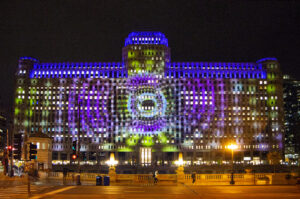
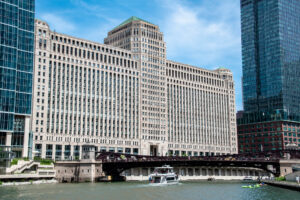
Art on theMart, Art Institute of Chicago’s exhibition, Monet and Chicago, April, 2021
Merchandise Mart
Merchandise Mart. Credit: Brandon Olafsson on Flickr Creative Commons CC BY 2.0 Deed

Today, theMART continues to celebrate an appreciation for architecture and art. The building now hosts a digital art display popularly known for “Art on theMART,” to showcase the work of prominent artists on the south façade of the structure. 

With our love for all things “forever modern” at Optima, we are proud to have this magnificent example of design innovation and tireless reinvention in our midst.
Exploring Lakeview’s Theatre District

Lakeview’s deep appreciation for the arts and support for its thriving creative community are just some of the many reasons we love the neighborhood. In anticipation of Optima Lakeview’s upcoming opening, we’re taking a walk through one of the community’s most vibrant sectors, the Belmont Theater District

Star-studded Location

A collaboration between the Lakeview and Lakeview East Chambers of Commerce in partnership with local theaters and businesses, the Belmont Theater District functions as a critical supporter of the immense talent that calls the Lakeview community home.

Located in the heart of Lakeview, the theater district pulses with lively energy through more than 20 theaters that line the streets surrounding Belmont Avenue. Its prime location is within walking distance to hundreds of shops and restaurants, making it the perfect spot to spend quality time with friends, family and everyone in between. The historic venues, some of which are nearly a century old, all bring their own unique contributions to the theater district. 

Standout Performances

With more than 100 live shows every week, visitors can find everything from world-class performances to hole-in-the-wall comedy shows. In the midst of this abundance and variety, the Belmont Theater District — the largest theater district in Chicago — is home to a few showstopping venues and performances that stand out from the rest. 

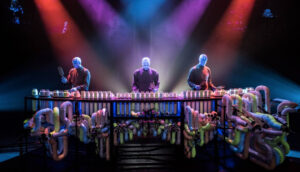
The Blue Man Group performing at the Briar Street Theater.
The Blue Man Group performing at the Briar Street Theater

One of the neighborhood’s most beloved venues, the Briar Street Theater has provided a constant source of entertainment since its opening in 1985. The renowned theater has hosted several famous guests, including Sada Thompson and Dorothy Loudon, and displays artwork created by Van Gogh and Picasso. Since 1997, it has been the home to the iconic Blue Man Group act, which continues to delight audiences of all ages with its stage productions that incorporate many kinds of music and art, both popular and obscure.

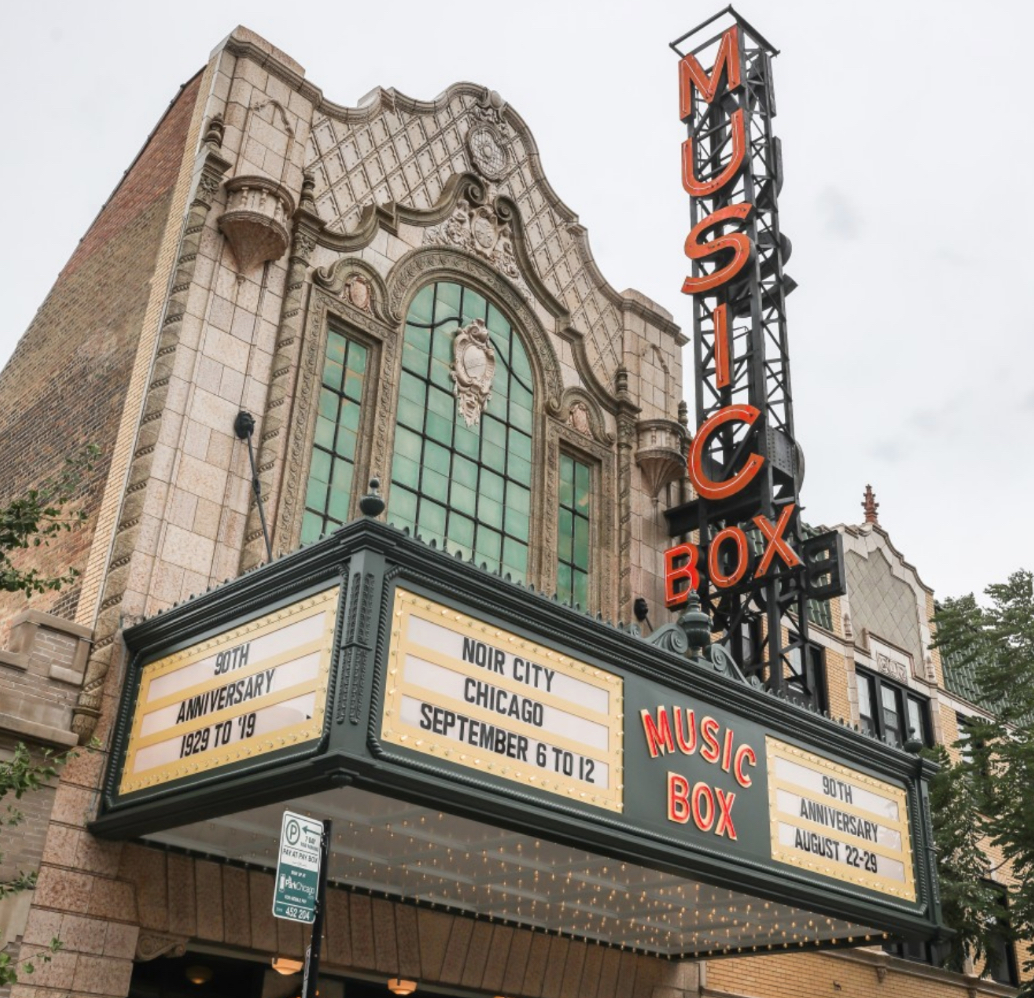
The Music Box Theater found on North Southport Avenue has been standing for nearly a century, making it one of the oldest theaters in the neighborhood. The venue originally opened as a single-screen theater playing everything from independent films to Spanish and Arabic language films. Today, the ornately-designed theater operates as an art-house and revival cinema and is recognized as the largest full-time operating film theater in Chicago. 

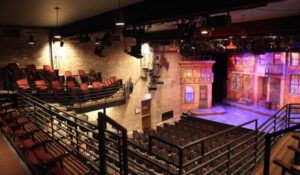
The interior of the Mercury Theater, Courtesy of the Mercury Theater

Other iconic venues in the community include The Playground Theater, which showcases the Chicago-born art form of improvisation, and Mercury Theater, where melodramatic musicals and plays ranging from Sister Act to Clue are enjoyed by all. 

With a shared appreciation for the arts and community, we couldn’t be more excited to become an official member of the Lakeview community and can’t wait to explore more of the charismatic neighborhood.

Lakeview’s Holiday-Themed Pop-Ups

With the holiday season comes vibrant lighting, extravagant decorations and joyful crowds. And in these gleeful times, Lakeview is one of the best neighborhoods to partake in festive celebrations. The annual Wrigleyville Wonderland, Chicago’s largest pop-up event, draws visitors from near and far, but Optima Lakeview residents and those living in the area have prime access. 

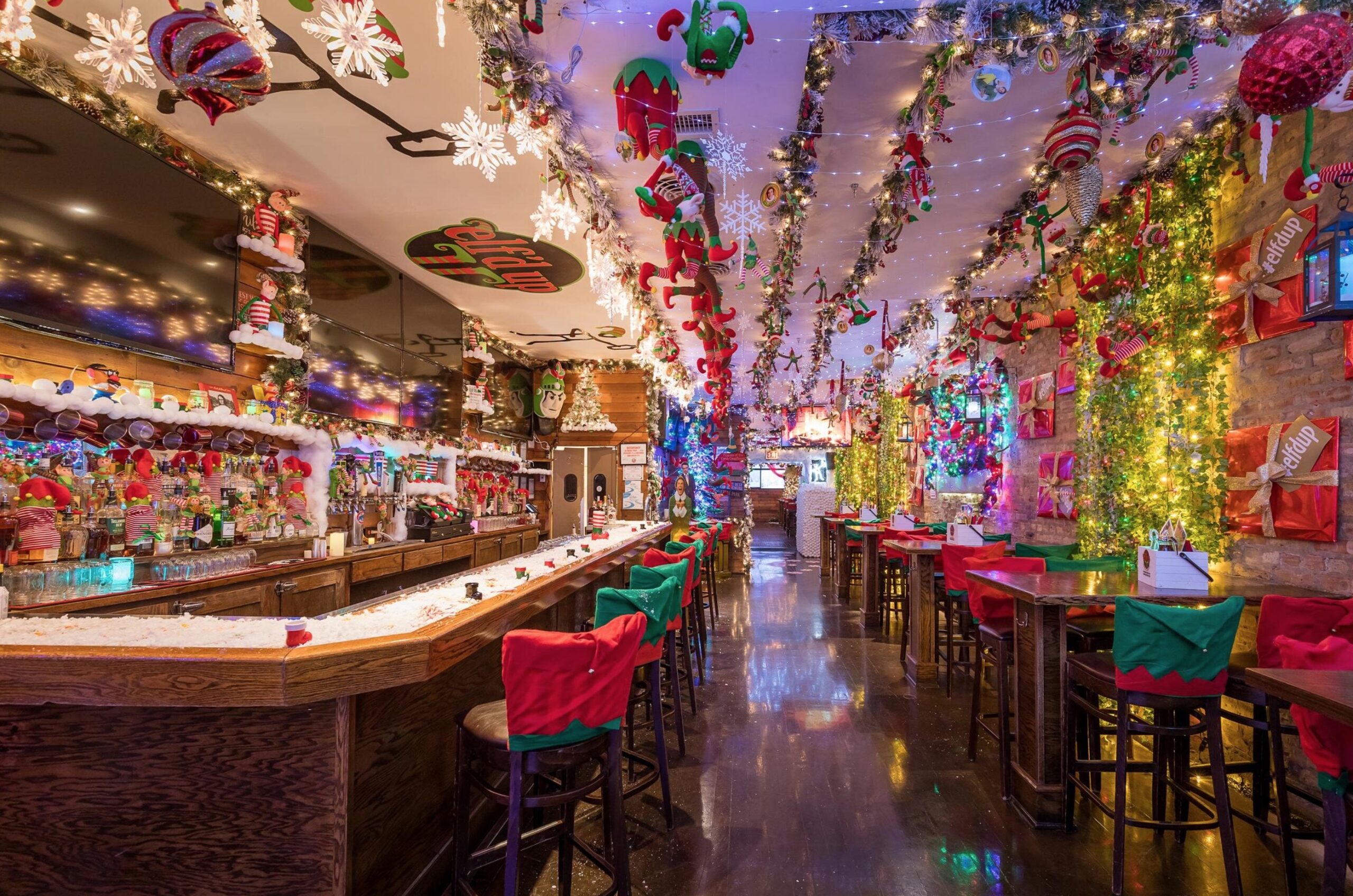
The beloved tradition returns this year to celebrate the holidays with 20 show-stopping Lakeview locations. Each bar brings its own unique twist on a festive theme. Visitors are promised fully decorated spaces filled with costumed performers, cheery music and holiday-inspired food and drinks throughout the season.

The participating bars will be sure to fulfill your craving to celebrate the holidays over the next few weeks and some long after the start of the new year. Check out the list of Wrigleyville Wonderland’s participants below:

  • The Country Club, 3462 N. Clark St., its original holiday pop-up runs through Feb. 1.
  • Deuces, 3505 N. Clark St., Santa Baby Christmas Bar runs through January.
  • Diver at the Park, 3475 N. Clark St., promises a Tulum holiday inspired experience.
  • Gallagher Way, 3635 N. Clark St., featuring Wrigleyville’s Christkindlmarket.
  • The Graystone Tavern, 3441 N. Sheffield Ave., a Hanukkah themed pop-up, running through Jan. 2.
  • Houndstooth Saloon, 3369 N. Clark St., inspired by the famous Griswold family, running through Jan. 10.
  • HVAC Pub, 3530 N. Clark St., the holiday pop-up runs through Jan. 15.
  • The Irish Oak, 3511 N. Clark St., a mash-up of St. Patrick’s Day and Hanukkah, Leprechanunaka,.
  • Wrigleyville Kilwins, 3519 N. Clark St., serving its 25 Days of Chocolate pop-up through Dec. 31.
  • Lucky Dorr, 1101 W. Waveland Ave., the festive Lucky Lodge pop-up is open through Dec. 31.
  • Moe’s Cantina, 3518 N. Clark St., inspired by the beloved holiday classic The Grinch and Whoville. 
  • Casey Moran’s, 3660 N. Clark St., has transformed into Rudolph’s Christmas Bar, open through Dec. 30.
  • Mordecai, 3632 N. Clark St., the annual holiday pop-up bar, Mistletoe, runs until Dec. 30.
  • NOLA Bar & Kitchen, 3481 N. Clark St., its Very Cajun Christmas pop-up runs through Jan. 20.
  • Old Crow Smokehouse, 3506 N. Clark St., featuring a festive Santa’s Workshop pop-up.
  • Rizzo’s Bar and Inn, 3658 N. Clark St., the holiday-themed pop-up features local singer John Vincent at 7 p.m. Thursdays and 5 p.m. Sundays through Dec. 30.
  • Roadhouse 66 Gas N’ Grill, 3478 N. Clark St., the Jingle Junkie pop-up is open through Jan. 8. 
  • Stretch Bar & Grill, 3845 N. Clark St., its Elf’d Up pop-up runs through Jan. 8.
  • Underground Lounge, 952 W. Newport Ave., inspired by the Island of Misfit Toys, the pop-up is open through Jan. 31.
  • Vines on Clark, 3554 N. Clark St., the holiday pop-up transports customers to an Apres Ski vacation.
The Graystone Tavern’s Hanukkah themed pop-up features traditional food and drinks options with a twist

With Wrigleyville Wonderland officially open for the season, don’t miss out on savoring the delicious festive food and drinks served at each immersive location. While some of the pop-ups run through February, others will end with the beginning of the new year. And, due to the popularity of the favorite tradition, many of the participating businesses are reservation only, so make sure to check their availability before making plans for a fun evening out. 

Chicago’s Christkindlmarket

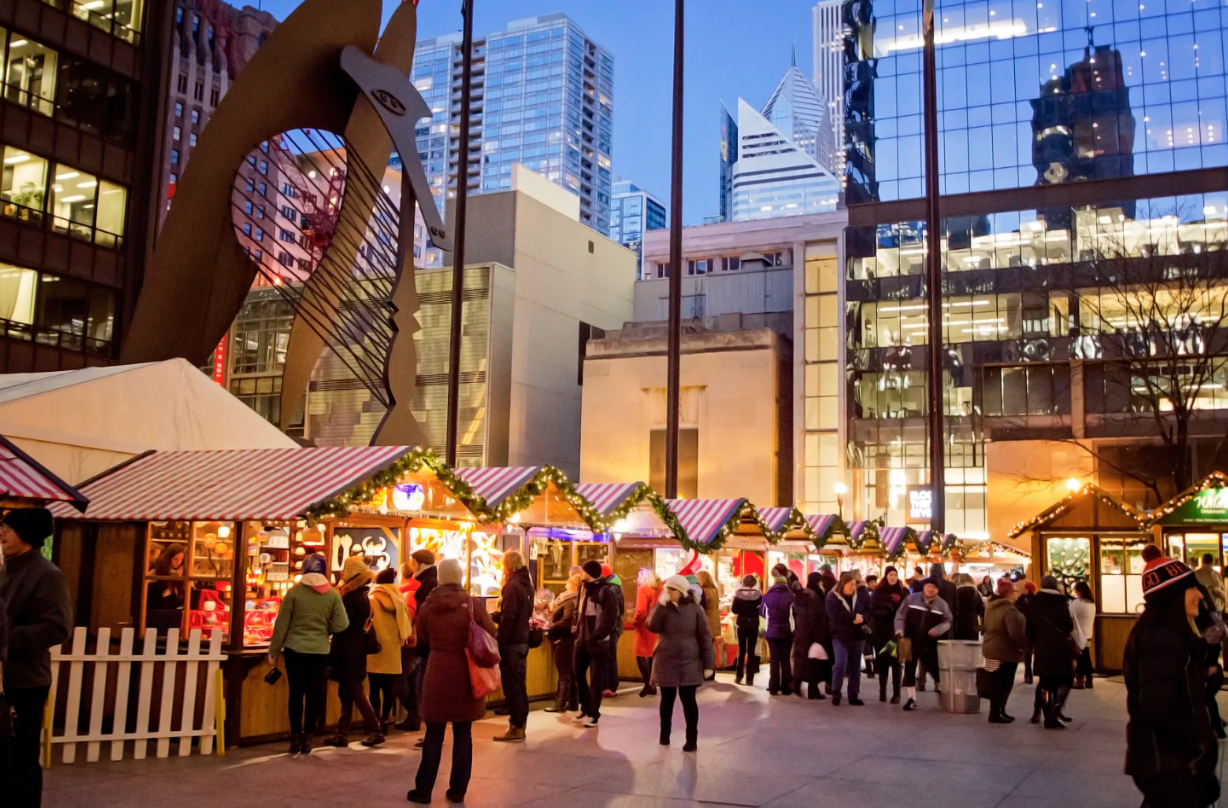
One of the city’s most festive traditions, Chicago’s Christkindlmarket, is celebrating its 25th anniversary this season. The holiday favorite celebrates culture and is beloved by locals and tourists alike. And, since the celebration can be found in two locations this year, at Daley Plaza downtown and Gallagher Way in Wrigleyville, residents at Optima Lakeview and Optima Signature have prime access to the festivities just blocks away from their door.

History

Visitors have flocked to Chicago to visit the Christkindlmarket since its founding in 1996, and today, the festival attracts more than one million visitors every year. The unique outdoor market takes inspiration from one of the first outdoor exchanges of its kind from 16th century Nuremberg, Germany, which shares its namesake. 

The festival embraces its Germanic heritage and brings international charm to a local scale. Traditional architecture mirroring the original outdoor markets is key to the Christkindlmarket locations, and transports visitors into a winter wonderland. Entangled in the classical architecture are ropes of vibrant lighting, garland and other merry trimmings, giving the market an extra spark of life. 

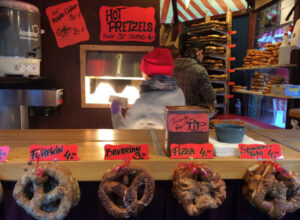
Crowd favorite hot pretzels at the Christkindlmarket, Courtesy of Benita Gingerella

Visiting

For those who make the trip to Chicago’s Christkindlmarket for its 25th anniversary, expect a lively environment in both locations — abundant in holiday spirit, jovial music, festive activities, eccentric shops and traditional cuisines. 

At the market’s Daley Plaza location, an alpine-themed heated dining area allows guests to unwind and feast on delicious foods and drinks from various food trucks, including German beer, brats, pretzels, Belgian hot chocolate and apple strudel, among others. Wrigleyville’s Christkindlmaket brings even more seasonal festivities — some traditional and some less so — with its ice skating rink, ice bumper cars, curling, holiday movies, wreath-making workshop and other curated activities.

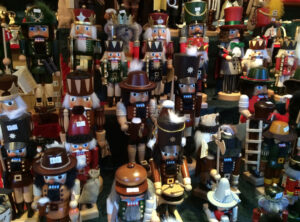
Handcrafted nutcrackers fill a vendor’s stand, Courtesy of Benita Gingerella

Exclusive vendors, both local and international, also fill the grounds at each location, selling their own authentically made gifts. Everything from intricately-carved nutcrackers to hand-knitted mittens can be discovered within both markets. 

A truly transformed landscape, Chicago’s Christkindlmarket is the perfect tradition to take part in this winter, whether you find yourself downtown or in Lakeview. Regardless if you’re searching for an entertaining winter activity, uniquely crafted gifts for family and friends or just looking to take in the crisp winter air, consider this your one-stop-shop. 

Daley Plaza’s market is open through December 24 from 11 a.m. – 8 p.m. most days, and Wrigleyville’s market is open through December 31 from 3 p.m. – 9 p.m. most days.


Winter Activities in Chicago

Although winter routinely draws the wrath of Chicagoans and visitors alike, it also brings an abundance of joy and entertainment for all. Chicago residents, especially those at Optima Signature, are particularly fortunate, with convenient access to some of the city’s most sought-after activities and venues. Here are just a few of the many ways you can experience the best of winter in the city. 

Daytime Agenda

There is no better way to start your morning than with an invigorating walk along the lakefront, where Chicago’s crisp air will stir your senses. You’ll be dazzled by the views of a snowy Chicago skyline that showcases many of the city’s architectural achievements — including John Hancock Center, St. Regis Chicago, the Mies van der Rohe buildings at 860–880 N Lakeshore Drive and more. And the spectacular sight of towering ice chunks piling up along the Lake Michigan shoreline is not to be missed.

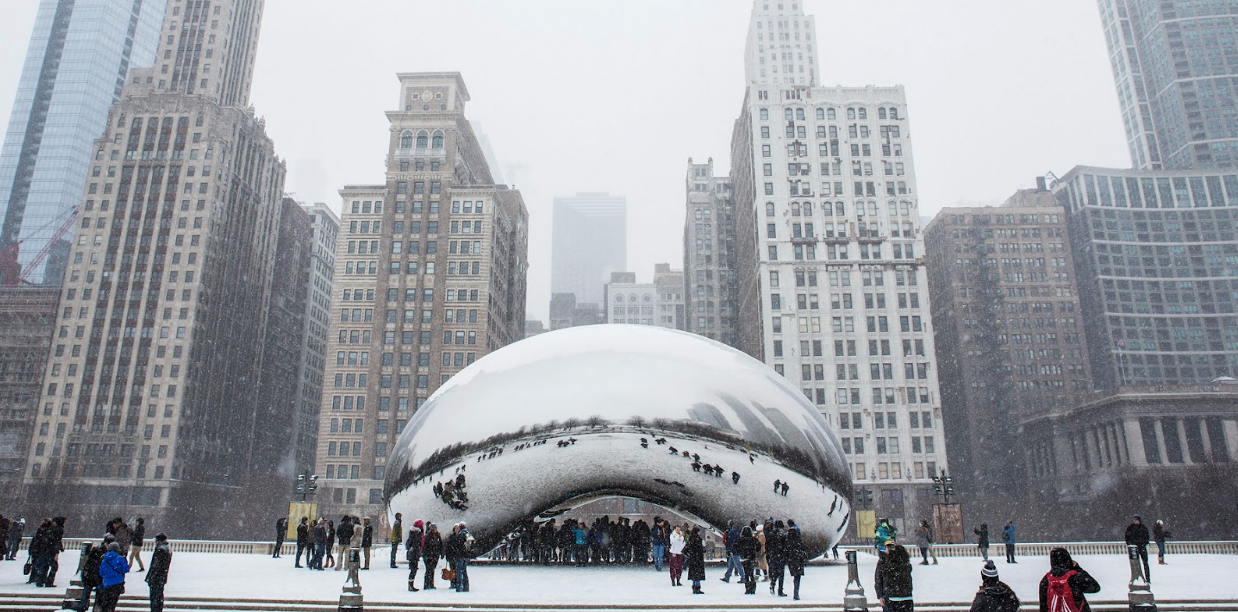
We recommend your morning route takes you to Millennium Park. This iconic Chicago park lights up with vibrant colors and sounds during the winter months. Don’t miss out on winter musts like taking a snowy selfie at The Bean, or popping into the Art Institute to view one of the many blockbuster exhibitions on view.

The festive drinks at JoJo’s Shake Bar

If you’re searching for a unique ice skating experience this year, make your way to the famous Peninsula Hotel, which is only a few blocks north of Optima Signature. Explore the hotel’s exceptional sky rink for the special experience of skating in the clouds of downtown Chicago, surrounded by the city’s skyscrapers and inspiring views. The one-of-a-kind experience is a kid-friendly activity too. If you bring your child, the proceeds for admission ($20 for adults and $10 for children) are donated to two Chicago children’s charities: Ann & Robert H. Lurie Children’s Hospital of Chicago and Hephzibah Children’s Association.

Once you’re ready for a warm-up, head a few blocks North and indulge in a Biggie Shake or a gourmet Hot Chocolate from JoJo’s Shake Bar. You can’t go wrong with any of their famous, over-the-top specialty drinks that are essential to experiencing the best of Chicago’s winter season. 

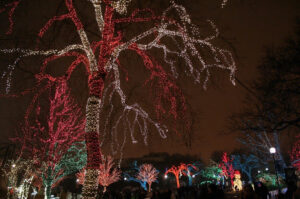
Trees are illuminated with vibrant colors at The Lincoln Park ZooLights experience

Evening Agenda

The fun doesn’t end once the sun goes down! There are countless evening winter activities throughout the city that you can’t miss this year. 

Of course, we can’t go without mentioning the legendary Lincoln Park Zoo Lights. Brighten up your night by strolling through the hundreds of holiday light displays. This year, the exhibition introduces new features, including an alluring Enchanted Forest experience and an 18-foot Christmas tree! The beloved holiday tradition runs until the beginning of January and costs $5 for admission, excluding Mondays and Tuesdays, which are free for visitors.

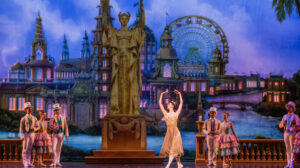
The Nutcracker at the Joffrey Ballet, Photo courtesy of Cheryl Mann

Finally, cap your night by seeing a production of The Nutcracker at the Joffrey Ballet. This is a Chicago must, as it celebrates the culture and history of the city. During the performance you’ll be transported into another world, serenaded by the orchestra’s performance of Tchaikovsky and wowed by the dancers’ performances. Tickets can be found on their website and the production runs from December 4–26, 2021. 

Chicago’s winter can feel long, so while you can, fill your days and nights with enthralling seasonal activities to brighten your spirit. We promise you’ll feel the magic.

Public Art in Chicago’s Lakeview Neighborhood

As we continue to explore the dimensions of Chicago’s Lakeview neighborhood that make it so unique and dynamic, we’re showcasing one of the community’s most significant ongoing projects, a thoughtful offering of public art to the city, the Lakeview Public Art Program

Because the Lakeview creative community has a long history of celebrating art and culture, even the most casual stroll through the neighborhood reveals an abundance of public art installations. And thanks to the Lakeview Public Art Program, the neighborhood is growing its collection of murals and sculptures, while hosting cultural events and other artistic happenings that support emerging artists. 

The Lakeview Public Art Program is run by the Lakeview Public Art Committee, a diverse group of volunteers responsible for finding forward-thinking, culturally-aware artists. Working in collaboration with Lakeview Roscoe Village Chamber of Commerce and Special Service Area (SSA) 27, the Committee supports and advances the non-profit Friends of Lakeview, an organization dedicated to improving and enhancing public streets and spaces, creating memorable experiences, and promoting the neighborhood.

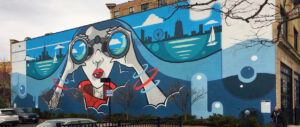
Many of the artists whose work has been commissioned by the Lakeview Public Art Committee are Chicago natives themselves, like Anthony Lewellen; you can see his mural titled Lake View in the geographical heart of the neighborhood, at the corner of 3241 N. Lincoln Ave. For this mural, the artist took inspiration from memories of growing up in Lakeview. This 4,000 square foot wall painting displays a girl holding binoculars looking at Lake Michigan with the rest of Chicago behind her. The girl personifies the neighborhood itself, as she looks toward a horizon of opportunity.

A mural painted on a the side of a brick building depicts a woman gazing onto Lake Michigan with the skyline of Chicago behind her.
Lake View, Anthony Lewellen, Courtesy of Lakeview Public Art Program

Another mural commissioned by the Committee is Felix Maldonado’s Bears on Parade, which can be seen at  3409 N. Ashland Ave. Maldonado drew inspiration from the fact that in the 18th century, this area of Lakeview was once inhabited by the Miami, Ottawa and Winnebago Native American tribes. Featuring a group of bears and cubs walking through a blue forest, this mural celebrates the neighborhood’s culture and history while also subtly referencing the city’s favorite sports teams. 

With Optima’s commitment to thought-provoking, inspiring art in and around our properties, we are proud to join the Lakeview neighborhood, and celebrate its commitment to public art and talented artists.

Romanticism to Ruin: Two Lost Works of Sullivan and Wright

Chicago is fortunate to have a rich architectural tradition. From the city’s first skyscraper built in 1885 to the transcending towers that look over the urban landscape today, architecture is at the forefront of Chicago’s role as a world-class city. At Optima, we are grateful to be part of an ecosystem that appreciates thoughtful and purposeful design. In the spirit of celebrating some of Chicago’s most prominent architects, we are delighted to see an exhibition at Wrightwood 659 that brings two magnificent lost buildings, designed by luminary architects to the public.

Romanticism to Ruin: Two Lost Works of Sullivan and Wright can be seen at Wrightwood 659, located just south of Optima Lakeview. This collection offers a glimpse into the rich history of two buildings designed by renowned architects Frank Lloyd Wright and Louis H. Sullivan. Though few connections are evident between the two structures at first glance, a deeper dive uncovers the rich relationship between the Garrick Theatre in Chicago and the Larkin Administration Building in Buffalo.

Photo of the Garrick Theatre
The Garrick Theatre, 1891, Photo courtesy of The Richard Nickel Committee and Archive

Reconstructing The Garrick

At the time of its completion in 1892, the Garrick Theatre, with a capacity of 1,300 seats, was among the tallest buildings in Chicago. Sullivan and his firm partner, Dankmar Adler, designed the exquisite structure to reflect the German heritage of its original investors, but made every development choice with careful thought for the theatre’s visitors. As the historic structure faded with time, its decline accelerated, and in 1961, amid much controversy and disagreement, the theatre was razed and replaced with a parking structure.

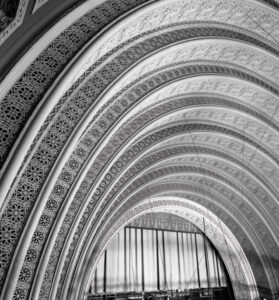
Reconstructing the Garrick uses stencils, fragments, drawings, photography and narrative to bring the lost architectural treasure back to life. Some of Sullivan’s most opulent designs for the Garrick included numerous terracotta portraits of well-known German men of the arts that protruded from the Theatre’s upper floors. Fragile ornamentation and vibrantly-colored plasters consisting of gold, jade and salmon, salvaged before and after the building’s demolition, are on view as part of the exhibition, offering access to delightful details of this grand structure that have been long-forgotten.

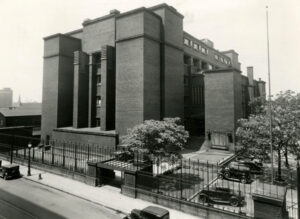
Photo of the Larkin Administration Building
Larkin Administration Building, 1934, Larkin Company photography collection

Reimagining the Larkin

Razed in 1906, the Larkin Administration Building, owned by Darwin D. Martin, was Wright’s first commercially-designed structure and allowed him to apply his innovative and pioneering techniques to a much larger scale. The building, designed and constructed for the Larkin Soap Company, was groundbreaking in its own right as a center where all of the company’s products were both manufactured and mailed. However, at the forefront of Wright’s mind was designing for workability.

Wright and Martin both understood that an ordered, well-lit and harmonious environment would champion the workers. The five-story red brick building included numerous modernized mechanics, including air conditioning, built-in desk furniture and suspended toilets. Wright designed most of the building’s furniture himself, and many pieces are on display within the exhibition. Deemed by critics and architects at the time as the finest commercial building in the world, the Larkin also seamlessly unified technology with the nature that surrounded it with its rooftop garden, recreation areas and water lily ponds.

Unlike the Garrick, after years of deterioration, there was little fight to save the Larkin. However, today both buildings hold greater significance than ever before. The Gerrick and the Larkin prove how transcendent architecture is defined not only by its material and look, but also by the lasting impression it stamps into history.

Romanticism to Ruin is currently open to visitors Fridays and Saturdays through the end of December 2021. You can reserve tickets to the exhibit here.


Ludwig Mies van der Rohe and His Role in the Chicago Skyline

Mid-Century Modernism defines the Chicago skyline. Organic forms rise from Chicago’s foundation and cast shadows across the Lake while innovative use of glass reflects waves of light onto the city streets. The Willis Tower, Marina City, the Aon Center are all notable examples of the mid-century modern masterpieces towering over the city.

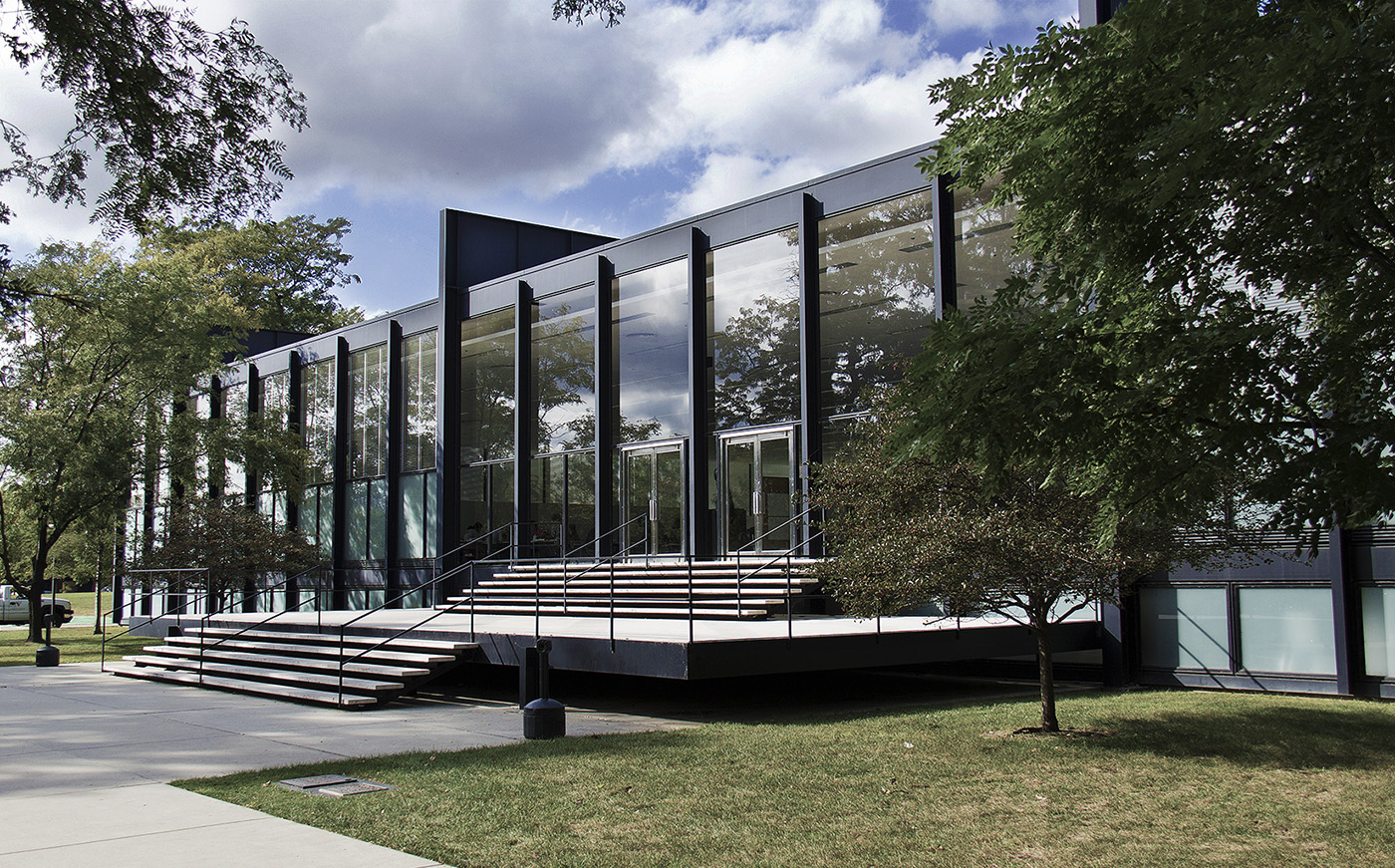
Chicago’s mid-century modern skyline would not be complete without the exceptional contributions of architecture titan Ludwig Mies van der Rohe. Born 1886 in Germany, Mies emigrated to Chicago in the 1930s due to the rise of Nazism in Europe. Already an esteemed architect, in Chicago Mies accepted the position as head of the architecture school at the Armour Institute of Technology (now the Illinois Institute of Technology). At IIT, Mies was commissioned to design buildings for the campus which still stand today. These buildings include Alumni Hall, the Carr Memorial Chapel, and S.R. Crown Hall, some of Mies’ many masterpieces. 

Mies aspired to create architecture that represented modernity with clarity and simplicity. In 1951, Mies completed the two residential buildings of 860-880 Lakeshore Drive which are considered Chicago Landmarks and are listed as National Historic Places. Initially, the towers were viewed critically. However, with time the buildings became the prototype for steel and glass skyscrapers around the world.

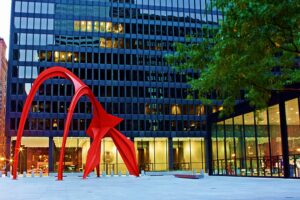
Mies also designed Chicago’s Federal Center Plaza which is composed of three buildings; the Everett McKinley Dirksen courthouse building, the John C. Kulczynski building, and the Post Office building. The three buildings situate themselves around a plaza with Calder’s red Flamingo sculpture at the center. The plaza serves as one of the main gathering points in the Loop, Chicago’s commercial center. 

Kluczynski Federal Building, Chicago, 1973, designed by Mies van der Rohe. Credit: Matt B on Flickr Creative Commons, CC BY-NC-ND 2.0 Deed

Not too far away at 330 North Wabash sits the former IBM Plaza and Building, one of the last American projects designed by Mies. Built in 1973, the building was designed with advanced technology in mind and became well-known for the several atypical features it included as an office space at the time. Today, the Chicago Landmark is known as the AMA Plaza and includes the Langham Hotel, often regarded as one of the best hotels in the nation.

The Promontory, situated at 5530 S Shore Dr, stands 22 stories over Chicago’s Promontory Point and extensive shoreline in the Burnham neighborhood. Mies built the structure with a “Double T” design in which horizontal cross-bars join and the stems of the T’s form wings to the rear. Mies would employ this design in many of his future buildings. 

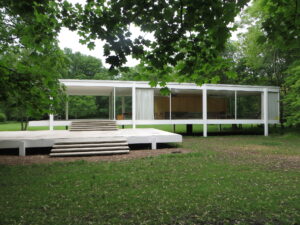
Farnsworth House exterior, Ludwig Mies van der Rohe,1945-1951. Credit: David Wilson on Flickr Creative Commons, CC BY 2.0 Deed

The Farnsworth House, designed as a vacation retreat for Dr. Edith Farnsworth, is located just outside of Chicago in Plano, Illinois. Though the Farnsworth House is not a grand skyscraper, it has left a lasting impact on the Chicago architectural landscape. The house was an exploration for Mies in the convergence of humans, shelter, and nature. Consisting of a glass pavilion raised six feet above a floodplain beside the Fox River, the house has been described as “sublime” an “a poem” and is now a public museum.

Today, Chicago’s skyline has completely transformed from what it was more than 50 years ago when Mies passed. However, even as it continues to evolve with every new development, Mies iconic buildings still stand out as striking, inspiring architectural masterpieces.

Optima Communities: Revisiting Lakeview

​​As our newest development, Optima Lakeview, nears completion, we are diving back into this beloved neighborhood. Here are just a few things that make Lakeview special to us at Optima and to the residents who call the neighborhood home.

Festivities Year-round 

No matter the season, festivals and markets fill Lakeview’s social calendar, providing locals with numerous opportunities to connect and celebrate. A neighborhood favorite, Restaurant Week kicks things off each spring with a handful of specials on local menus, allowing foodies to explore Lakeview one dish at a time. Fitness fanatics will enjoy the Lincoln Hub Workout Series hosted in South Lakeview Park during the summertime. Halsted Street is filled with pride in June to celebrate Chicago’s LGBTQ+ community. 

Lakeview’s Festival of the Arts spotlights local artists, musicians and restaurants in the autumn months annually. In October, families take part in Trick or Treat Southport, with Halloween-themed activities for all ages. To close the year, festive lights, photos with Santa and more can be found at Lakeview’s Holiday Stroll.

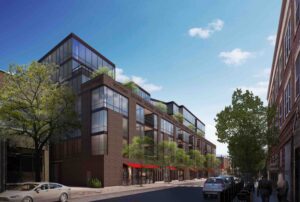
Rendering of Optima Lakeview

Hidden Gems 

Lakeview has plenty of shops, restaurants, museums and theatres to satisfy all interests. However, there are a few neighborhood staples that not many know about. Located just off of Diversey, Clark and Broadway, Landmark Century Centre Cinema is a favorite for film buffs and is complete with a Spanish Baroque façade designed by the prominent architecture firm Levy & Klein. On Lakeview’s South Side, Wrightwood 659, designed by Pritzker Prize-winner Tadao Ando, presents visitors with thought-provoking exhibitions of international art and architecture not found anywhere else. The museum’s current exhibition, Romanticism to Ruin, includes reconstructions of two lost works from Louis H. Sullivan and Frank Lloyd Wright.

Near the exhibition space sits a neighborhood favorite for food, Del Seoul. The local restaurant fuses traditional American, Korean and Mexican food into a tasty menu unique to the city. One of Lakeview’s more well-known hidden gems is Northalsted Market Days. The annual tradition takes place on Halsted Street for six blocks, making it the largest outdoor street festival in the Midwest. During the two-day festival that takes place in August, tourists and locals celebrate the community and enjoy local vendors, food, arts, crafts and music.

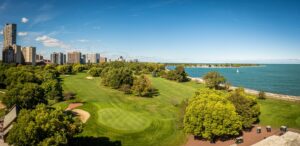
Sydney R. Marovitz Golf Course

An Abundance of Green Space

Neighboring Lincoln Park offers virtually endless pastimes for everyone to enjoy. The Lincoln Park Zoo and landmark Lincoln Park Conservatory offer free admission and are filled with animals and lush greenery to enjoy throughout the year. Located just below the Zoo, dozens of sustainable local vendors sell fresh produce at the Green City Market from May through November, named one of the best markets in the nation.

Residents will find a number of accessible outdoor recreational activities just steps from Optima Lakeview. A short stroll down Lakeshore Drive West leads to a driving range, the Peggy Notebaert Nature Museum, and several beaches and restaurants near the lake. Kayakers and rowers have easy access to Diversey Harbor and South Lagoon, granting the perfect spot to spend a warm day. Tennis and golf lovers can conveniently walk to the renowned Sydney R. Marovitz Golf Course and various tennis courts that neighbor Optima Lakeview and are all open to the public.

The opening of Optima Lakeview is fast approaching and we look forward to sharing more about this state-of-the-art development as it becomes part of the Lakeview community!

A Guide to the Chicago Architecture Biennial: The Available City

The first of its kind in North America, Chicago’s Architecture Biennial, an international exhibition of architectural ideas, projects and displays, began in 2014 with the support of the city’s Cultural Affairs department. Similar to Optima, Chicago’s Architecture Biennial celebrates the relationship that design and nature have with one another in urban environments.

Former Chicago mayor, Rahm Emanual described the Biennial as “an ode to the city’s past and an echo to our future.” This year’s theme, “The Available City” stands true to that sentiment. The 2021 edition of the Chicago Biennial “is a framework for a collaborative, community-led design approach that presents transformative possibilities for vacant urban spaces that are created with and for local residents.” Artistic Director, David Brown, a designer, educator, and researcher based at the School of Architecture at the University of Illinois focuses his work on non-hierarchical, flexible and variable approaches to urban design and has selected a group of accomplished collaborators to reflect his vision of an “Available City.” 

In order to achieve a collaborative and community-led design approach that transforms vacant urban spaces, the Biennial invites artists, architects and designers from Chicago and around the world to come together and share their creations, lead workshops and conversations, and create communal spaces where Chicagoans can come together and appreciate their city. Workshops will be held in neighborhoods across the city in which vacant spaces will be transformed into collective spaces. Digital programming will be used to activate these spaces. 

This year’s lineup of collaborators include creators from around the globe and creators who call Chicago home. Chicago-based architect, designer, and educator, Ania Jaworksi, will present a solo exhibition at Volume Gallery in which she pays homage to Chicago and urban life through the humor, pragmatism, and seduction that can be found in design. Other local contributors include Borderless Studio, a research-design practice that leads community-based projects addressing issues of social equity, Central Park Theater Restoration Committee, a group aiming to revive Chicago’s abandoned Central Park Theater, Englewood Nature Trail, a two-mile green infrastructure reuse project located in the Englewood neighborhood, in care of Black women, a creative initiative launched in Chicago’s south side focused on re-activating vacant spaces and creating “cartographies of care,” Open Architecture Chicago + Under the Grid led by Haman Cross III, Lawndale’s resident artist which leads and promotes design-efforts and creative projects in the Lawndale community, PORT, a public-realm design practice founded by Christopher Marcinkowski and Andrew Moddrell, and The Bittertang Farm, an architectural duo composed of Antonio Torres and Michael Loverich who explore architecture’s connection to living organisms. 

International contributors, ranging from Boston to South Africa to China, include Ana Miljački of the Critical Broadcasting Lab at MIT, Atelier Bow-Wow from Tokyo, Japan, Studio Ossidiana from Rotterdam, Netherlands and Venice, Italy, Matri-Archi(tecture) from Basel, Switzerland and Cape Town, South Africa, and Hood Design Studio from Oakland, California among numerous other designers and creatives from around the country and world. 

The 2021 Chicago Architecture Biennial is open to the public starting September 17.

person name goes here

Maintenance Supervisor

Glencoe, IL


    Acceptable file types: *.pdf | *.txt | *.doc, max-size: 2Mb