Scottsdale Public Art: Pinball Wizard

Scottsdale’s appreciation for art enables artists to publicize their talents and add to the environment’s imaginative aesthetic year-round. From initiatives like IN FLUX Cycle 10 to classic installations like Knight Rise, Scottsdale proudly embraces the impact behind sharing art with others. Today, we’re spotlighting Scottsdale’s latest addition of public art, Pinball Wizard

Completed in June 2022, Old Town Scottsdale welcomes Pinball Wizard as the city’s newest public art installation. Public Artist Annette Coleman worked with Scottsdale Public Art to design and construct the vibrant project using colored glass. Coleman is well-known for her illustrative mosaic public art installations, many of which reside in Colorado, and embraces a public art philosophy rooted in stimulating inspiration and creating community. 

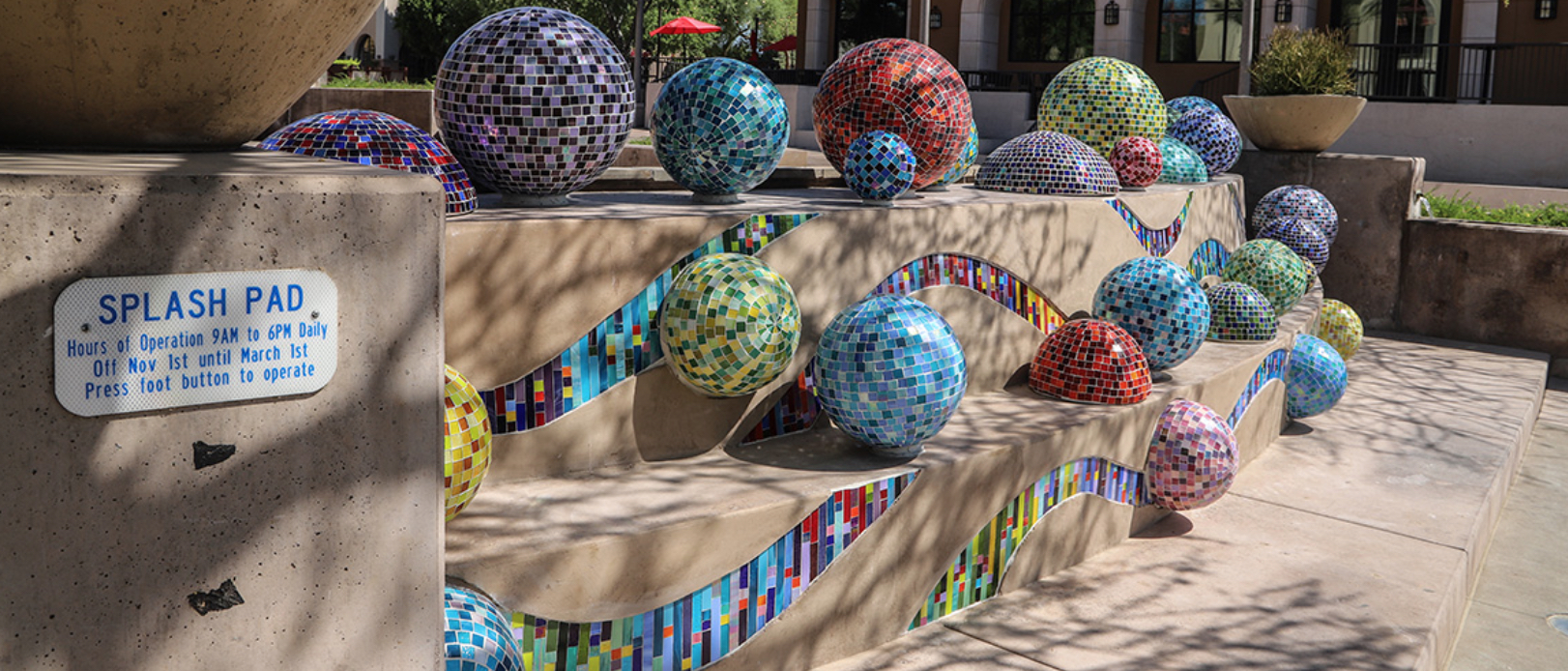
Pinball Wizard resides at the Stetson Plaza Splash Pad at the Scottsdale Waterfront and features 30 disco-like mosaic orbs and various mosaic waves built into the environment. Designed to catch light from every angle, the myriad of shapes and bright colored glass in Coleman’s design embraces the playful attitude that already fills the area. 
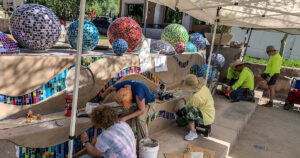
Annette Coleman installing Pinball Wizard, Courtesy of Scottsdale Public Art

Drawing inspiration from her appreciation for the outdoors, specifically water, wind, flora and fauna, Coleman included various serpent-shaped waves throughout the concrete wall of the splash pad. Her inspiration behind Pinball Wizard, and many of her other projects, also draws from television shows, games and science productions, and other pop culture references. 

Pinball Wizard brings a splash of color to the already lively surrounding at Scottsdale’s Stetson Plaza Splash Pad. Visit the public art yourself and hear more from Coleman about its creation here

A Brief History of Constructivism

As Modernism and its influence spread across the world in the early 1900s, new art and design factions emerged throughout cultures. Today, we’re exploring Constructivism, a Russian art and architecture movement that brought abstraction to the country. Learn more about the short-lived, industrial-heavy movement below:

The History of Constructivism

Constructivism popularized in the 1910s Soviet Union, the same period that the Bauhaus and De Stijl movements emerged across Eastern Europe. Constructivism was largely inspired by other modern, innovative developments of the time, specifically Bauhaus and Russian Futurism.

Constructivist artists strived to reflect the industrialization of urban society in their work. The movement’s art and architectural works combined characteristics from existing modern principles such as geometric and minimal design, with a more experimental approach.

Often staying away from ornate decorative elements, Constructivist architecture instead favored mechanical and industrial materials. This design direction also focused on space and rhythm, frequently resulting in futuristic and abstract-presenting structures.

Notable Works

Arguably the most well-known and famous Constructivist architectural work was the 1919 proposal of Tatlin’s Tower by Vladimir Tatlin. The project, which was never completed, intended to use iron, glass and steel in its design. As a towering symbol of modernity, its main feature included a twin helix — reaching taller than the Eiffel Tower — paired with four other suspended geometric structures that planned to rotate around the helix.

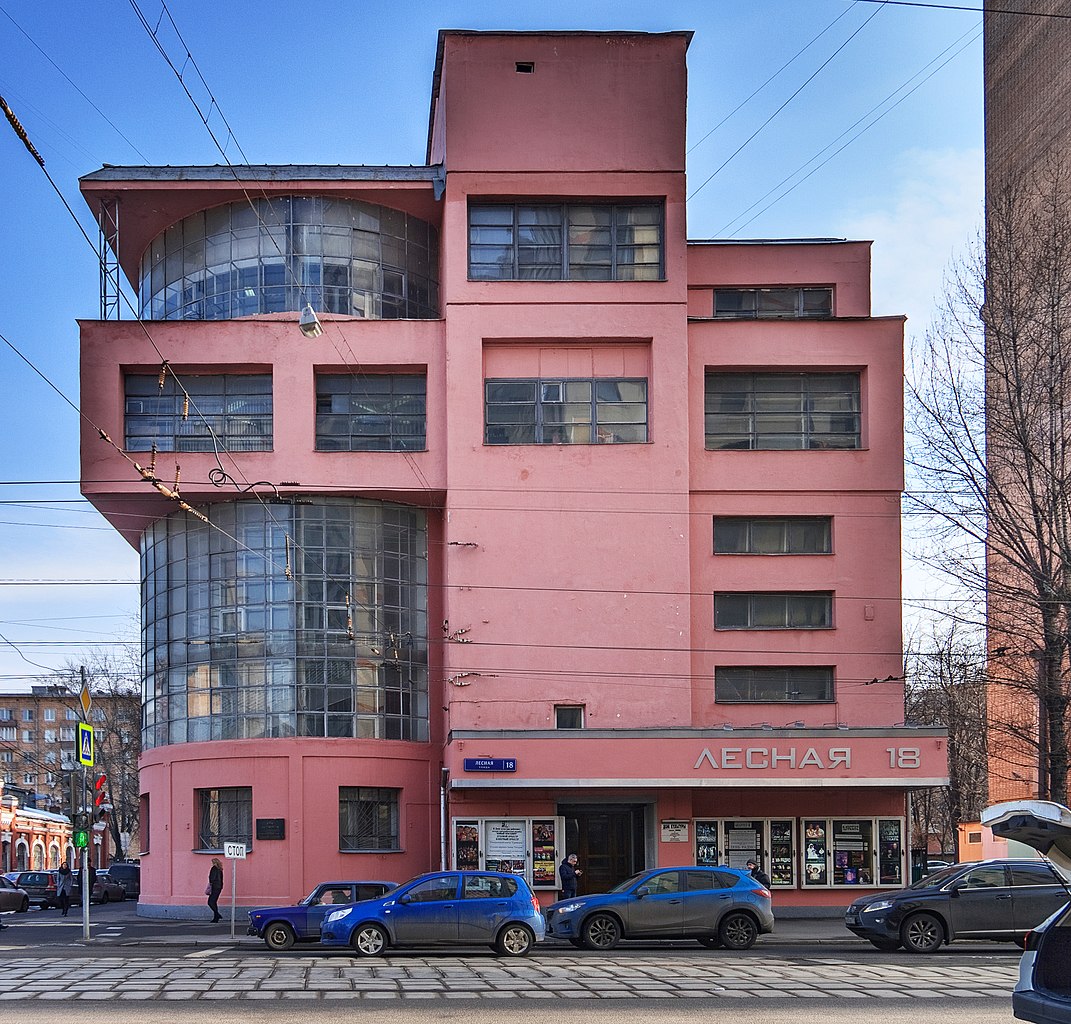
One of the main philosophies of Constructivism was to instill new aesthetics of the avant-garde into everyday life, which led architects to design some of the country’s most visited buildings in their unique style. The Zuev Workers’ Club in Moscow was one of many workers’ clubs to adopt the Constructivist style when completed in 1929. The composition of the building’s facade features a mix of circular staircases, stacked rectangular floors, bright pink paint and an exterior glazed treatment which was innovative for the time.

Another famous work of Constructivism is Ogonyok Magazine’s printing plant which was commissioned in 1932 in Moscow. Russian artist El Lissitzky designed the building, and it remained his only architectural creation. The dynamic building features a mansard roof and circular windows that contrast the long rectangular exterior. Although damaged in a 2008 fire, the building remains a heritage site, and in 2012 it was named a regional landmark of the country.

EL-LISITZKY-OGONYOK-PRINTING PLANT-3
El-Lisitsky Ogonyok Printing Plant. Credit: Sergei Dorokhovsky, 2010, Wikimedia Commons, CC BY-SA 3.0 Deed

Although Constructivism lost steam only a decade after emerging, its influence is found in other movements like Brutalism, and works of graphic design, industrial design, fashion, and ultimately the Deconstructivism Movement. Stay tuned for more blogs spotlighting the many subsects of Modernist architecture!

A Brief History of Architecture in the Expressionist Movement

Although many know expressionism for its evocative poetry and painting, expressionist architecture was also a subsect of the Modernist Movement. While coexisting with the minimalist rigor of the Bauhaus, this avant-garde style allowed designers to explore new, radical perspectives, gifting to the world some of the most dynamic, expressive architecture of the 20th century. 

Origins of Expressionism

Expressionism originated in the late 1800s from a small group of artists based in Germany. The artists who founded the movement felt that 19th-century impressionism – which commanded the art world – was out of touch with the social climate of the times due to the various changes that came with the Industrial Revolution. This feeling of detachment helped inspire what would soon be known as expressionism.  

Acclaimed painters like Van Gogh, Paul Gauguin, Edvard Munch and Francis Bacon all contributed remarkable works of art throughout the movement, but artists who worked with other mediums also adopted the ideals that expressionists held close. Because of the vivid colors and distorted lines and angles associated with expressionism, German cinematography, in particular, took advantage of the moody standards. 

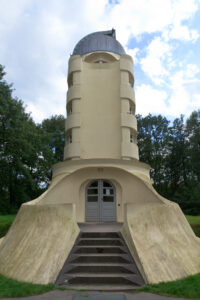
Einstein Tower by Erich Mendelsohn. 1921
Einstein Tower, Erich Mendelsohn, 1921. Credit: H. Raab on Flickr Creative Commons, CC BY-NC-ND 2.0 Deed

After more than 30 years of commanding the art world itself, expressionists became banned from showing and selling their work in Germany, where the majority of the artists lived. The result left many artists suppressed, eventually leading to various radical movements, including Abstract Expressionism, Pop-Art, Minimalism and in the late 20th century, Neo-Expressionism. 

Expressionism in Architecture

Expressionist architecture took advantage of the many characteristics associated with the movement’s other works of art, including distortion of form, themes of romanticism, expression of inner experience and the conception of architecture as a work of art, among others. Much of the movement’s builds featured Gothic, Romanesque and Rococo affinities. 

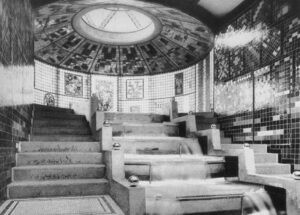
Glass Pavilion’s interior featuring the seven-tiered waterfall. Public Domain photo.

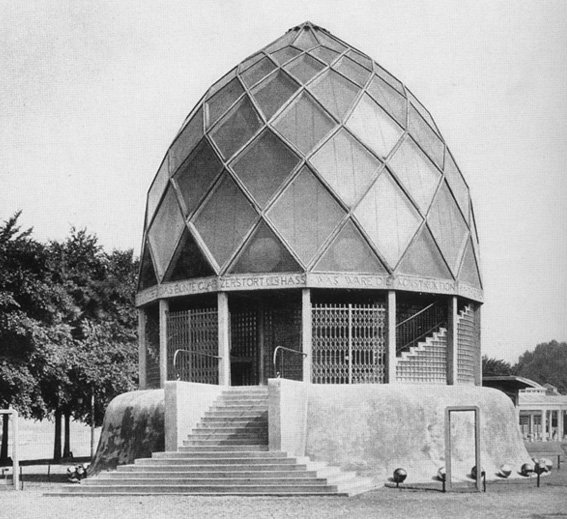
Bruno Taut’s Glass Pavilion is one of the earliest examples of expressionist architecture. The structure was built in 1914 as a feature of the Cologne Deutscher Werkbund Exhibition. Constructed using only concrete and glass, the exterior of the pavilion showcases a vibrantly colored prismatic dome and a grand staircase. The interior of the building featured a kaleidoscope of color from the crown above it and a seven-tiered cascading waterfall.

The Einstein Tower is another striking example of expressionist-style architecture. The observatory was built by German Architect Erich Mendelsohn from 1919 to 1921 and was envisioned to hold a solar telescope. Mendelsohn designed the building to reflect the radical theories formed by Einstein – specifically his theory of motion. The structure is built with brick but covered with stucco to give it its smooth, tidal-like exterior. 

More recent examples of expressionist-style architecture include Walt Disney Concert Hall designed by Frank Gehry in Los Angeles, the Lotus Temple designed by Fariborz Sahba in Delhi, and Zaha Hadid’s Vitra Fire Station in Weil am Rhein. 

Immersive Art: The Fusion Between Art and Technology

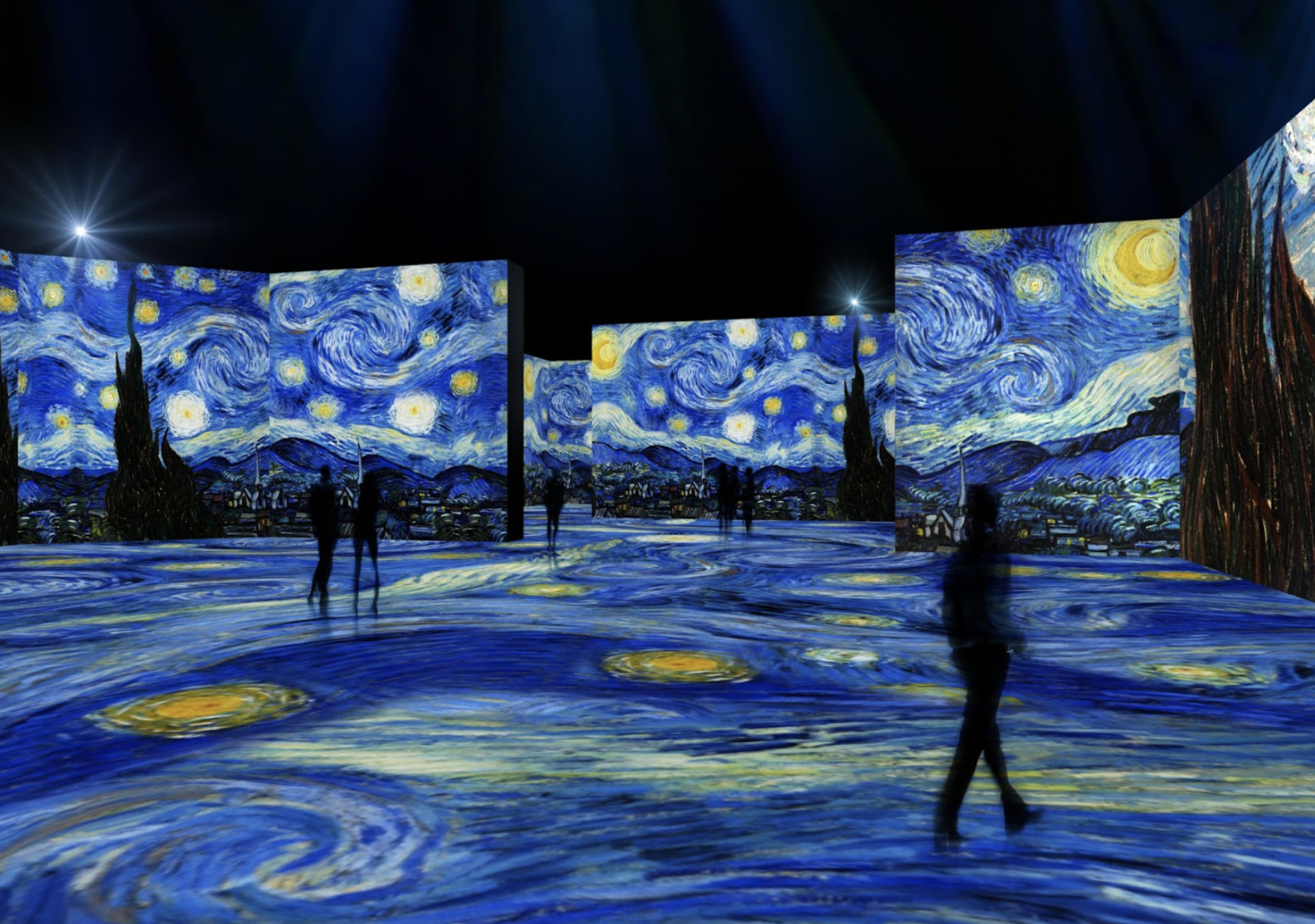
Whether you’re in Chicago or Scottsdale, immersive art exhibitions are quickly becoming the latest trend, unveiling a new approach for art lovers to savor their favorite works and artists. What separates these shows from what you would expect to see at a traditional museum or gallery space?

The History of Immersive Art

While immersive art may seem like a new phenomenon to many of us, immersive experiences can be traced back centuries. One of the finest examples can be found in the architecture of the middle ages. Employing stained glass in the construction of churches was often used to create an otherworldly experience for patrons. As natural light floods through each window, colors fill the interior, telling a vibrant visual story.

More recently, thanks to the help of modern technologies that include virtual reality, holography and digital projection, immersive experiences have transformed how we can view works of art, enabling us to explore each piece as a protagonist within it. 

The objective of immersive art lies in entertainment, taking 2D environments and metamorphosing them into 3D worlds often filled with accompanying music. Video projection mapping programmed individually for each immersive environment makes sure that every inch of the space is sure to be covered, further enveloping the audience in the engaging work. 

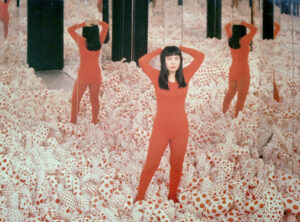
And while many spaces are utilizing immersive technology to revamp older works, ambitious artists are also constructing their own participatory installations. Yayoi Kusama, a Japanese artist, has been creating immersive work since the 1960s. Kusama’s most famous installation, Infinity Mirror Room—Phalli’s Field, uses dozens of mirrors to augment the perception of the stuffed polka dot sculptures she created, and because of those mirrors, casts the visitor as the work’s subject. 

Infinity Mirror Room—Phalli’s Field, Yayoi Kusama, 1965

Experience A Show For Yourself

Chicago offers a variety of immersive art experiences. Just South of Lincoln Park and within close proximity to Optima Signature and Optima Lakeview at Lighthouse ArtSpace, the Van Gogh, and Frida Kahlo exhibits continue to run throughout the summer, transporting visitors into both of the artist’s worlds. Other, more traditional immersive art experiences include the Museum of Illusions, Sky Shows at the Adler Planetarium, the upcoming Museum of Ice Cream exhibit coming to The Shops at Tribune Tower and the Illinois Holocaust Museum’s onging exhbit, The Journey Back: A VR Expeerience

Scottsdale and Phoenix also offer a variety of engaging installations to choose from. Just walking distance from Optima Sonoran Village is Scottsdale’s Lighthouse Artspace, found in the heart of Old Town Scottsdale, is home to the Immersive Van Gogh and Klimt exhibits scheduled to run through July. Wonderspaces, another extraordinary venue in Scottsdale Fashion Square, features an evolving lineup of interactive installations and signature cocktails.

Immersive art has always been a revolutionary way to interact with different crafts, and thanks to technology, not only is it becoming more innovative but more accessible. With the trend on the rise, there’s sure to be no shortage of immersive art experiences, and we’re excited to see what modernisations come next.

The Synthesis of Art and Architecture

Art and architecture share a rich, timeless connection rooted in their design, creators and intended meaning. Both forms of expression become envisioned and constructed through similar principles, visual elements and ambition to engage with one’s senses. Today, we’re exploring this essential relationship and what happens when the two worlds collide. 

David Hovey Sr., FAIA, Optima’s CEO and Founder, says it best when describing the linkage between art – in particular, sculptures – and architecture, saying that “architecture is about function, as well as aesthetics, while sculpture is really just about aesthetics.”

Architecture is traditionally informed by functionality first, with aesthetics coming into play as with a significant role. Art, on the other hand, is commonly guided by aesthetics, without any burdens to deliver an object or outcome that is functional. However, both forms of expression are typically influenced by similar social and political factors that affect the environment surrounding the work or structure. 

Centuries-old cultural movements, including the Renaissance, where art imitated life and vice versa, demonstrate the linkage between art and architecture. However,  it wasn’t until the Avant-Garde movements of the late 19th and early 20th centuries that the integration of the two took a new meaning. 

This integration between the disciplines quickly became a core characteristic of modernism and modernist design, and is distinctly present in the work of some of the greatest architects and artists of the time period. Because artists use their art as a tool to shape emotions, modernism emerged as an expectation in which art and architecture would provide a new value when combined. 

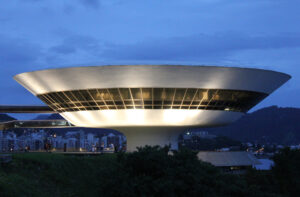
Oscar Niemeyer Museum
The Oscar Niemeyer Contemporary Art Museum in Niterói exhibits the synthesis of art and architecture, displaying bold geometric forms, sculptural curves and vivid murals in a functional structure, reminiscent of a human eye. Credit: Rosa Menkman, Flickr Creative Commons, CC BY 2.0 Deed

The Bauhaus Movement was one of the first to introduce this idea, encouraging the unification of all arts and coupling aesthetics with the technology of the time. Notably, this ideology was cultivated through Le Corbusier’s use of painting and sculpture within his established concepts of architecture. Le Corbusier also argued that it was of equal importance to architects, painters and sculpturists to contribute constructive collaborations to the world by designing and creating in harmony with one another. 

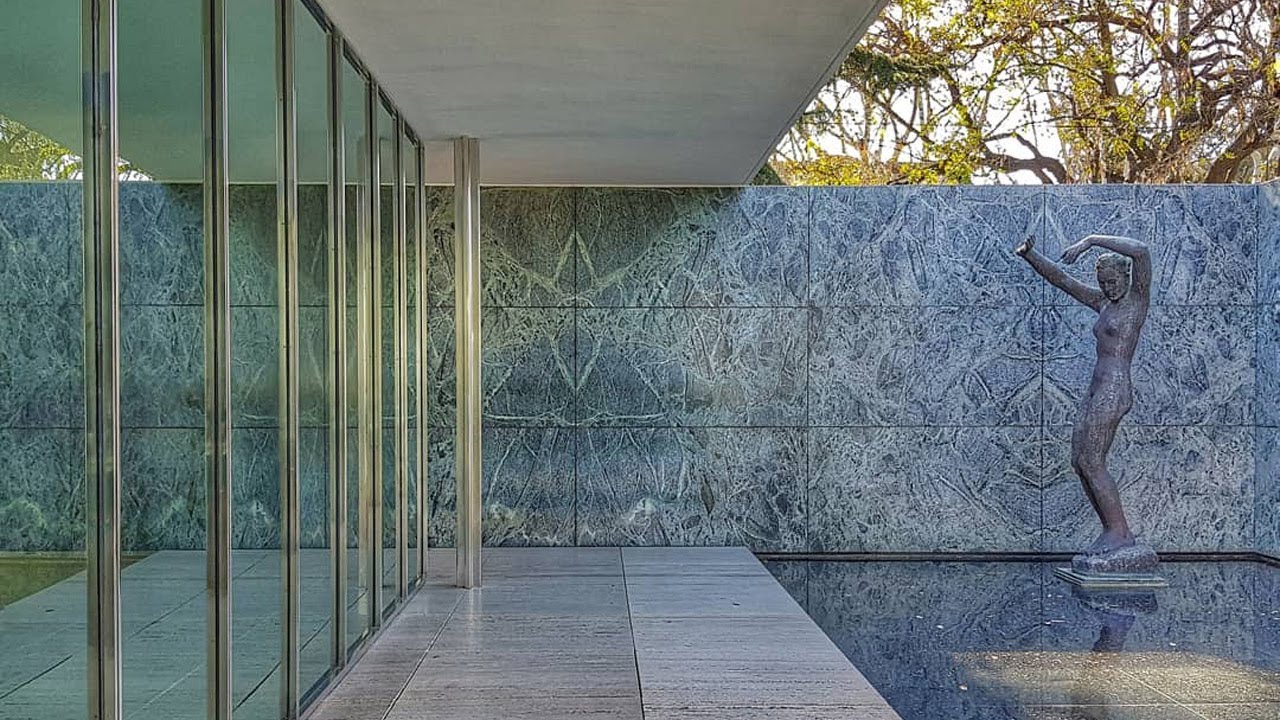
Along with Le Corbusier, various other artists throughout the past century have tried to synthesize art and architecture throughout their work, particularly Oscar Niemeyer, Mies van der Rohe and Zaha Hadid. Today, architects and artists continue to collaborate and integrate their disciplines more than ever, exploring and expanding the dynamic relationship shared between the two.

Arcosanti: Creating a City

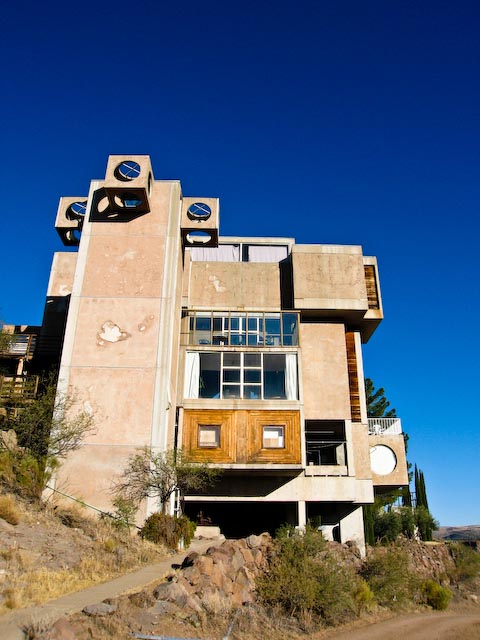
Known for his unique approach to architecture, Paolo Soleri brought the philosophy of arcology to numerous of Arizona’s most stunning environments. In Cosanti, he welcomed his otherworldly construction elements to the surroundings of Scottsdale. Today, we’re spotlighting another of the architect’s treasures, which embraces all of Soleri’s design principles on a much grander scale, Arcosanti

Inception of Arcosanti

Following the completion of his first build, Cosanti, Soleri began to explore more behind the meaning of arcology – a word he coined himself to label if design philosophy. What he began to discover was just how significant ecologically sound human habitats were to the ideology. 

In 1970, following the release of his book Arcology: The City in the Image of Man, in which he detailed the concept of cities embodying the fusion of architecture and ecology, Soleri began developing his own planned city, Cosanti. The project – found roughly 70 miles North of Scottsdale – was built to exhibit how urban environments can be elevated while minimizing negative impacts on the surroundings. 

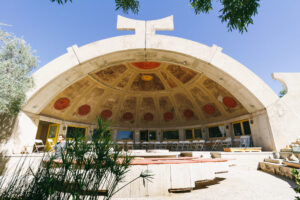
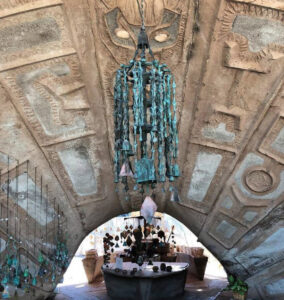
Arcosanti Apse
Arcosanti Apse. Credit: Devon Christopher Adams on Flicker Creative Commons, CC BY-NC 2.0 Deed

Arcosanti is built on 25 acres of a 6.25 square mile property, and though originally planned to house 5,000 people, the community is home to a population that varies from 100 to 150 throughout the year. Because the planned city is ever-changing, construction and development continue today due to the many students and volunteers who call it home. 

The magnificent community currently consists of 13 major structures, ranging in size and purpose and featuring diverse design features unique to the town. One particular feature is the site-cast tilt-up concrete panels used to support various buildings, expressing similar patterns to the earth around them, some even cast in embedded art. 

Other attentive design features include the southward orientation of most buildings designed to capture the most natural light and an apse – similar to Cosanti’s – built to house the community’s bronze bell-casting space. 

The city also features essential builds intentionally placed to help the community thrive, including two barrel vaults, apartment residences, an outdoor amphitheater, a community swimming pool, an office complex and a lush greenhouse. 

Today, Arcosanti continues to fulfill Soleri’s vision as an educational center for upcoming architects and philosophers. Scholars from across the world choose the community to attend advanced workshops and classes on everything from experimental design to architectural agriculture.  

Nearly 40,000 tourists visit the unique community annually to witness Soleri’s philosophy of arcology in person. Visitors can take guided tours through the sweeping campus or stay overnight in one of its lavish guest accommodations. To plan your trip to the historic community, or learn more about its events and programming, visit Arcosanti’s website here.

Cycle the Arts in Scottsdale

Thanks to the city’s deep appreciation for the arts, Scottsdale is home to some of the most visionary public art in the country. And, with warm weather here and summer approaching, there is no better way to experience the city’s inspiring works than on a bike! Here is our guide to Cycle the Arts Scottsdale 2022:

Cycle the Arts Scottsdale is hosted by Scottsdale Public Art and the City of Scottsdale. The annual cycling event is back for the first time since 2019 to showcase some of the city’s exciting public art displays and sculptures. And because this is the event’s first time back in more than three years, participants will be able to hear about some of Scottsdale’s newest public art additions. 

The leisurely 9-mile bike ride is free and perfect for the whole family. It kicks off on Sunday, April 3, and check-in is at 8:30 a.m. at Scottsdale’s Museum of the West. While the event is expected to last until noon, the ride on Scottsdale’s award-winning bike paths will only take about two hours. 

Industrial Pipe Wave, Christopher Fennel, 2015, Courtesy of Scottsdale Public Art

The event includes 17 works from the city’s public art collection, including Jack Knife, Industrial Pipe Wave and Terraced Cascade. Each stop will include information about the art provided by Scottsdale Public Art staff and board members and possibly feature the artists themselves.

Made for both bike riders and art enthusiasts, Cycle the Arts Scottsdale is the perfect event for those looking to explore and learn more about the vibrant community. If you plan to participate, please bring your own helmet and water, and RSVP on Scottsdale Public Art’s website here.

Exploring Paolo Soleri’s Cosanti

Scottsdale and its surroundings offer some of the country’s most historic art and architectural sites, including Taliesin West and its museum of contemporary art – SMoCA. Because of the popularity of these marquee locations, some of the area’s other unique contributions are often overlooked. Today, we’re spotlighting one of the community’s most ambitious architectural and design feats, Cosanti

Cosanti’s History

Found in Paradise Valley, Arizona, less than a 15-minute drive from Optima Kierland Apartments, Cosanti is a standout in its suburban neighborhood. The Gallery and design studio were designed and built by the Italian-American architect, urban designer and philosopher, Paolo Soleri. Soleri, who built the project in 1956, lived with his wife on the five-acre property only a few miles from Taliesin West, where he studied under renowned architect Frank Lloyd Wright just ten years earlier. 

The interior of Cosanti’s Earth House where Soleri resided until 2013, Courtesy of Cosanti Originals

The structure’s name originates from Soleri’s Italian roots. Cosanti combines the two Italian words for ‘object’ and ‘before’, and the word itself means, ‘There are things more important than objects’ – a philosophy Soleri lived by. This attitude extends beyond the structure’s name and into its architecture, where he introduced his own philosophy of arcology. The term recognizes the importance between built and lived environments, similar to that of sustainable or regenerative design

Otherworldly Architecture

Cosanti’s otherworldly design elements easily separate it from its modern surroundings. Some of the build’s most alluring features are its outdoor studio, performance spaces, swimming pool, Soleri’s residence, and of course, his famous ‘Earth House’. 

Cosanti’s earth-cast wind-bells produced of bronze and ceramics, Courtesy of Cosanti Originals

To create the Earth House, Soleri utilized an earth-casting technique, where his team formed dense mounds of earth and then covered them in concrete molds. After developing, the earth under each mold became excavated and concrete structures built partly underground appeared – a building method that allows the structure to utilize natural insulation from the earth. 

Soleri also used terraced landscaping, courtyards and garden paths to separate branches of the unique campus and further connected the environment to its natural surroundings using earth-cast wind-bells. 

Today, the Arizona Historic Site offers local residents and tourists free guided tours of the visionary structure and property. To explore the grounds and more of Cosanti yourself, visit their website here.

Calling all Photo Buffs: Jump into Wilmette’s Sesquicentennial Photography Project

As construction gets underway on Optima Verdana, we continue to connect more strongly with Wilmette and its surroundings. We appreciate how special it is that a village gets to celebrate its 150th anniversary, and Wilmette has packed 2022 with a series of events, happenings and projects that bring the community together. Art fairs, picnics, parades, concerts, garden walks, you name it. The programming is broad, deep and guaranteed to capture the interests of residents and visitors alike.

One of the most engaging programs on the roster for Wilmette’s big birthday year is the Sesquicentennial Photography Project. Behind the project is the desire to invite the community to share their personal reflections and experiences in Wilmette by capturing photographs around the theme “Building Community” to create an important historical record.

The magic of a community photo project is that it provides an open invitation for anyone — and everyone — to participate. Taking photos in today’s world, with the ease of a smartphone, allows people of all ages to capture snippets of everyday life and glimpses of their surroundings that captivate them, and share them with others to enjoy. 

The project is easy for all participants. Simply submit photos to the village — from now until September 30, 2022. A team from the Wilmette Historical Museum will review the submissions and curate an exhibition of photos at the Museum and at other locations throughout Wilmette. Once the exhibitions are taken down, the photographs will be archived by the Museum, and will be accessible for viewing on request. 

Here are some guidelines for photographers. If you have any additional questions regarding the project, please contact Jan Loew at jerryloew@aol.com. Technical questions should be directed to the Wilmette Historical Museum’s curator, Rachel Ramirez, at ramirezr@wilmette.com or 847-853-7714.

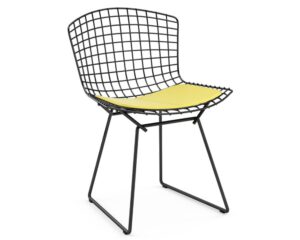
Curated Furniture at Optima Lakeview: the Bertoia Side Chair

Our love of mid-century classic furniture can be found throughout all of the Optima communities. And with our soft spot for iconic seating, it’s no surprise that the famed Bertoia Side Chair is a staple in many of our amenity spaces. Let’s take a closer look.

About Harry Bertoia
Born in San Lorenzo, Italy in 1915, Bertoia built an international reputation as an artist, sound art sculptor and modern furniture designer. After leaving his home at the age of 15 to join his older brother Oreste in Detroit, Harry embarked on a career that centered on the exploration of modernist ideas and ideals, often in collaboration with some of the greatest thinkers and visionaries of that era.

In 1936, a one-year scholarship to the School of the Detroit Society of Arts and Crafts allowed Harry to study painting and drawing. He entered and placed in many local art competitions, said to be the most awarded student up until that time. The following year, another scholarship took him to the Cranbrook Academy of Art in Bloomfield Hills, Michigan. Working among some of the most famous artists and designers of the modernist age, including Eero and Eliel Saarinen, Charles and Roy Eames and Florence Knoll, Bertoia’s creativity and mastery of materials flourished.

Bertoia as Furniture Designer
Bertoia was first exposed to furniture design at Cranbrook when Eero Saarinen and Charles Eames entered and won the Organic Furniture Design Competition sponsored by the Museum of Modern Art. In fact, Bertoia developed his initial chair design ideas while working with Charles Eames and others in California in the late 1940s, which he later incorporated into his work.

Bertoia eventually left Eames to join the Point Loma Naval Electronics Laboratory. While there, he learned how to study the human body to design control panels and knobs that focused on comfort for reach and grip. This sensitivity to ergonomics contributed significantly to Bertoia’s fascination with designing well-fitting practical chairs.

In 1950, at the invitation of former classmate Florence Knoll and her husband Hans, Harry moved to eastern Pennsylvania to work at their emergent furniture company Knoll, Inc. Florence had seen Harry’s work at Cranbrook, heard he had left Eames, and knew that he had enormous promise as a furniture designer. The Knolls offered him the opportunity to design what he wished with full credit and complete recognition of his work, which was their policy with all designers.

About the Bertoia Side Chair
Once on staff at Knoll, Bertoia was asked to develop hospital furniture, but he preferred to work with healthy bodies. He gravitated towards metal as his material of choice, and he continued to experiment with it until he landed on the concept of the wire grid, which could be shaped at will. with it until arising at the wire grid concept that could be shaped at will to conform to the human body. This was a radical departure from the use of rigid wood, which was characteristic of the late 1940s and early 1950s furniture. He not only created the airy welded metal design of the chairs, but also devised the production molds used for mass manufacture. 

Knoll produced the first Bertoia chairs in 1952 — an amazing collection of furniture that reflects a profoundly beautiful study in space, form and function. As with other designers of his time, including Mies van der Rohe, Bertoia found infinite elegance in an industrial material, elevating it beyond its utility into a work of art. 

Today, the Bertoia collection remains one of the great achievements of mid-century modern furniture design by one of the master sculptors of the last century and a proud part of the Knoll heritage.

person name goes here

Maintenance Supervisor

Glencoe, IL


    Acceptable file types: *.pdf | *.txt | *.doc, max-size: 2Mb